




















Overview
Heliophysics — the study of the Sun and how it influences space — is full of exotic phenomena that shape space from the Sun to the outer edges of the solar system, billions of miles away. Some of them are well understood by scientists, while others remain under study. The Heliopedia is a collection of “living” definitions of some of those phenomena, adapted and expanded upon as we learn more.
Entries are listed alphabetically. Click on a letter below or use the index at left to navigate the Heliopedia.
The term heliophysics was first used in a scientific newsletter in 1910 — that's 48 years before NASA was created!

A, B, C, D
Alfvén surface/Alfvén zone
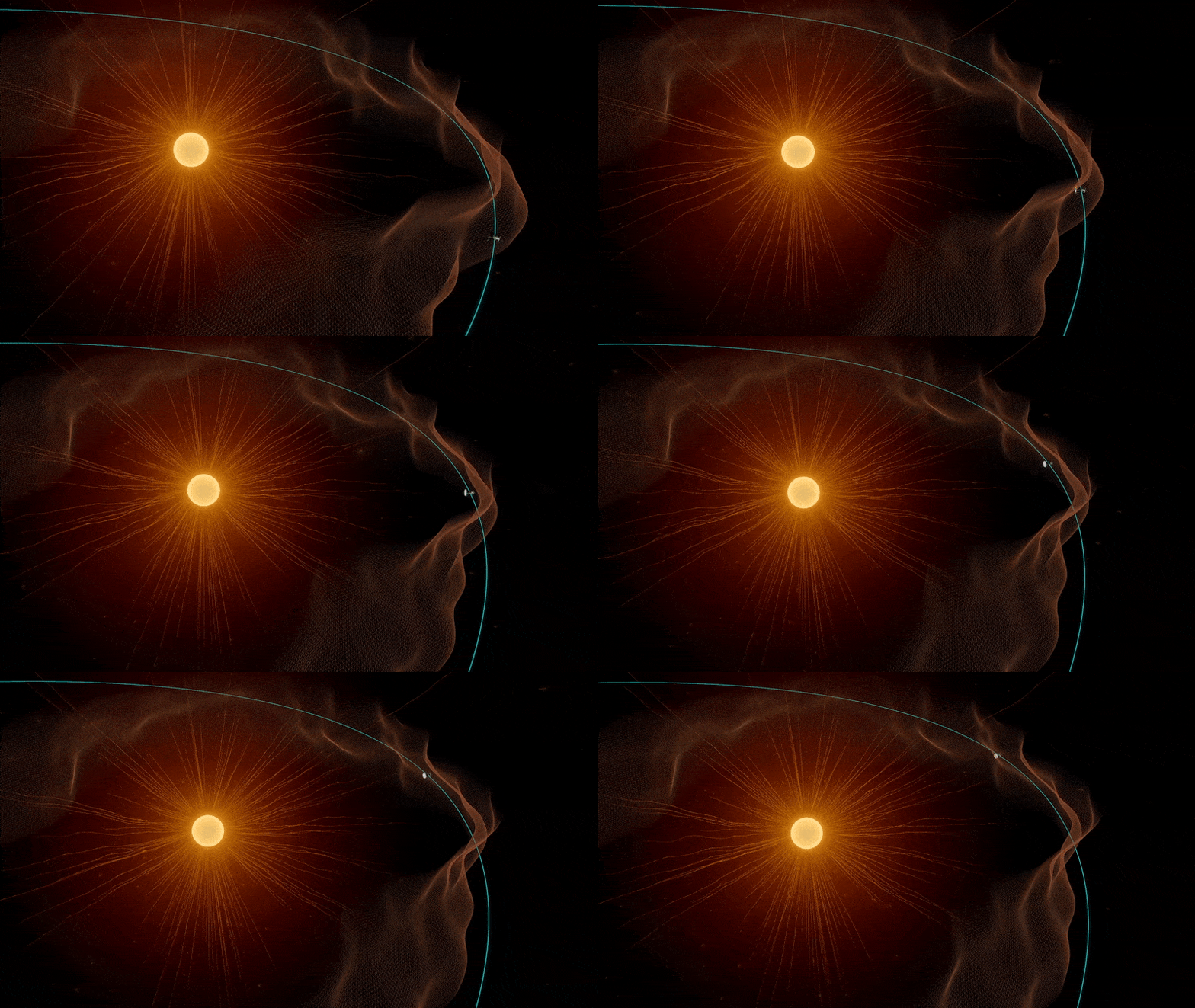
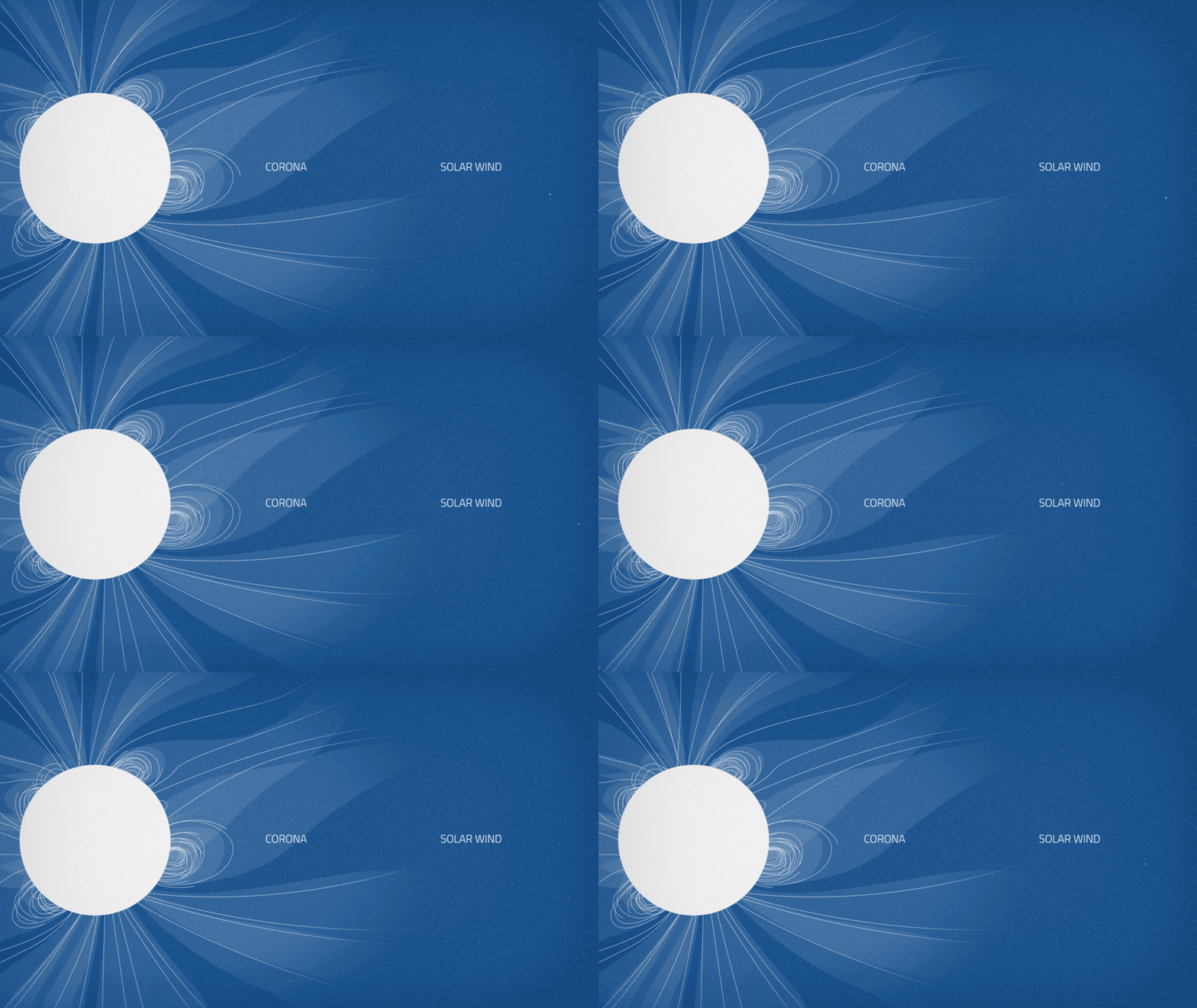
The Alfvén surface (or zone) is the point past which material leaving the Sun is moving too quickly for it to propagate back to the Sun. As material leaves the Sun — in the form of solar wind or explosive clouds called coronal mass ejections — it accelerates, eventually moving too fast to return. The Alfvén surface marks the transition point between the Sun’s outer atmosphere (the corona) and the solar wind.
Annular solar eclipse
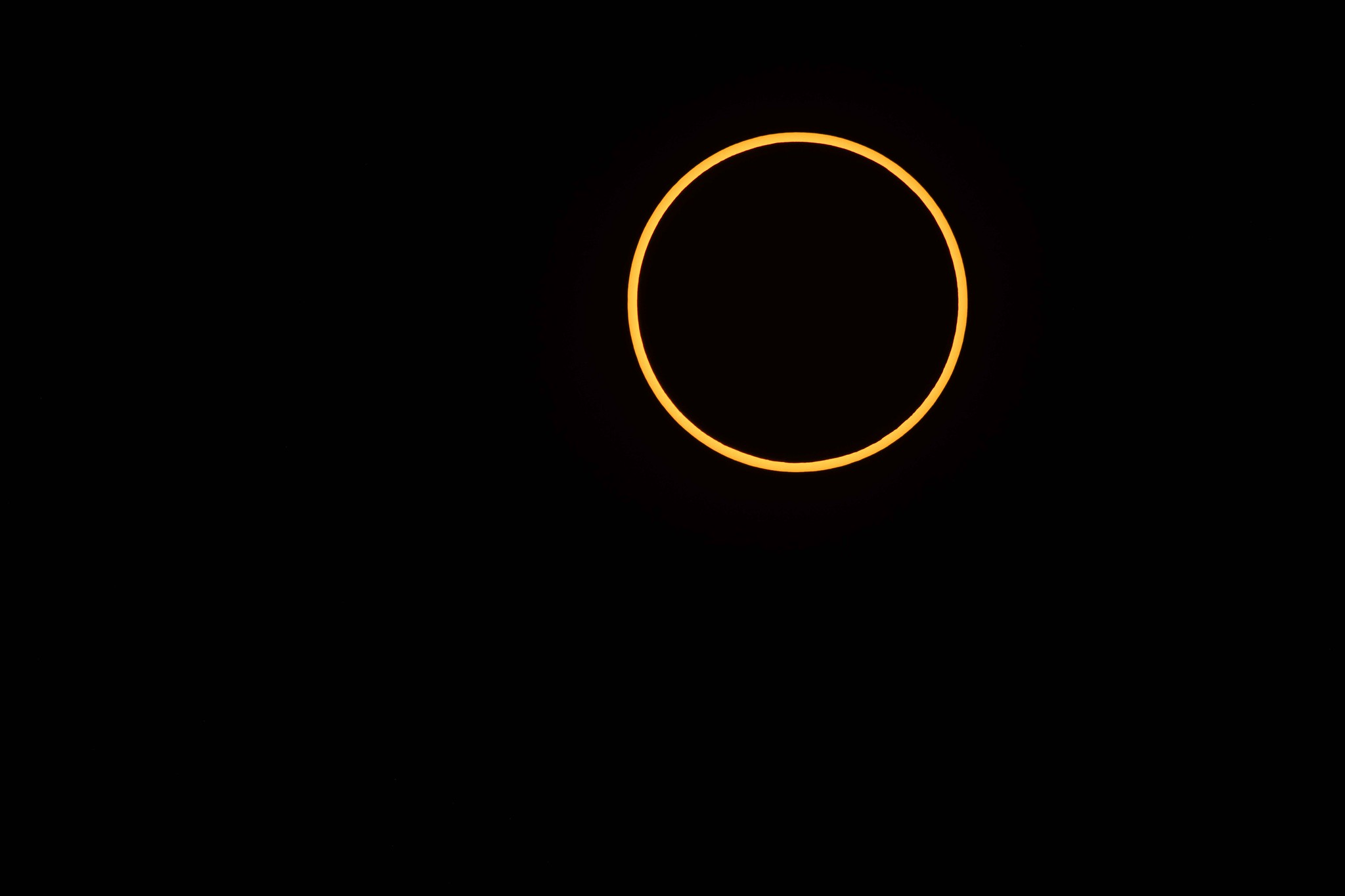
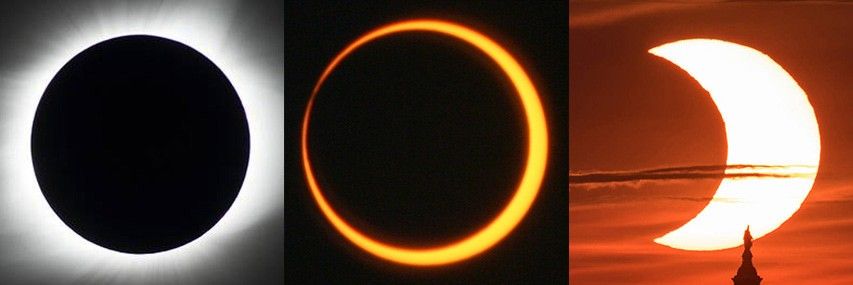
An annular solar eclipse happens when the Moon passes in front of the Sun but the Moon is near its farthest distance from Earth in its orbit, so its apparent size in the sky is too small to completely block the Sun’s bright disk. As the Moon moves in front of the Sun, its slightly smaller apparent size means that the Moon is completely contained within the solar disk and leaves a bright ring of the Sun visible around the edges. This ring around the edge of the Moon is too bright to look at safely with the unaided eye and is often described as a “ring of fire.” The path of the Moon’s shadow cast during an annular eclipse is called the path of annularity.
Aurora
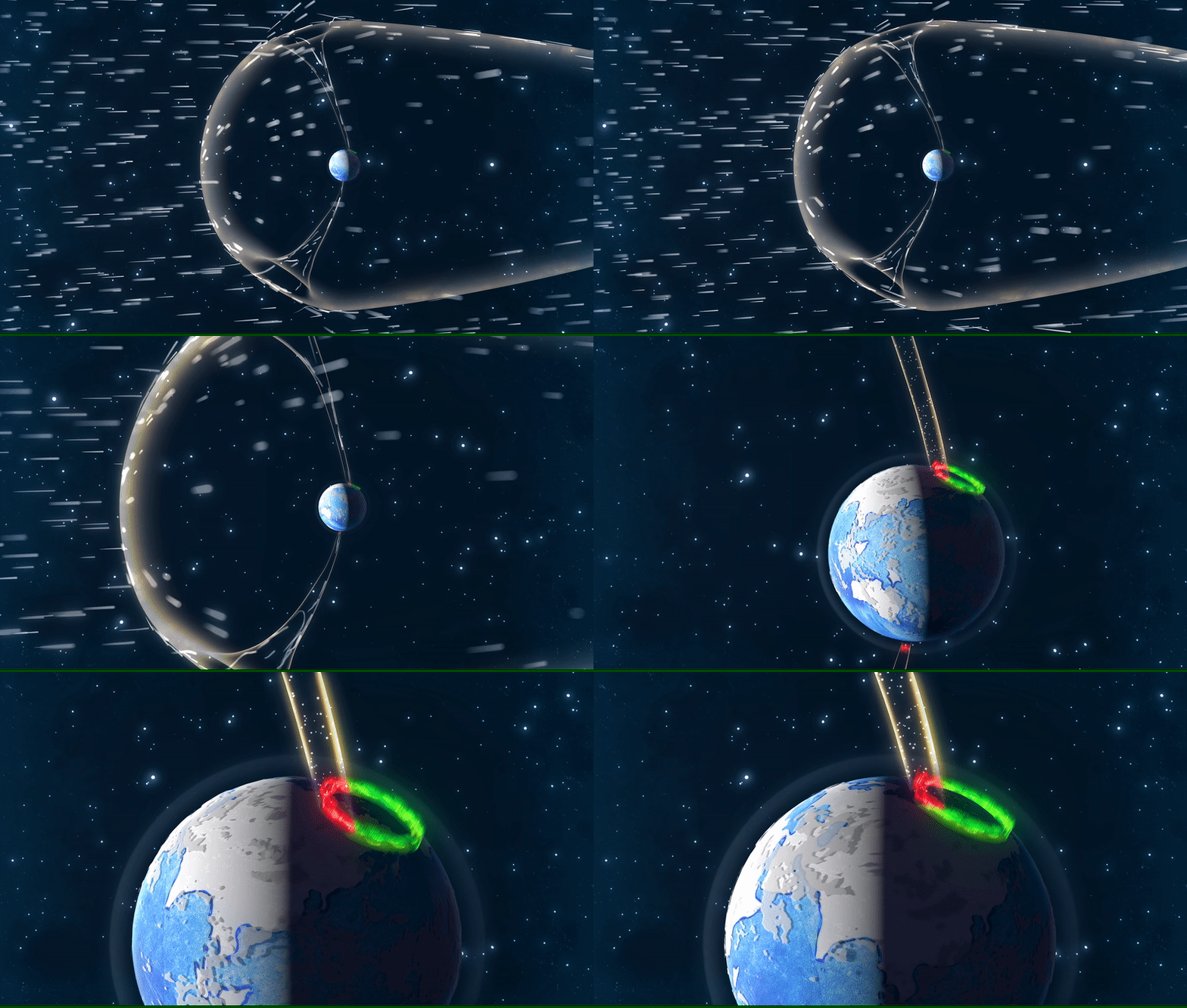
An aurora is a brilliant display of light in the night sky. The aurora borealis and aurora australis — also known as the northern and southern lights — occur mainly near Earth’s poles. When the solar wind reaches Earth’s magnetosphere, it can send charged particles trapped in Earth’s magnetic field raining down toward Earth’s poles, driven by a powerful process called magnetic reconnection.
Along the way, particles can collide with atoms and molecules in Earth’s upper atmosphere, providing the atoms with extra energy that they release as a burst of light. These interactions continue at lower and lower altitudes until all the excess energy is lost. Glowing auroras are the result of millions of individual particle collisions, lighting up Earth’s magnetic field lines. Studying auroras offers insights on how our magnetosphere reacts to near-Earth space weather.
See cusp aurora, diffuse aurora, discrete aurora, pulsating aurora

Baily’s Beads
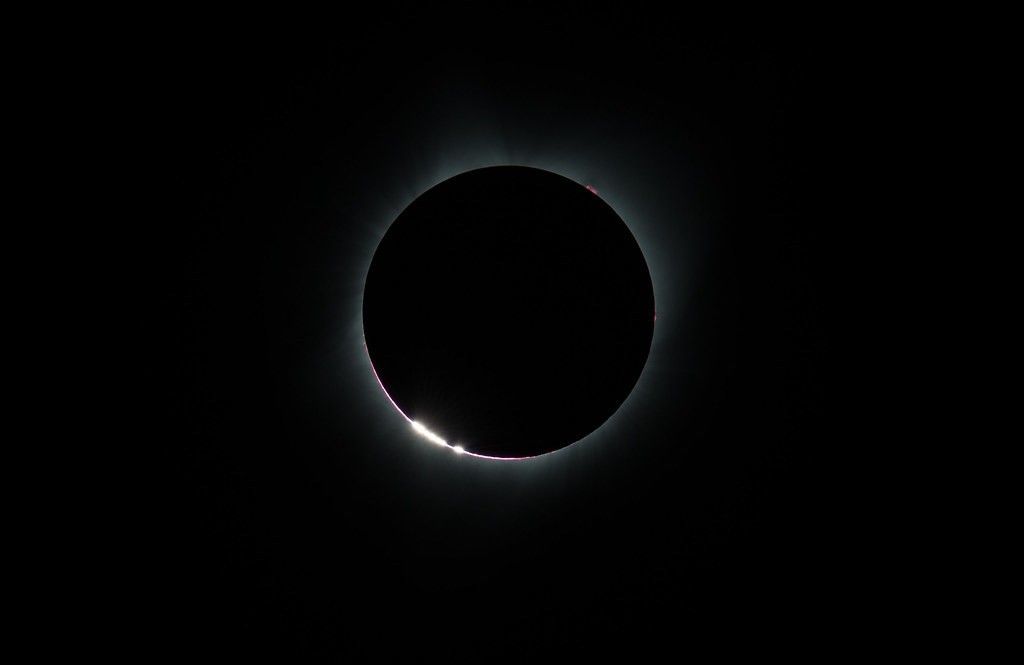
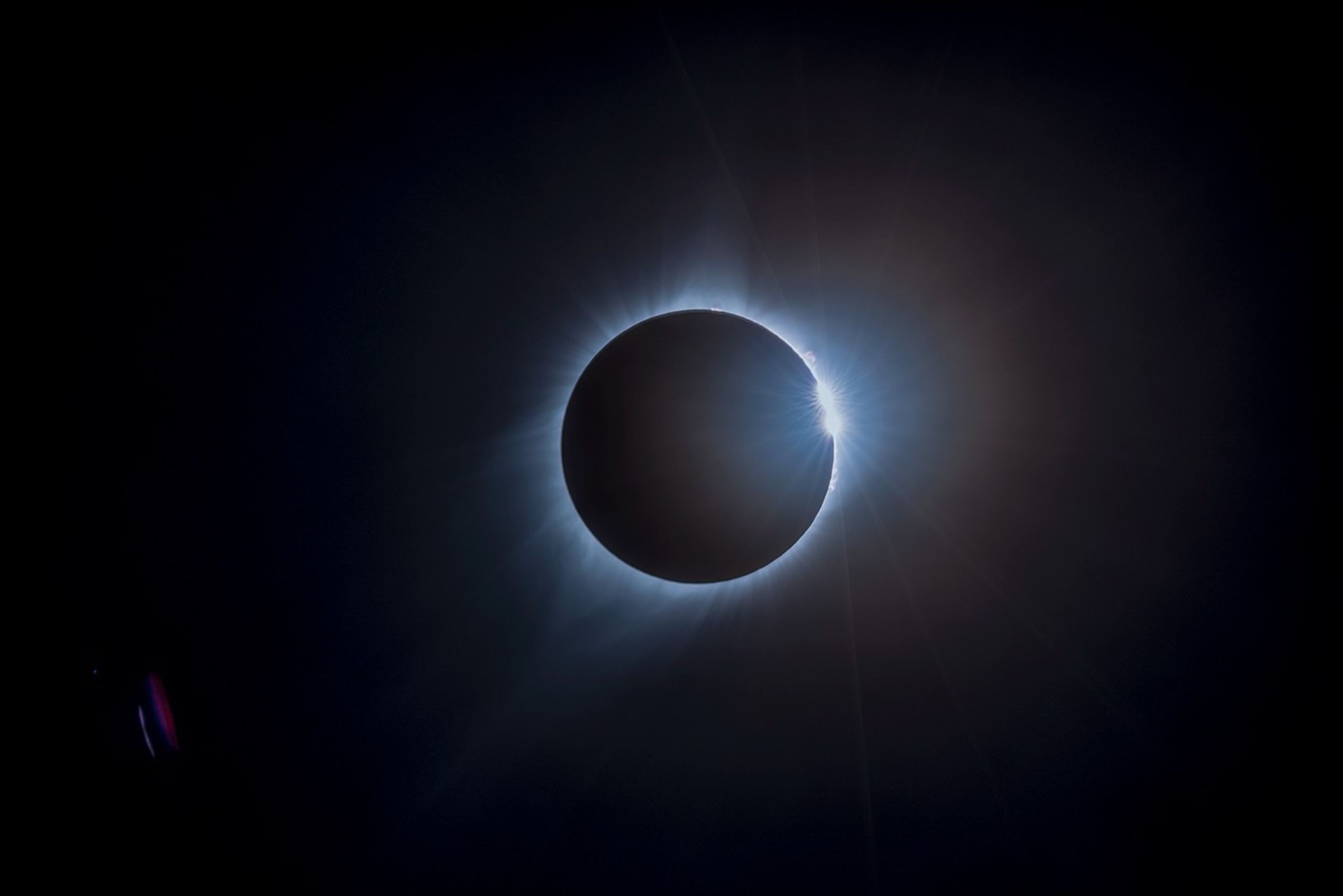
During a total solar eclipse, as the Moon moves across the Sun, the light forming the “diamond” in the “diamond ring” stage may break up into several points of light that shine around the Moon’s edge. Known as Baily’s Beads, these are light rays from the Sun streaming through low-lying valleys along the edge of the Moon. Baily’s Beads are very short-lived and may not last long enough to be noticeable to all observers of the total solar eclipse. Baily’s Beads can also be visible just after totality.
Chromosphere
The chromosphere is a layer of the Sun that lies just above the photosphere and is about 1,050 miles thick on average. The temperature in the chromosphere rises from about 10,000 degrees Fahrenheit to about 36,000 degrees Fahrenheit, hotter than the photosphere but nowhere near as hot as the Sun’s multimillion-degree upper atmosphere, known as the corona. Named for the bright reddish color it gives off, the chromosphere is notoriously tricky to study, because it’s where the physical laws affecting the motion of solar material begin to change. In the lower chromosphere, solar material moves as a typical gas or fluid; in the upper chromosphere and above, magnetic forces dominate the motion.

Convection zone
The convection zone is the outermost layer of the solar interior and makes up about two-thirds of the Sun’s volume. At the base of the convection zone, the temperature is about 3.5 million degrees Fahrenheit. The convection zone is much less dense than the radiative zone, with about the same density as the air 50 miles above Earth’s surface. The hot material there rises to the surface of the star, carrying (or convecting) heat with it. Once the material cools by giving off sunlight, it sinks down, where it picks up more heat. The convective motions themselves are visible at the Sun’s surface as features called granules and supergranules.
Core (Sun)
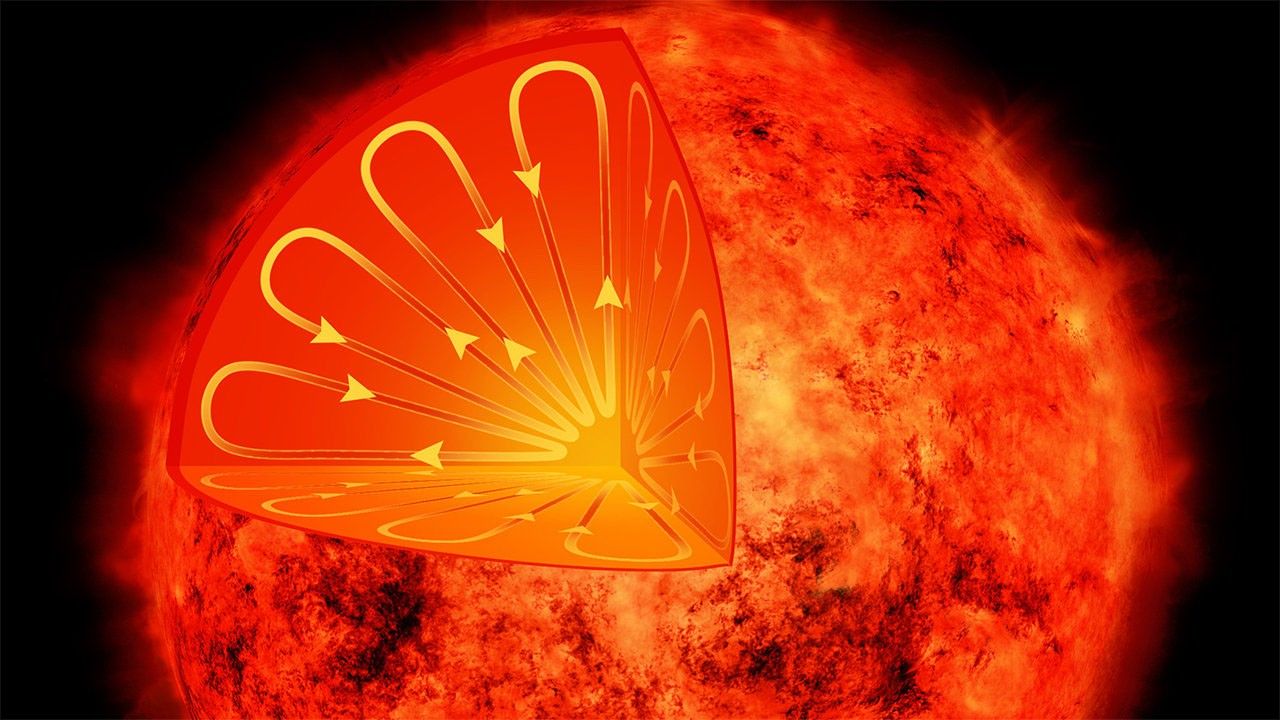
More than 27 million degrees Fahrenheit and 10 times denser than lead, the solar core is the very center of our Sun. Here, the intense pressure from surrounding layers compresses the center to a dense ball — about 172,000 miles across — where hydrogen atoms are squeezed together to form helium, releasing energy and light in the process. This reaction, known as nuclear fusion, has powered our Sun for over 4 billion years and will continue for an estimated 5 billion more.
Corona
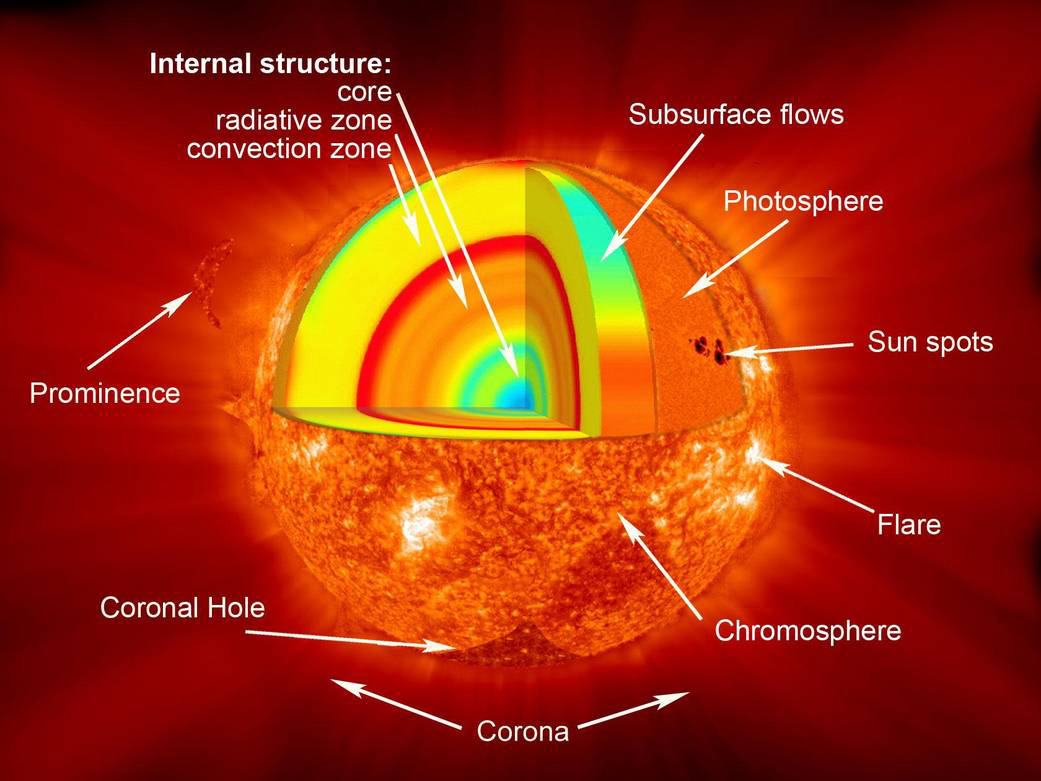
The Sun’s dynamic upper atmosphere is called the corona. It is filled with plasma, whose movements are governed by the tangle of magnetic fields surrounding the Sun. Temperatures in the corona can reach millions of degrees. The corona is the source of the solar wind as well as solar flares and coronal mass ejections — the energetic solar eruptions that create the strongest space weather.
Coronal hole
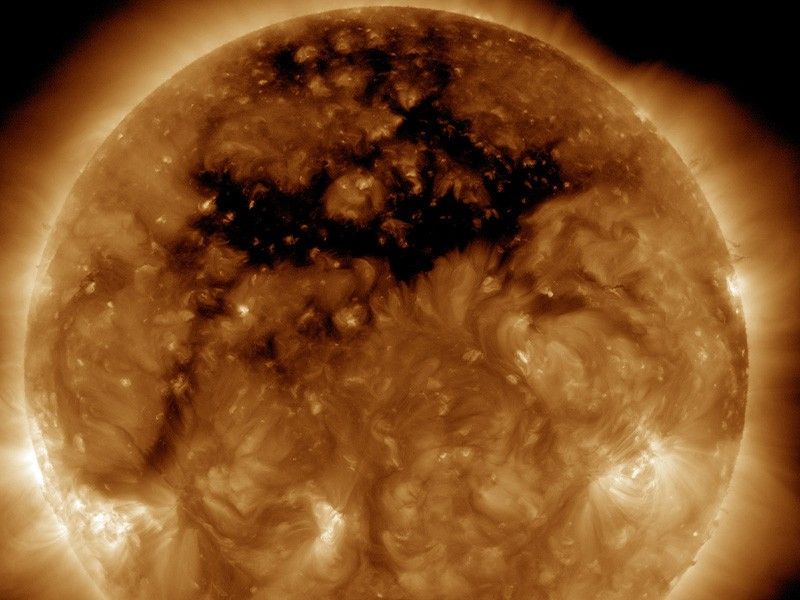
A coronal hole is a patch of the Sun’s atmosphere with much lower density than elsewhere. In ultraviolet views of the Sun, coronal holes appear as dark splotches. These are regions where the Sun’s magnetic field lines are connected directly to interplanetary space, allowing solar material to escape out in a high-speed stream of solar wind, leaving a dark “hole” near the surface of the Sun. Coronal holes appear throughout the solar cycle, but can last for much longer during solar minimums, when the Sun is less active.
Coronal (plasma) rain
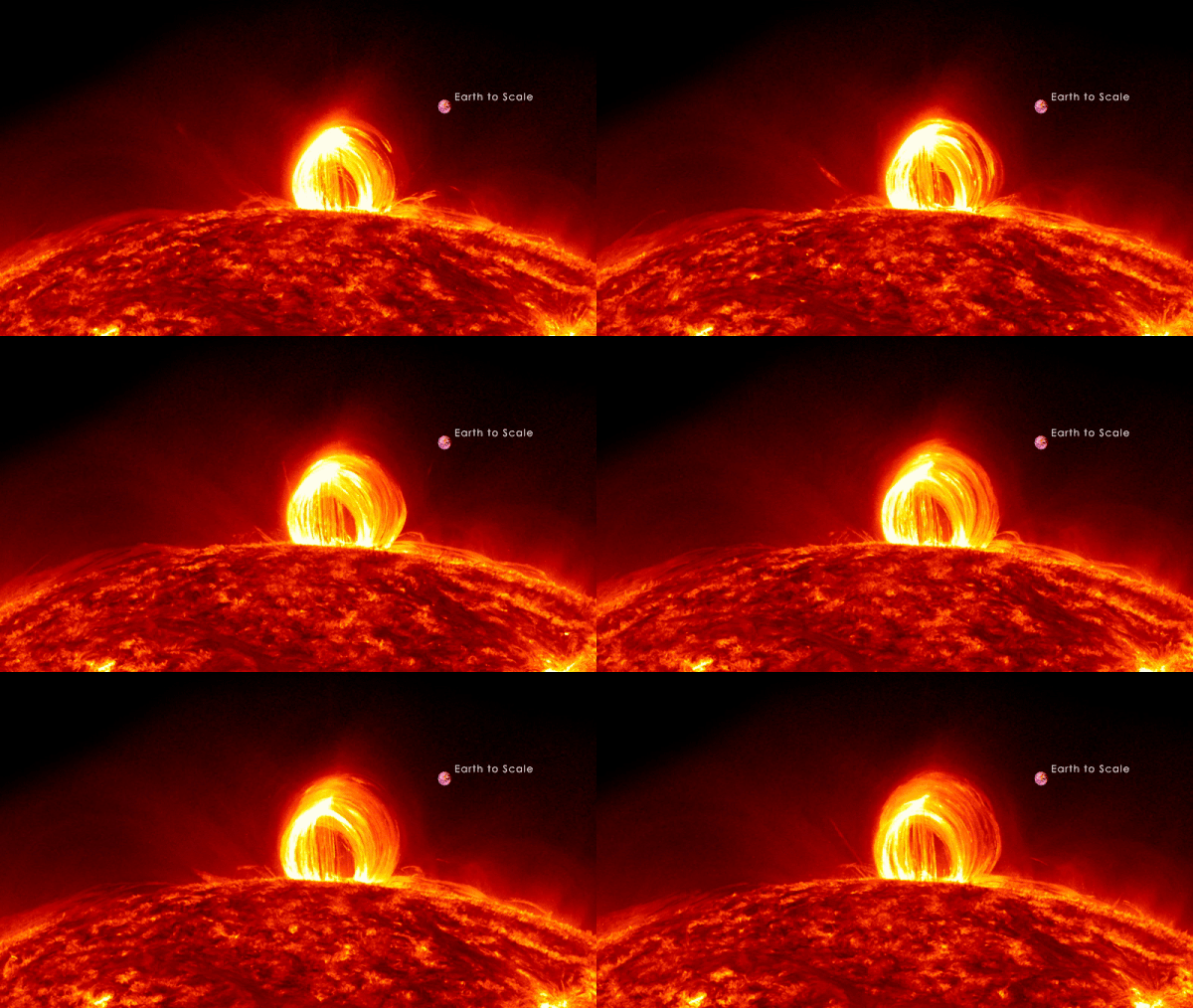
Coronal rain, also known as plasma rain, is made of giant globs of plasma that drip from the Sun’s outer atmosphere back to its surface. It occurs when particular conditions, such as magnetic field line configurations and local heating events in the corona, cause the plasma globs there to become cooler and denser than their surroundings, making them rain down.
Coronal mass ejection (CME)
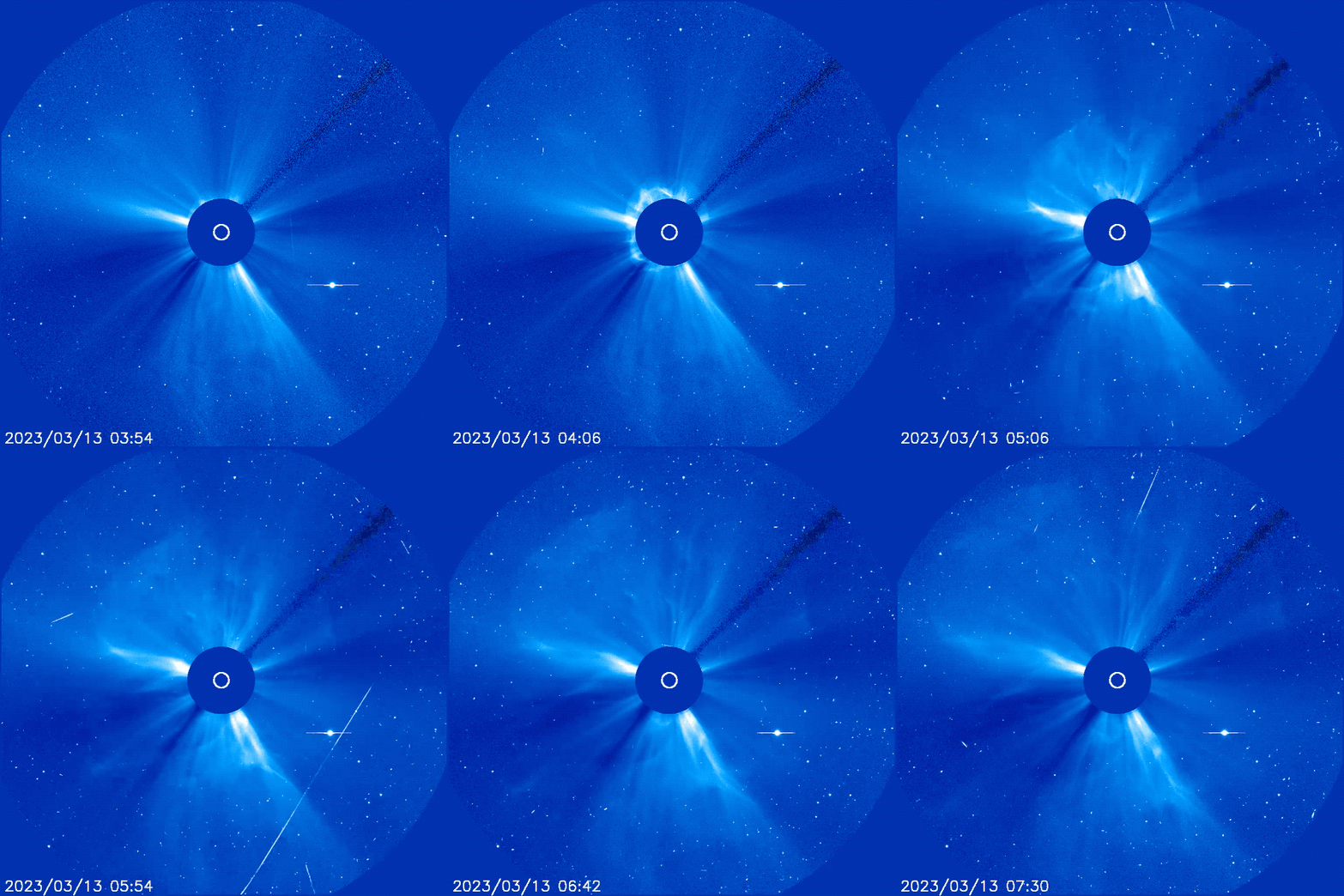
A coronal mass ejection, or CME, is a large cloud of solar plasma and embedded magnetic fields released into space after a solar eruption. A CME expands as it sweeps through space, often measuring millions of miles across, and can collide with the magnetic fields of planets. When directed at Earth, a CME can produce geomagnetic disturbances that ignite bright auroras, short-circuit satellites and power grids on Earth, or endanger astronauts in orbit.
Cosmic rays
Cosmic rays are not a form of light as their name suggests, but instead are high-energy pieces of atoms that move at nearly the speed of light. When produced in or near the Sun, they are known as solar energetic particles, but in high-energy environments across the galaxy, such as supernovae and black holes, they are called galactic cosmic rays. To understand more about high-energy environments where cosmic rays are made, scientists study these particles with special detectors in space.
On Earth, scientists commonly measure cosmic rays indirectly after they run into particles in our atmosphere. The collision of the particles and cosmic rays creates a shower of smaller particles, which are easily picked up by special detectors on the ground.

Cusp aurora
Earth’s magnetosphere has two cusps: regions in the magnetosphere where Earth’s magnetic field lines funnel solar wind directly to the upper atmosphere. A unique kind of aurora occurs at the cusp, marking where auroras can be seen during the daytime. They are unique not only for where they are found, but also how they form. Unlike other auroras, they are sparked directly by solar wind particles.
Diamond ring effect
As the Moon moves in front of the Sun during a total solar eclipse, there is a moment when a single bright spot is left — a bright spot that, in combination with the atmosphere of the Sun visible around the Moon, looks like a giant diamond on a ring. This “diamond ring” effect is created by sunlight streaming through valleys on the Moon’s limb — the “diamond” — along with the Sun’s outer atmosphere, the corona, forming a “ring” around the Moon. The diamond ring effect also occurs shortly after totality.
Diffuse aurora
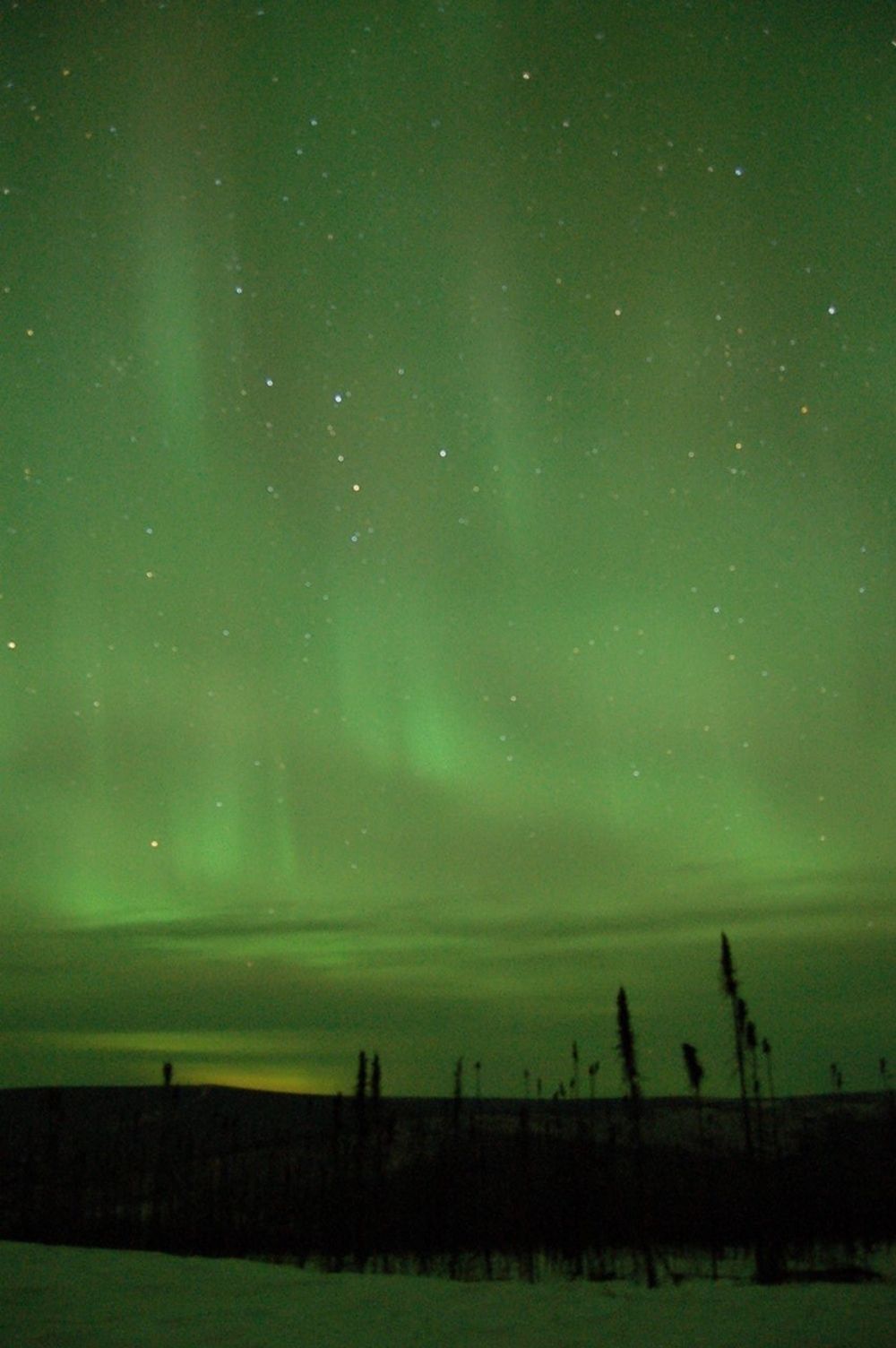
Diffuse auroras are dim, often motionless auroras. They can be green, whitish, or red and occur over a wide area, typically closer to the equator than discrete auroras. They might be confused for clouds.
Discrete aurora
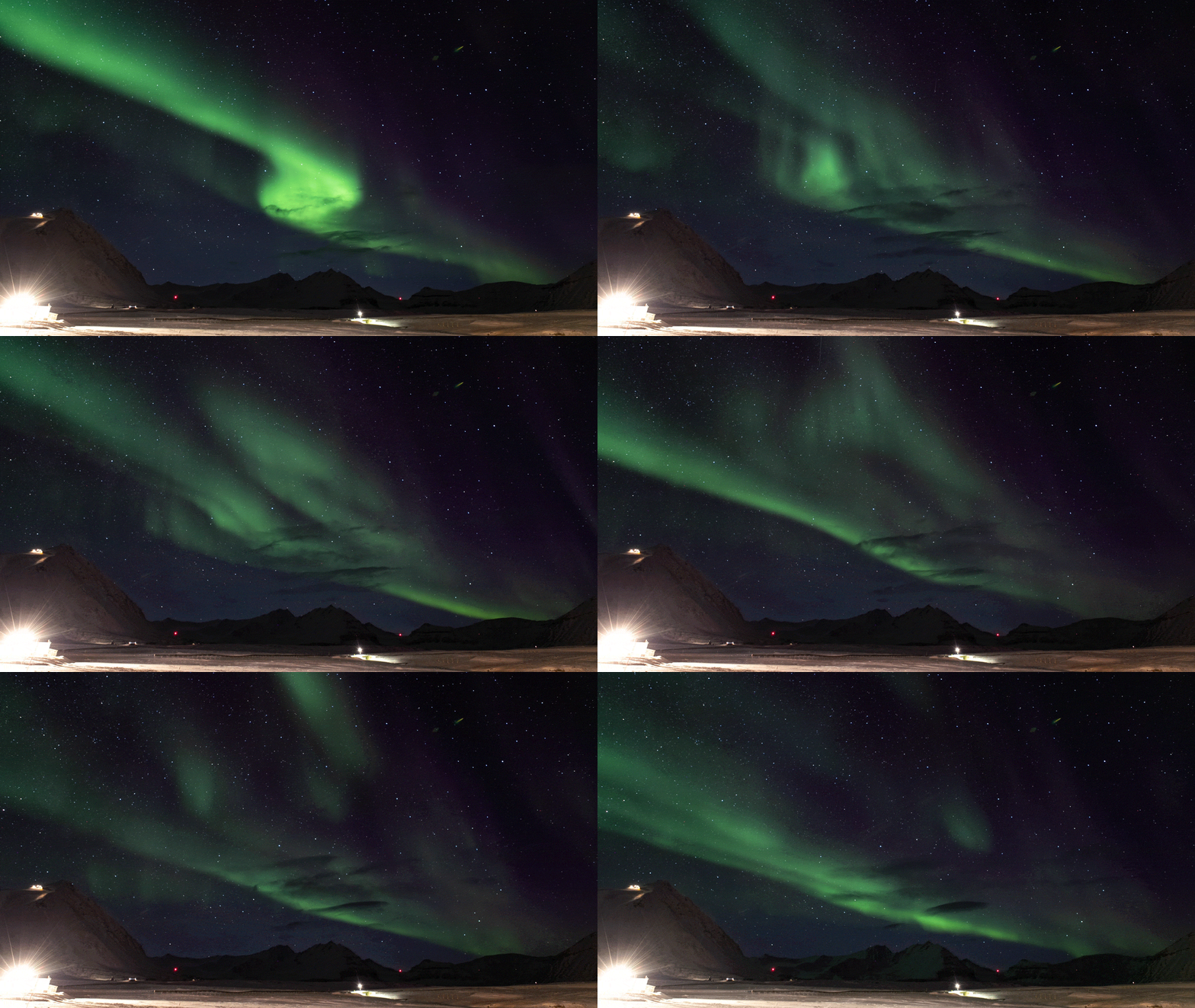
Discrete auroras are bright, thin bands with a definite lower border. They can stretch high into the sky and take on curtain-like shapes when viewed from the side. They can wave slowly or rapidly across the sky.
E, F, G, H
Eclipse
An eclipse happens when one celestial body — like a moon or a planet — moves into the shadow of another celestial body. On Earth, we see solar eclipses when Earth moves into the Moon’s shadow (and our view of the Sun is blocked), and we see lunar eclipses when the Moon moves into Earth’s shadow. Both solar and lunar eclipses can be partial or total.
See annular solar eclipse, hybrid solar eclipse, partial solar eclipse, and total solar eclipse

Energetic neutral atom (ENA)
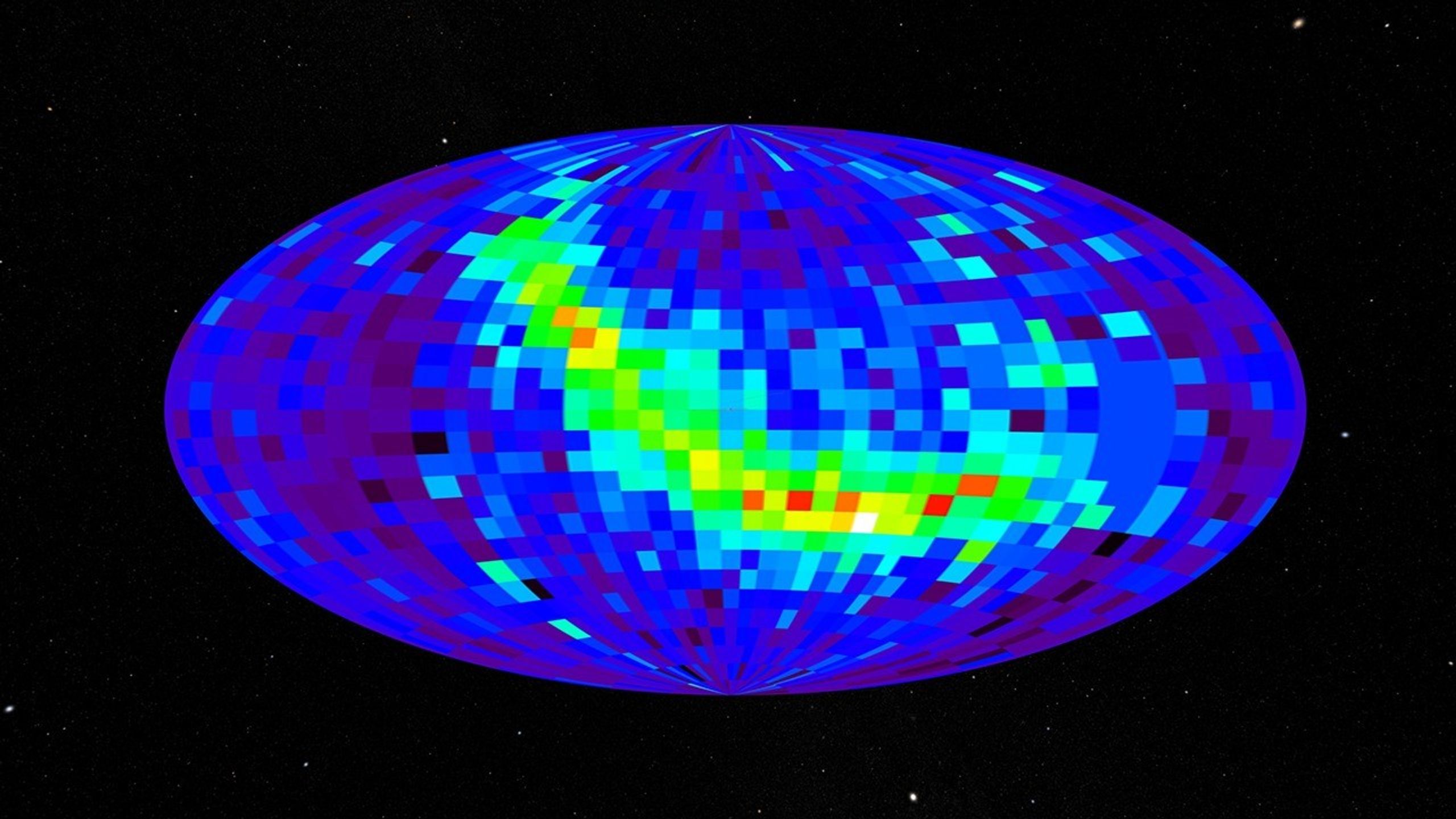
An energetic neutral atom (ENA) is a type of uncharged, or neutral, particle. An ENA forms when an energetic, positively charged atom (or ion) runs into a slow-moving neutral atom. The ion picks up an extra electron in the collision, making it neutral — hence the name energetic neutral atom. Since ENAs aren’t charged, they don’t interact with the magnetic fields that permeate space. This means they travel in a straight line, which allows scientists to track their origins and study distant plasma-filled regions of space, such as the boundary of the heliosphere.
Exosphere
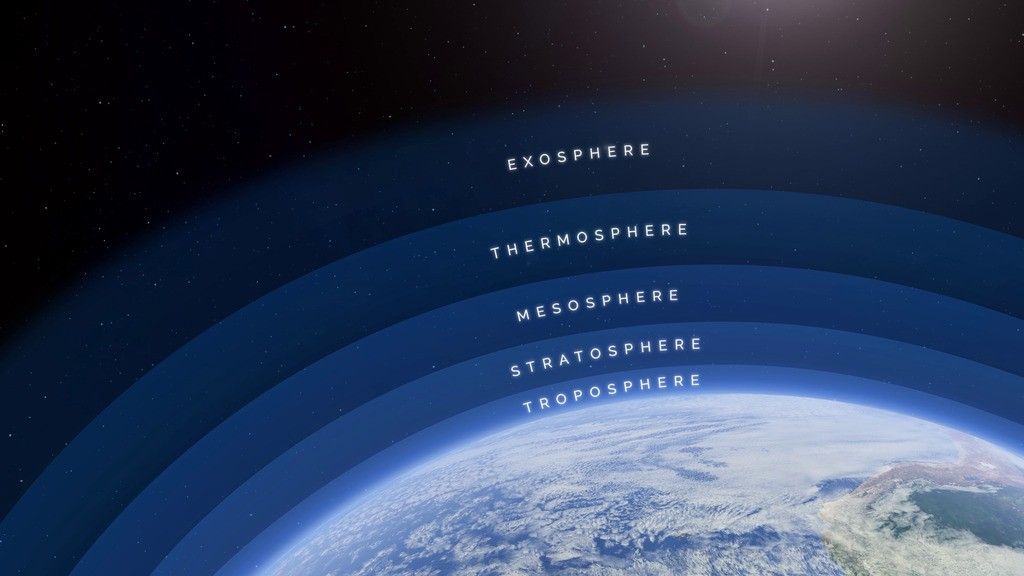
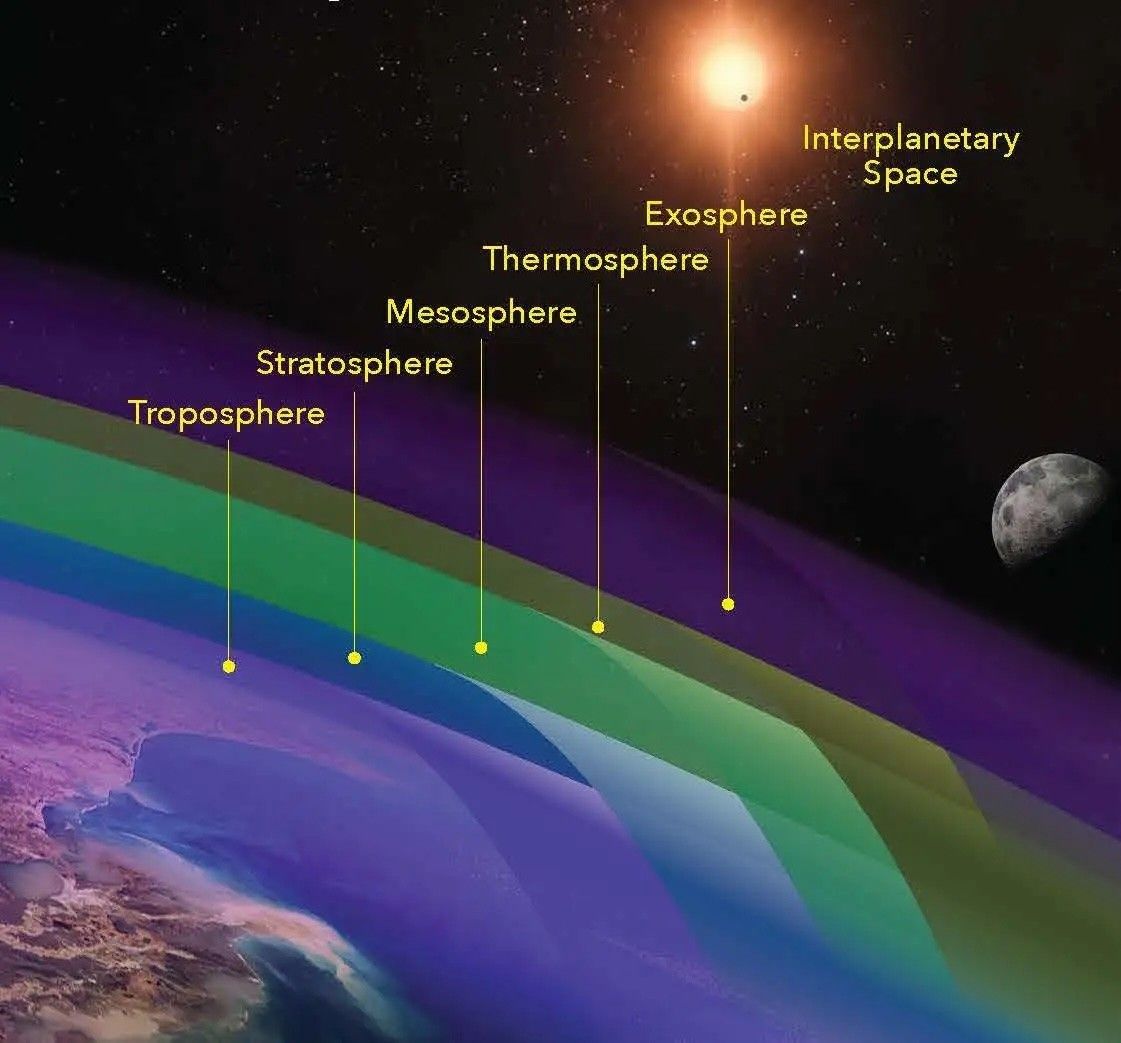
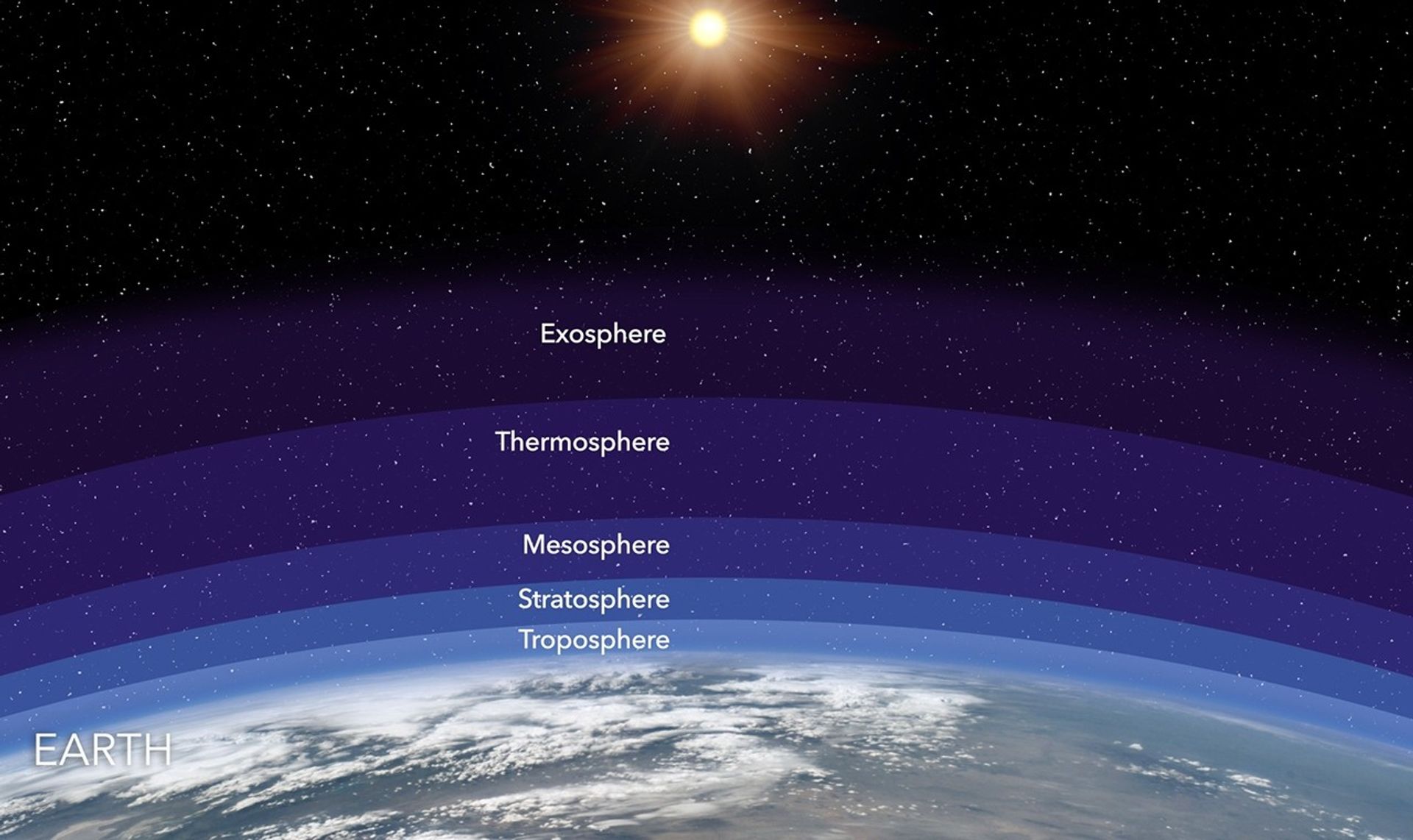
Located between about 440 to 6,200 miles (700 to 10,000 kilometers) above Earth’s surface, the exosphere is the highest layer of Earth’s atmosphere and, at its top, merges with the solar wind. Molecules found here readily escape into space. While there’s no weather at all in the exosphere, the aurora is sometimes seen in its lowest reaches. Most Earth satellites orbit in the exosphere.
Filament
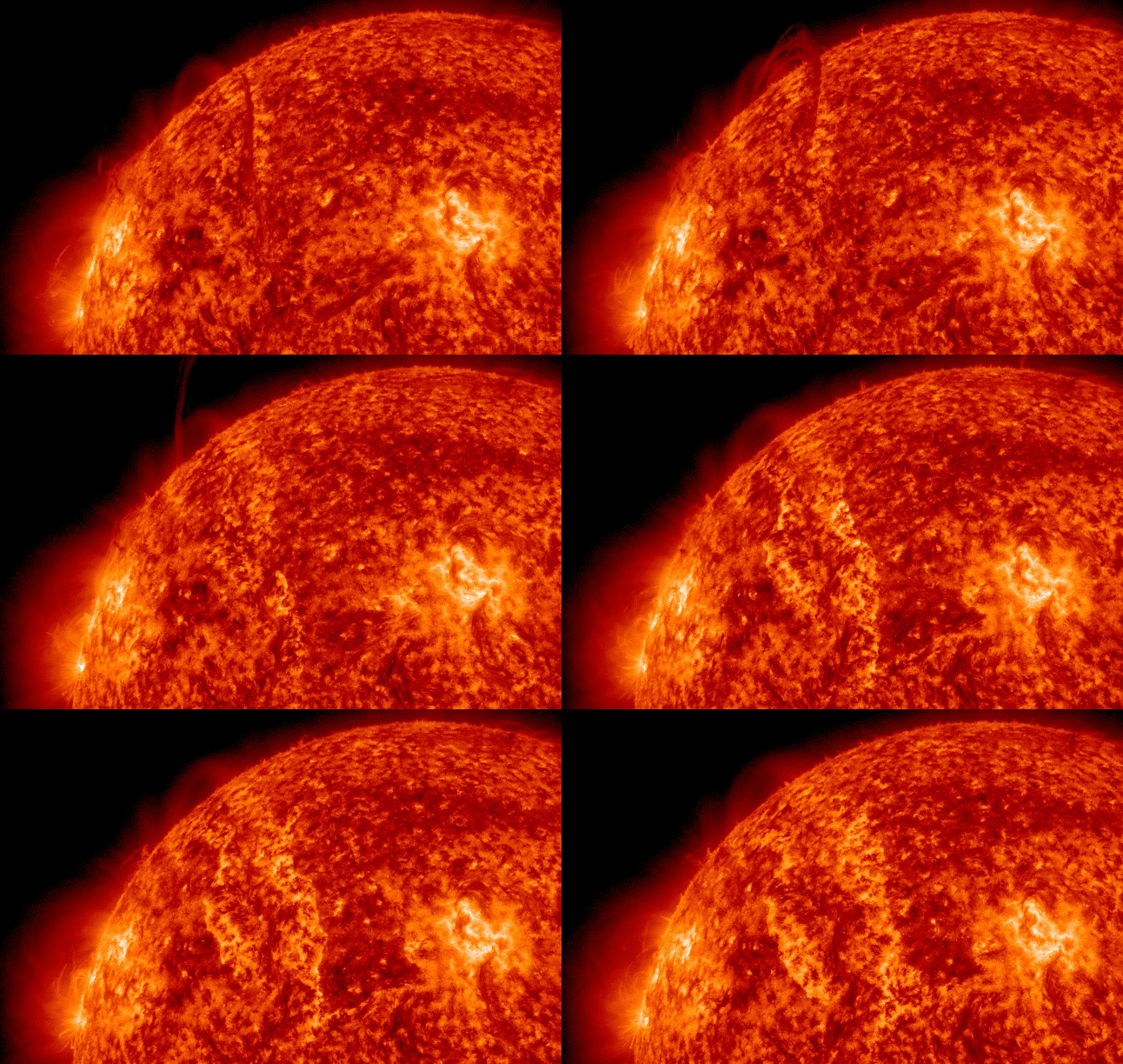
A filament is a strand of solar material, cooler and denser than its surroundings, suspended above the Sun by magnetic forces. Filaments appear as dark lines when seen against the bright Sun. When solar filaments become unstable, they can either fall back onto the Sun or erupt into space, sending a coronal mass ejection away from the Sun. (When a solar filament is seen at the edge of the Sun, against the blackness of space, it is called a prominence instead.) Space weather forecasters keep an eye on filaments, as they can be important contributors to space weather.
Flux rope
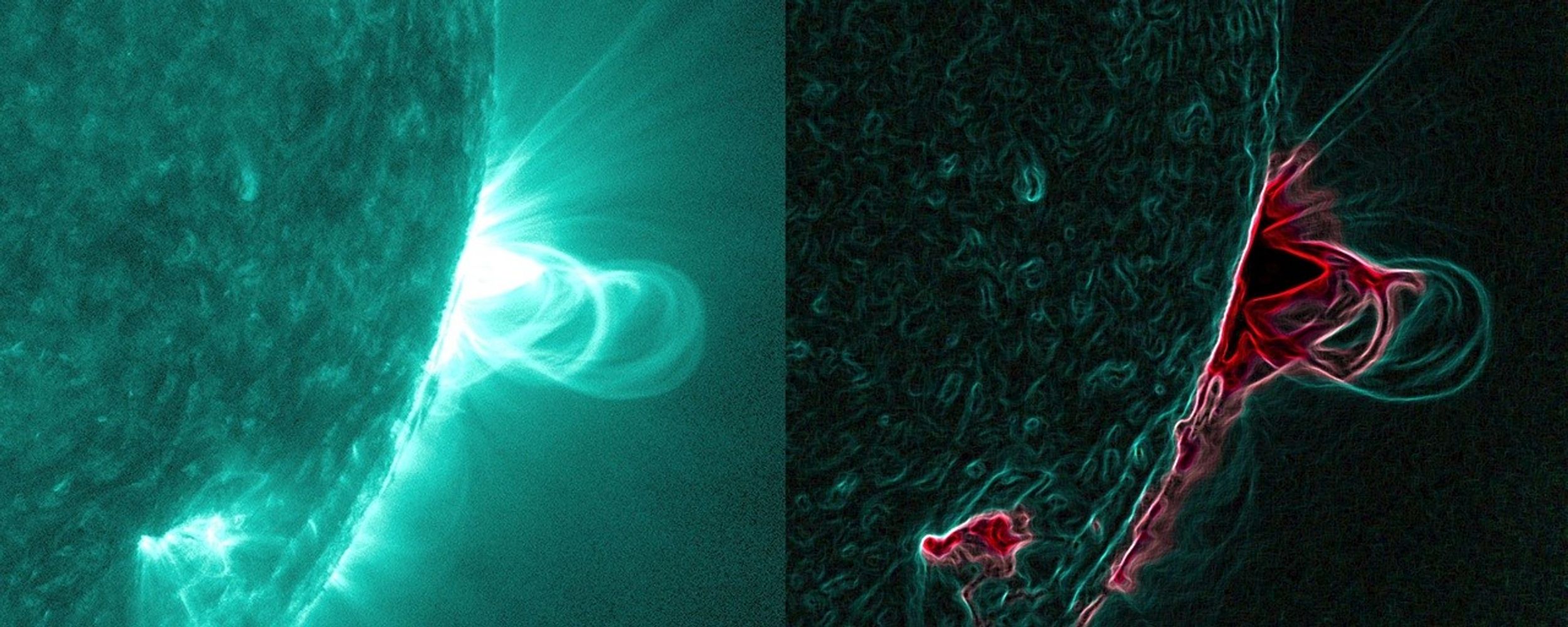
A flux rope is a type of magnetic structure thought to be central to many of the Sun’s eruptions. Flux ropes form in plasmas, such as in the Sun’s corona, when loops of magnetic field lines connect with each other. The resulting flux ropes form from bundles of magnetic fields that have a magnetic field wrapped around them, like the stripes on a candy cane. These twisted structures extend in a series of loops from the Sun’s surface, and can be carried away from the Sun by a coronal mass ejection.
Geospace
Geospace is the broad term used to refer to the region of space surrounding Earth. It is usually used to reference the area from the mesosphere through the magnetosphere.
Heliosphere
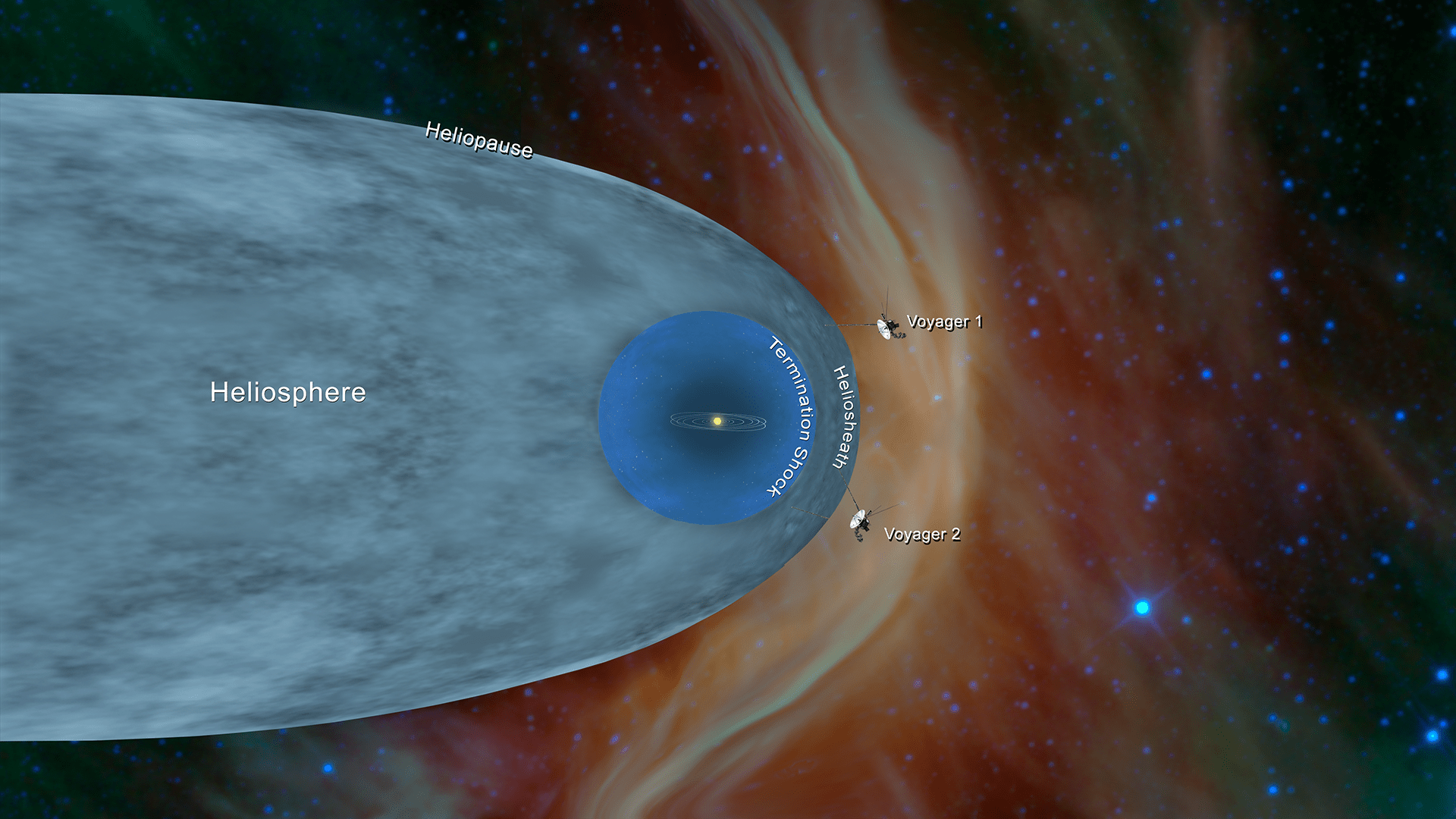
The Sun’s constantly outflowing material, the solar wind, inflates a bubble in space called the heliosphere. The heliosphere encloses all of the planets in the solar system and is filled by the Sun’s plasma and magnetic field. In interstellar space outside the heliosphere, the interstellar medium and the galactic magnetic field are dominant. The heliosphere acts as a shield for our solar system, blocking many of the high-energy galactic cosmic rays from elsewhere in our galaxy. Of the spacecraft sent from Earth, only the twin Voyager spacecraft — launched in 1977 — have sent back data from beyond the boundaries of the heliosphere.
Hybrid solar eclipse
A hybrid solar eclipse happens when a solar eclipse transitions from total to annular (or vice versa) during the eclipse.
I, J, K, L
Ionosphere
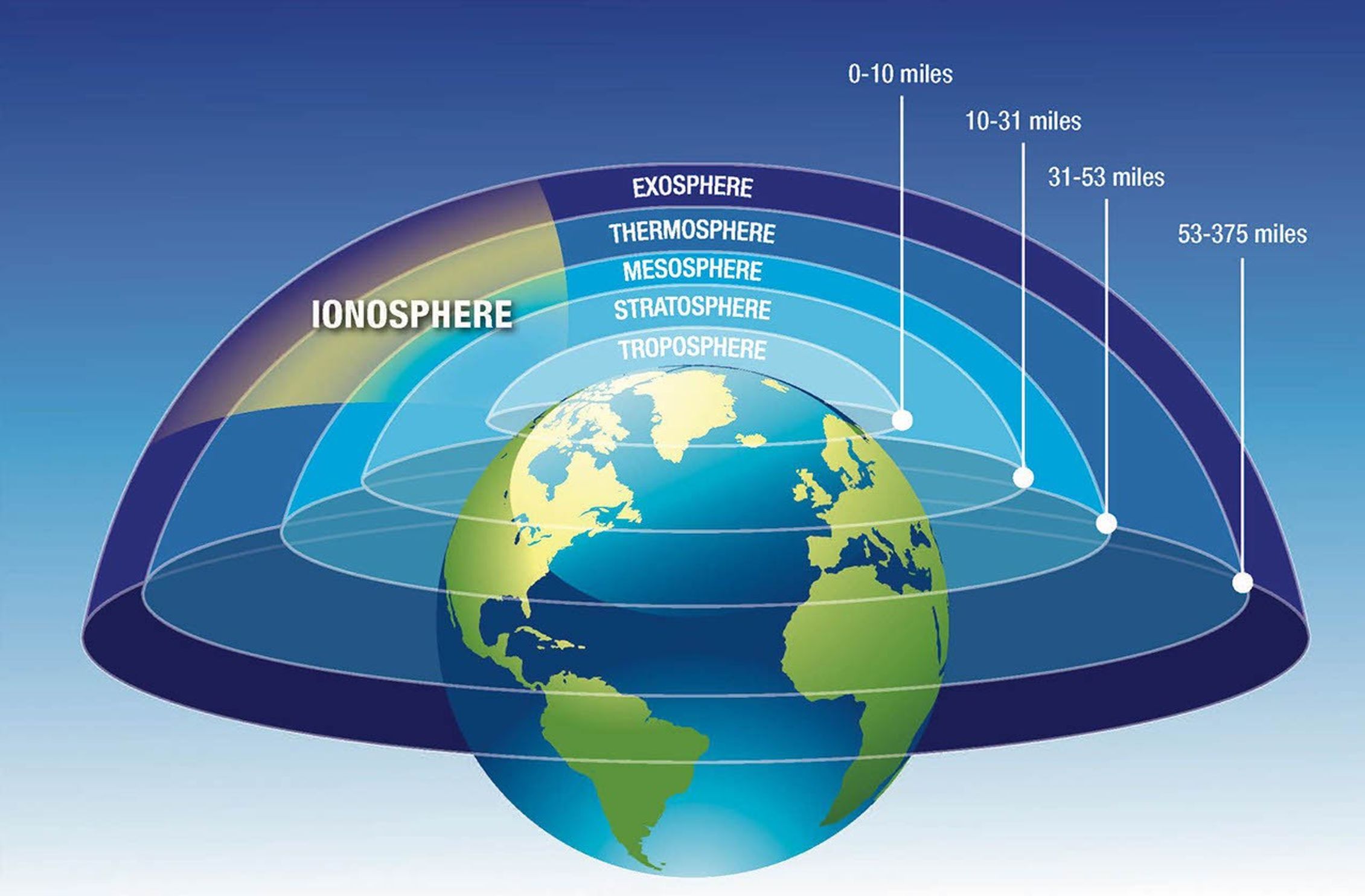
The ionosphere is a dynamic, electrically charged region of Earth’s atmosphere located between 50 and 400 miles above our planet’s surface. The ionosphere overlaps with both the lower reaches of space and many of the upper layers of Earth’s atmosphere, like parts of the thermosphere and mesosphere. The ionosphere is electrically charged because the Sun’s radiation hits particles and gases there, electrifying (or ionizing) them. As such, the ionosphere is created by the Sun’s energy.
As night falls on one side of Earth, the ionosphere diminishes there and grows on the daytime side. The ionosphere carries enormous electrical currents that link it to the magnetosphere, heat the upper atmosphere, and can even drive damaging currents in power lines on the ground.
Lagrange points
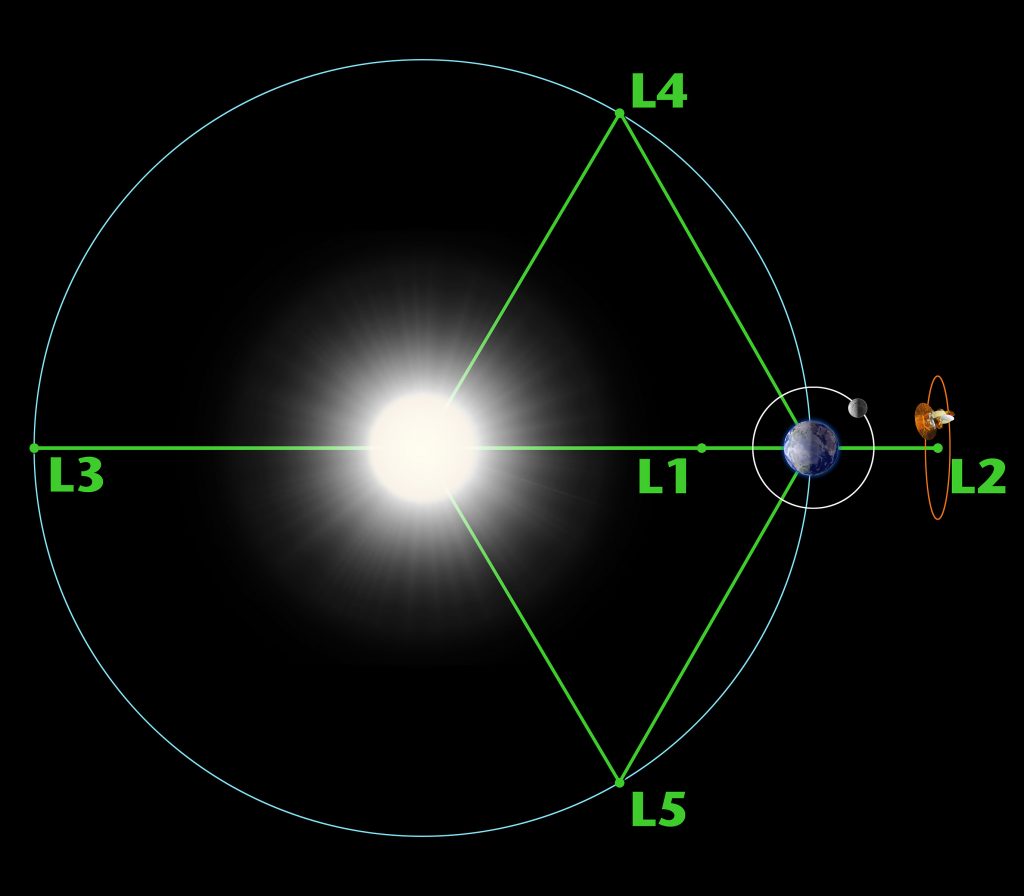
Lagrange points are positions in space near two massive bodies (a star and a planet, or a planet and its moon, for example) where objects tend to stay put. At Lagrange points, the gravitational pull of the two large masses equalize, keeping a smaller object stable. Spacecraft can be placed at Lagrange points to reduce the amount of fuel needed to remain in position.
In any two-body system there are five Lagrange points labeled L1 through L5. In the Sun-Earth system, L1, located between the Sun and Earth, is the current home of many spacecraft studying the Sun and solar wind. L2, about a million miles away on the opposite side of Earth, is the home of NASA’s James Webb Space Telescope. L3, L4, and L5 are not home to any current or planned spacecraft.
M, N, O, P
Magnetic reconnection
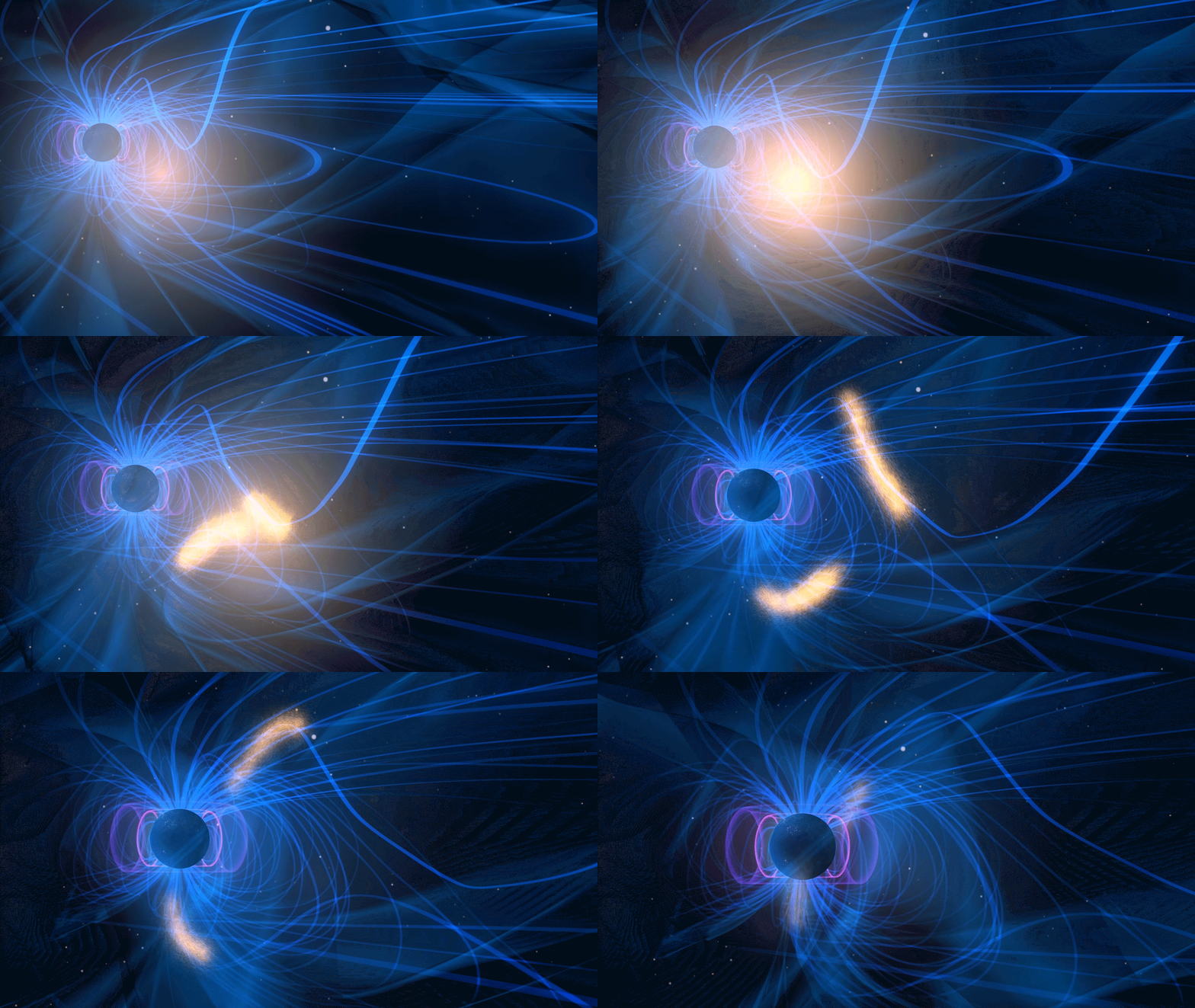
When magnetic field lines mix, they can explosively snap and realign, flinging away nearby particles at high speeds in a process called magnetic reconnection. This process occurs across the universe, including on the Sun, near black holes, and around Earth. Particles launched by magnetic reconnection near Earth can travel along magnetic field lines into the atmosphere, where they can spark auroras.
Magnetosphere
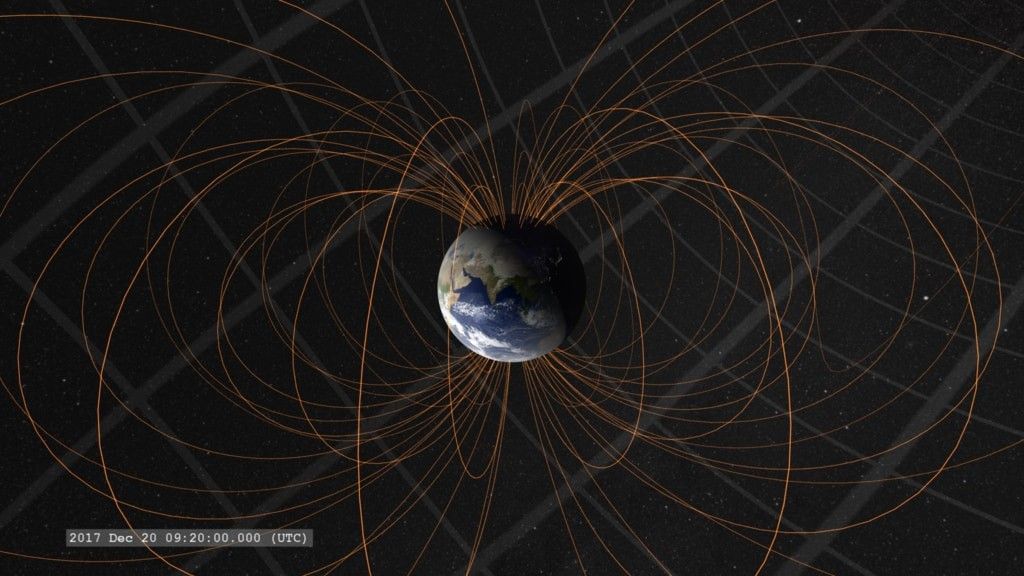
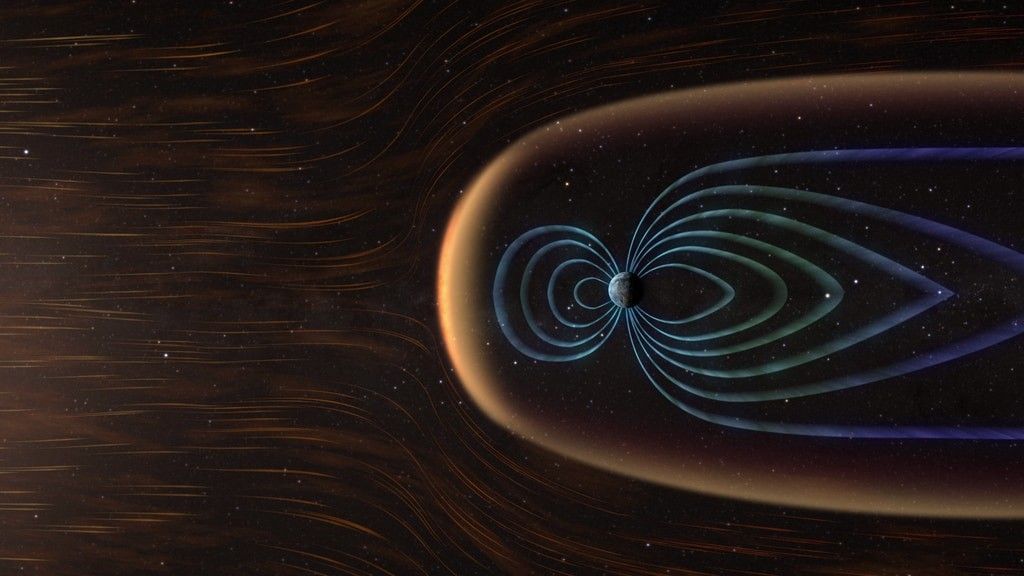
A magnetosphere is the region around a planet dominated by the planet’s magnetic field. In the solar system, several planets (including Earth) and even one of Jupiter’s moons have magnetospheres. Planetary magnetospheres have a teardrop or cone shape, with a rounded, shorter end (created as the solar wind pushes against the magnetic field) and a long tail trailing away on the other side. Earth’s magnetosphere has played a crucial role in our planet’s habitability as it shields our home planet from solar and cosmic particle radiation, as well as erosion of the atmosphere by the solar wind.
Mesosphere
The mesosphere is located in the middle of Earth’s upper atmosphere, sandwiched between the stratosphere and thermosphere around 31 to 53 miles above Earth’s surface. (“Meso” means middle.) The mesosphere is the atmospheric layer where meteors burn up, creating what we call shooting stars. It is also the coldest layer of Earth’s atmosphere; at the mesosphere’s upper reaches, the temperature averages about minus 120 degrees Fahrenheit (minus 85 degrees Celsius).
Nanojet/nanoflare
Nanojets are bright, thin tendrils of plasma that travel perpendicular to magnetic structures in the solar atmosphere, reaching lengths of thousands of miles. They are spawned by nanoflares, tiny explosions on the Sun caused by a process known as magnetic reconnection, which occurs in tangled magnetic field lines.
Noctilucent clouds (polar mesospheric clouds)
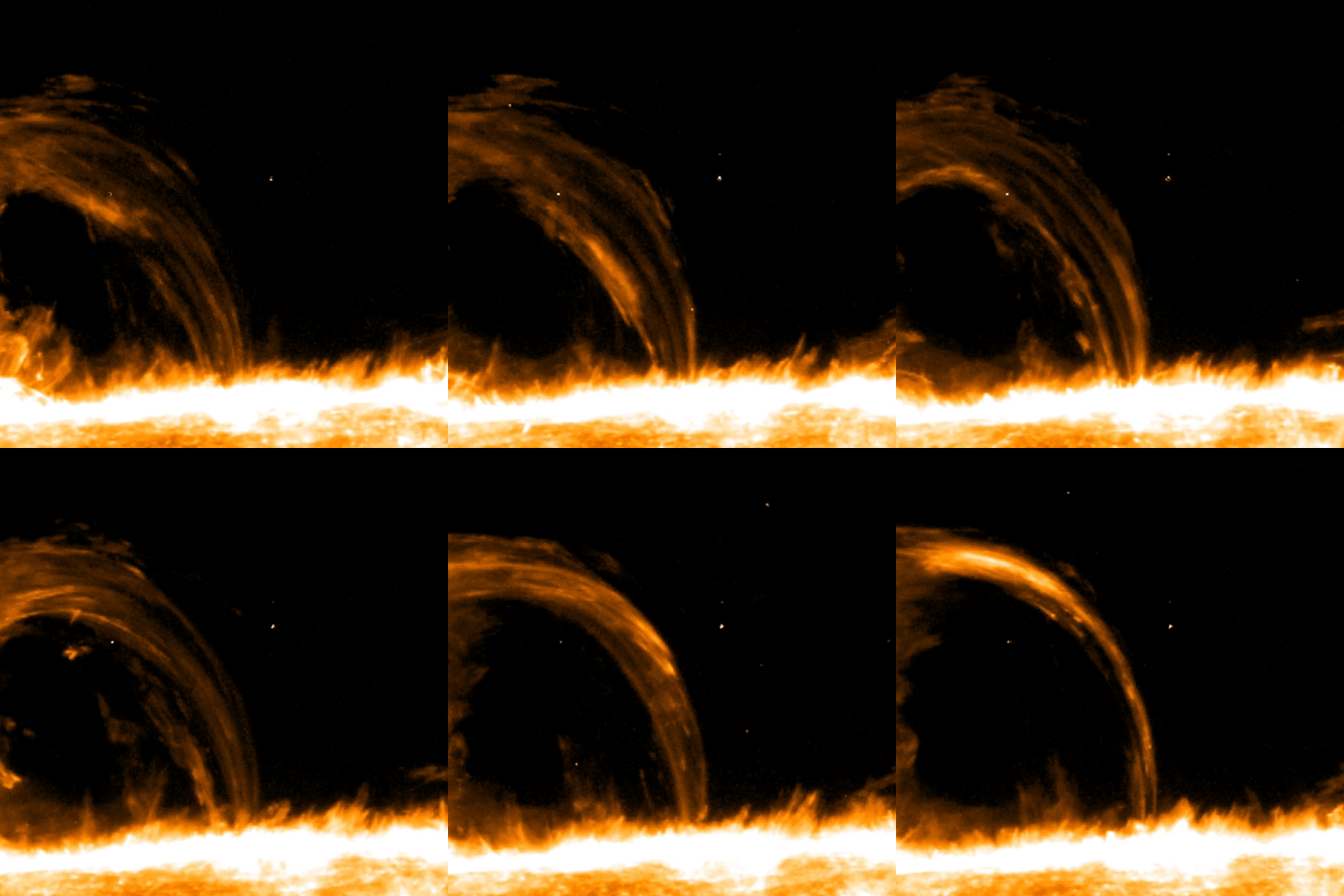
Noctilucent, or night-shining, clouds are clouds of ice that reflect sunlight and shine with an electric-blue glow. They drift about 50 miles overhead. They are also known as polar mesospheric clouds, since they tend to huddle over Earth’s poles and form in the mesosphere. Noctilucent clouds commonly appear in the summer, when this part of the upper atmosphere has all three ingredients the clouds need to form: dust from burned-up meteors, extremely cold temperatures, and water vapor. The clouds form when water molecules freeze around the dust. The clouds and their seasonal variations help scientists better understand the mesosphere and its connections to the rest of the atmosphere, weather, and climate.
Parker spiral
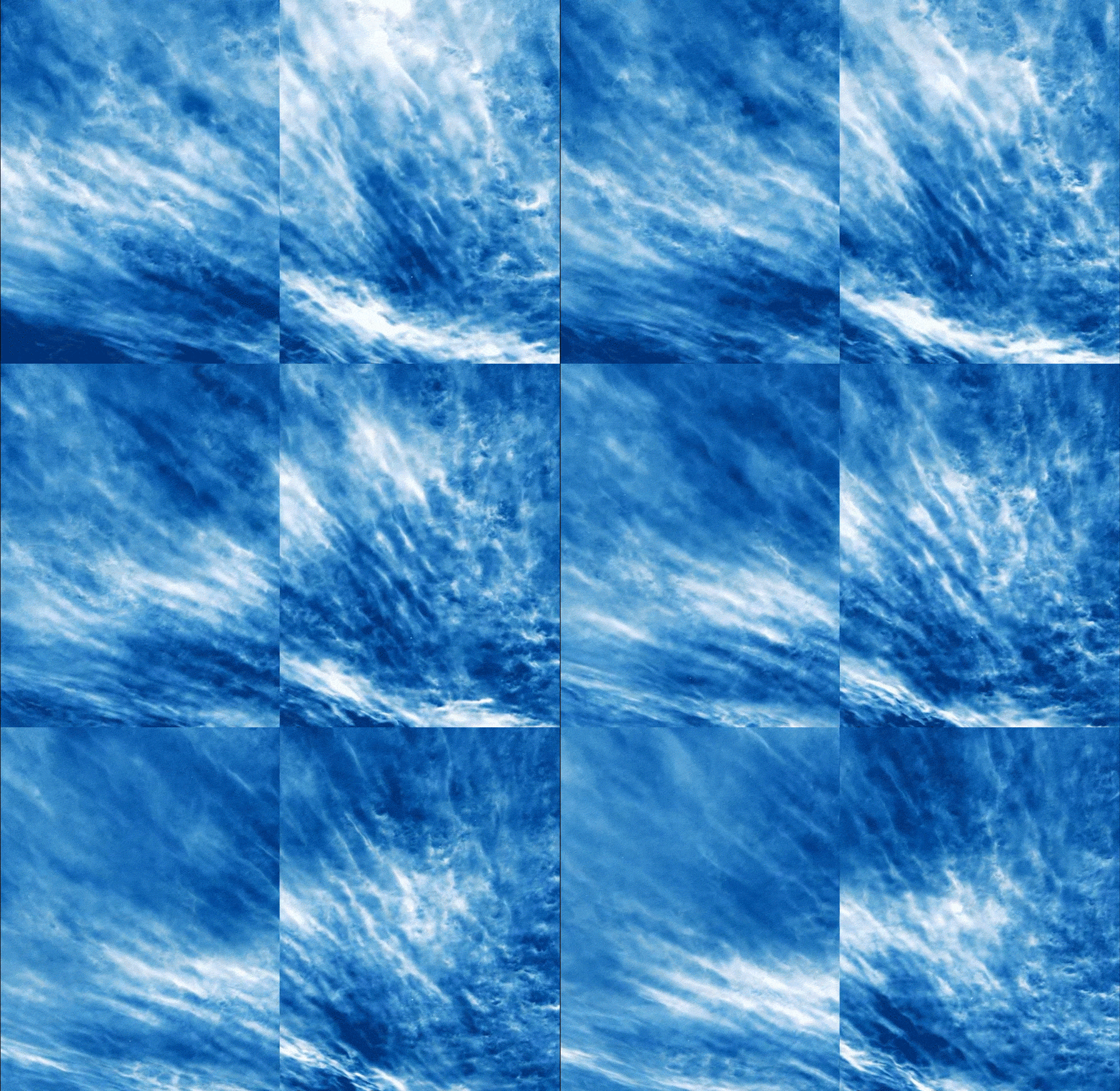
As the Sun rotates and the magnetized solar wind blows outward, the Sun’s magnetic field forms a spiral, known as the Parker spiral, which looks like the water coming out of a rotating sprinkler. Around the spiral, there is a surface where the Sun’s magnetic field changes polarity, forming a wavy spiral like a ballerina’s skirt called the heliospheric current sheet.
Partial solar eclipse
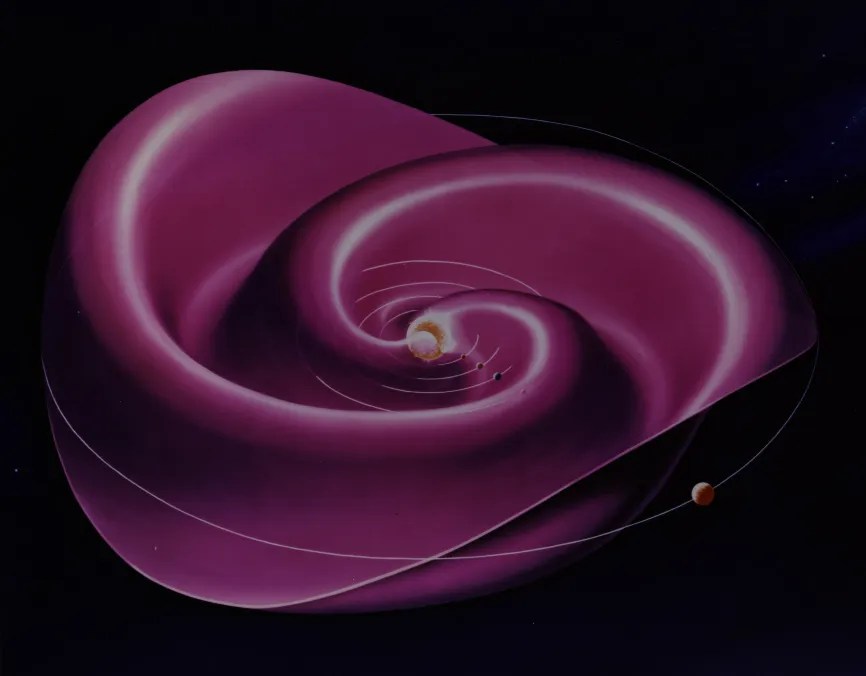
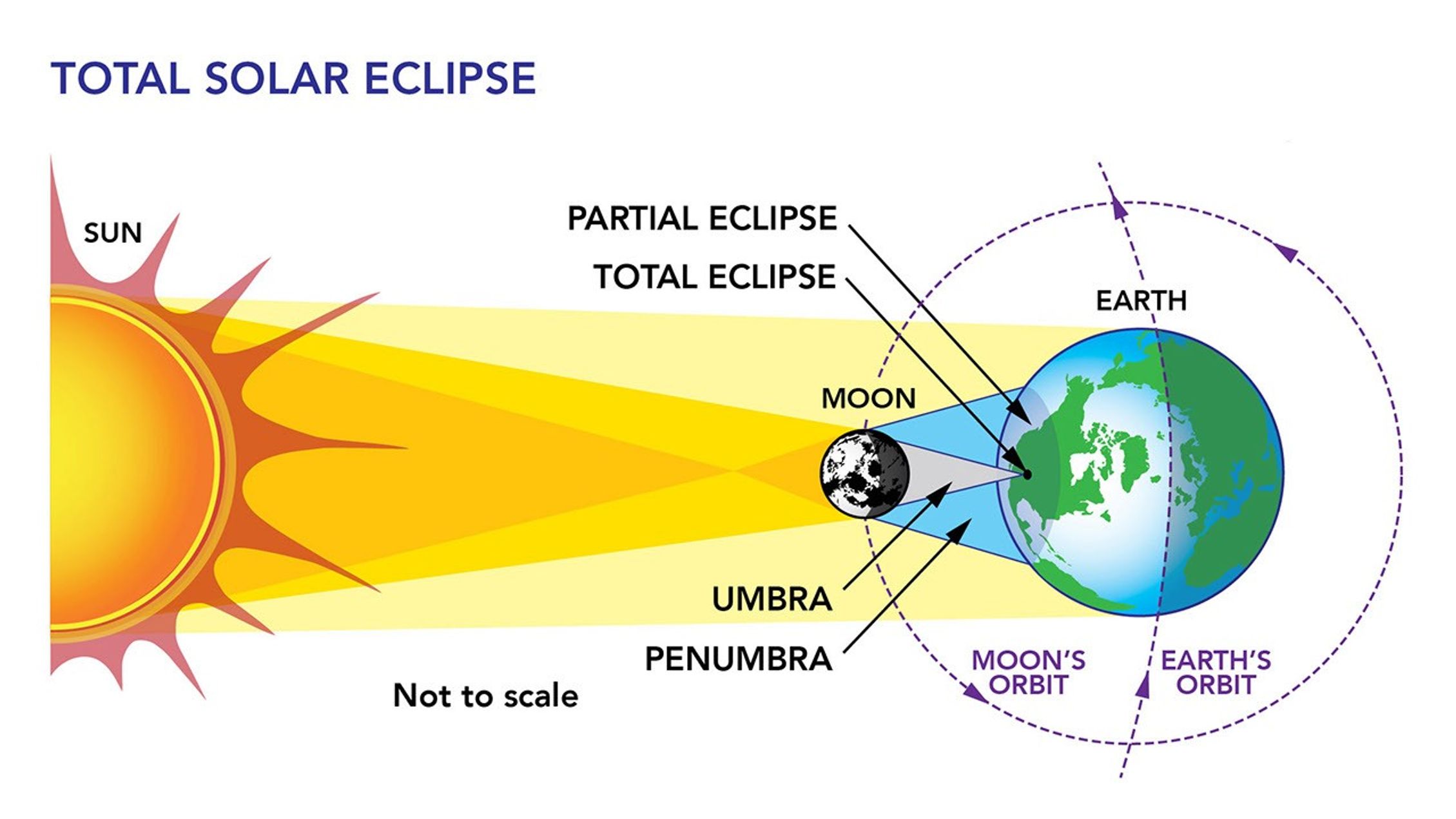
A partial solar eclipse happens when the Moon passes between the Sun and Earth but the Sun, Moon, and Earth are not perfectly lined up. Only a part of the Sun will appear to be covered, giving it a crescent shape. During a total or annular solar eclipse, people outside the area covered by the Moon’s inner shadow see a partial solar eclipse.
Penumbra
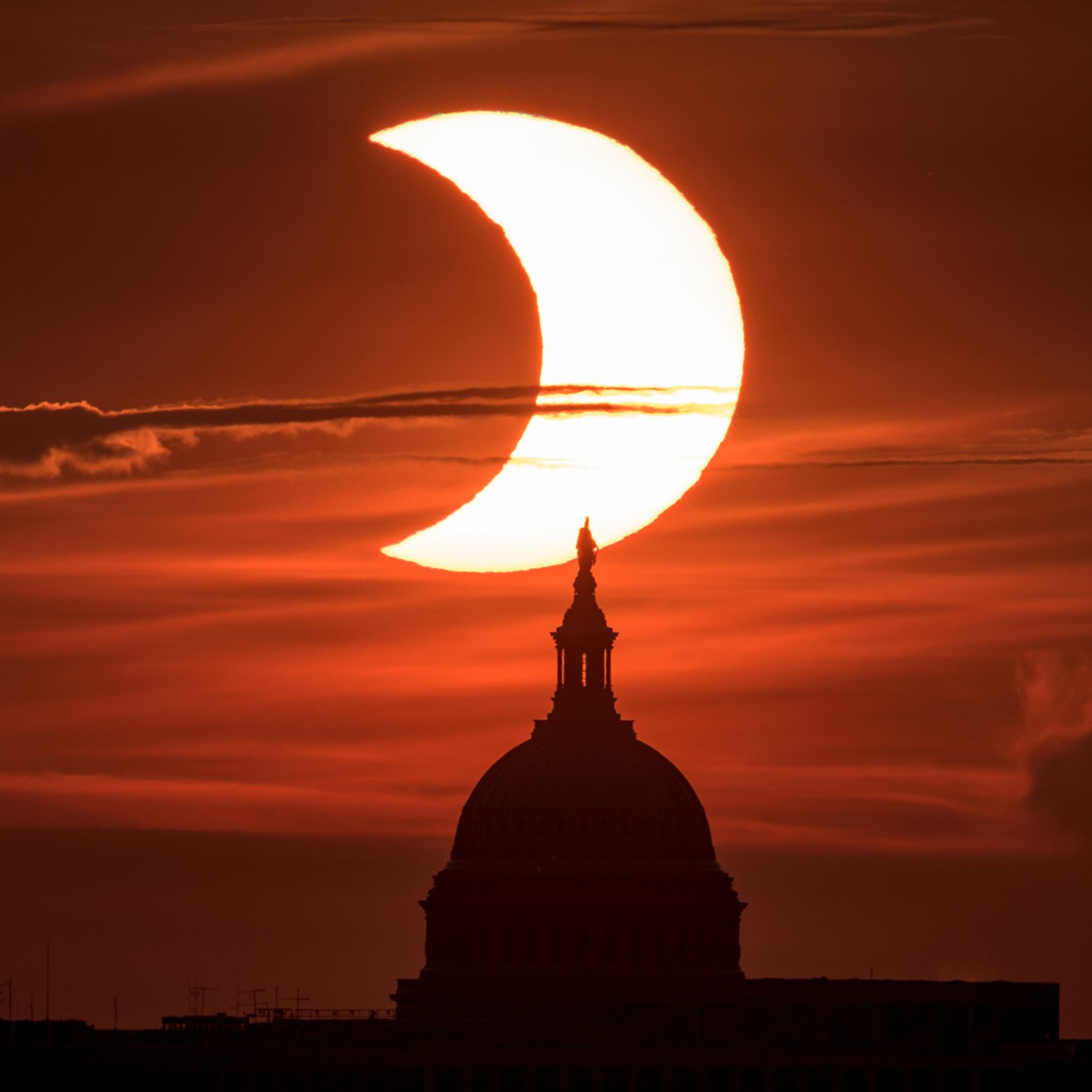
The penumbra is the outer part of a planet or moon’s shadow. During a solar eclipse on Earth, observers in the Moon’s penumbra will see a partial eclipse, and the Sun will not be completely blocked by the Moon.
Photosphere
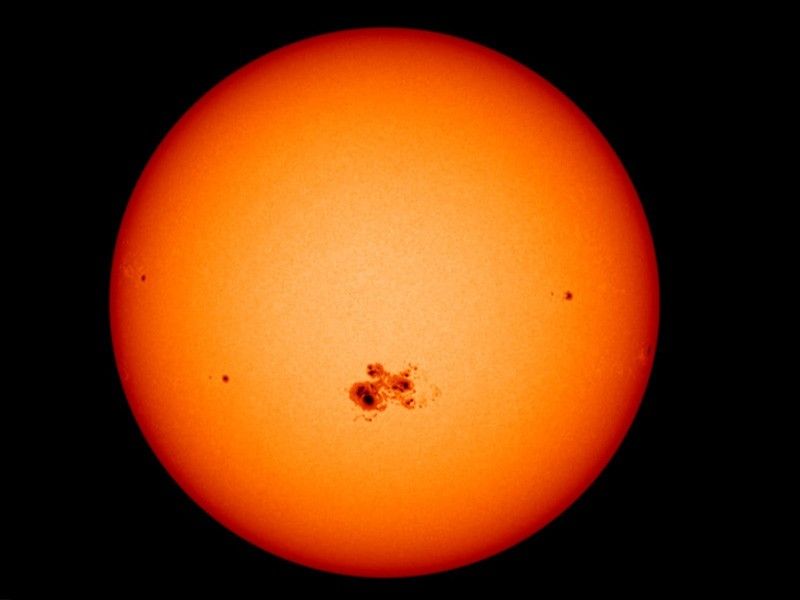
Often called the “surface” of the Sun, the photosphere is actually the first layer of the solar atmosphere — and it is far less dense than Earth’s air at sea level. About 250 miles thick and averaging about 10,000 degrees Fahrenheit, this layer emits the white light we can see with our eyes. (The Sun appears yellow from the surface of Earth because the blue light is scattered out by the particles in our atmosphere, which also makes the sky appear blue.)
Plasma
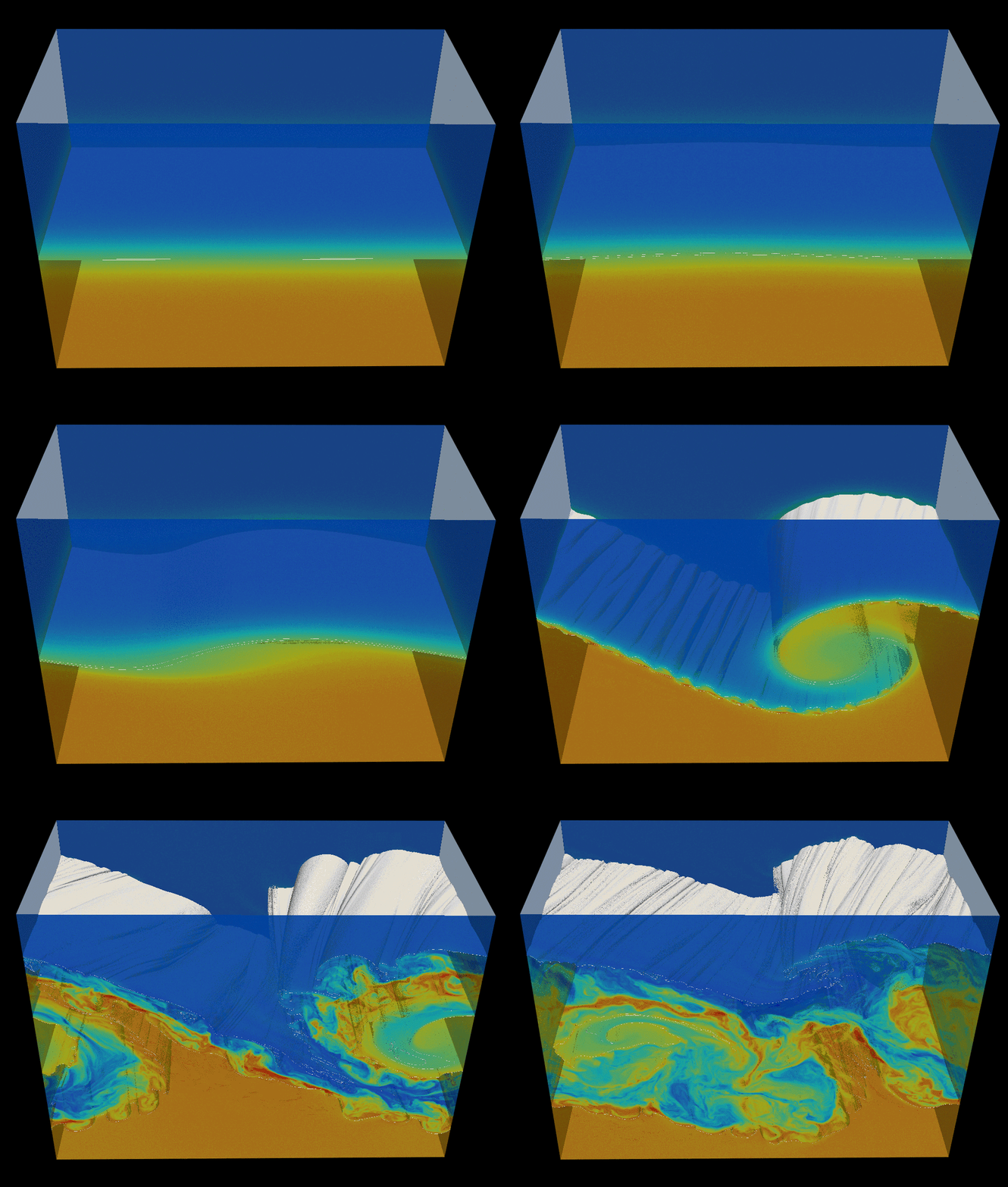
Plasma is a state of matter distinct from solids, liquids, and gases. Though rare on Earth, plasma makes up over 99% of the directly observable (i.e., not dark) matter in the universe, including every star and much of the material between them. On Earth, plasma is found in fluorescent lights, torches used for metalworking, and lightning strikes.
Plasma forms when the atoms in a gas become ionized, meaning electrons separate from the atom and move around independently. This makes plasmas electrically charged and they can interact with external electric and magnetic fields. They can also create their own electric and magnetic fields.

Plasma waves
Plasma waves are structures that move energy through a plasma. These waves occur as fluctuating electric and magnetic fields plow through clumps of ions and electrons that compose the plasma, pushing some to accelerated speeds. There are many types of plasma waves that have different effects, from disturbing magnetic fields to interacting only with specific particles.
Heliophysicists study plasma waves throughout the Sun-Earth system to better understand how the Sun influences the rest of the solar system and how plasma behaves throughout the universe.
Plumes/plumelets
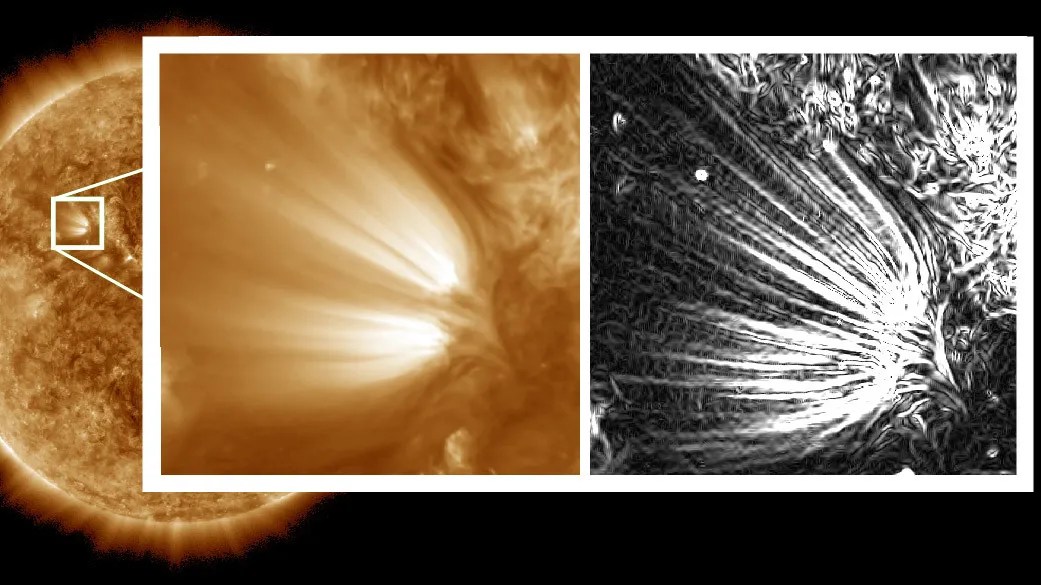
Plumes are streamers of solar material that stretch out from coronal holes on the Sun. They appear bright in extreme ultraviolet views of the Sun and are made up of many smaller streamers, called plumelets. Plumes play a role in creating the high-speed solar wind.
Prominence
A prominence is a snakelike structure made of cool, dense solar material that is suspended above the Sun’s surface by a strong local magnetic field. (When these structures are viewed against the solar disk, head-on rather than off the visible edge, they are called filaments.) Prominences can erupt when the magnetic structure becomes unstable, flinging the plasma outward in a blast called a coronal mass ejection.
Pulsating aurora
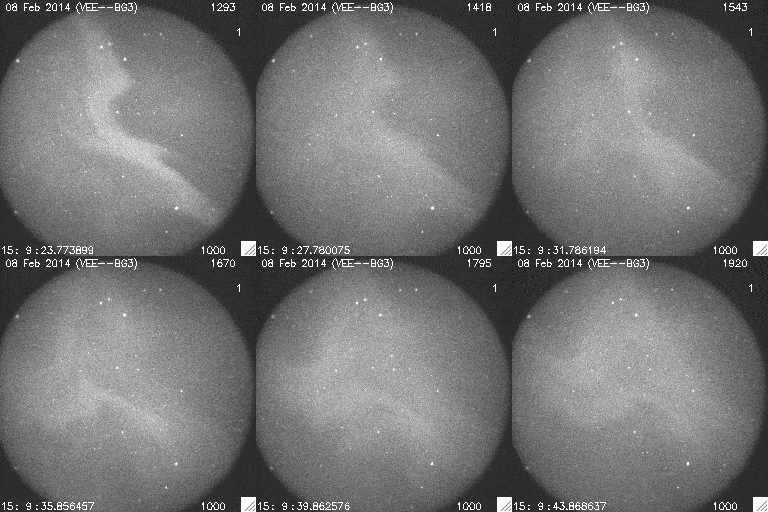
A pulsating aurora is a diffuse aurora that has pulsating patches that flicker on and off every few seconds. These pulsating auroras are dim and irregularly shaped. They usually occur late in the night or early in the morning.
Q, R, S
Radiative zone
The radiative zone is the layer just outside the Sun’s core. This region varies in density, from denser than gold to less dense than water. The radiative zone gets its name from how light is transferred from the core below to the zone above. Here, light passes from atom to atom instead of circulating as it does in the less dense convection zone.

Solar cycle
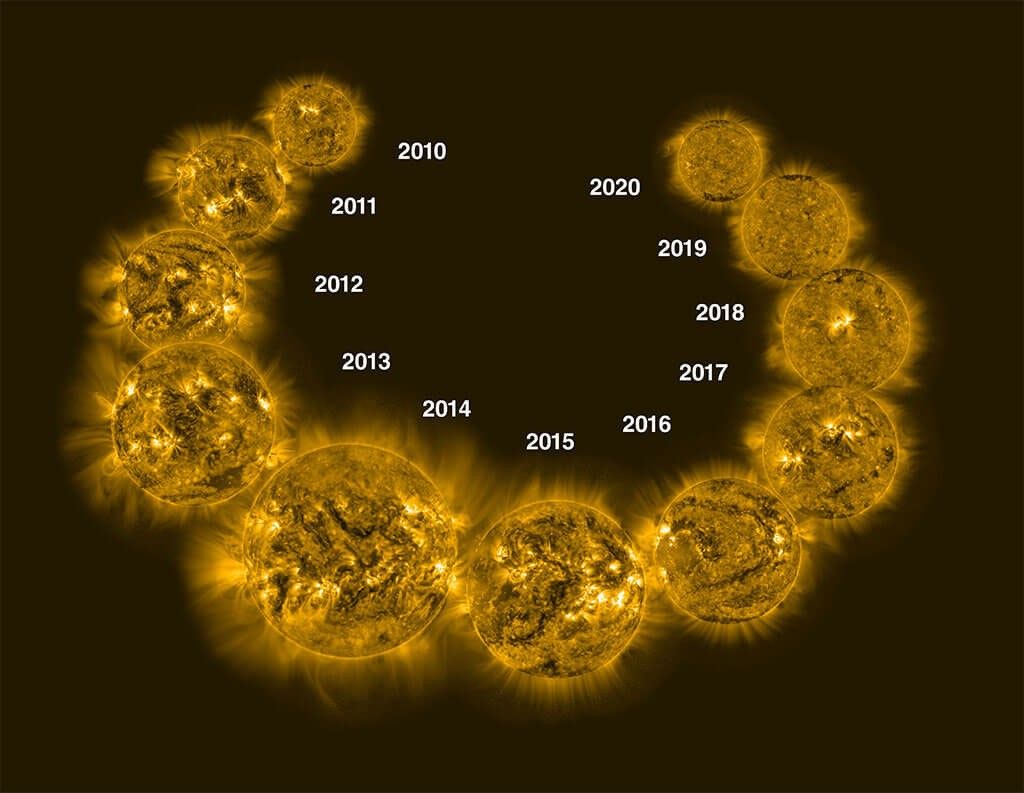
Sunspots and other solar activity increase and decrease in a natural rhythm called the solar cycle. Each cycle lasts roughly 11 years. At the peak of each cycle, called solar maximum, the Sun’s magnetic poles flip, with the north and south poles swapping places. The solar cycle is often tracked by counting sunspots. During solar minimum, the Sun has the fewest sunspots of the cycle, and during solar maximum it has the most. Solar flares, coronal mass ejections, and other solar activity generally increase during solar maximum as well. Each cycle begins during solar minimum, with solar maximum occurring during the middle of the cycle. When the Sun returns to solar minimum, a new cycle begins.
Solar energetic particles (SEPs)
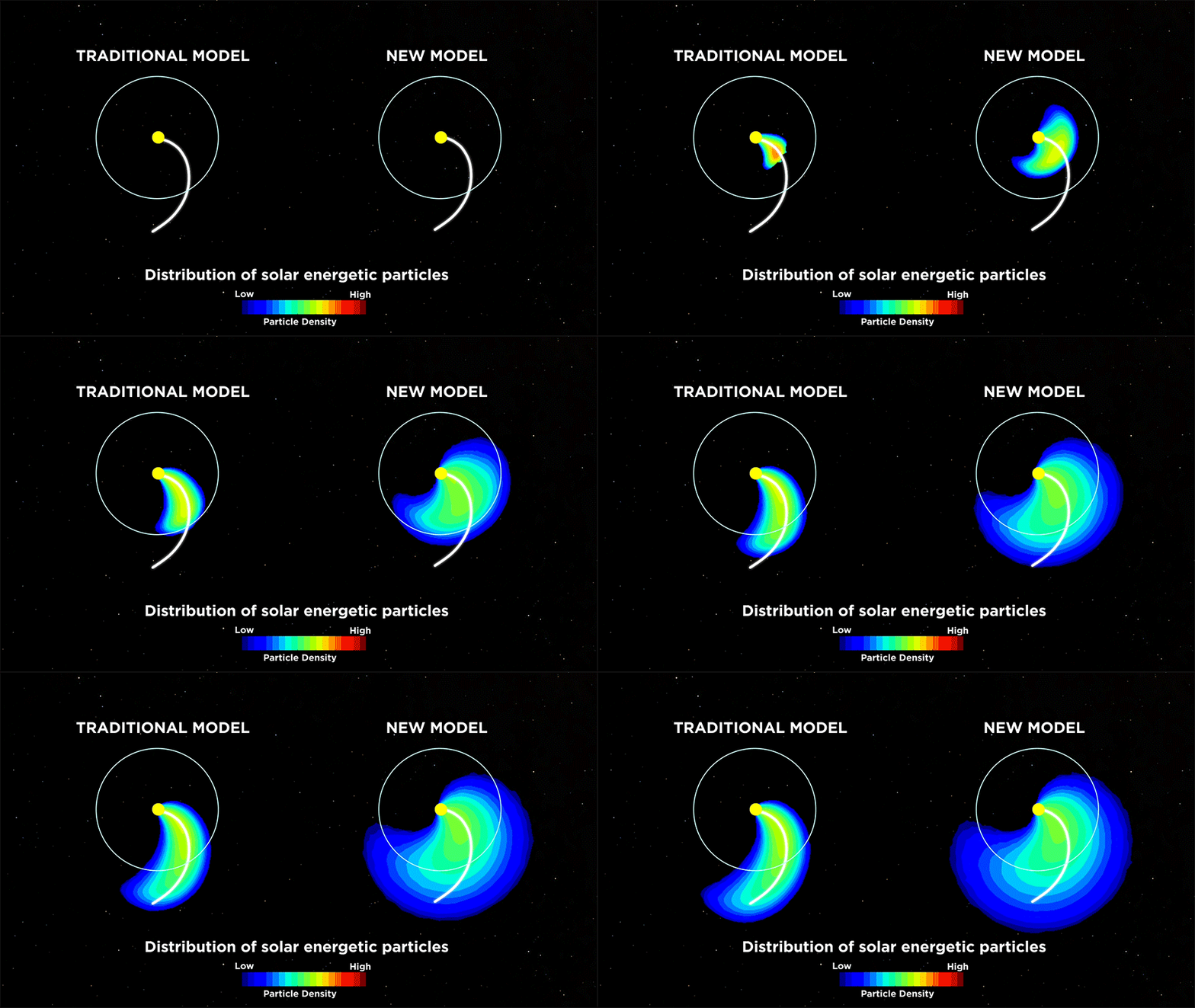
Solar energetic particles, or SEPs, are high-energy charged particles — mostly electrons and protons — accelerated by activity on the Sun. SEPs can be accelerated on the Sun in conjunction with solar flares, or they can be accelerated in space — for example, at the forefront of a fast-moving coronal mass ejection. Because SEPs are charged particles, their movement is guided by magnetic fields as they move away from the Sun and travel through space. SEPs can pose a radiation hazard to astronauts and electronics in space, and their effects on Earth’s atmosphere can hinder high-frequency radio communications like GPS.
Solar flare
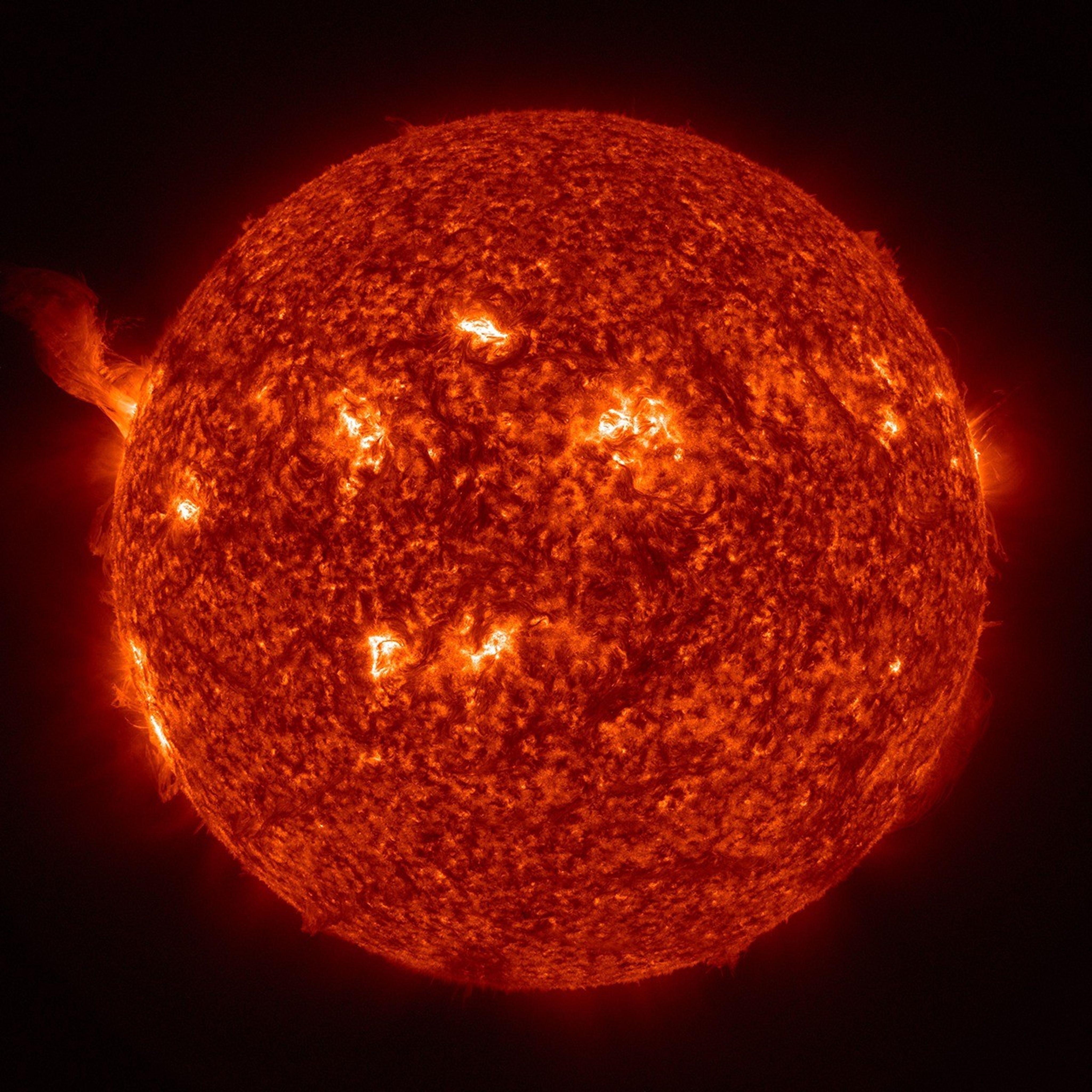
A solar flare is an energetic burst of light and particles triggered by the release of magnetic energy on the Sun. Flares are by far the most powerful explosions in the solar system, with energy releases comparable to billions of hydrogen bombs. The energetic particles accelerated by flares travel nearly at the speed of light, and they can travel the 93 million miles between the Sun and Earth in less than 20 minutes. Some solar flares have an associated coronal mass ejection.
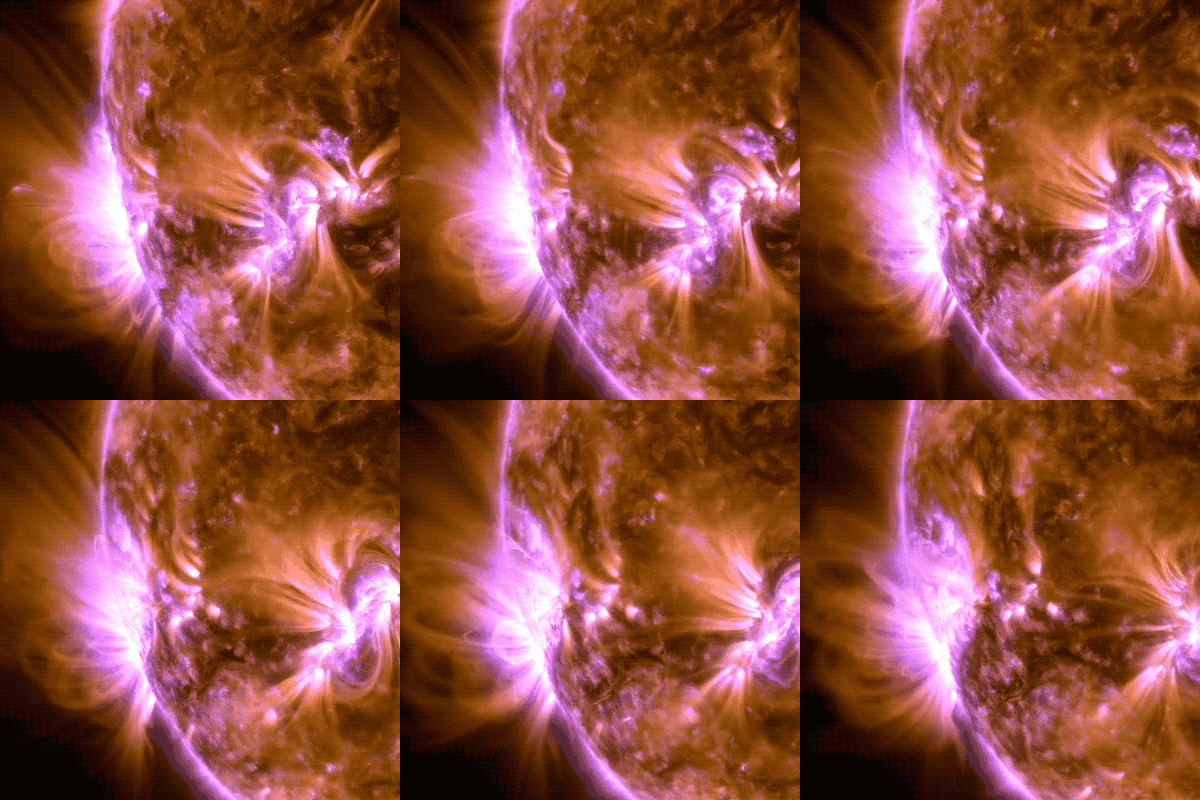
Solar layers
The Sun can be divided into distinct layers, including (from innermost to outermost) the solar core, the radiative zone, the convection zone, the photosphere, the chromosphere, the transition region, and the corona.
Solar wind
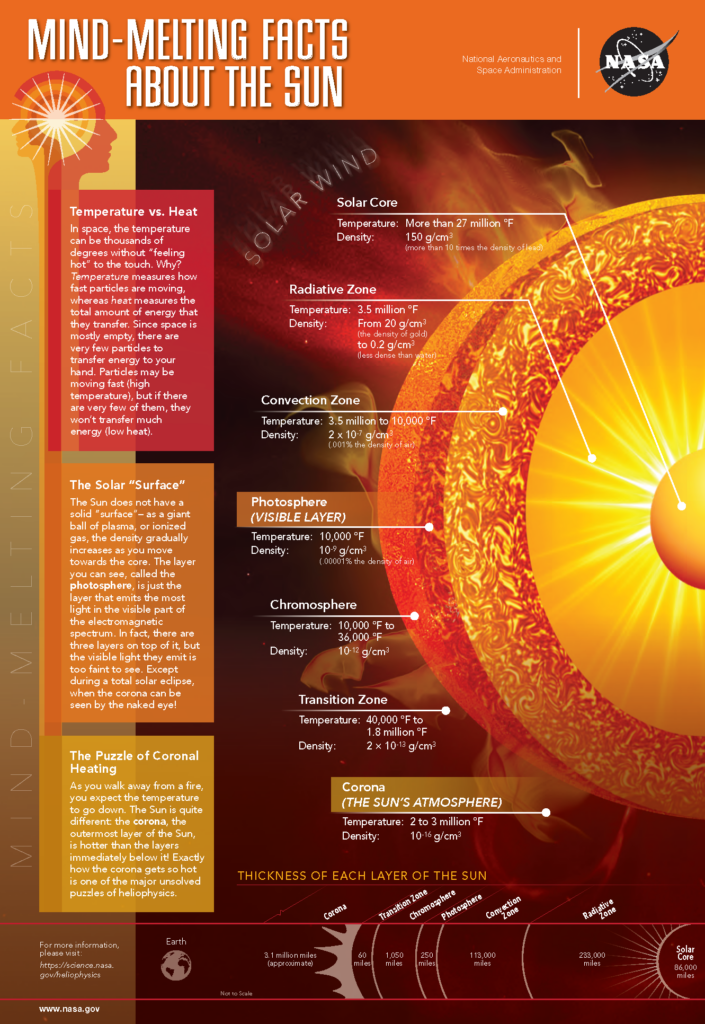
The solar wind is a gusty stream of material that flows from the Sun in all directions, all the time, carrying magnetic field from the Sun’s corona out into space. While it is much less dense than wind on Earth, it is much faster, typically blowing at speeds of one to two million miles per hour. The solar wind is made of charged particles — electrons and ionized atoms — that interact with each other and the Sun’s magnetic field. The extent of the solar wind creates the heliosphere, the Sun’s region of influence within interstellar space.

Sounding rocket
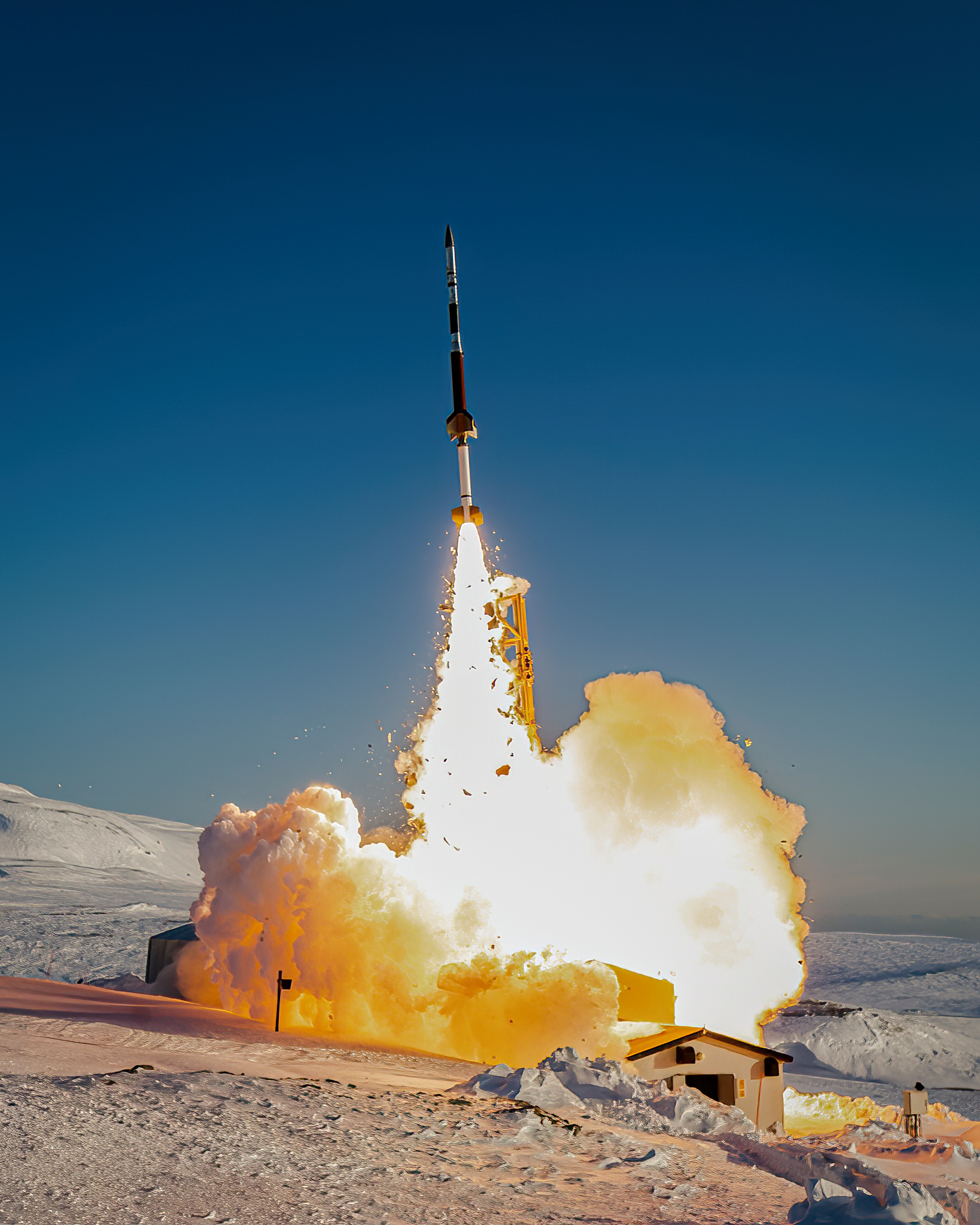
A sounding rocket is a suborbital rocket that launches scientific instruments into space, flying between 30 and 800 miles (50 to 1,300 kilometers) high before falling back to Earth. Typical flights last between 5 to 20 minutes.
Sounding rockets were NASA’s first space vehicles and remain valuable tools for research today. Sounding rockets can study everything from the atmosphere immediately surrounding the rocket to distant galaxies. Their instruments can be recovered and re-used across several flights, significantly lowering development costs. They are also quicker to develop than satellite missions — as little as a year from idea to launch — so scientists often use them to test new technologies and explore cutting-edge scientific ideas.
Space dust
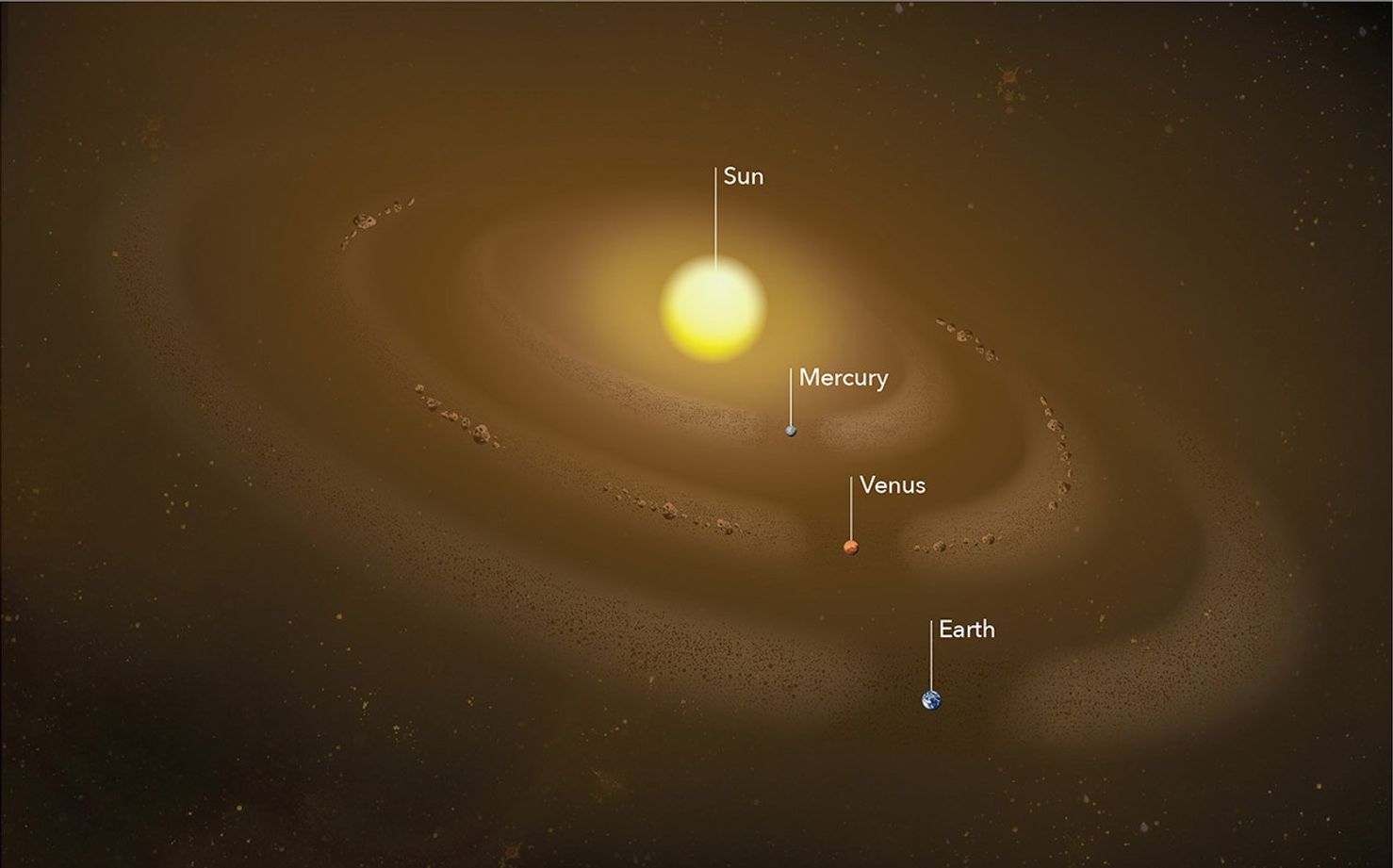
Space dust is made up of fine particles that float around in between stars, planets, and galaxies. Space dust is composed of tiny clumps of molecules and compounds left over from the formation of objects in space or shed by comets and asteroids. However, most of these particles are still much smaller than a grain of sand. While the dust you encounter here on Earth is made up of mostly organic materials — such as dirt and skin cells — space dust is largely rocky or carbon-rich grains.
Space weather
Space weather refers to conditions in space produced in large part by the Sun’s activity. The Sun affects the space around us through a constant stream of plasma known as the solar wind, with occasional bursts from solar flares and coronal mass ejections. These solar discharges carry their own magnetic field, so when they collide with Earth’s magnetic field, the two magnetic fields can repel or attract each other like two magnets. This repulsion and attraction creates geomagnetic disturbances. Space weather events produce the beautiful glow of the northern and southern lights, but they can also endanger astronauts, disrupt radio communications, and even cause large electrical blackouts.
Every planet in the solar system experiences its own space weather, driven by interactions with the solar wind.

Spicule
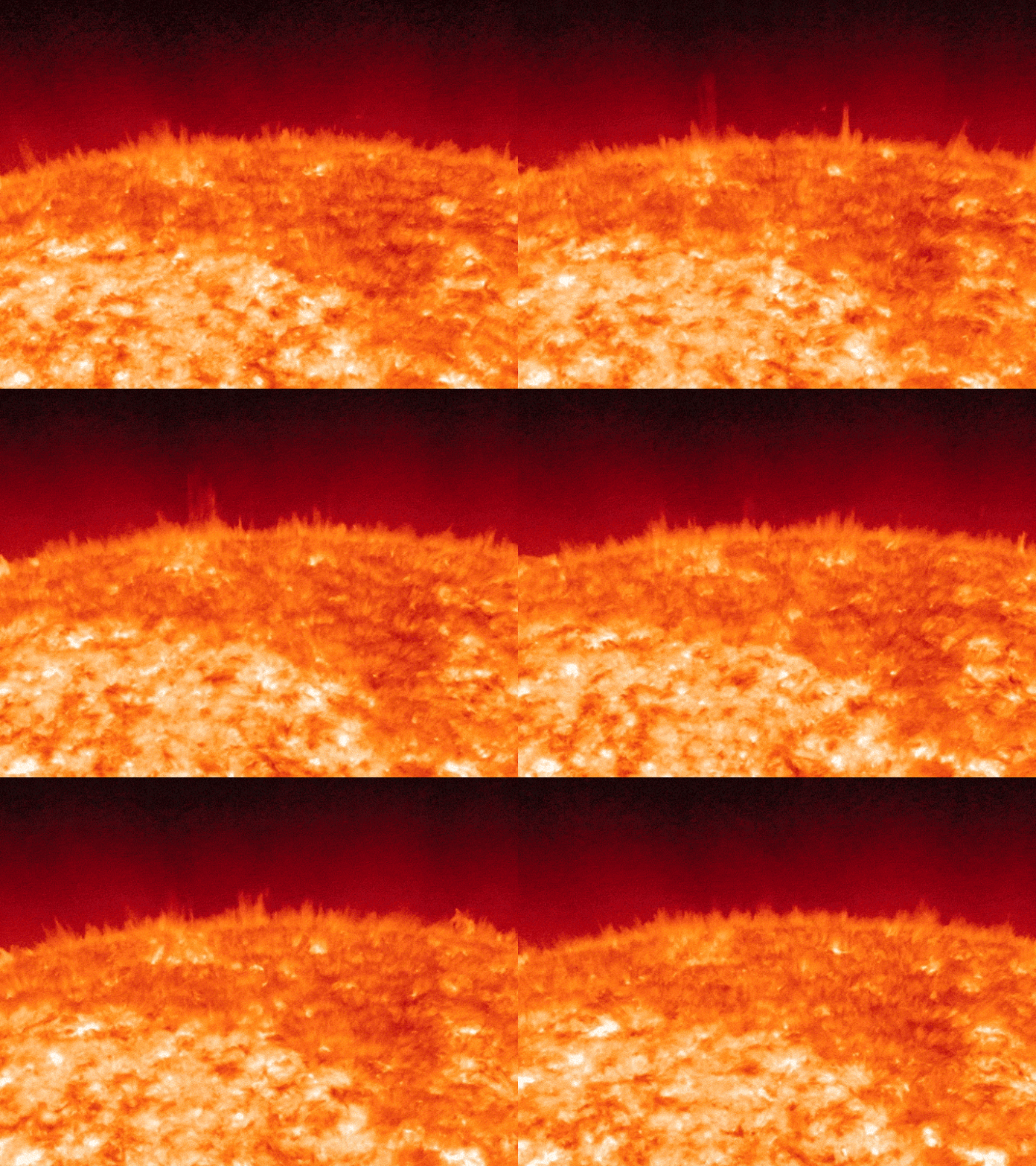
At any given moment, as many as 10 million jets of solar material burst up from the Sun’s surface. Known as spicules, these grass-like tendrils of plasma erupt as fast as 60 miles per second and can reach lengths of 6,000 miles before collapsing.
STEVE
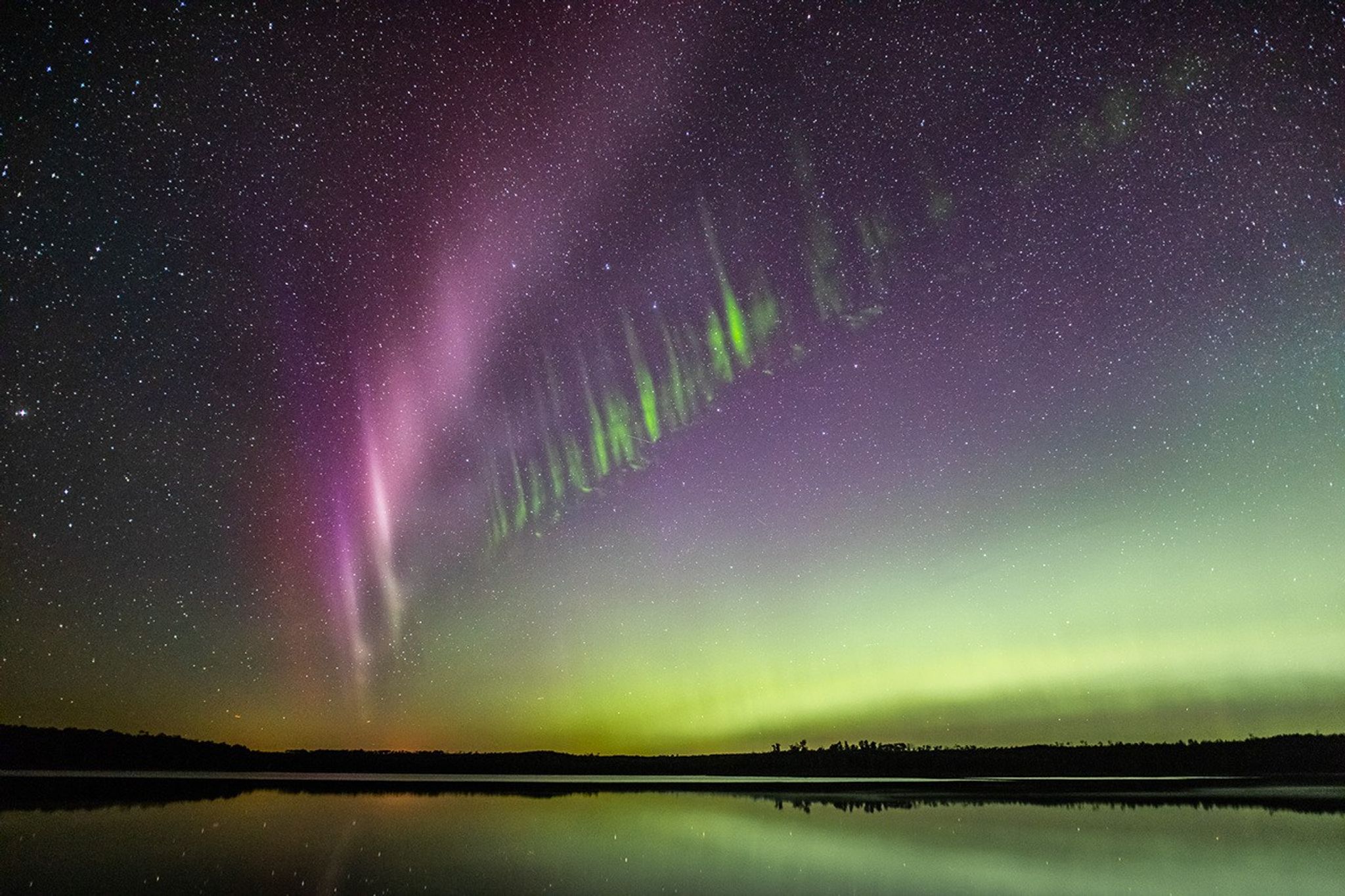
The Strong Thermal Emission Velocity Enhancement, or STEVE, is an aurora-like phenomenon that looks like a purple ribbon in the sky, often accompanied by a green, picket-fence-like structure. It runs east to west and appears closer to the equator than typical auroras. The phenomenon has been observed for centuries by skywatchers and citizen scientists — including, more recently, those participating in the Aurorasaurus project, whose observations were instrumental to the first modern STEVE scientific paper published in 2018. STEVE results from processes different than those that produce traditional auroras. Scientists don’t yet fully understand the mechanisms that cause STEVE to appear.
Substorm
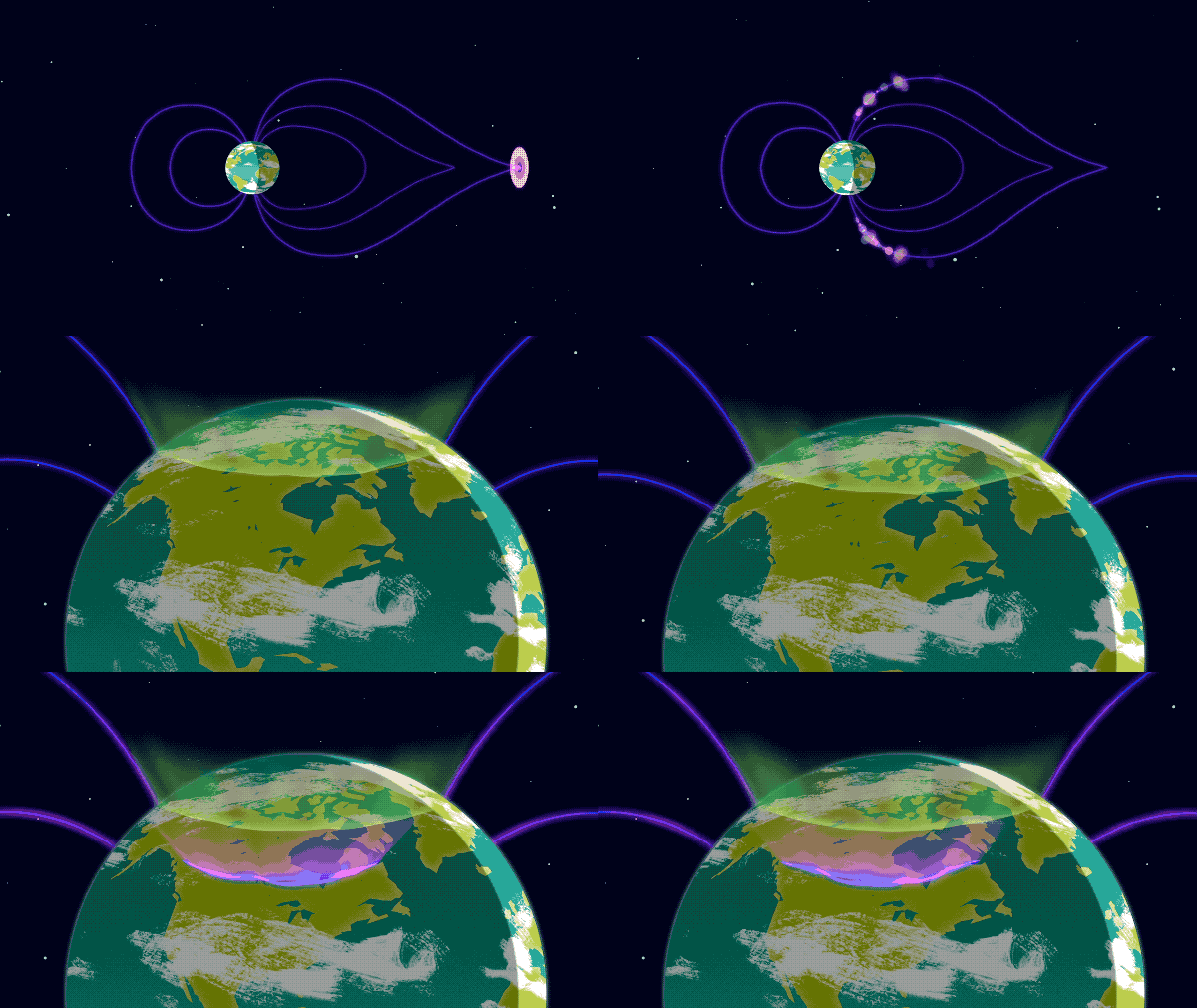
Substorms can be thought of as the magnetic, near-space counterpart to severe weather storms on Earth. A substorm occurs when Earth’s magnetosphere captures and stores material and energy from the solar wind, then suddenly releases that energy.
Substorms start small but spread across vast regions of the magnetosphere within minutes and typically initiate the most intense space weather effects — those that create dramatic auroral displays, disrupt communications, cause power line transmission failures, and produce the most penetrating radiation. During a substorm, auroras brighten and expand poleward.
Sunquake
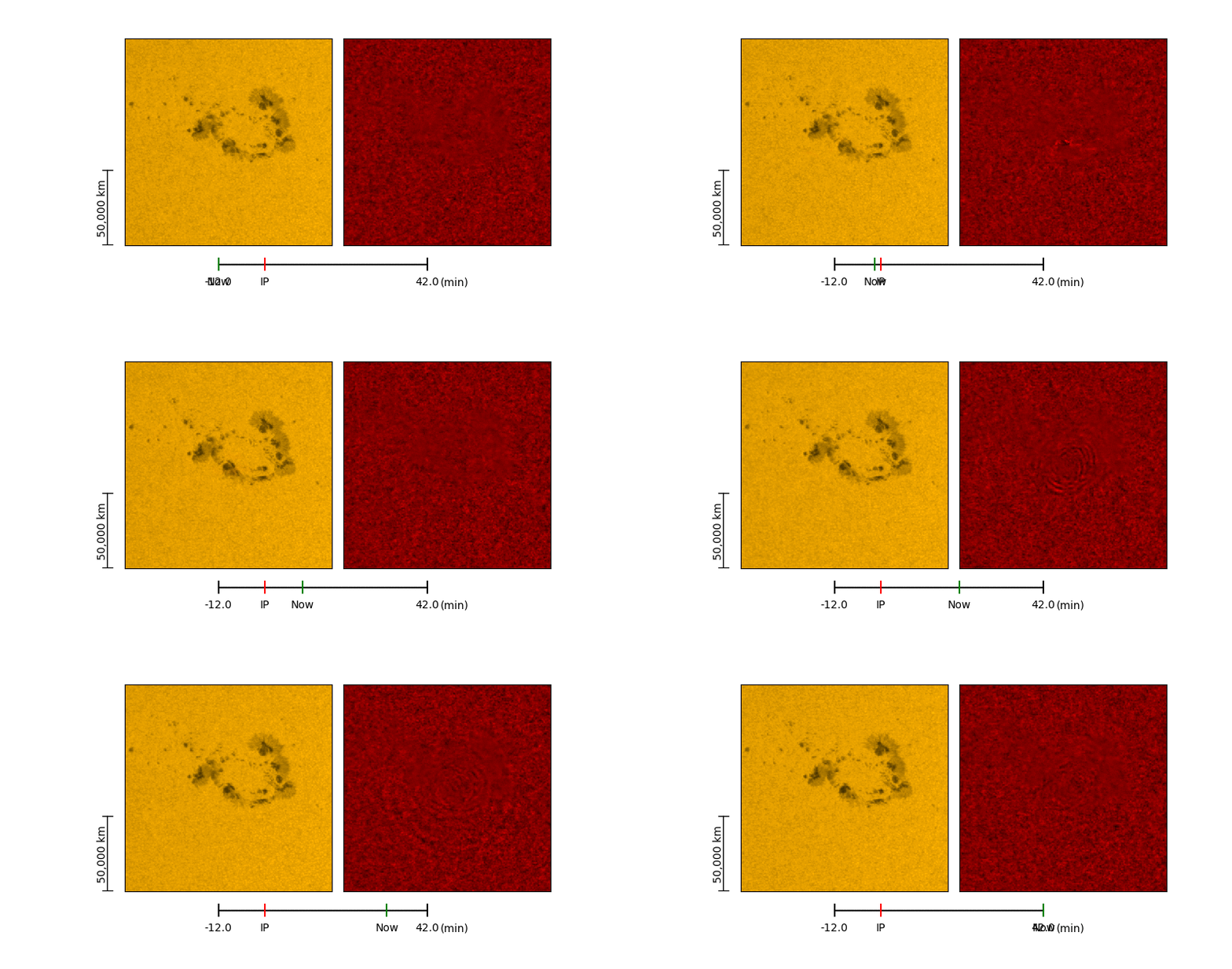
A sunquake is a seismic-like event on the Sun that ripples across the visible surface, not unlike an earthquake. Sunquakes are known to accompany some solar flares, but scientists are uncertain how exactly they are triggered.
Sunspot
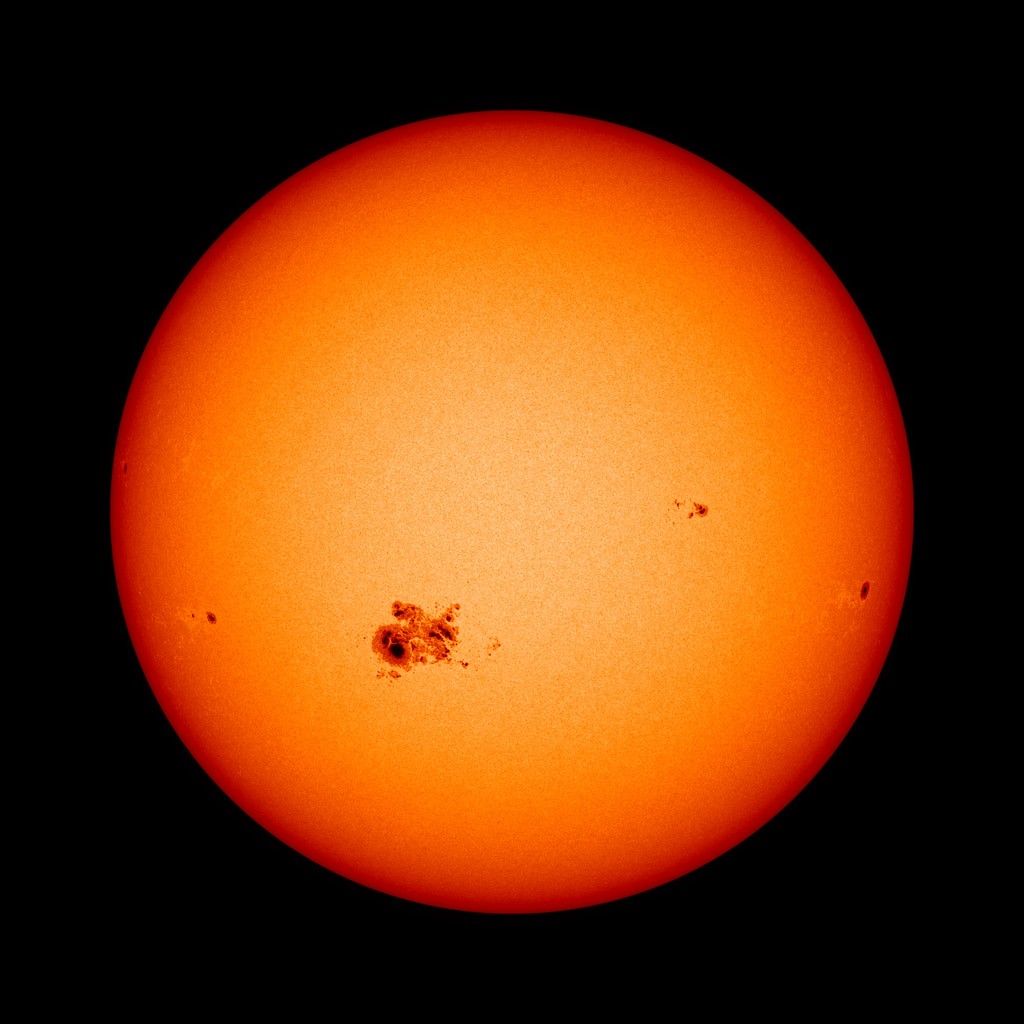
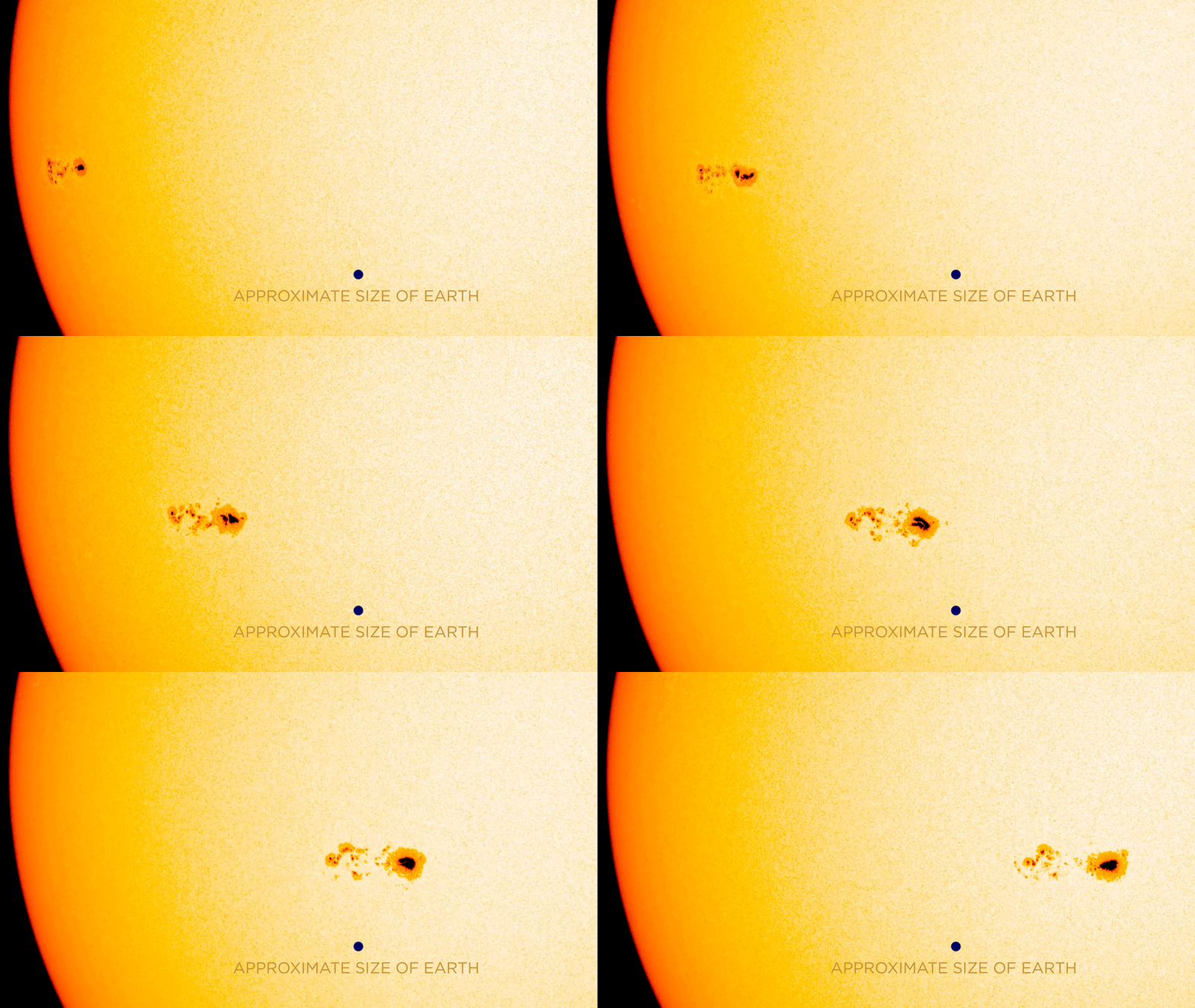
A sunspot is a dark, freckle-like feature on the face of the Sun. Sunspots are cooler regions on the Sun’s visible surface caused by a concentration of magnetic field lines. Sunspots are the visible component of active regions, areas of intense and complex magnetic fields on the Sun that are the source of solar eruptions. Lasting from days to months, sunspots typically stretch 1,000 to 100,000 miles across. The number of sunspots goes up and down as the Sun goes through its natural 11-year activity cycle. Scientists use sunspots to help track this cycle.
Supergranule
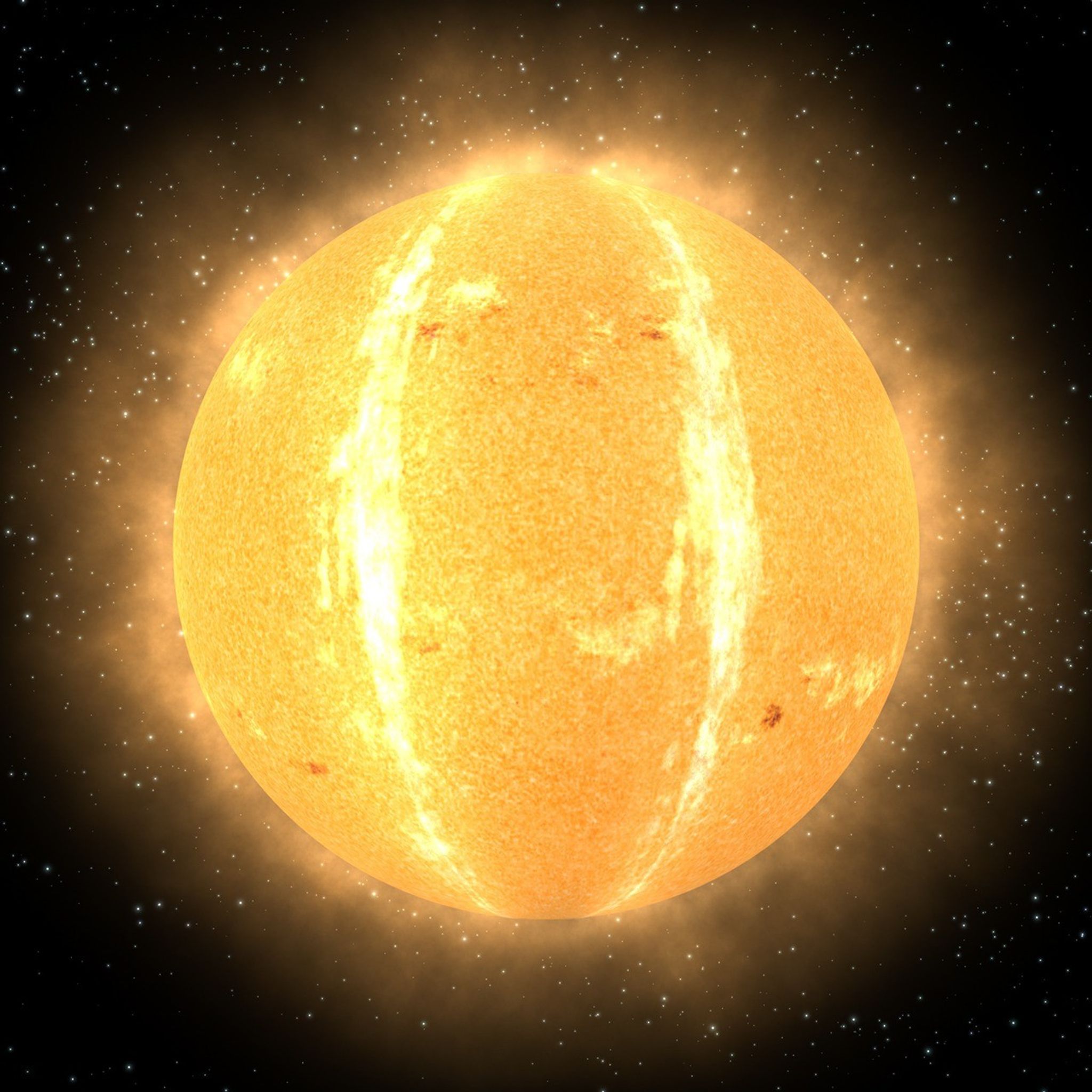
A supergranule is a network of cells covering the Sun’s visible surface that stretch some 18,000 miles across — more than large enough to fit two Earths side by side. They are caused by the convection of material in the Sun. Supergranules sometimes appear to move faster than the rotation of the Sun, but scientists have confirmed that this apparent motion of the cells themselves is actually wave-like motion propagated across them.
T, U, V
Thermosphere
The thermosphere is a layer of the atmosphere above the mesosphere, beginning about 53 miles above Earth’s surface and reaching 372 miles high. The name thermosphere comes from the region’s extremely high temperature, up to 2,700 degrees Fahrenheit (1,500 degrees Celsius). However, the low density in this region means it doesn’t transfer much heat.
The thermosphere is a busy place — it is where you can find the International Space Station, many satellites, and auroras. Like the mesosphere, the thermosphere experiences its own active “weather,” with high and low pressure zones, winds up to 1,600 miles per hour, and complex chemical disturbances.
Total solar eclipse
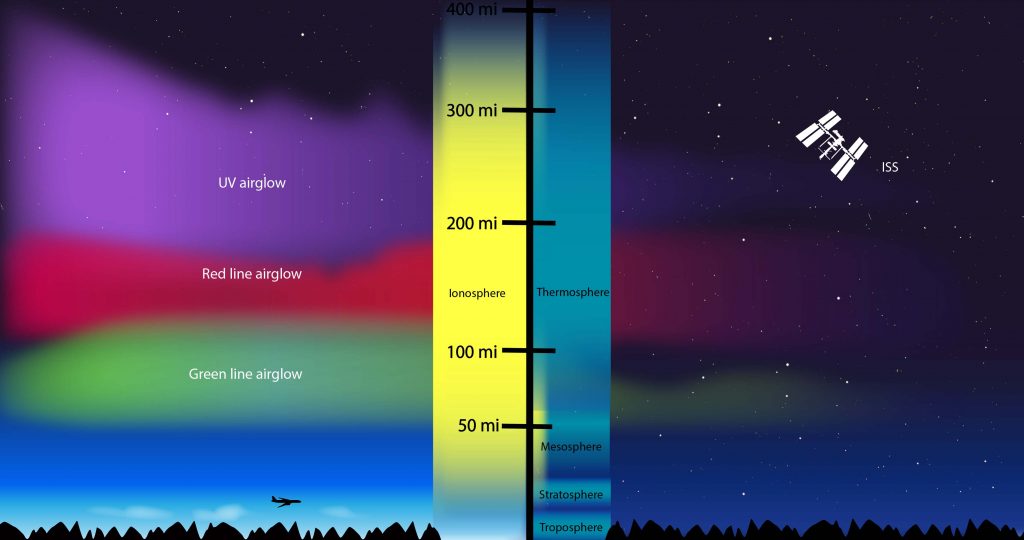
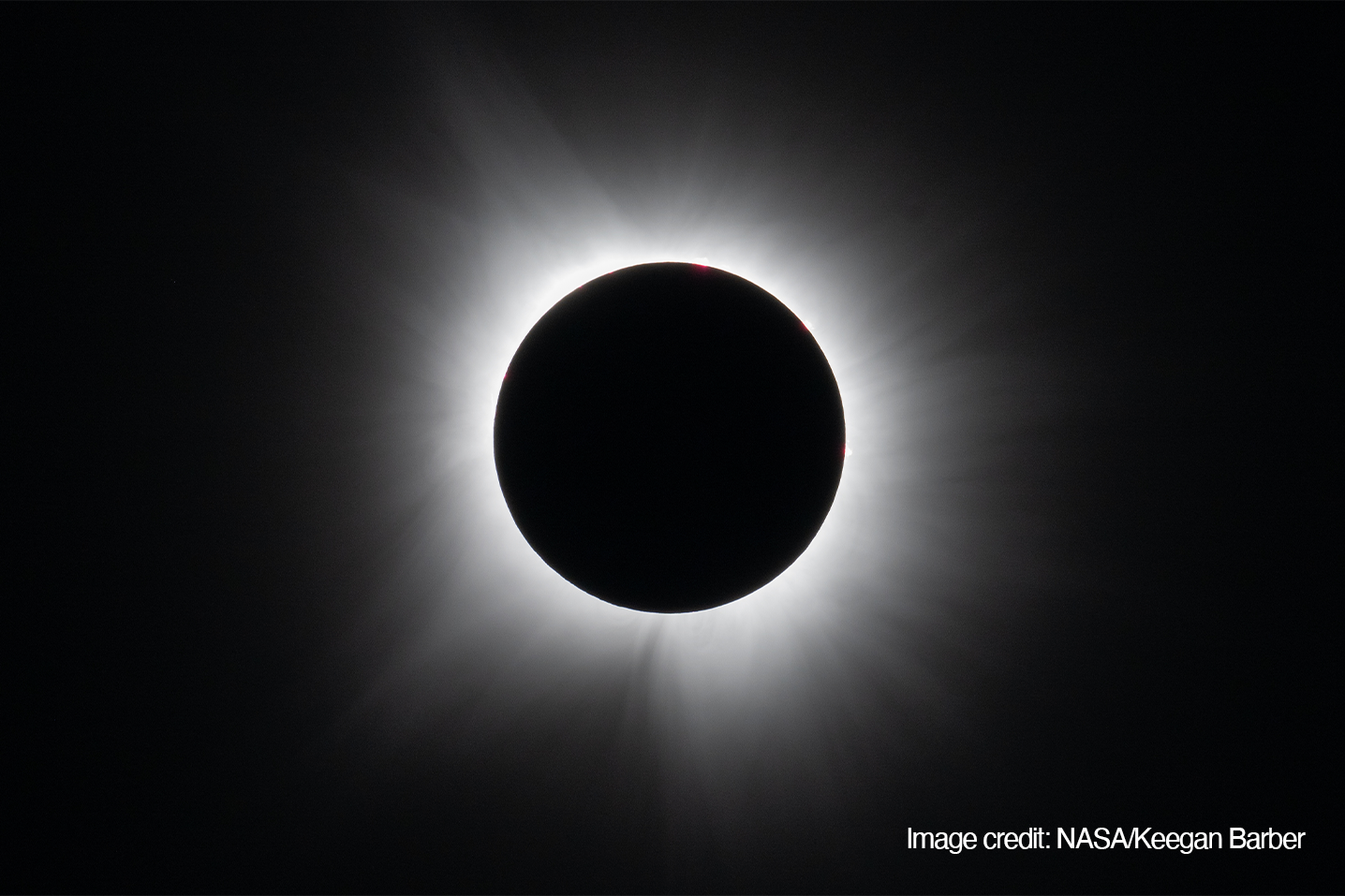
A total solar eclipse happens when the Moon passes between the Sun and Earth, completely blocking the face of the Sun. People located in the center of the Moon’s shadow when it hits Earth will experience a total eclipse. The sky will darken, as if it were dawn or dusk. Weather permitting, people in the path of a total solar eclipse can see the Sun’s corona, the outer solar atmosphere, which is usually obscured by the bright face of the Sun. A total solar eclipse is the only type of solar eclipse that viewers can momentarily look at safely without eye protection.
Totality
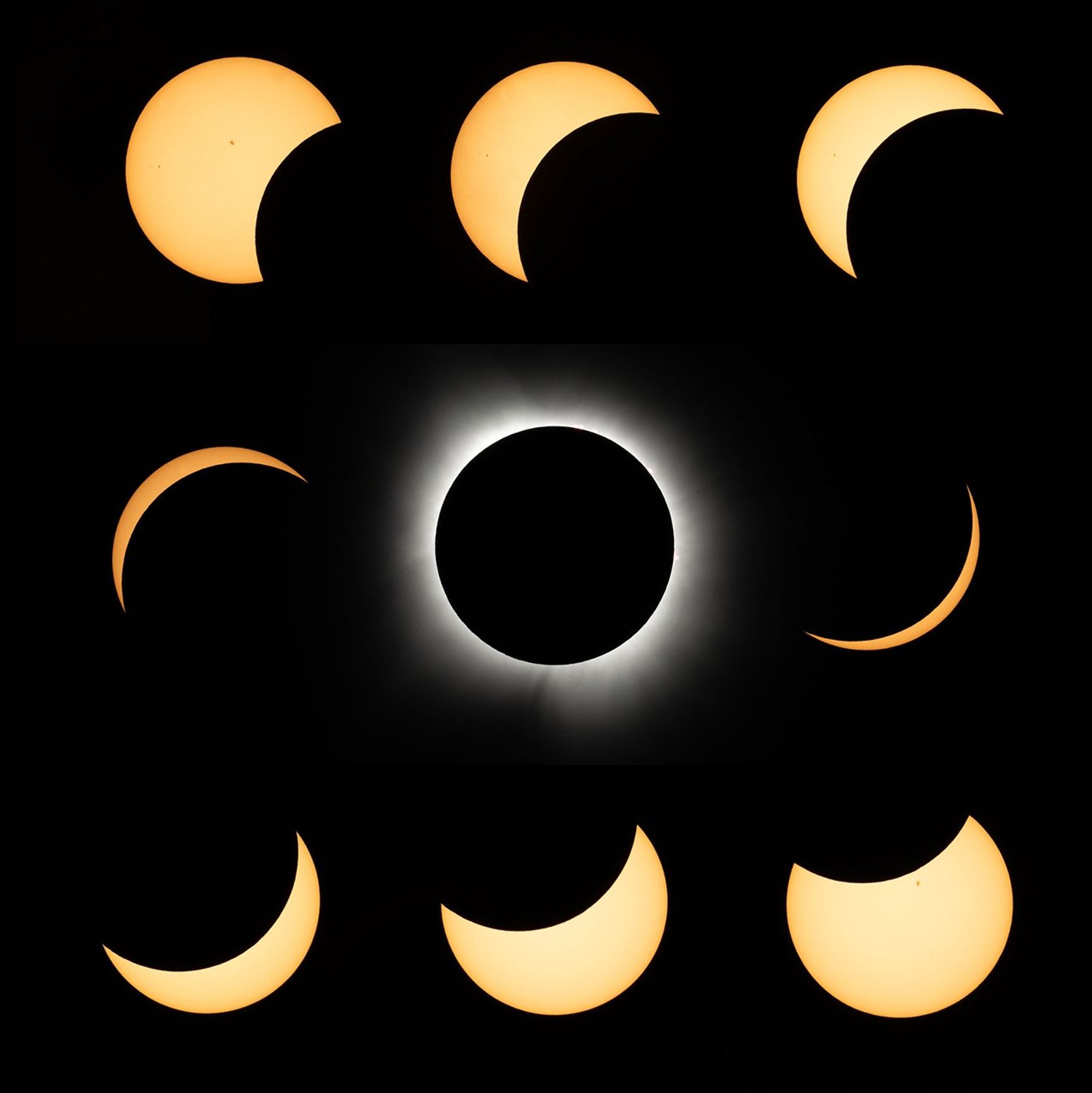
Totality is the time during a total solar eclipse when the Moon is completely blocking the Sun’s bright face. During totality, the Sun’s relatively faint and wispy outer atmosphere, the corona, is visible to observers — the only time the corona is visible to the unaided eye. Totality only happens within the Moon’s inner shadow, the umbra.
During totality — and ONLY during totality — it is safe to watch a solar eclipse directly without solar viewing glasses or solar filters. Observers must use an indirect viewing method or a solar filter before or after totality. The reappearance of Baily’s Beads or the diamond ring effect indicate that totality is over.
Transit
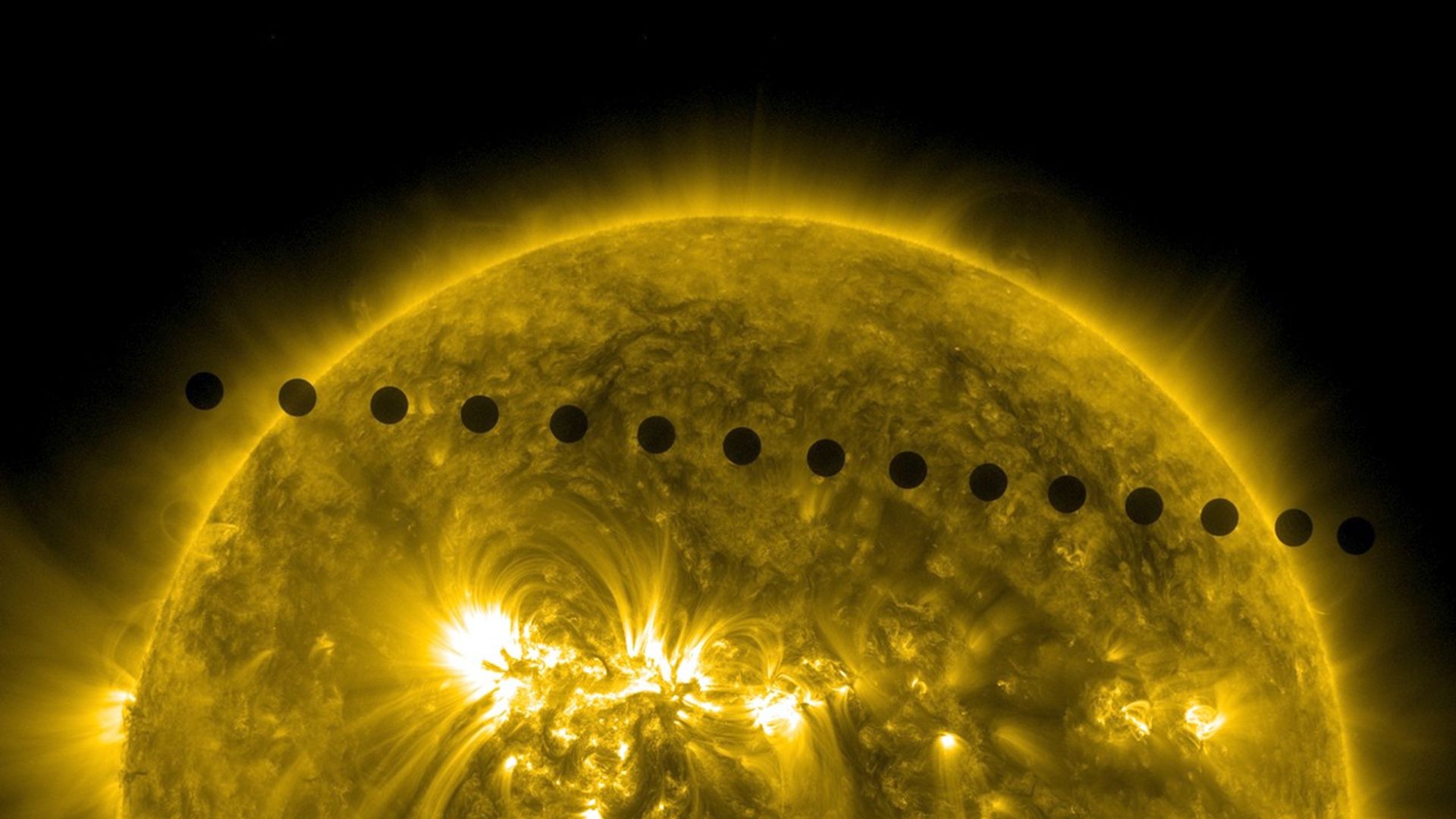
A transit happens when one celestial body crosses in front of another from a specific point of view. Eclipses are a type of transit. On Earth, we can sometimes see Mercury or Venus transit the Sun.
Transits are also one of the primary ways scientists look for evidence of exoplanets, planets beyond our solar system. As an exoplanet passes in front of its host star, the light we measure from the star decreases slightly, giving scientists clues about the exoplanet’s properties.
Transition region
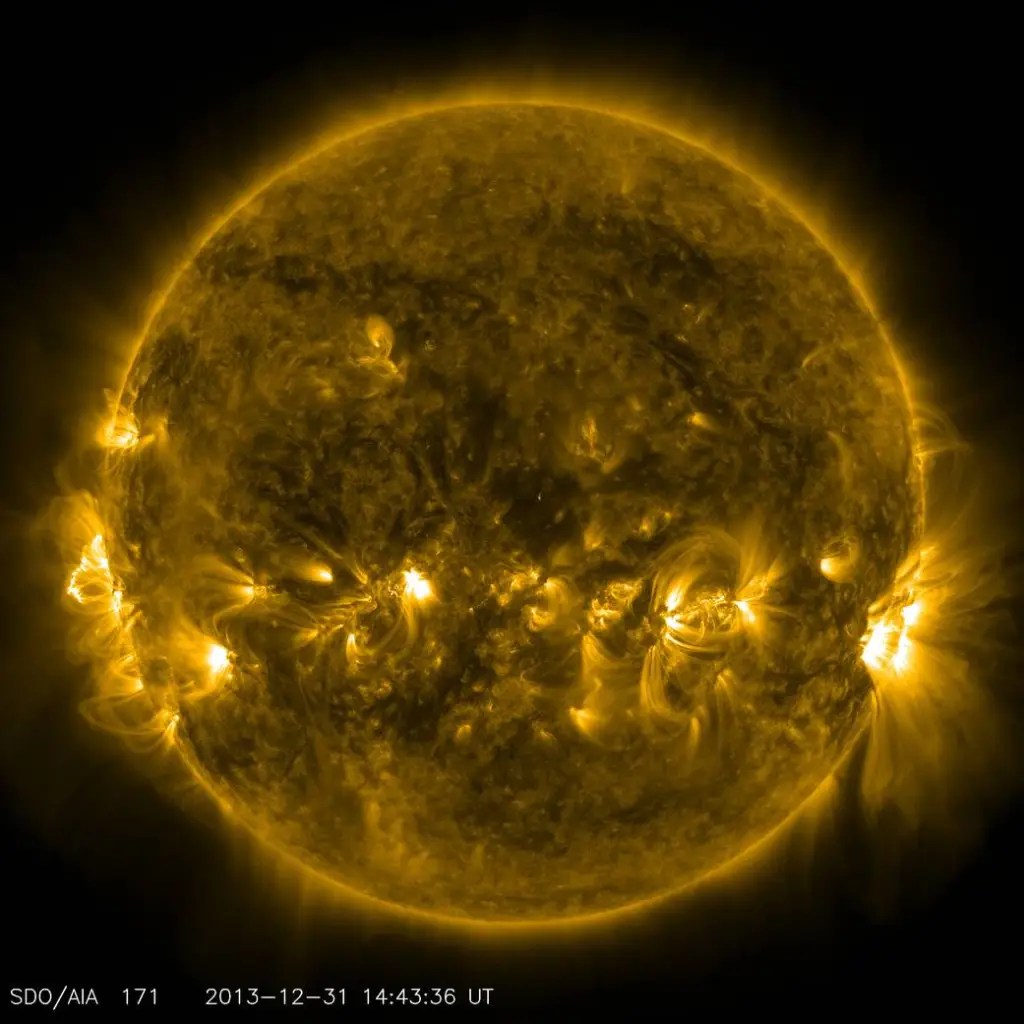
The transition region on the Sun is where the chromosphere becomes the corona, and where the temperature rapidly rises from thousands to millions of degrees. Though the transition region is estimated to be about 60 miles thick, its exact height and position are not well defined. Instead, the transition region forms a kind of halo around the shifting, churning features of the chromosphere.
Umbra
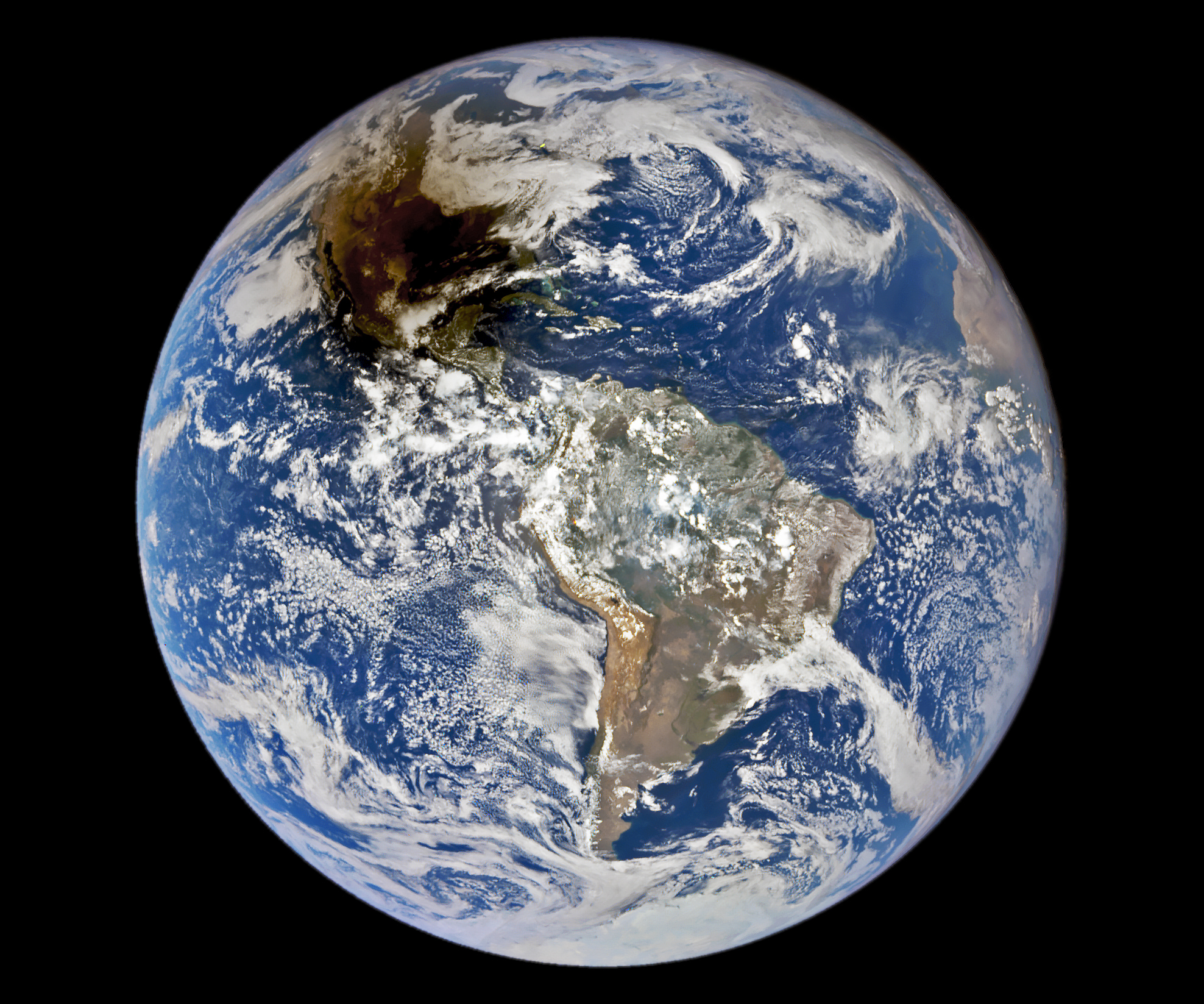
The umbra is the inner part of a planet or moon’s shadow. During a total solar eclipse, the Moon’s umbra passes across Earth’s surface to create the path of totality. Observers inside the path of totality can see the Moon completely block the Sun’s face.
Upper atmosphere (Earth)
The upper layers of Earth’s atmosphere include the mesosphere, thermosphere, and exosphere. The upper atmosphere also includes the ionosphere, a layer identified by its population of ionized, or electrically charged, particles that overlaps with the upper portions of the mesosphere and extends through the thermosphere and exosphere.
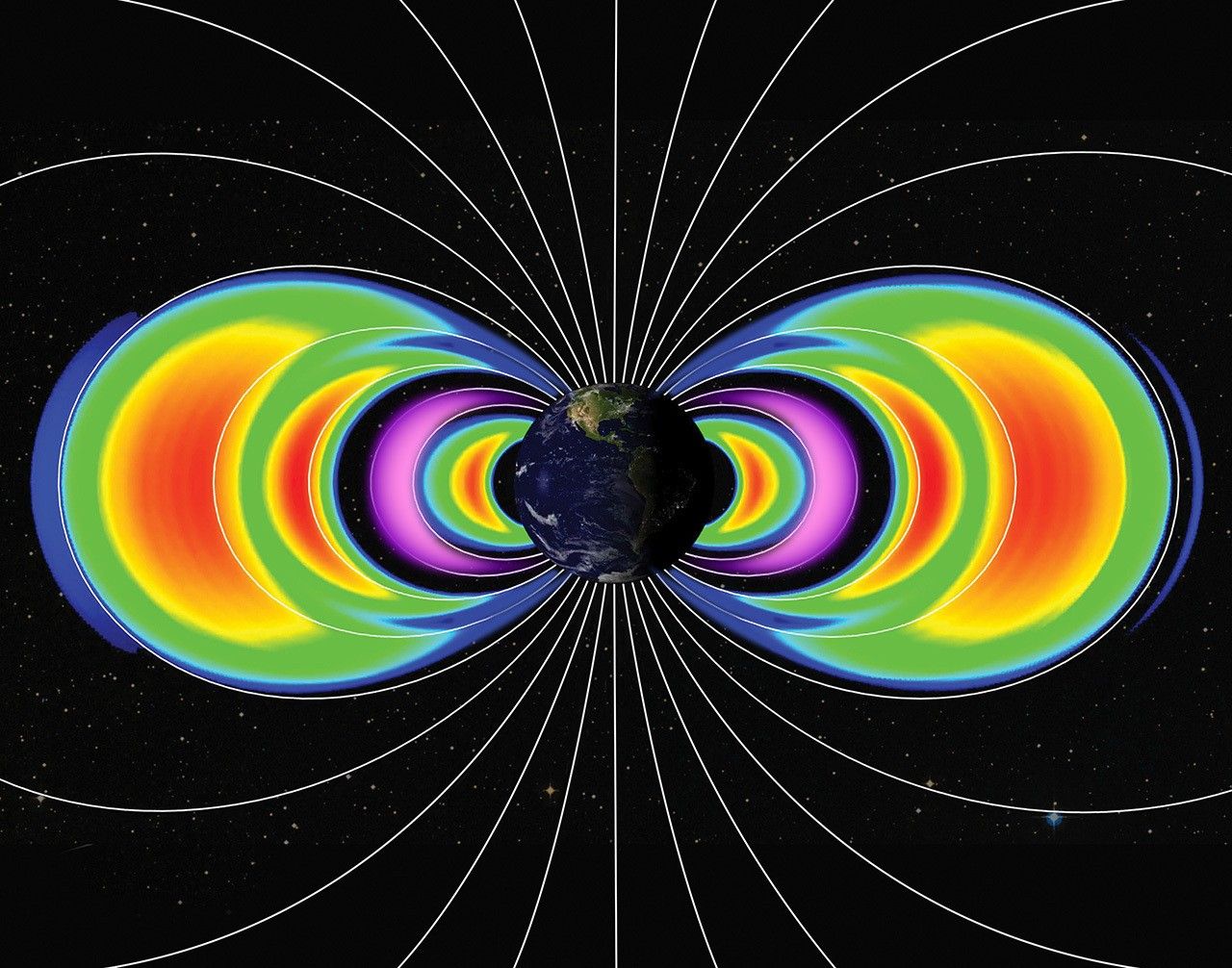
Van Allen radiation belts
Named for their discoverer, James Van Allen, the Van Allen radiation belts are concentric, doughnut-shaped rings that encircle Earth and are filled with high-energy particles trapped by Earth’s magnetic field. The particles — electrons and ions — gyrate, bounce, and drift through the region, sometimes shooting down into Earth’s atmosphere, sometimes escaping out into space. The radiation belts swell and shrink during geomagnetic storms as part of a much larger space weather system driven by energy and material that erupts off the Sun and fills the entire solar system. The Van Allen Belts are an important component of Earth’s magnetosphere.