















Auroras
Image credit: NASA/Bin Li
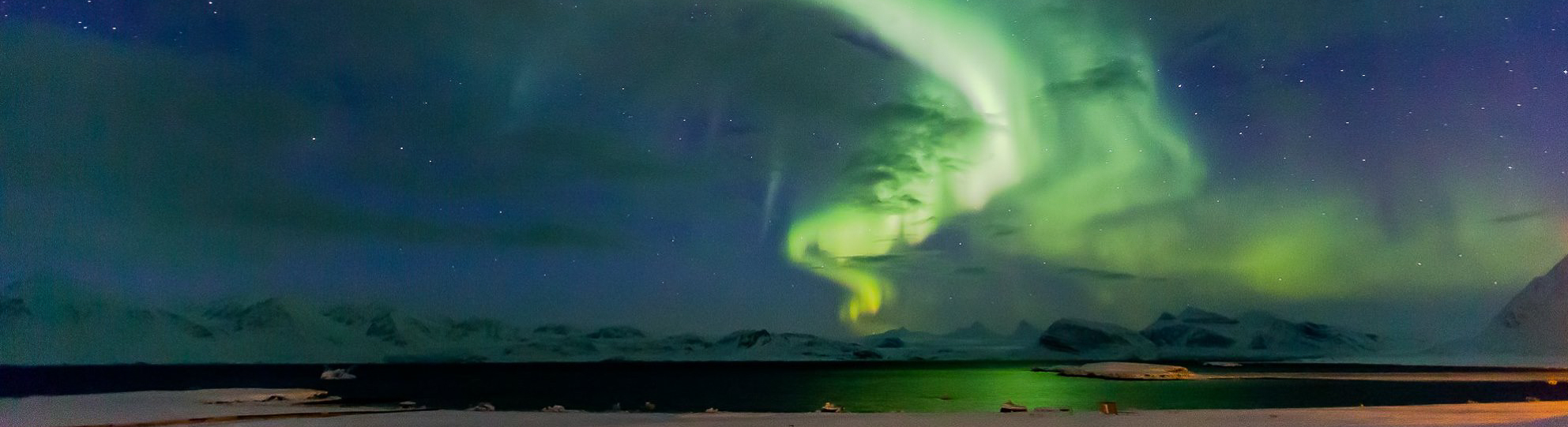
Also known as the northern lights (aurora borealis) or southern lights (aurora australis), auroras are colorful, dynamic, and often visually delicate displays of an intricate dance of particles and magnetism between the Sun and Earth called space weather.
When energetic particles from space collide with atoms and molecules in the atmosphere, they can cause the colorful glow that we call auroras.
Quick Facts
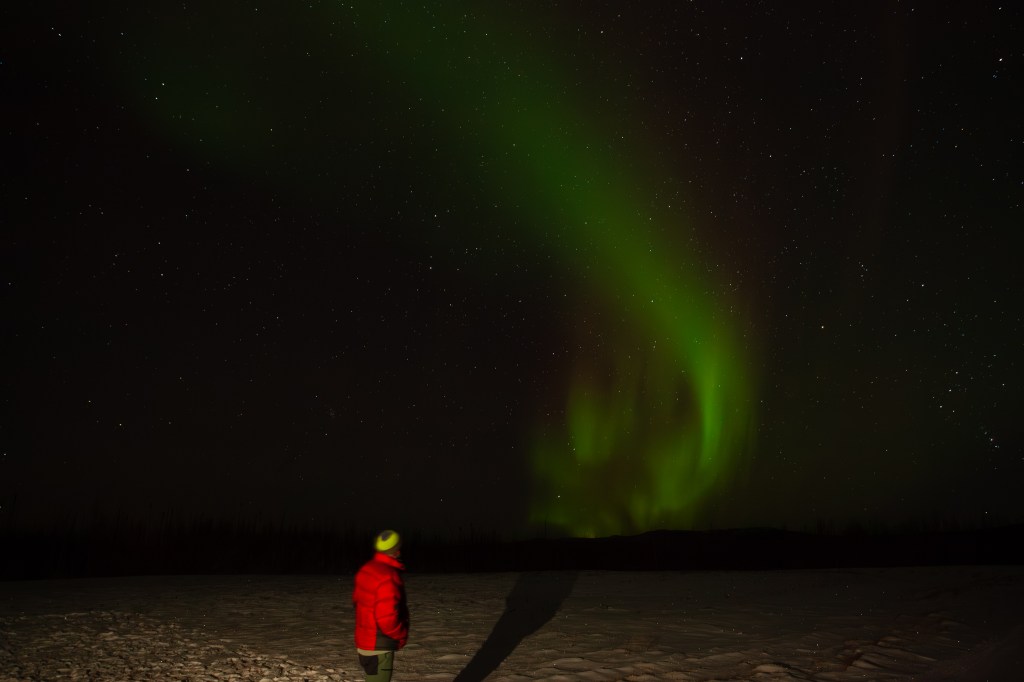
Aurora is the Latin word for "dawn" and is also the name of the Roman goddess of the dawn. Europeans living far from the Arctic Circle usually experienced auroras as a faint red glow to the north, resembling the reddish glow in the east at dawn. Aurora borealis translates to “northern dawn.”
Image credit: NASA/George Varros

Communities around the world have observed and documented auroras for thousands of years. The Iñupiat peoples of northern Alaska call them kiuġuyat or kiuġiyaq in their language, Iñupiaq. Learn more about their perspectives with the University of Alaska Fairbanks’ Cultural Connections project.
Image credit: NASA/Rachel Lense
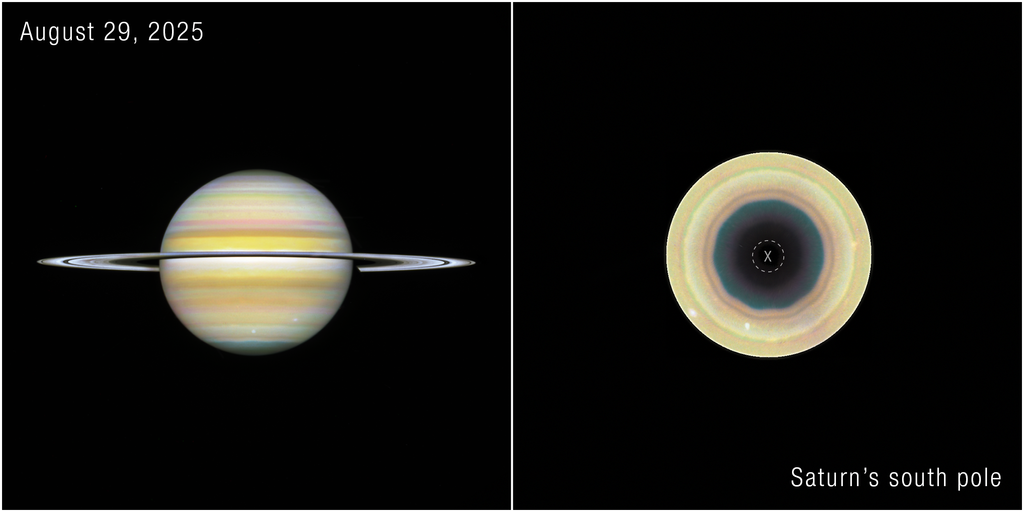
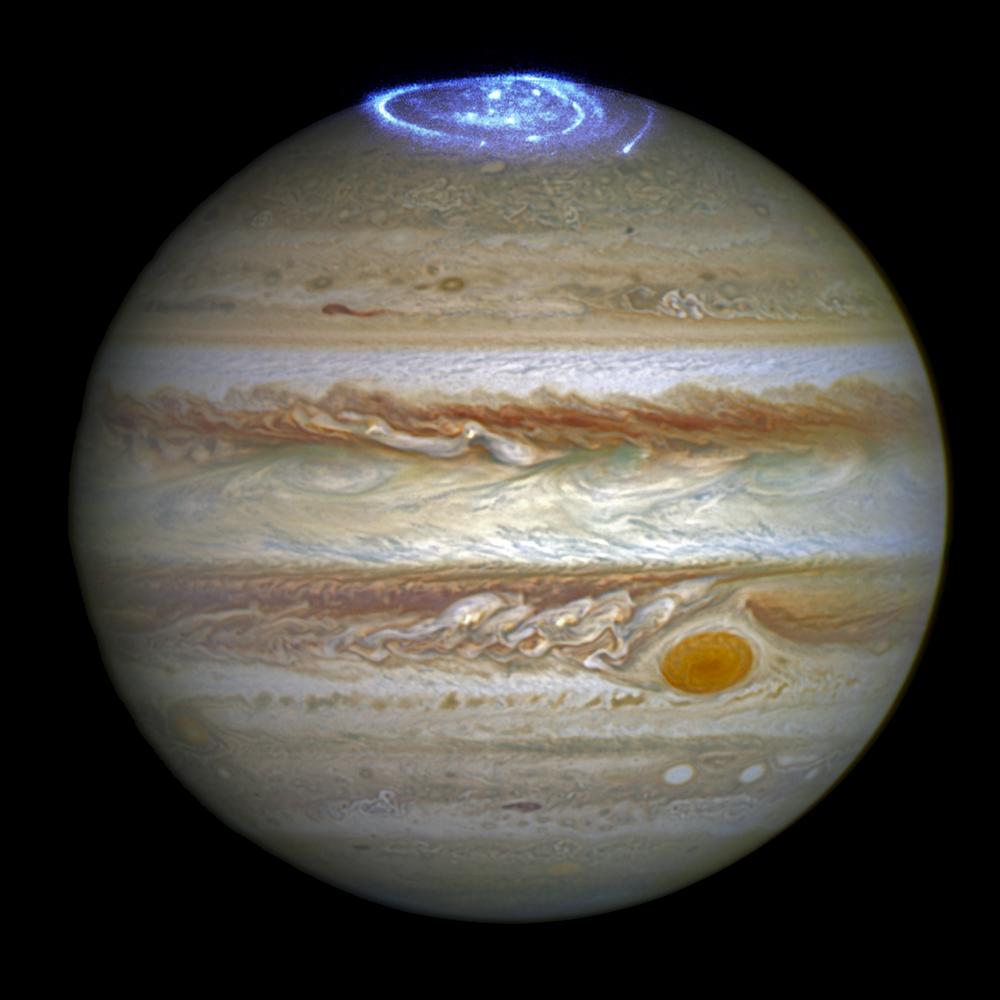
Auroras can occur on other planets and moons with atmospheres. They usually happen where a planet's magnetic field lines meet its atmosphere and have been seen on places like Saturn and Jupiter. However, they can occur in different ways on any planet with an atmosphere.
Image credit: NASA/ESA/J. Nichols, A. Simon
The colors of an aurora come from atoms and molecules being energized by colliding with energetic particles in the upper atmosphere. The most common color is green, which is produced when oxygen is excited by electrons around 60 mi (100 km) above Earth's surface.
Image credit: Gunjan Sinha, used with permission
What Causes Auroras?
The Sun continuously produces an outflow of charged particles into the solar system known as the solar wind. When the solar wind reaches Earth, it can interact with Earth’s magnetic shield, often depositing and accumulating energy there. When this energy is finally released, much of it rains down on our atmosphere, causing auroras.
More on the Physics Behind Auroras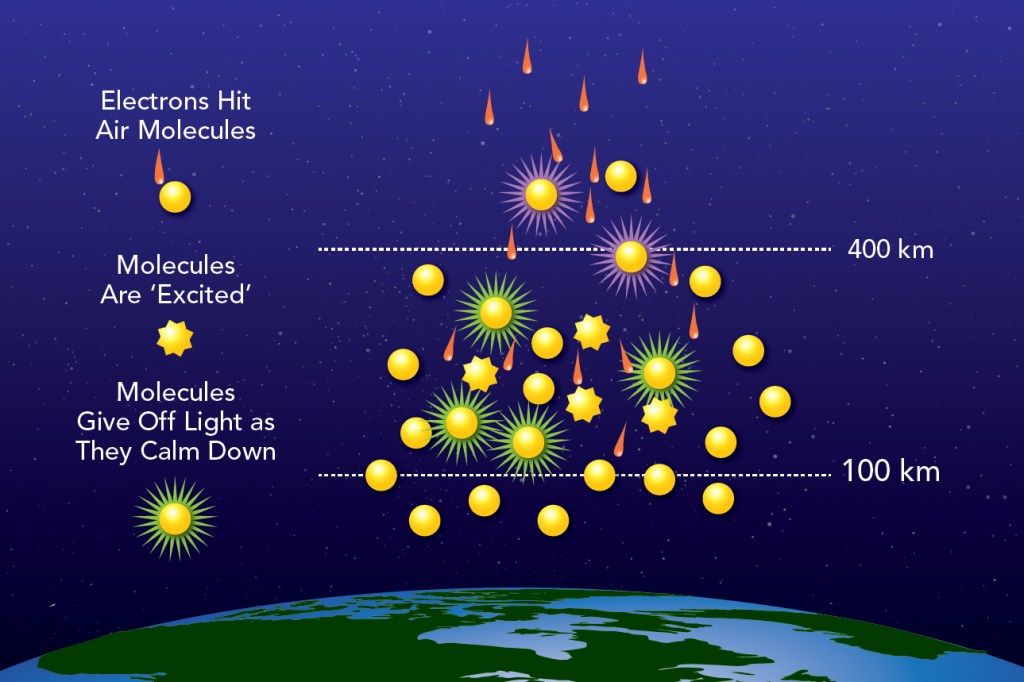
Related Reading
The Atmosphere… After Dark!
12 MIN READ
Why Are Auroras Colorful?
-
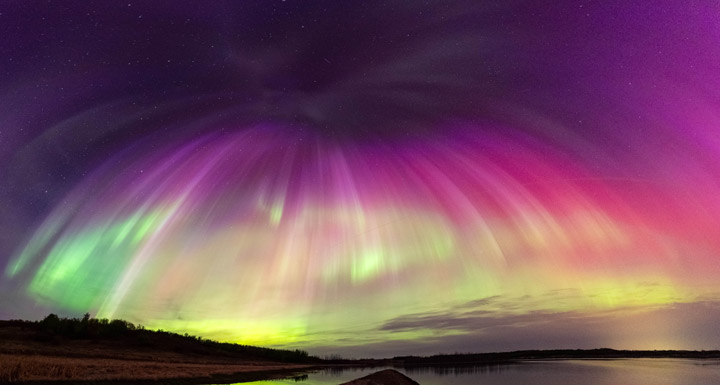
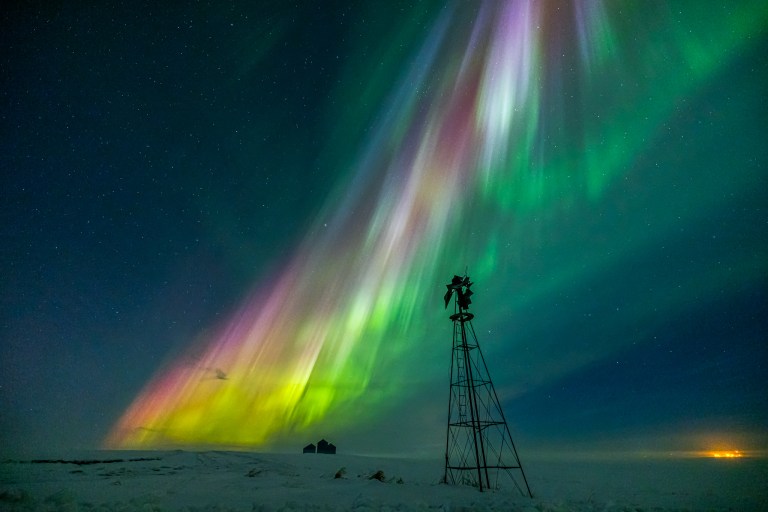
An aurora can appear in a variety of colors, from an eerie green to blue and purple to pink and red. When particles from space bombard gases in the atmosphere, they can give the atoms and molecules of the gases extra energy that’s released as tiny specks of light.
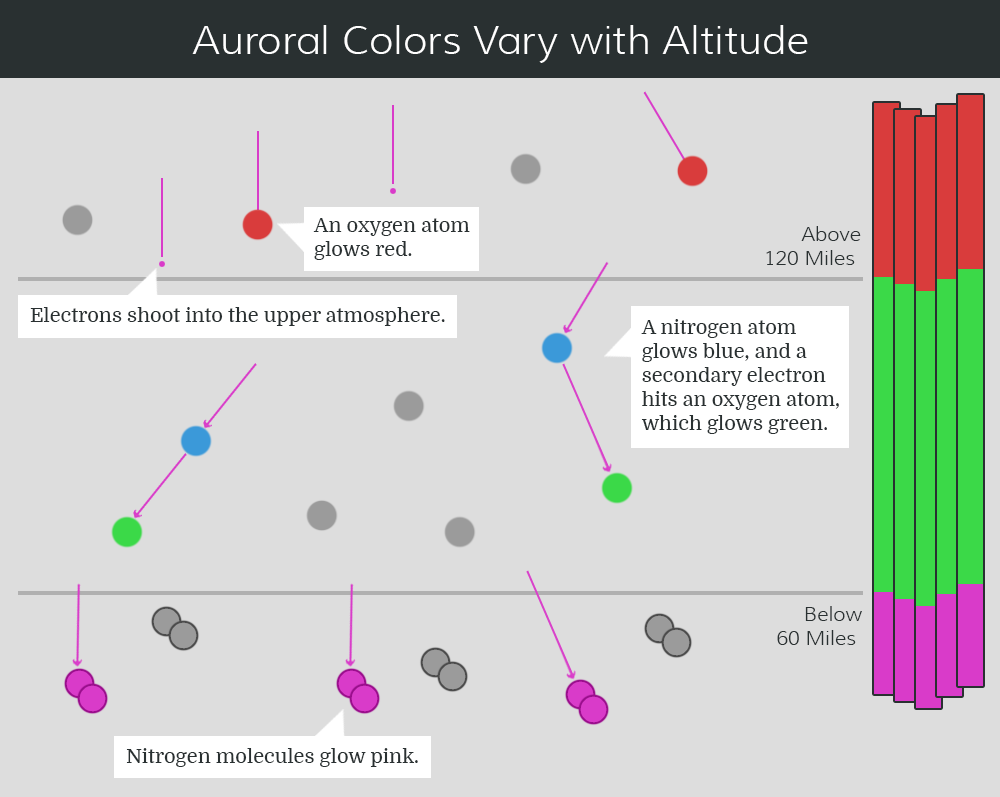
The color of an aurora depends on the type of gas that is hit and where that gas is located in the atmosphere.
Oxygen excited to different energy levels can produce green and red. Green occurs roughly between 60 to 120 miles (100-200 km) altitude, and red occurs above 120 miles (200 km).
Excited nitrogen gas from about 60 to 120 miles (100-200 km) glows blue. Depending on the type and energy of the particle it is interacting with, nitrogen can give off both pink and blue light. If it is below about 60 miles (100 km), it gives the lower edge of the aurora a reddish-purple to pink glow.
Sometimes, the light emitted by these gases can appear to mix, making the auroras seem purple, pink, or even white.
Image credit: Neil Zeller, used with permission
| Color | Altitude | Composition |
| Red | ≥120 miles (≥200 km) | Oxygen |
| Green | 60-120 miles (100-200 km) | Oxygen |
| Blue | 60-120 miles (100-200 km) | Nitrogen |
| Pink | ≤60 miles (≤100 km) | Nitrogen |
Researching Auroras
Ground-Based Measurements
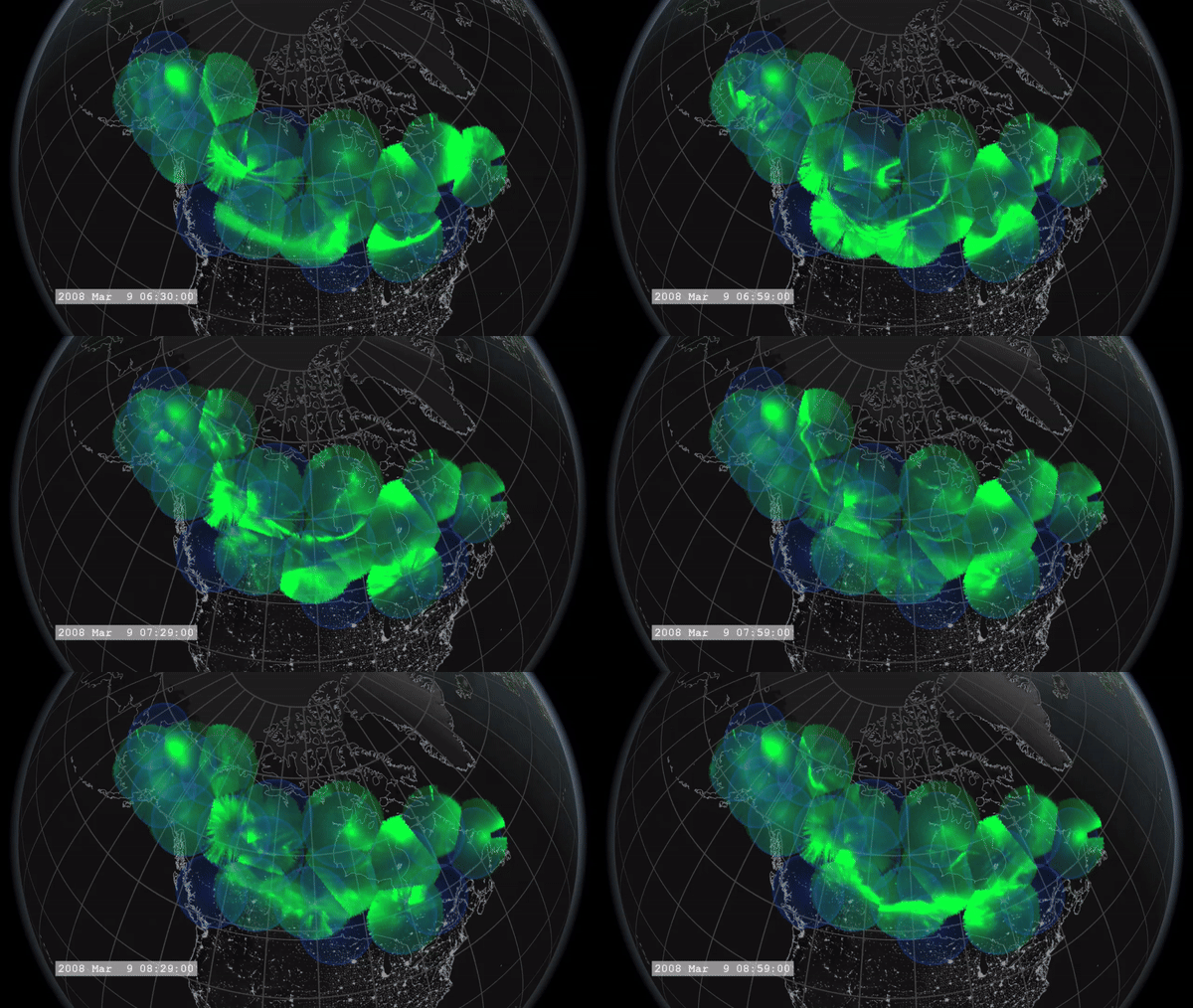
Using ground-based scientific equipment, we can learn a lot about auroras. With tools like magnetometers that show changes in Earth's magnetic field and radar networks that monitor particle activity in the upper atmosphere, scientists can analyze the various effects that occur during auroral displays. Some ground stations even provide real-time views of auroras using special wide-field cameras called all-sky imagers.
Different countries and agencies collaborate to conduct aurora research using ground stations worldwide, representing just how collaborative science can truly be.
Researching Auroras
Scientific Balloons
For more than 30 years, the NASA Balloon Program has allowed scientists to conduct experiments with balloons floating high into the atmosphere. It's important to have a clear, steady view of auroras in action to learn about their dynamics. Balloons can be launched across the globe and are a low-cost way to carry scientific instruments to great heights above most atmospheric clouds. At times, this allows balloons to provide a clearer view of the aurora than ground-based cameras.
One of these balloon missions was called BALBOA (Balloon-Based Observations for sunlit Aurora) and used infrared cameras to observe how auroras behave during the day.

Researching Auroras
Sounding Rockets
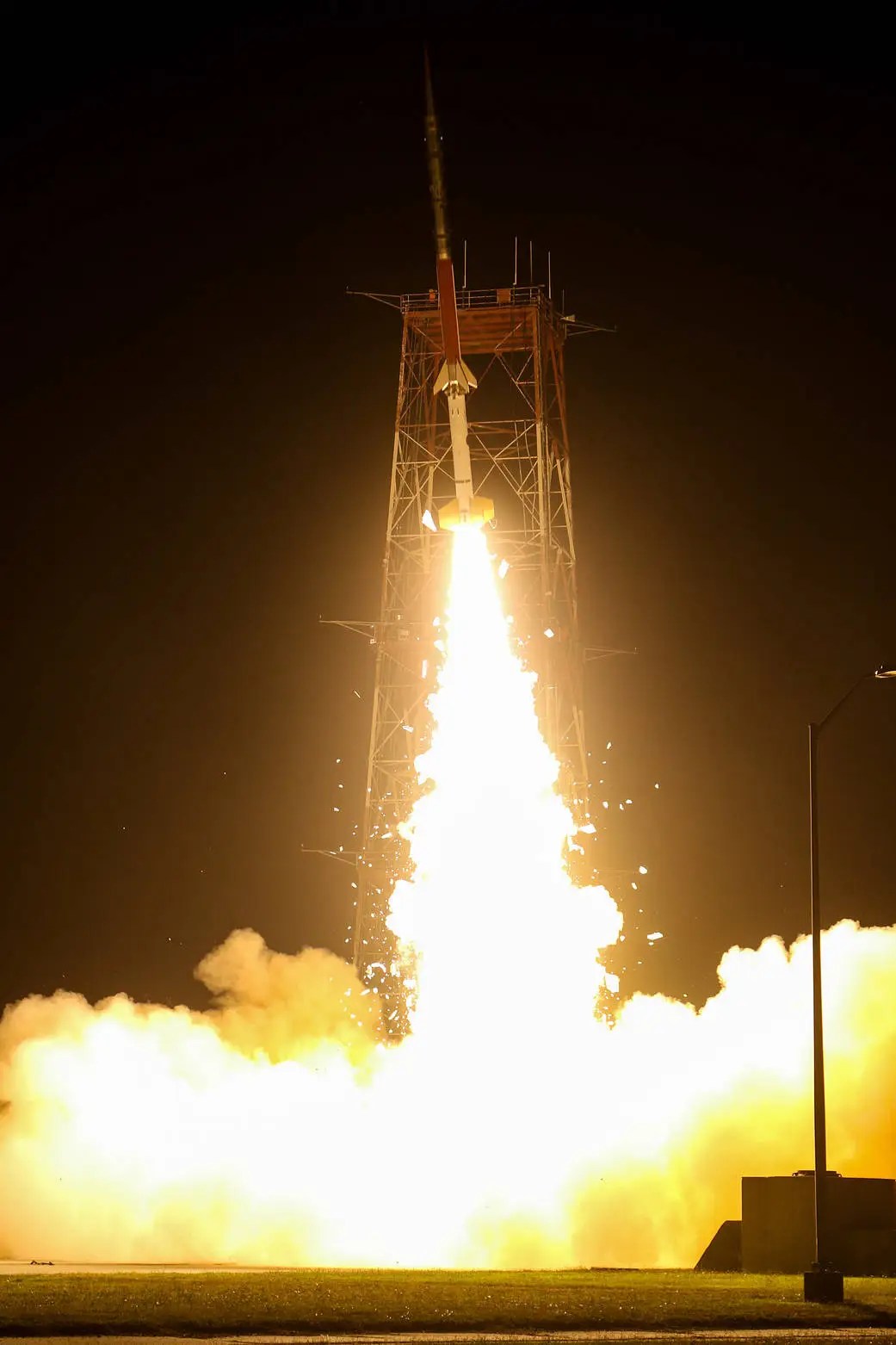
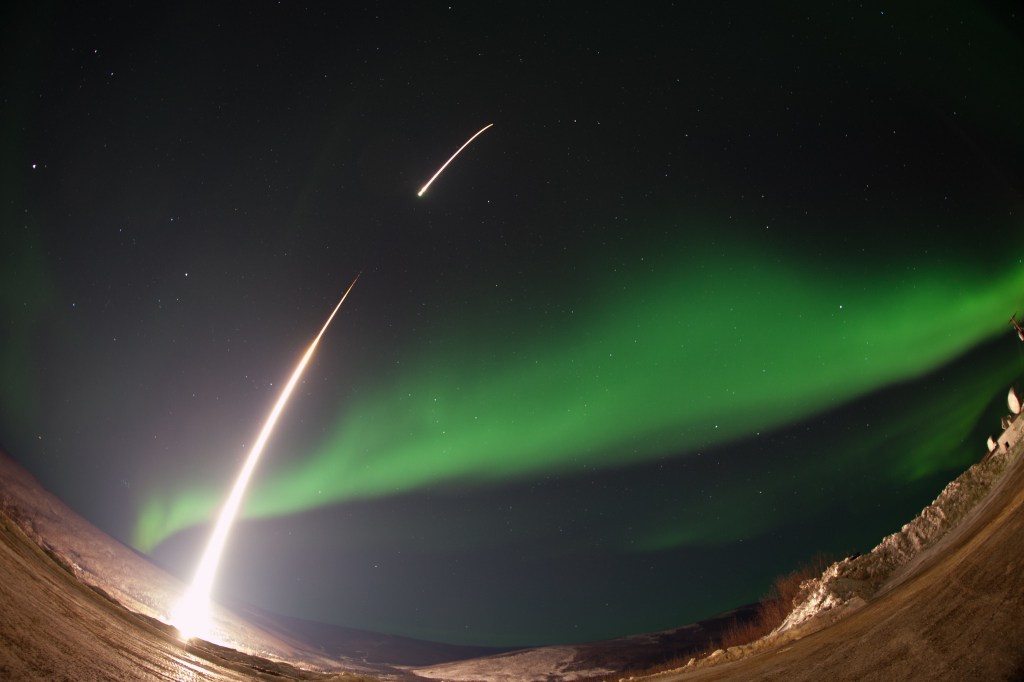
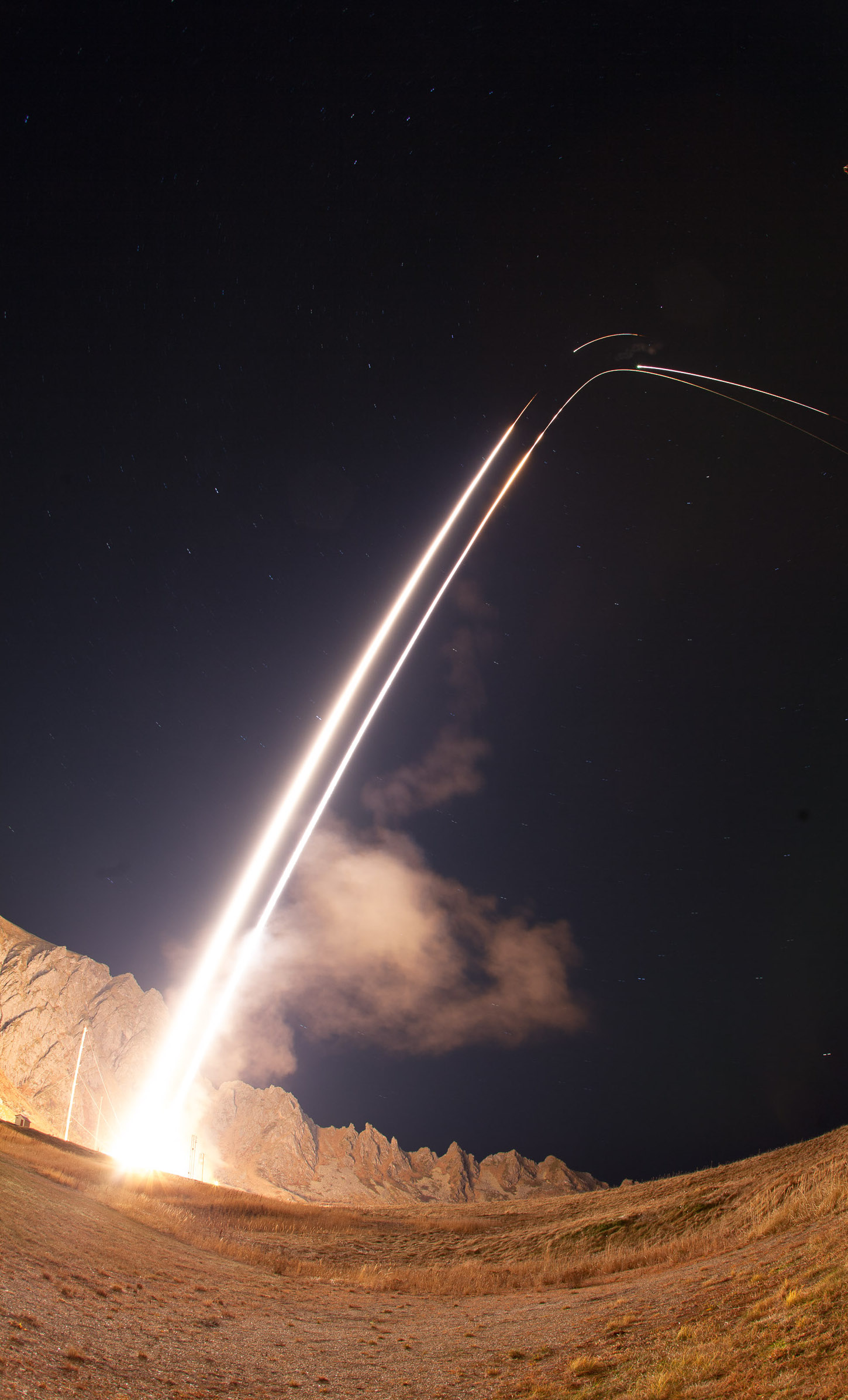
Unlike the large rockets that send humans to space, sounding rockets are smaller and equipped with scientific instruments. They're an important tool for scientists studying auroras because they collect observations as they arc through the sky, showing how physical processes change with altitude and time. And with the ability to reach anywhere from 30 to 800 miles (50 to 1,200 km) above Earth, they can take measurements at elevations too high for balloons to reach and too low for satellites to fly through, making them necessary for painting a fuller picture of how auroras work.
For instance, NASA scientists joined a global Grand Challenge to use sounding rockets to better understand the fundamentals of the polar cusp — a region of Earth’s magnetic field over the poles where energetic particles funnel into and out of the atmosphere.
Researching Auroras
Spacecraft
NASA has a storied history of studying auroras with spacecraft, whether Earth-orbiting or flying past other planets in our solar system. In 1979, Voyager 1 caught a glimpse of auroras on the dark side of Jupiter. More recently, the Hubble Space Telescope, Galileo, and Juno have also seen auroras on the gas giant. Cassini and other missions observed them on Saturn, MAVEN (Mars Atmosphere and Volatile Evolution) found them on Mars, and Pioneer discovered them on Venus. Even some moons have shown signs of auroras, as have celestial bodies beyond our solar system.
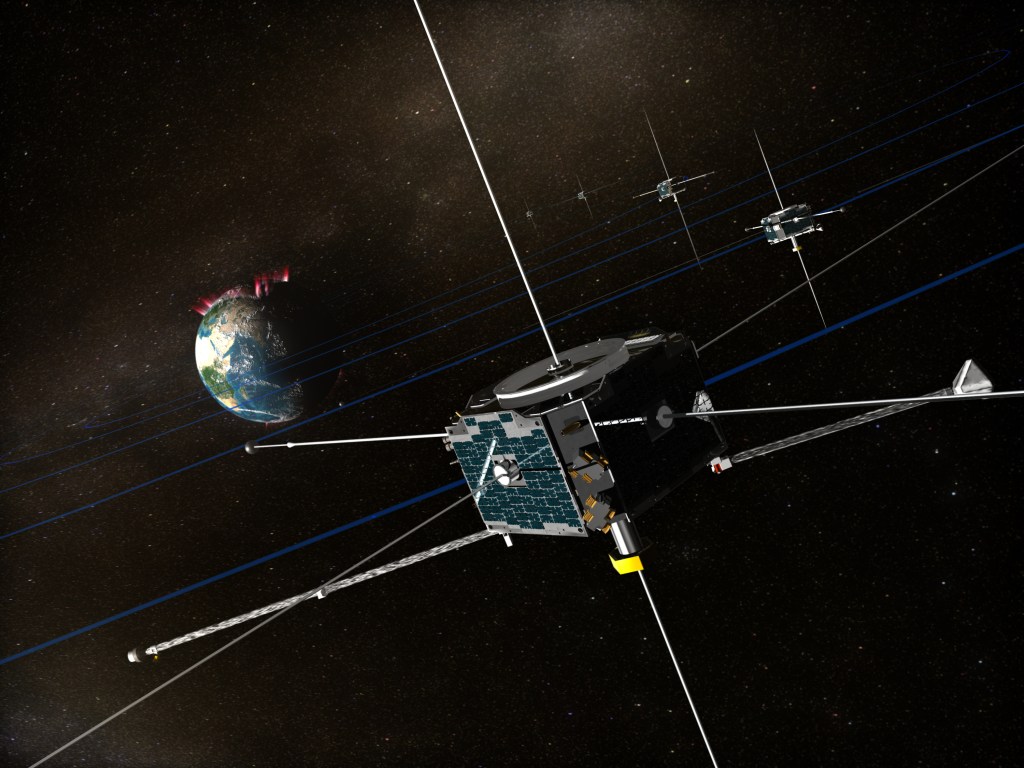
But the majority of spacecraft studying auroras look Earthward, like THEMIS (Time History of Events and Macroscale Interactions During Substorms) or the upcoming EZIE (Electrojet Zeeman Imaging Explorer) and GDC (Geospace Dynamics Constellation) missions.
Researching Auroras
Citizen Science
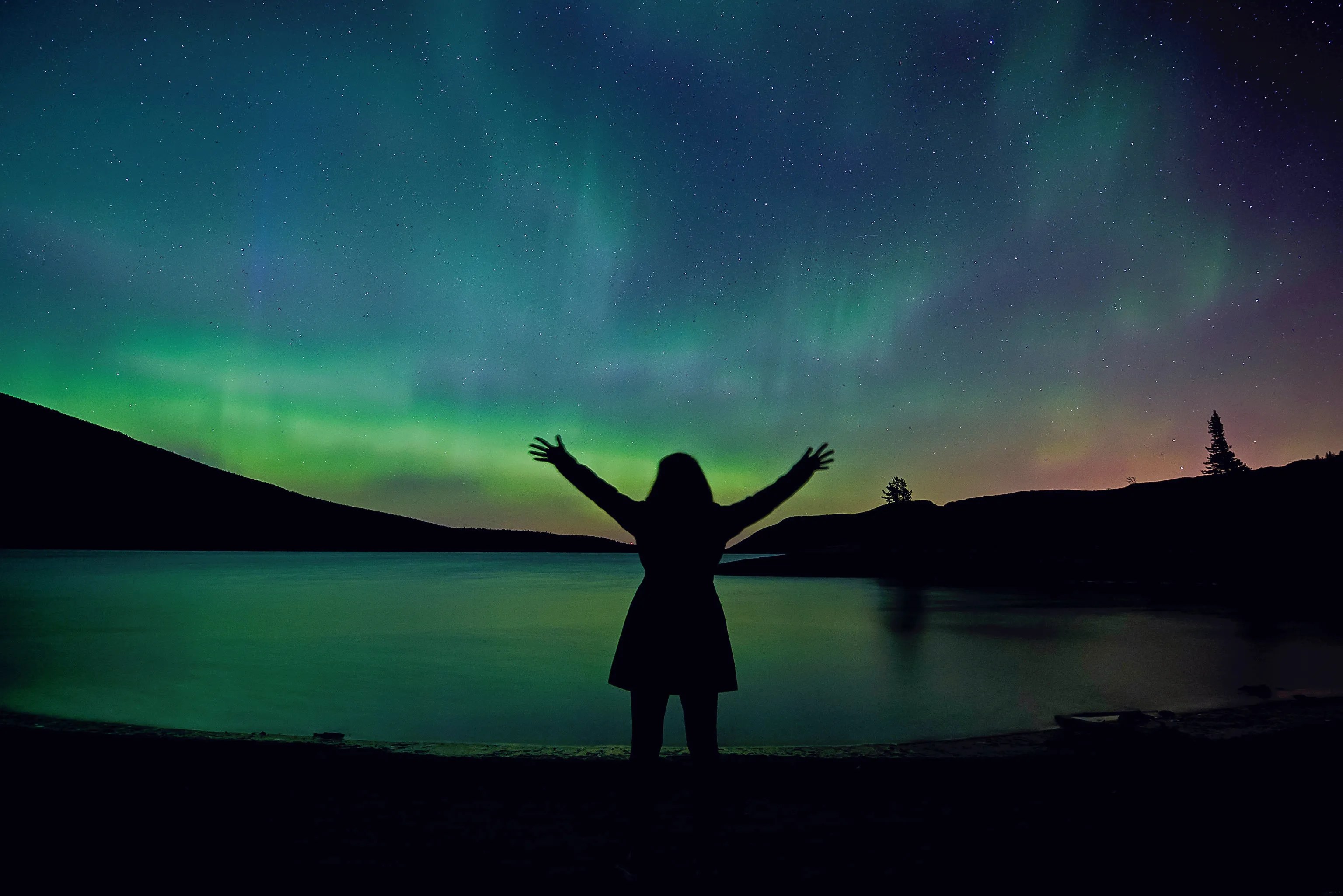
Did you know you don’t have to be a professional scientist to help advance our understanding of auroras? Citizen science (or participatory science) is a form of open collaboration in which individuals or organizations participate voluntarily in the scientific process.
NASA’s Aurorasaurus citizen science project encourages people to report their aurora sightings. Each verified report of an aurora serves as a valuable data point for scientists who model these phenomena and can lead to published scientific papers or even new discoveries!
Aurora Science Made EZIE
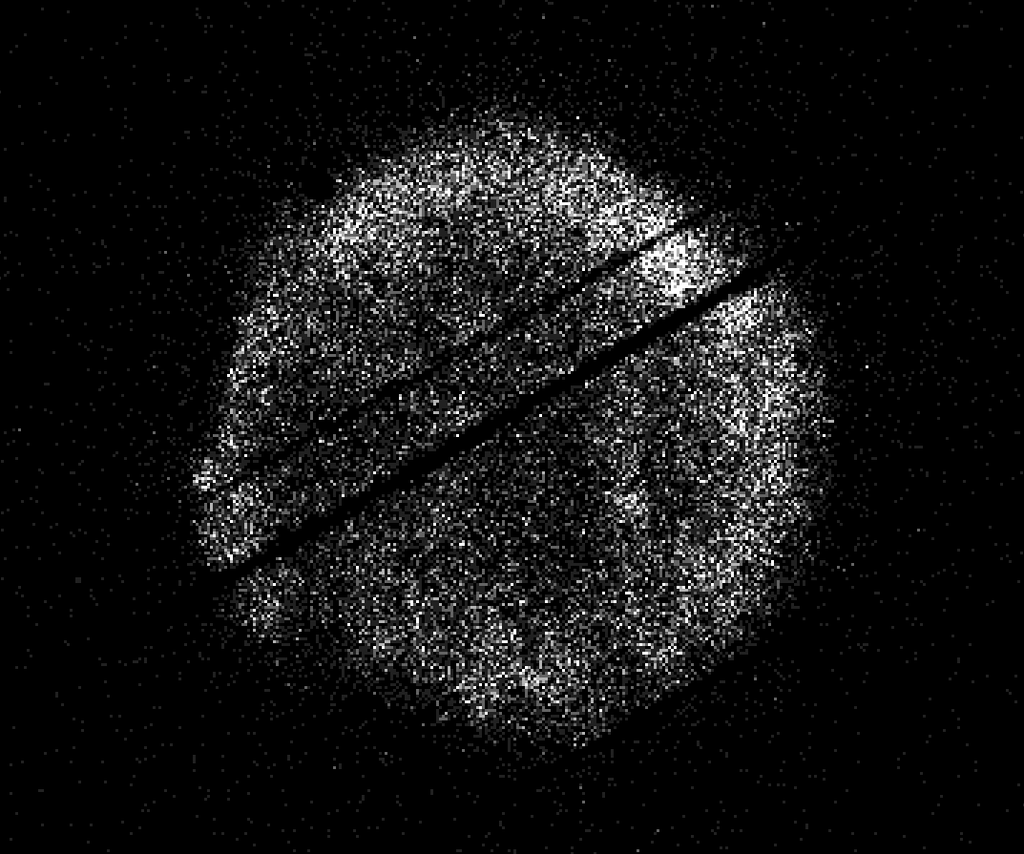
The Electrojet Zeeman Imaging Explorer (EZIE) is a NASA mission to image the magnetic fingerprint of the auroral electrojets, electric currents in the atmosphere linking the magnetosphere to the aurora.
NASA/Johns Hopkins Applied Physics Laboratory
Rockets to Uncover Electric Circuit That Powers the Northern Lights

New Compact Remote Sensor to Image Ionospheric Current's Spatial Structure from Space
Bundling the Best of Heliophysics Education: DigiKits for Physics and Astronomy Teachers
Finding and Photographing Auroras
Auroras are one of our night sky’s most dramatic spectacles. With modern cameras and smartphones, photographing these beautiful displays is easier than ever. Digital camera sensors are incredibly sensitive and can even allow you to record auroras you can’t see with the naked eye.
Explore Photography Tips and Tricks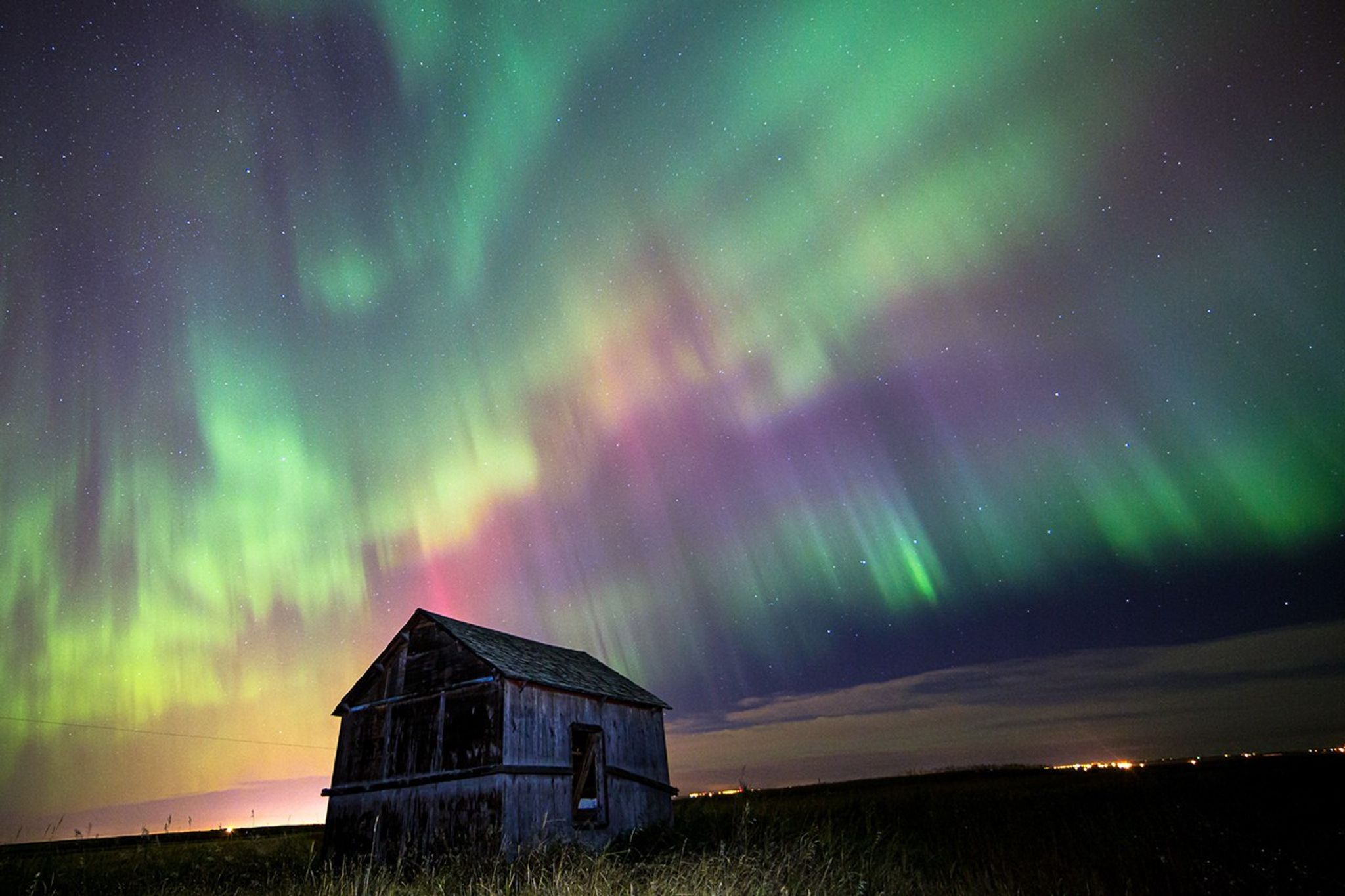
Contribute to Aurora Science
Help scientists track and study auroras by reporting your aurora sightings to the Aurorasaurus citizen science project. Verified reports of auroras from people around the world provide valuable data points for scientists and can lead to published scientific papers and even new discoveries.
Aurorasaurus