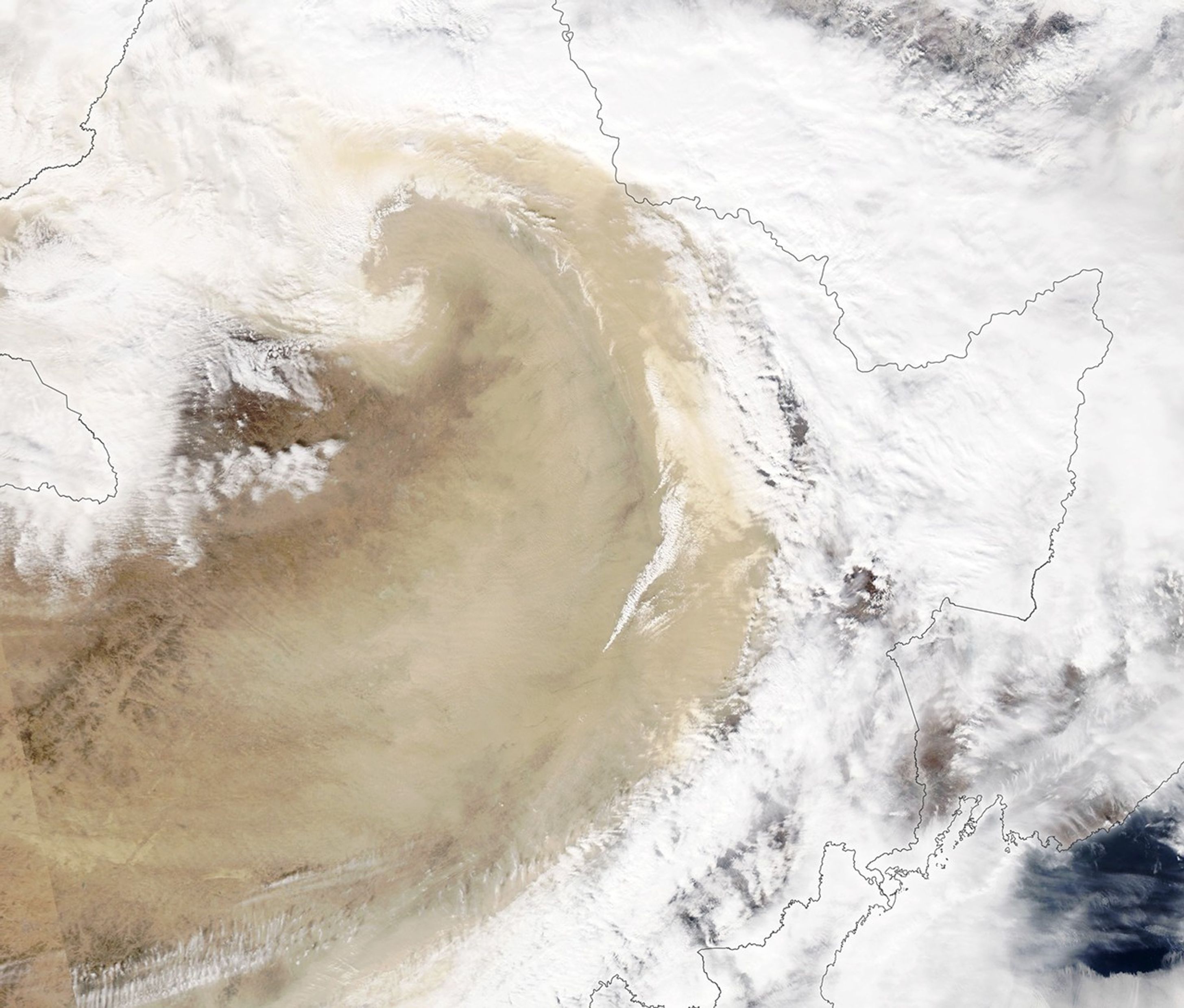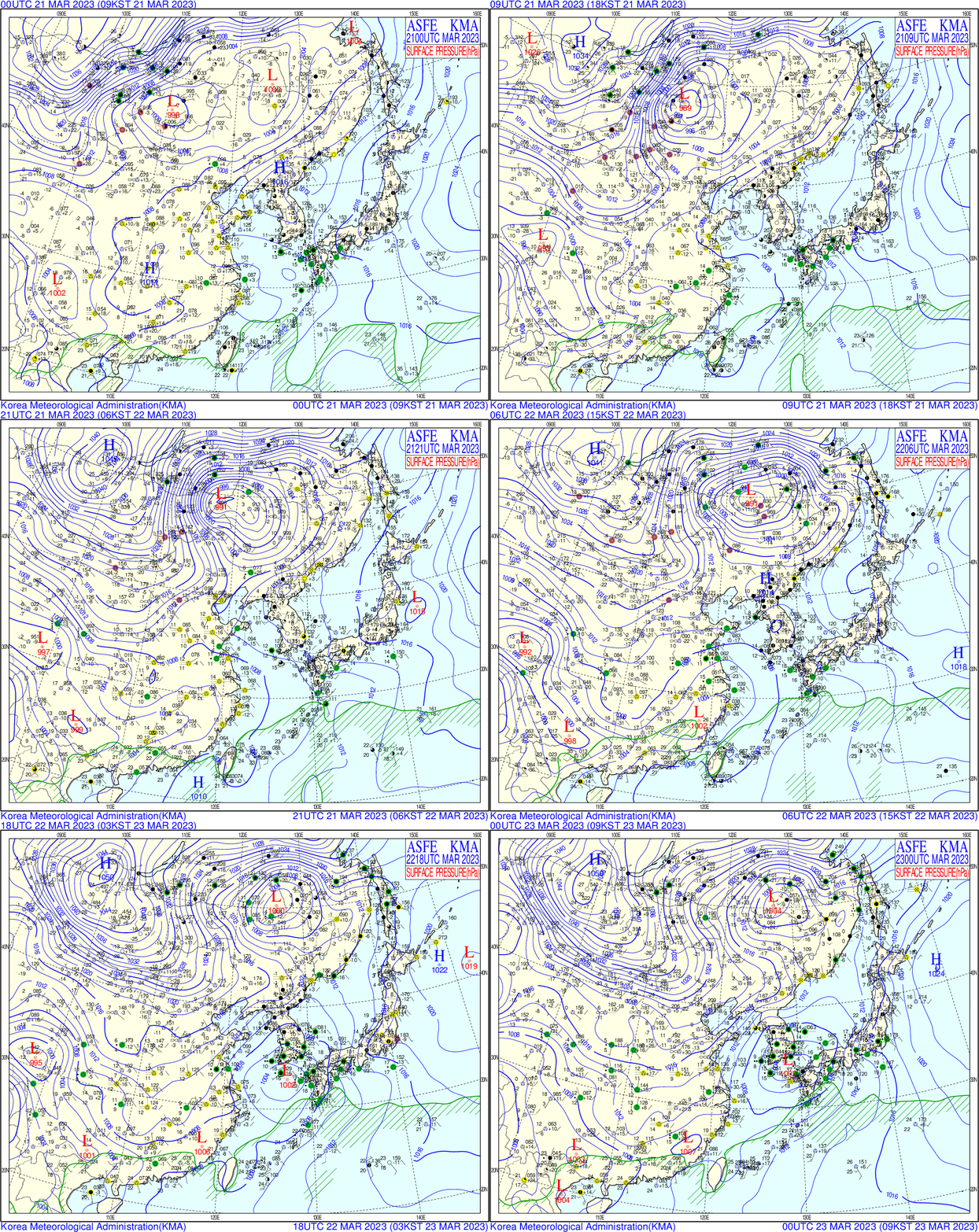






















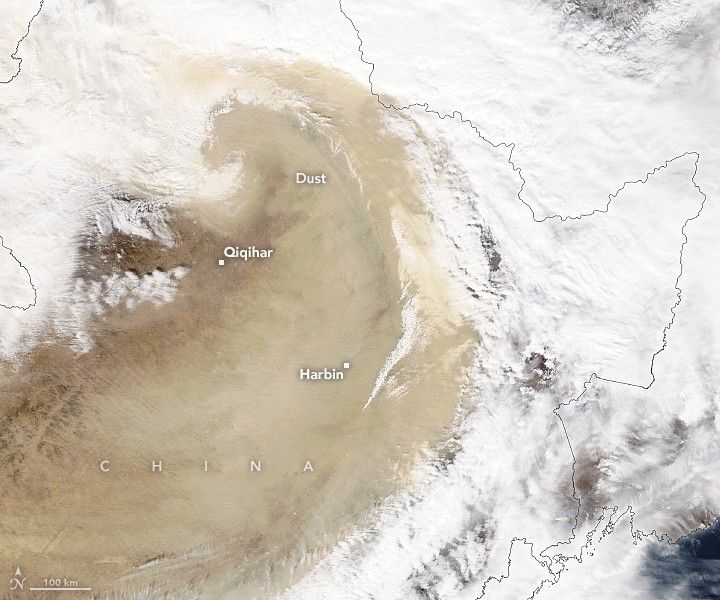
A comma-shaped low-pressure system that pushed across Mongolia and China unleashed a major dust storm in late-March 2023. A tight pressure gradient fueled the strong winds that lifted sand and dust from the Gobi Desert as the system moved into eastern China on March 22. With visibility plummeting in Beijing, air quality sensors measured soaring levels of particulate matter (PM).
The Moderate Resolution Imaging Spectroradiometer (MODIS) on NASA’s Aqua satellite captured this image showing a thick swirl of dust over China’s Harbin, Changchun, and Shenyang provinces on March 22, 2023. Cyclonic atmospheric circulation appears to have sucked dust into and above the clouds. (Read our earlier coverage to learn more about why the presence of dust and smoke above clouds is of interest to climate scientists.)
The dust has affected more than 560 million people in the densely populated region, according to China’s National Forestry Grassland Administration. In Beijing, which has a population of more than 20 million, the air quality index rose well above 500 for coarse (PM10) particles and above 200 for fine (PM2.5) particles on that day. Those levels are considered “hazardous” and “very unhealthy” to human health.
Research led by a team of atmospheric scientists based at NASA’s Goddard Space Flight Center indicates that exposure to high levels of PM2.5 over the course of a year likely contributed to 2.89 million premature deaths worldwide in 2019. According to that analysis, 22 percent of these premature deaths were linked specifically to dust. The scientists estimated that roughly 43 percent of premature deaths occurred in China.
Breathing significant amounts of dust can exacerbate cardiovascular and respiratory disease. Dust storms can also transport certain types of fungal, bacterial, and viral pathogens.
To combat the spread of deserts and reduce the negative air quality effects of dust storms, Chinese authorities are working to establish forests along the edges of the Taklimakan and Gobi deserts. Called the Three-North Shelter Belt, or Great Green Wall, this may be the most ambitious greening and tree-planting project in the world. Since the effort began in 1978, more than 66 billion trees have been planted; the aim is to plant 100 billion by 2050.
Though many saplings die before reaching maturity, and some ecologists worry about the use of non-native species and the long-term viability of the project, tree cover in China has increased in recent decades, partly because of reforestation efforts.
There is some evidence that the new greenery may be reducing the impact of dust storms in the region. Studies published in 2020 and 2021 found that the frequency of dust storms in northern China has decreased in recent decades—a change the authors say could be related to the greening efforts.
References & Resources
- AirNow US Embassies and Consulates. Accessed March 24, 2023.
- Climate Diplomacy (2019) Forty years of tree-planting in China: successes and failures. Accessed March 24, 2023.
- CIMSS Satellite Blog (2023, March 22) Blowing dust across Mongolia and China. Accessed March 24, 2023.
- China Daily (2023, March 24) China should help Mongolia restore its ecological balance. Accessed March 24, 2023.
- CNN (2023, March 24) Sandstorms blanket Beijing and northern China as air pollution soars off the charts. Accessed March 24, 2023.
- DW (2023, March 22) China: Sandstorms blanket Beijing as air pollution spikes. Accessed March 24, 2023.
- The Economist (2014, August 23) China’s Great Green Wall. Accessed March 24, 2023.
- ECNS (2023, March 22) 560 million people affected by strong sandstorm: Chinese administration. Accessed March 24, 2023.
- NASA Earth Observatory (2019, February) China and India Lead the Way in Greening.
- Reuters (2023, March 22) Thick sandstorms shroud Beijing and several provinces in China. Accessed March 24, 2023.
- Song, Q. et al. (2021) Global dust optical depth climatology derived from CALIOP and MODIS aerosol retrievals on decadal timescales: regional and interannual variability. Atmos. Chem. Phys., 21, 13369–13395.
- Tao, W. (2015, March 18) Aeolian desertification and its control in Northern China. International Soil and Water Conservation Research, 2 (4), 34-41.
- Tan, M. & Li, X. (2015, February) Does the Green Great Wall effectively decrease dust storm intensity in China? A study based on NOAA NDVI and weather station data. Land Use Policy, 42, 42-47.
- Yale Environment 360 (2012, January 17) China’s Reforestation Programs: Big Success or Just an Illusion? Accessed March 24, 2023.
- World Air Quality Project Beijing Air Quality Index (AQI). Accessed March 24, 2023.
- Zhang, X. et al. (2016) A Systematic Review of Global Desert Dust and Associated Human Health Effects. Atmosphere, 7 (12).
NASA Earth Observatory image by Lauren Dauphin, using MODIS data from NASA EOSDIS LANCE and GIBS/Worldview . Story by Adam Voiland .