




















November 25, 1984-November 18, 2022
Dublin’s Urban Expansion
Dublin is the social and economic heart of Ireland. About 40 percent of the country’s residents live in the capital, the largest city in the country by area and population. But the vertical reach of Dublin’s city center is relatively short. Unlike the tall skyscrapers found in Hong Kong or New York City, the cityscape of Dublin consists of mostly low-rise buildings. Though upward expansion is limited, Dublin has expanded outward and into the countryside.
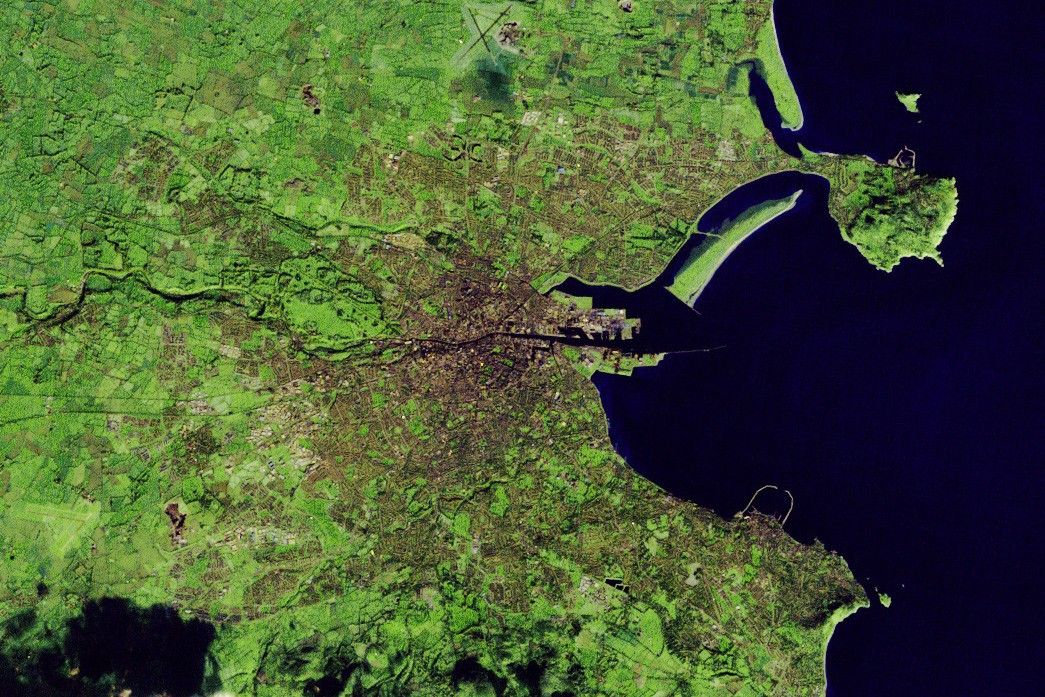
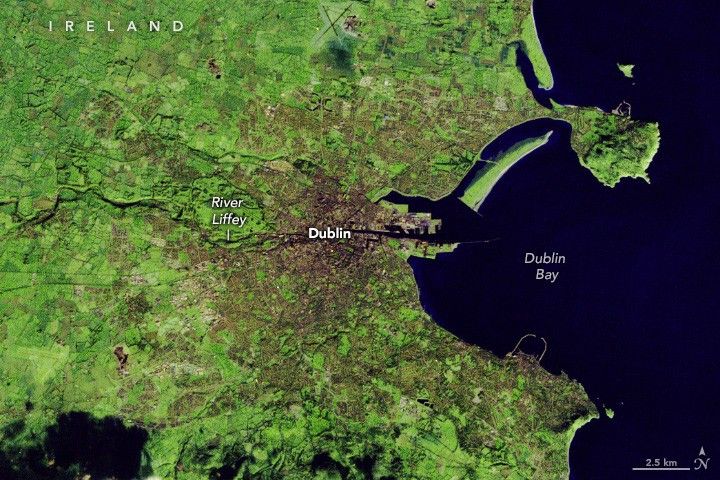
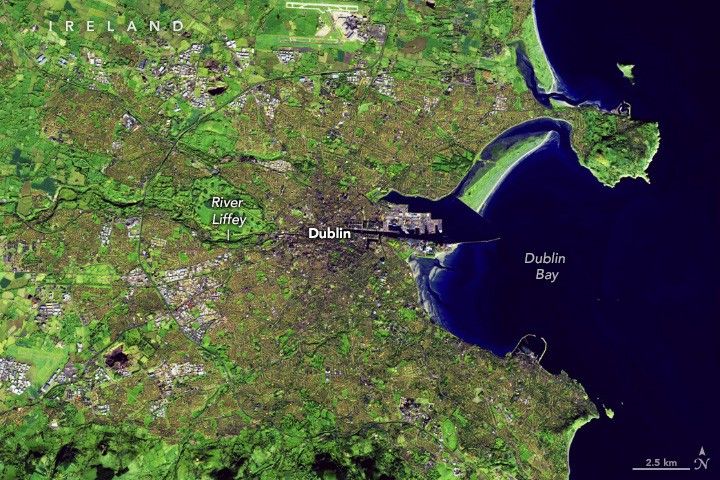
These images show the extent to which urban areas have grown between 1984 (left) and 2022 (right). The images were acquired by Landsat 5 and Landsat 8, respectively, and are false color to emphasize the difference between vegetated (green) and built-up areas (gray and brown). Dublin’s growth has been fairly low-density, and some greenness remains even in urban areas.
Between the late 1950s and the 1990s, the city’s physical footprint doubled, according to the European Environment Agency, and the city continued to expand as residential and commercial zones were built on the fringes of the city. In the 2022 image, urban areas reached well beyond the city center of Dublin, which straddles the River Liffey.
The growth of urban areas, or “urban sprawl,” is caused by a number of social and environmental factors. Although Dublin’s downtown area is denser than its surroundings, the buildings in the city rarely exceed five or six stories, due to policies to maintain the city as predominantly low-rise. As Dublin has grown, high home prices have driven residents out to the suburbs, according to the European Environment Agency. Personal preference for larger, single-family homes has also led to growth outside the city, which often occurs near major roads and railways. In a 2006 report, the agency found that Dublin is one of the most sprawled cities in the European Union.
Over half of the world’s population now lives in cities, and how a city grows has implications for the surrounding landscape. Cities that grow vertically (“up”) can house more people in the same footprint and reduce reliance on cars for transportation. On the other hand, cities that grow “out” can come at the expense of natural ecosystems or agricultural land. Most of Dublin’s recent expansion has replaced agricultural areas and to a lesser extent, natural areas.
Dublin experienced rapid urban growth in the 1980s and 1990s, especially on the periphery of the city. Researchers in Europe found that between 1986 and 1996, the population in Dublin’s urban periphery increased faster than the population of the city as a whole. While the population of the greater Dublin area grew by about 4 percent during that time, the urban fringe grew by about 10 percent in South Dublin and 21 percent in Fingal, to the north. The researchers hypothesize that the building of new roads drove residential and commercial development into the outskirts of the city.
References & Resources
- European Environment Agency (2016) Urban Sprawl in Europe: The ignored challenge. Accessed April 5, 2024.
- European Environment Agency (1999) Environment in the European Union at the turn of the century. Chapter 3.12: Urban Areas. Accessed April 5, 2024.
- Irish Times (2004, April 22) Major growth in urban sprawl around Dublin. Accessed April 5, 2024.
- Nedovic-Budic, Z., et al. (2016) Measuring urban form at community scale: Case study of Dublin, Ireland. Cities, 55, 148-164.
- Van de Voorde, T., et al. (2009) Multi-temporal spectral unmixing to characterise urban change in the Greater Dublin area. In Remote Sensing for a Changing Europe (pp. 276-283). IOS Press.
- Van de Voorde, T., et al. (2016)Projecting alternative urban growth patterns: The development and application of a remote sensing assisted calibration framework for the Greater Dublin Area. Ecological Indicators, 60, 1056-1069.
- World Resources Institute (2019, January 31) Too Many Cities Are Growing Out Rather than Up. 3 Reasons That’s a Problem. Accessed April 5, 2024.
NASA Earth Observatory images by Wanmei Liang , using Landsat data from the U.S. Geological Survey . Story by Emily Cassidy .