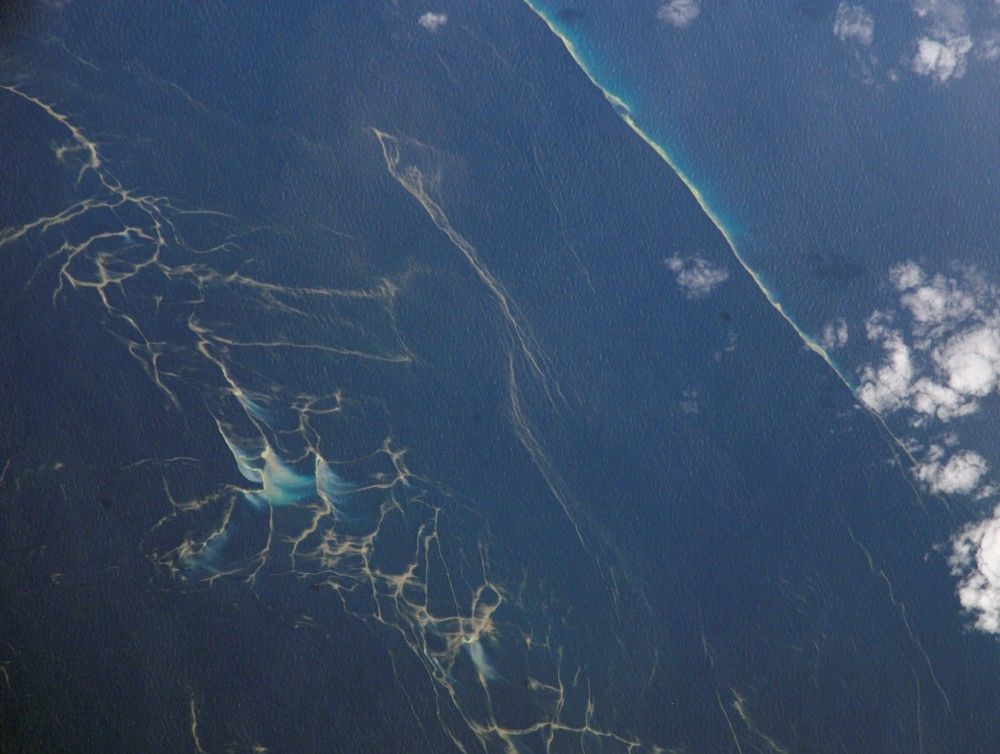












Detailed imagery taken by astronauts from the International SpaceStation (ISS) provides a new way of looking at many features on theEarth’s surface. This image captures a plankton bloom in the CapricornChannel off the Queensland coast of Australia. The whispy pattern ofthe bloom suggests that the plankton are Trichodesmium—aphotosynthetic cyanobacteria, also called “sea saw dust” that is commonin the world’s oceans. Trichodesmium is frequently observed aroundAustralia this time of year. In fact, Captain Cook’s ship logs writtenwhile he was sailing in Australian waters in the 1700s contain detaileddescriptions of Trichodesmium blooms. Trichodesmium species areparticularly important because of their role as primary producers: bysheer abundance, they fix a large amount of CO2 and N2.
Astronauts frequently photograph large plankton blooms during theirmissions because a significant portion of the ISS orbits cross longstretches of ocean. In the process, astronauts become acute observersof subtle changes in sea surface dynamics. Imagery of surface planktonblooms are multi-dimensional (in space and time) visualizations for theunique physical and chemical circumstances that support the blooms.Astronauts are trained and encouraged to document phytoplankton blooms,and to make repeated observations to better understand the longevity and temporal variations of the blooms. Only recently have astronauts hadthe capability of documenting these ocean features at high resolution—weestimate that each pixel in this image represents a square with sides of6-8 m. The inset box shows zooms in on part of the bloom to illustratethe level of detail available.
For more information, read the article about Trichodesmium from the Woods Hole Oceanographic Institute.
References & Resources
Astronaut photograph ISS005-E-21572 was taken December 3, 2002, and is provided by the Earth Sciences and Image Analysis Laboratory at Johnson Space Center. Additional images taken by astronauts and cosmonauts can be viewed at the NASA-JSC Gateway to Astronaut Photography of Earth.