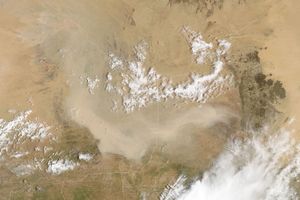





























Dense dust from at least three regions mingles in the air over northwestern China in this photo-like image from the Moderate Resolution Imaging Spectroradiometer (MODIS) on NASA’s Terra satellite. Dust storms sweep across this desert region throughout the year, but tend to peak in April and May. This storm happened on April 24, 2010, right in the middle of the peak period.
The edge of the large Taklimakan Desert, the first dust source, is on the left side of the scene. The desert is smooth and brown like a blank canvas. Pale, rose-tinted tan dust rises from the far eastern periphery of the Taklimakan from the base of the Kuruktag Mountains in the north to the peaks of the Altun Shan (beneath the clouds) in the south. The dust blows east, probably with winds that accompany the storm shown on the right side of the image.
The second source of dust is the Turfan Depression near the top of the image. The Turfan is divided in half by the Qoltag Mountains and bounded on the north by the Bogda Mountains. Water occasionally drains down the mountains into the depression, but no river is constant. All rise and fade with the seasons, leaving fine sediment behind. The sediment lifts easily on the wind, as seen on April 24. Thick yellowish dust blows south from the Turfan Depression, skirting the Qoltag Mountains. Smaller plumes of dust blow from the south side of the Qoltag Mountains.
All of the dust mixes over the third dust source in the center of the image. A large lake called Lop Nur, or the Wandering Lake, once covered the far eastern edge of the Tarim Basin, the oval-shaped bowl that is mostly the Taklimakan Desert. The Tarim River once flowed into the lake, but water use reduced the flow of water. With little water entering and the desert advancing from the west, the permanent lake disappeared, and salt-encrusted soil took its place. The fine, dry, salty soil blows easily on the wind. The dry lake bed is visible on a clear day, but on April 24, thick dust completely hid the ground from view.
The large image is the highest-resolution version of the image. The image is available in additional resolutions from the MODIS Rapid Response Team.
References & Resources
- Encyclopedia Britannica. (2010). Lop Nur. Accessed April 29, 2010.
- Encyclopedia Britannica. (2010). Qoltag Mountains. Accessed April 29, 2010.
- Prospero, J. M., Ginoux, P., Torres, O., Nicholson, S.E., and Gill, T.E. (2002). Environmental characterization of global sources of atmospheric soil dust identified with the NIMBUS 7 Total Ozone Mapping Spectrometer (TOMS) absorbing aerosol product. Reviews of Geophysics, 40(1). doi:10.1029/2000RG000095
NASA image courtesy Jeff Schmaltz, MODIS Rapid Response Team at NASA GSFC. Caption by Holli Riebeek.