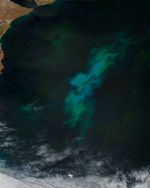






























East of Argentina, swirls of peacock green stretched across roughly 300 kilometers (175 miles) of the South Atlantic Ocean on October 27, 2012. The Moderate Resolution Imaging Spectroradiometer (MODIS) on NASA’s Aqua satellite captured this natural-color image the same day, showing an area southeast of Punta Ninfas.
When conditions are right, phytoplankton—microscopic plant-like organisms—undergo explosive growth, forming blooms big enough to be seen from space. To produce such blooms, phytoplankton need abundant sunlight, carbon dioxide, and dissolved nutrients. All of the necessary conditions frequently occur off the Argentina coast. The Malvinas (Falkland) Current flows northward along Argentina’s continental shelf, and winds may promote upwelling that brings nutrient-rich water up to the surface. October is springtime in this region, and increasing sunlight also promotes blooms.
References & Resources
- References
- Gyory, J., Mariano, A.J., and Ryan, E.H. The Malvinas Current. Ocean Surface Currents, National Oceanographic Partnership Program. Accessed October 30, 2012.
NASA image courtesy Jeff Schmaltz, LANCE MODIS Rapid Response Team at NASA GSFC. Caption by Michon Scott.