


















January 28, 1985
Establishing El Gouna


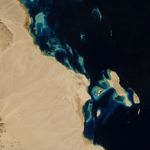
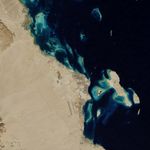
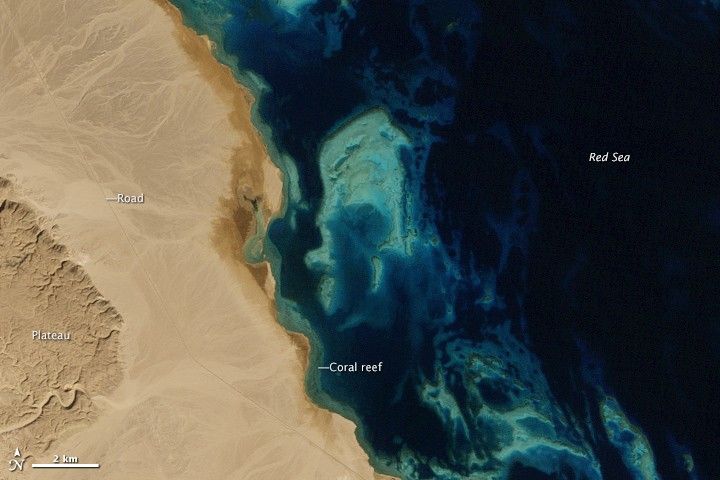
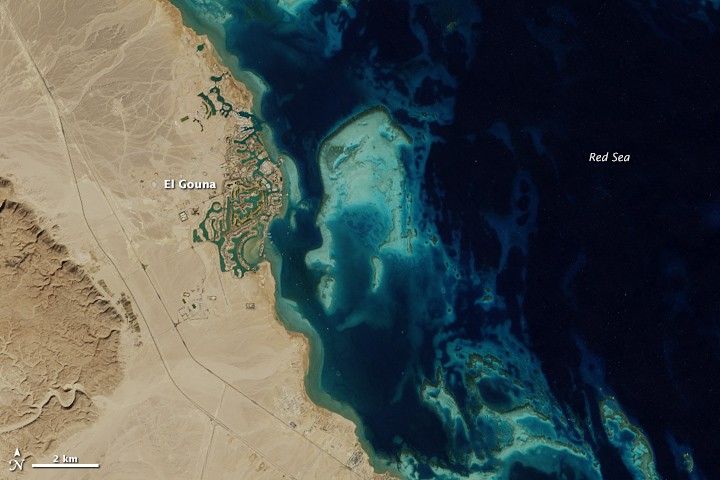
In 1985, sand and coral dominated the Red Sea coast in an area about 30 kilometers (19 miles) northwest of Hurghada, Egypt. Aside from a lone road that ran along the coast, the desert landscape was largely untouched by human activity. Three decades later, development has radically reshaped the coastline.
The construction of El Gouna, a resort town, began in 1989. Building proceeded in waves, with a small cluster of summer holiday homes eventually morphing into a year-round community of about 23,000 people. As of 2015, El Gouna included 16 hotels, some 2,700 villas, 3 marinas, an 18-hole golf course, and hundreds of restaurants and shops.
Developers were not content to simply build on the existing landscape. To give seaside views and easy access to the water to as many El Gouna residents and guests as possible, builders dredged huge amounts of sand from coastal bays and inlets to sculpt the canals, marinas, hotels, and artificial islands of the resort.
The changes to the coast are evident in this pair of natural-color images acquired by sensors on Landsat satellites. The top image was captured by the Thematic Mapper (TM) on Landsat 5 in 1985; the bottom image was captured by the Operational Land Imager (OLI) on Landsat 8 in 2014.
While El Gouna has pledged to become a carbon neutral town, the resort has come with a cost for the local environment, particularly the coral reef ecosystems that make the area so appealing. Construction of coastal hotels and other infrastructure often involved the destruction of fringing reefs along the coastlines, caused by the dredging or dumping of large amounts of sediment.
While it is difficult to distinguish between reefs, underwater sand, sea grass, and algae in natural-color Landsat imagery, some scientists have used other wavelengths to track changes in corals near El Gouna and neighboring Hurghada. The findings indicate the reefs may be in trouble. According to one study, corals near Hurghada have declined by as much as 50 percent over three decades.
References & Resources
- Badawy, M. et al, (2014, March 11) Applications of remote sensing and geographic information systems in geomorphological studies: Safaga - El Quseir area, Red Sea coast, Egypt as an example. Accessed August 18, 2015.
- Daily Mail (2015, February 15) Diving, snorkelling and five-star luxury: How Egypt's El Gouna resort really is a mirage in the middle of the desert. Accessed August 18, 2015.
- El-Askary H. et al, (2014, March 11) Change detection of coral reef habitat using Landsat-5 TM, Landsat 7 ETM+ and Landsat 8 OLI data in the Red Sea (Hurghada, Egypt). International Journal of Remote Sensing, 35 (6), 2327-2346.
- Kamh, S. et al, (2012, January 10) Evaluating urban land cover change in the Hurghada area, Egypt, by using GIS and remote sensing. International Journal of Remote Sensing, 33 (1), 41-68.
- NASA Earth Observatory (2015, January 15) Growth of Hurghada, Egypt.
- Sawiris Foundation (2014, Januar 27) Sawiris Foundation. Accessed August 18, 2015.
- Vanderstraete, T. et al, (2007, February 22) The use of multi-temporal Landsat images for the change detection of the coastal zone near Hurghada, Egypt. International Journal of Remote Sensing, 27 (17), 3645-3655.
NASA Earth Observatory images by Jesse Allen and Adam Voiland, using Landsat data from the U.S. Geological Survey. Caption by Adam Voiland.