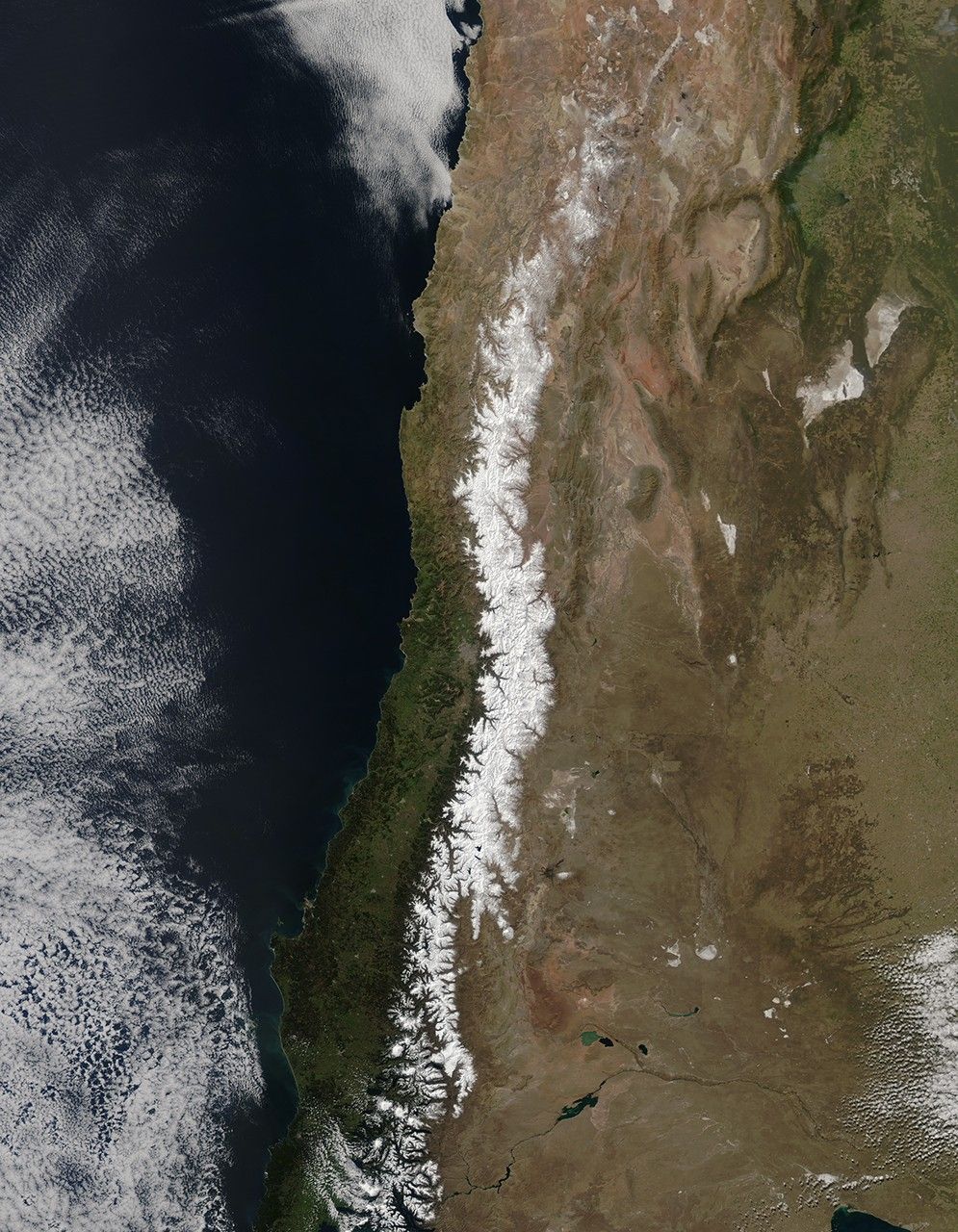





















As the end of Southern Hemisphere winter approached, snow painted the region’s mountain ranges. The Moderate Resolution Imaging Spectroradiometer (MODIS) on NASA’s Aqua satellite acquired this image of the snowy Andes Mountains on September 12, 2015.
The Andes—the longest series of mountain ranges the world—span about 7,242 kilometers (4,500 miles) and runs through seven countries. The segment visible in the image above shows about 1,200 kilometers (750 miles) of the range in Chile and Argentina. View the large image to see an even broader area.
The political boundary between Chile and Argentina runs through the rugged mountain terrain. Aconcagua, the highest mountain in the Southern Hemisphere, is visible just east of the border, in Argentina. The peak rises 6,962 meters (22,841 feet) above sea level.
The 2015 winter season began with little precipitation, compounding the effects of a multi-year drought in and around Santiago. In mid-July, however, a large storm dumped as much as 3 meters (10 feet) of snow in the mountains northeast of the city. Smaller accumulations were recorded elsewhere in the range.
The snowpack that accumulates in the mountains each winter is the primary source of water for communities at lower altitudes. Streams deliver the melt water to populated areas of central-western Argentina and central Chile, where it is particularly important for cities’ water supply, power generation, and agriculture. However, according to a report by the Intergovernmental Panel on Climate Change, frozen areas in the Andes are generally retreating, and runoff in the vicinity of Chile and Argentina is decreasing.
References & Resources
- Intergovernmental Panel on Climate Change (2014, March 31) Chapter 27. Central and South America. Accessed September 18, 2015.
- livescience (2013, March 14) Andes: World’s Longest Mountain Range. Accessed September 18, 2015.
- Powder (2015, July 28) Snow Report: South America. Accessed September 18, 2015.
- Reuters (2015, March 24) Chile says drought here to stay, lays out plan to ensure water. Accessed September 18, 2015.
- The Santiago Times (2014, April 8) IPCC report: Climate change threatens Chile’s water security. Accessed September 18, 2015.
NASA image by Jeff Schmaltz, LANCE MODIS Rapid Response. Caption by Kathryn Hansen.