


















Impact craters exist on every continent on Earth. While many have eroded away or been buried by geologic activity, some remain visible from the ground and from above. This week, we revisit stories featuring some of our most captivating satellite images of impact sites around the planet. The images and text on this page were originally published on May 31, 2021.
Most asteroids that survive an encounter with Earth’s atmosphere ultimately plummet into water, simply because oceans cover 70 percent of the planet. But massive space rocks occasionally hit land. That was the case 50,000 years ago when an iron asteroid smashed into North America and left a gaping hole in what is today northern Arizona.
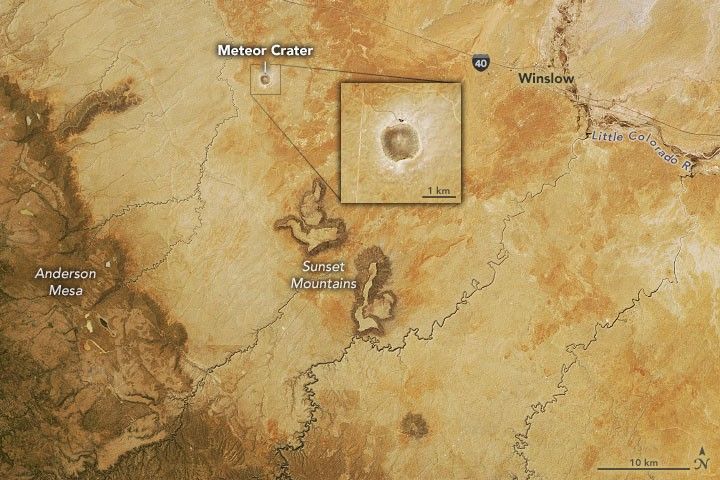
Meteor Crater (also called Barringer Meteor Crater) is located between Flagstaff and Winslow on the Colorado Plateau. The OLI (Operational Land Imager) on Landsat 8 acquired this image of the area on May 16, 2021.
Even at 50,000 years old, the crater is relatively young and remarkably well-preserved compared to other craters. Because of this, scientists have studied the site extensively to learn about cratering processes—how they work on Earth and elsewhere in the solar system—and about the modern hazards posed by asteroid impacts.
“A similar-size impact event today could destroy a city the size of Kansas City,” said David Kring, an impact cratering expert at the Lunar and Planetary Institute. Meteor Crater measures 0.75 miles (1.2 kilometers) across and about 600 feet (180 meters) deep. The size of the asteroid that produced the impact is uncertain—likely in the range of 100 to 170 feet (30 to 50 meters) across—but it had to be large enough to excavate 175 million metric tons of rock.
The wide perspective pictured above gives a sense of the crater in context with the surrounding area. This part of the Colorado Plateau drains from Anderson Mesa (lower left) and across a surface that dips toward the Little Colorado River near Winslow. The red blotchy areas near the crater are Moenkopi red siltstone amid light-brown Kaibab limestone. Volcanic landforms dot part of the wider landscape, including Anderson Mesa and the West and East Sunset Mountains.
Note how the crater’s rim and areas just outside it are much lighter tan. This is the debris that was ejected from the crater, consisting primarily of Kaibab limestone and Coconino sandstone. Also notice how the crater is not exactly circular, exhibiting almost a square shape. According to Kring, this is because pre-existing flaws in the rock caused it to peel back farther in four directions upon impact. These cracks, oriented northwest-southeast and northeast-southwest, formed when the Colorado Plateau was uplifted from below sea level to its current mile-high elevation.
The landscape has not always looked like this. When the asteroid hit, humans had not yet reached North America. The terrain of forested rolling hills was likely inhabited by mammoths, mastodons, and giant ground sloths. Now the crater stands amid shrub-covered desert.
References & Resources
- Kring, D. A. et al. (2019) Traces of Fallback Breccia on the Rim of Barringer Meteorite Crater (a.k.a. Meteor Crater), Arizona, 50th Lunar and Planetary Science Conference 2019, LPI Contrib. No. 2132.
- Lunar and Planetary Institute (2011) Lunar Analogue Training at Meteor Crater, Arizona & the San Francisco Volcanic Field, AZ (PDF). Accessed May 28, 2021.
- NASA Earth Observatory (2017, June 18) Sunset Crater.
- NASA Earth Observatory (2009, August 13) Fresh Craters on the Moon and Earth.
- NASA Earth Observatory (2009, September 7) Black Point Lava Flow, Arizona.
- Smithsonian Magazine (2020, January/February) The Fertile Shore. Accessed May 28, 2021.
NASA Earth Observatory image by Joshua Stevens , using Landsat data from the U.S. Geological Survey . Story by Kathryn Hansen .