



![Request for Information – Potential [Placeholder for Prize]](https://assets.science.nasa.gov/dynamicimage/assets/science/psd/solar/2023/09/s/solarsystem_0.jpg?w=1024)



Helio and You: April 2026
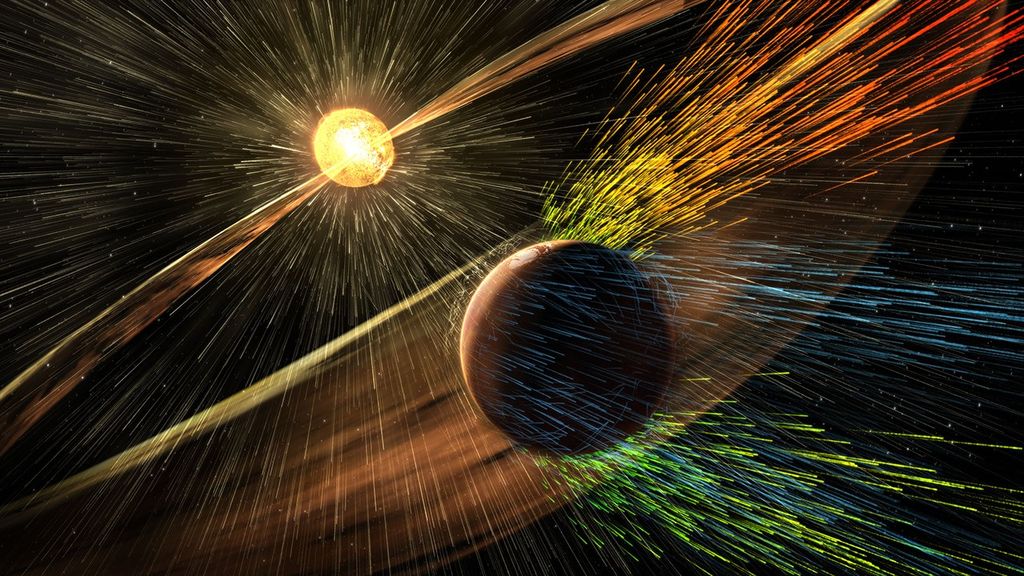
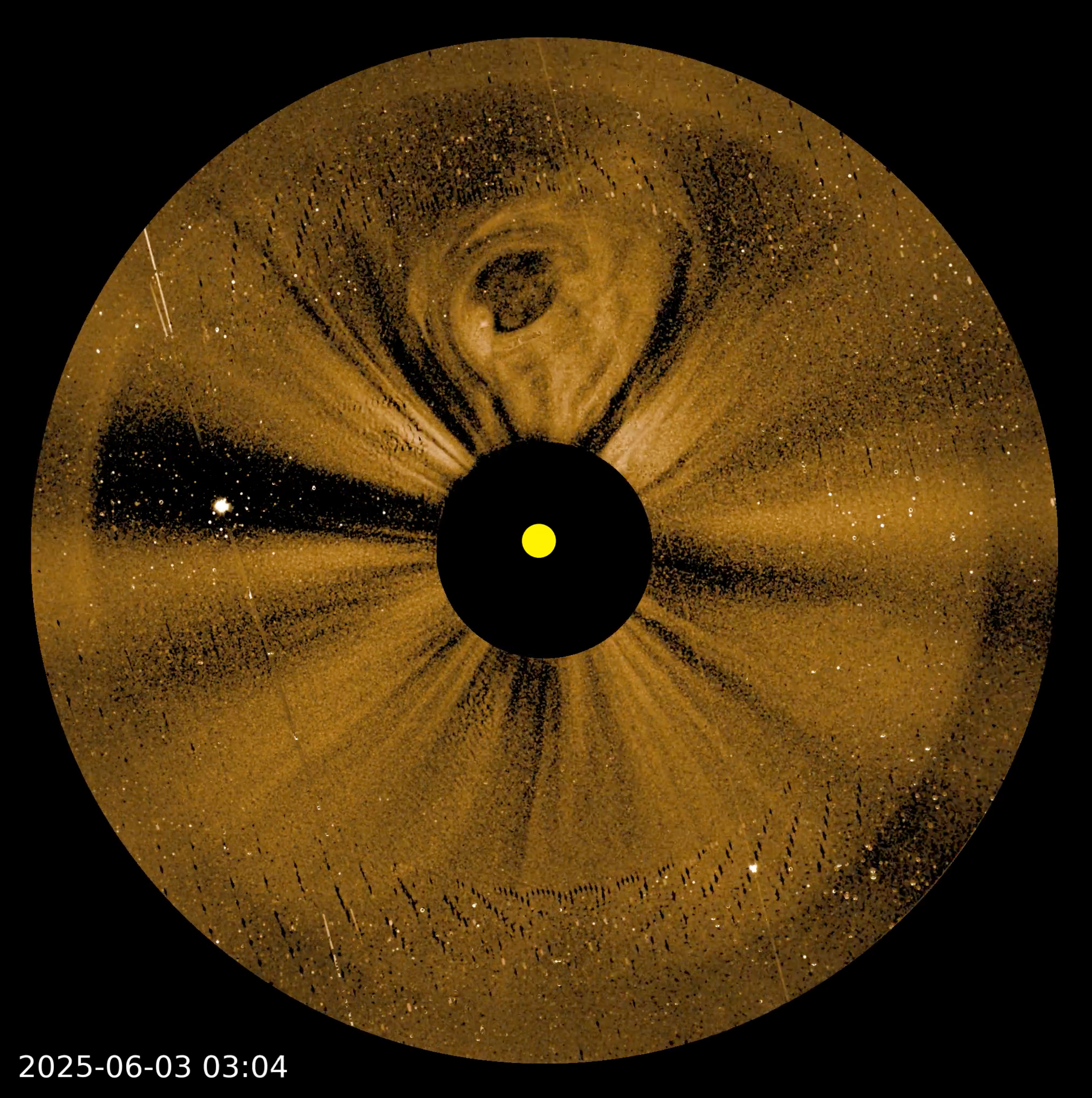
The PUNCH mission is designed to gain new insights into how the Sun's atmosphere, or corona, becomes the solar wind, how the solar wind develops as it traverses the inner heliosphere, and what impacts this evolving space weather has on the rest of the solar system.
The Sun, Solar Wind, and Earth as a Connected System
Looking Closer at the Sun
Launched on March 11, 2025, the Polarimeter to Unify the Corona and Heliosphere (PUNCH) mission is a constellation of four small satellites operating in low Earth orbit that make global observations of the entire inner heliosphere. The mission is designed to better understand how the mass and energy of the Sun’s atmosphere, or corona, becomes the solar wind that spreads out across the rest of the solar system.
The mission will answer longstanding questions about how the corona transitions to the solar wind, how structures in the solar wind are created, and how these processes affect the solar system. It also seeks to understand transient structures like coronal mass ejections (CMEs).
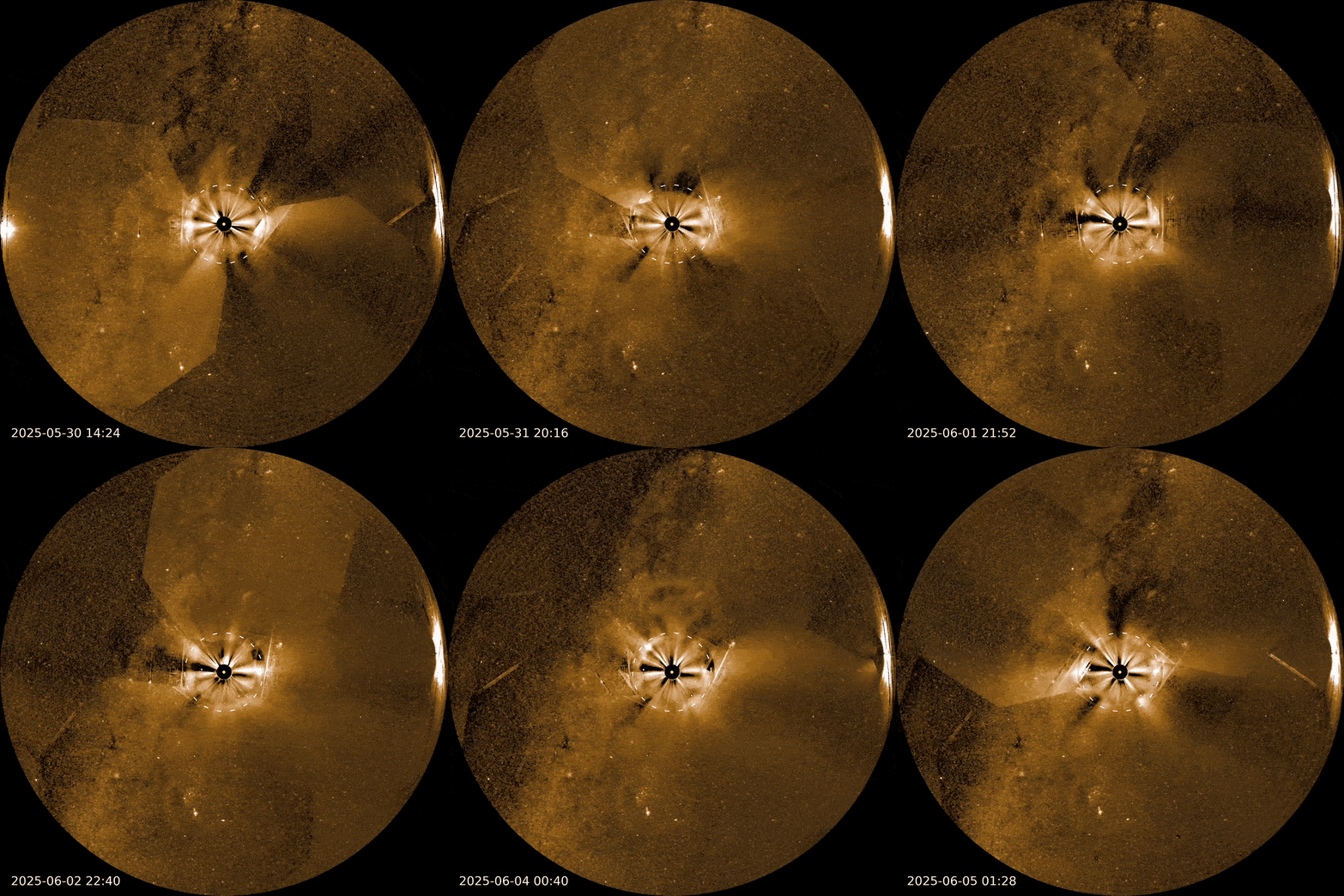
The mission will also investigate the Alfvén zone, a little-understood region in the outer corona where the solar wind enters interplanetary space as the solar wind speed exceeds the speed of the Alfvén waves (magnetic waves). Past that point, no magnetic information can make it back to the Sun.
In short, the mission seeks to better understand the Sun and heliosphere as a single system, and the origin and nature of structures in the solar wind. Although these features are born from the corona, they evolve on their way to Earth. The PUNCH mission can also help us to fill in the gaps in our knowledge of the plasma which makes up the border region between the outer corona and the inner heliosphere.
Small Spacecraft, Big Job
Each one of the mission’s four spacecraft is roughly three and a half feet (1 meter) in length and weighs about 90 pounds (40 kg). Each spacecraft acquires seven images every eight minutes of flight: three polarized images (one through each polarizing filter) every four minutes, plus an additional unpolarized image every eighth minute. Scientists merge these images to produce highly detailed 3D imagery.
The mission acquires polarized images over a 90° field of view centered on the Sun (from a few solar radii to 45° from the Sun in all directions). It requires four spacecraft because Earth blocks about half the view of the inner solar system from any one location in orbit. Synchronizing the images allows scientists to produce velocity maps and track features, and to localize those features by comparing brightness. Meanwhile, the cameras, optics, and image processing allow for accurate deep field imaging.
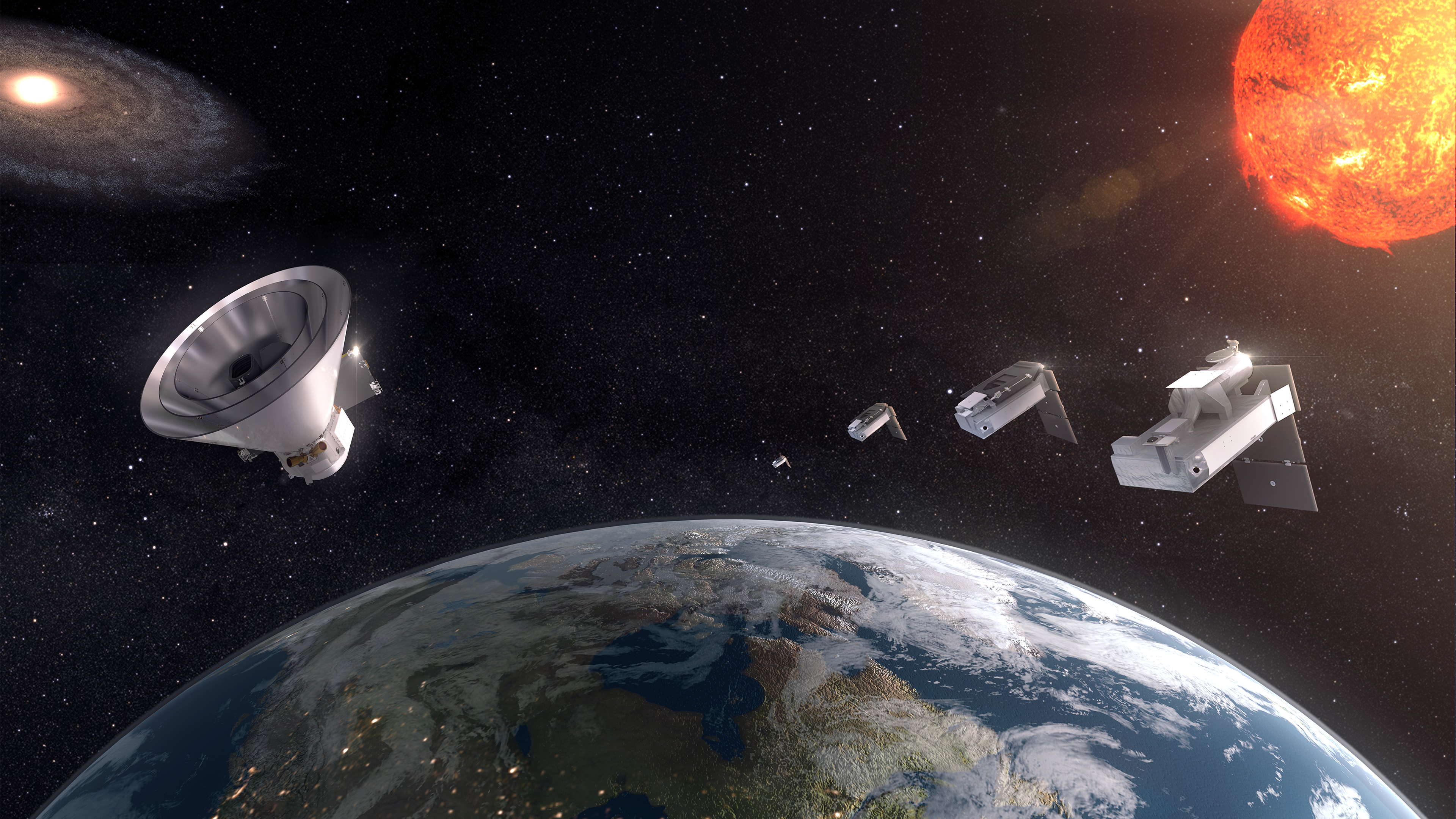
The Wide Field Imager (WFI) instrument is a wide-field heliospheric imager design based on an instrument aboard the STEREO (Solar Terrestrial Relations Observatory) mission, which also studies coronal mass ejections. Three of the PUNCH spacecraft carry one WFI instrument each, and they use a shielding ring of baffles to attenuate direct sunlight so that details of the Sun’s much dimmer atmosphere can be seen.
The fourth spacecraft carries the Near Field Imager (NFI) instrument, a compact coronagraph with a similar field of view to the Large Angle and Spectrometric Coronagraph (LASCO)-C3 instrument aboard SOHO (Solar and Heliospheric Observatory). This instrument uses an external arm to block direct sunlight from hitting its sensitive lenses, so they are not damaged by the Sun's intense energy.
An Expert Perspective
Dr. Nicholeen “Nicki” Viall conducts research at NASA Goddard Space Flight Center that links the solar corona to structures in the solar wind and their impact on the Earth's place in space. As the PUNCH mission scientist, she has a front-row seat to the science it produces. “The Sun makes the corona and the corona makes the heliosphere,” she explains. “But it's not a sharp transition, and the physics involved is complex.”

The PUNCH mission is designed to study this unique relationship between the corona and the heliosphere. It can examine that relationship from close in to the Sun all the way out to an Earth distance in one image.
Meteorologists don't model just one region of Earth. Instead, they model the whole globe, because knowing what's going to happen in one place requires knowing how the entire system interacts. “Think about CMEs observed with PUNCH,” explains Viall. “PUNCH sees the CME when it comes off the Sun, but with PUNCH, we can watch the CME the whole way through the inner heliosphere.”
With so much potential for new discoveries, it is easy to see why scientists are excited for PUNCH to start its main science mission. After spending the past year in the commissioning phase, the spacecraft is expected to send back data for 3D mapping around May 2026. This data will then help give us all a new perspective on how the Sun impacts the rest of the solar system, including life on Earth.
Resources for Educators ↓

Related Educational Resources
Stay up-to-date with the latest content from NASA's Heliophysics Resource Database (HRD) as we explore the universe and discover more about the Sun and our Solar System.
(Grades K-12+) A short video that introduces an unusual, curlicue petroglyph of a solar storm located in Chaco Canyon, New…
(Grades K-5) In this activity learners have the chance to play an online "drag & drop" word game to learn…
These resources guide learners to appreciate polarized light in our everyday environment and how the PUNCH Mission and the Citizen…
Related Articles
Keep up with the latest news in NASA heliophysics and the Science Activation portfolio.
Christine Shupla and Claire Ratcliffe Adams, from the NASA Science Activation program’s NASA@ My Library project, facilitated a professional development Co-Design Space Science, Technology, Engineering, & Mathematics (STEM) Workshop for Tribal libraries on August 29, 2024, hosted at the New…
Total Solar Eclipse in South America – December 14, 2020 NASA Space Science Education Consortium (NSSEC) members delivered products, gave presentations, and collaborated with NASA en Español, Office of Communications, and Pontificia Universidad Católica de Chile to engage many with…
In January, the American Museum of Natural History (AMNH) hosted its monthly planetarium program, offering attendees an insightful journey into the study of our solar system’s star. On January 23, 2024, Dr. Nour Raouafi, project scientist of the Parker Solar…
Helio and You
Find the full collection of past and future Helio and You articles here, as well as additional information about Heliophysics education.
Learn More