















Heliophysics Big Idea 1.2
The Framework for Heliophysics Education
Quick Facts
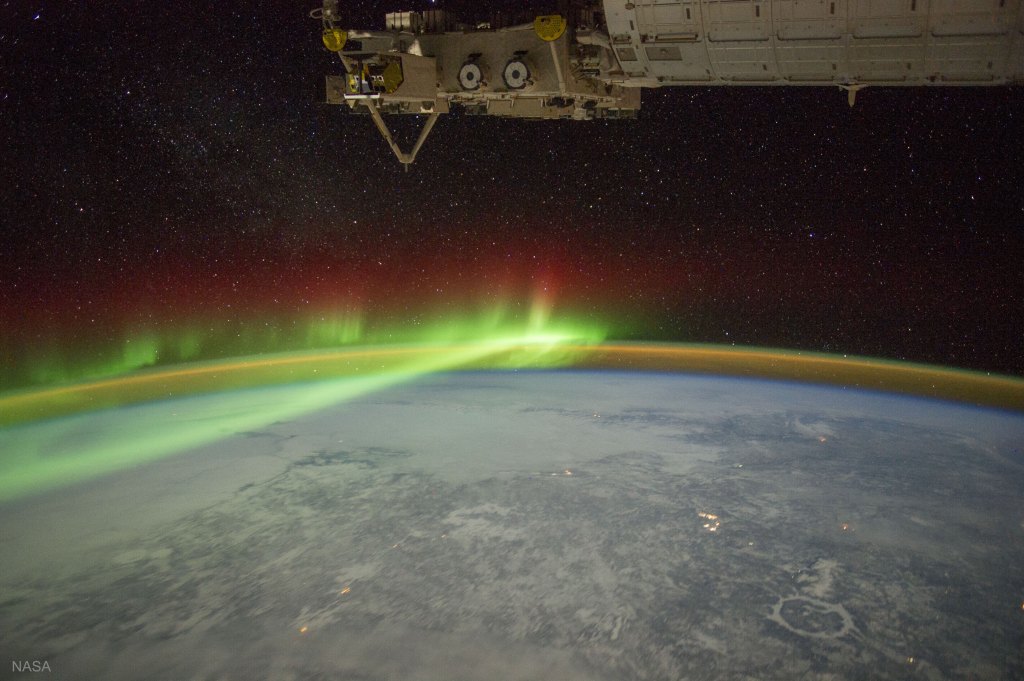
NASA studies aurora as they are visible markers of space weather processes around Earth.
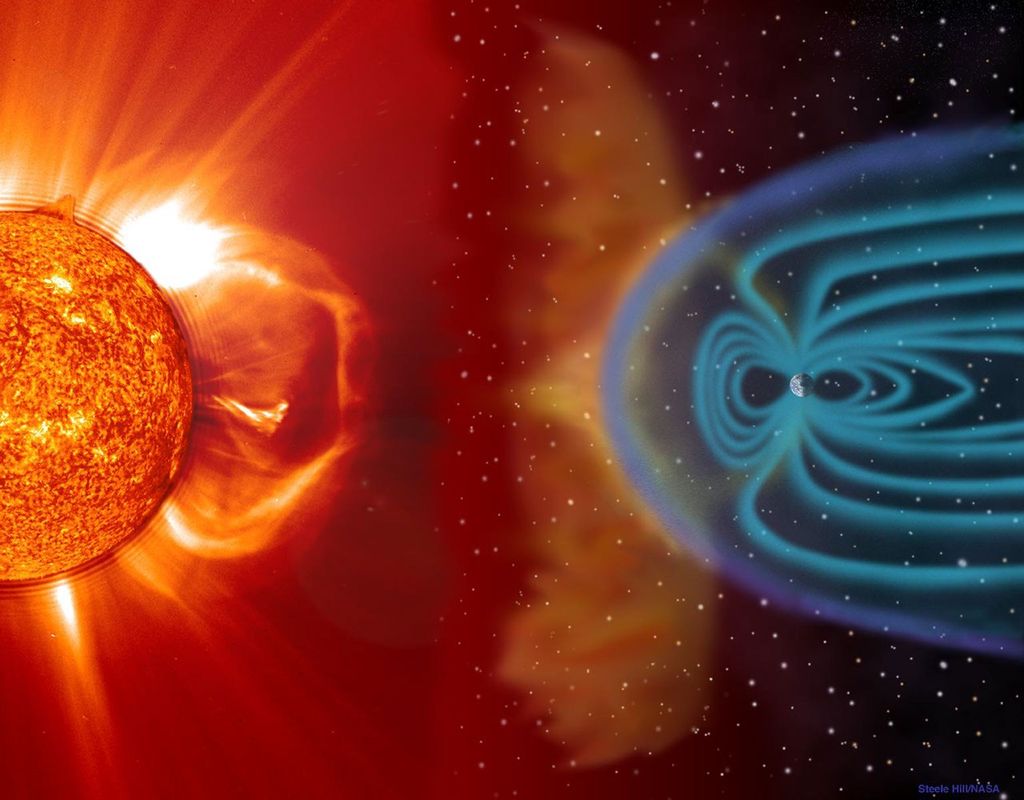
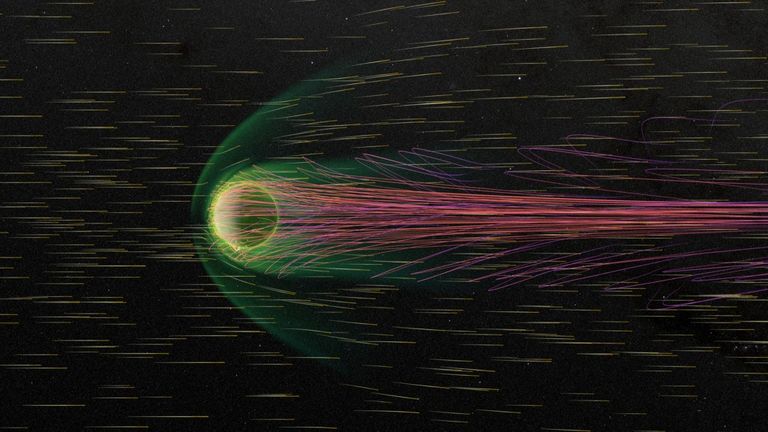
The Sun’s constant outflow of solar wind fills space with a thin wash of particles, fields and plasma.

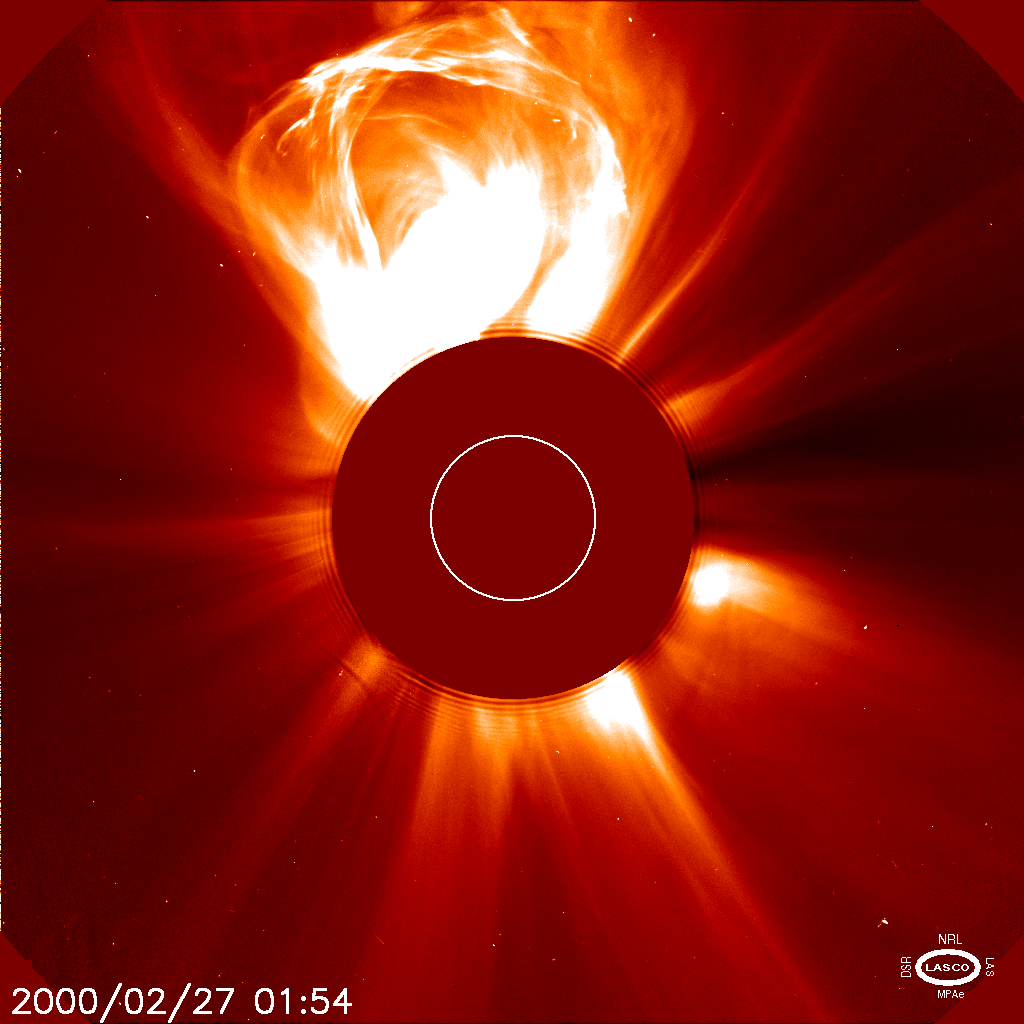
This solar wind, along with other solar events like giant explosions called coronal mass ejections, influences the very nature of space and can interact with the magnetic systems of Earth and other worlds.
Such effects also change the radiation environment through which our spacecraft travel. Close to Earth, such space weather can interfere with satellite electronics, communications and GPS signals, and even – when extreme – utility grids on Earth.
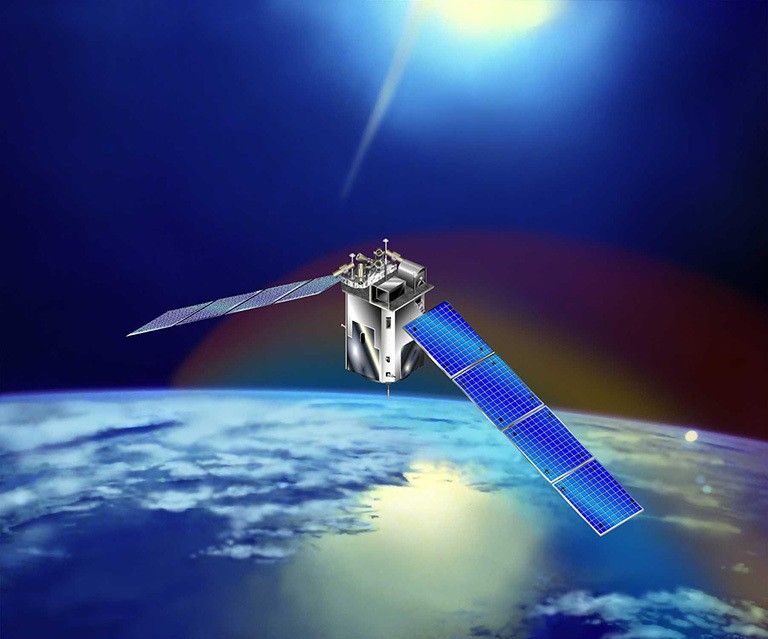
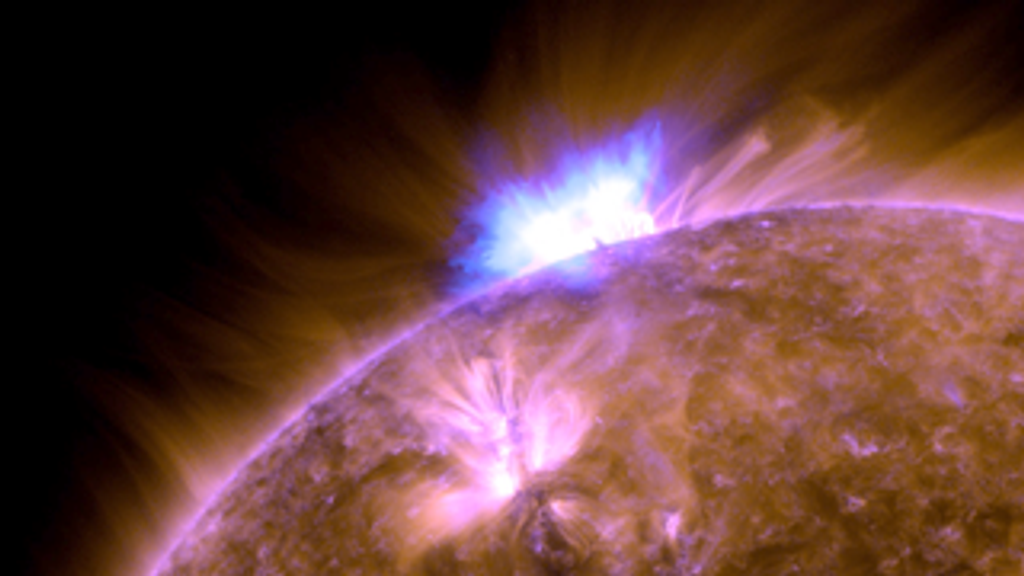
The Sun is active and can impact technology on Earth via Space Weather.
Guiding Questions
-
Introductory Learner (K-5)
How does the Earth keep us safe from the harmful effects of the Sun (including radiation and space weather)?3-PS2-3. Ask questions to determine cause and effect relationships of electric or magnetic interactions between two objects not in contact with each other.
3-PS2-4. Define a simple design problem that can be solved by applying scientific ideas about magnets.
5-ESS2-1. Develop a model using an example to describe ways the geosphere, biosphere, hydrosphere, and/or atmosphere interact. -
Intermediate Learner (6-8)
How does space weather impact my daily life?MS-ESS2-1. Develop a model to describe the cycling of Earth's materials and the flow of energy that drives this process.
MS-ESS2-6. Develop and use a model to describe how unequal heating and rotation of the Earth cause patterns of atmospheric and oceanic circulation that determine regional climates.
MS-PS1-4. Develop a model that predicts and describes changes in particle motion, temperature, and state of a pure substance when thermal energy is added or removed. -
Advanced Learner (9-12+)
How do scientists predict space weather?HS-ESS2-3. Develop a model based on evidence of Earth’s interior to describe the cycling of matter by thermal convection.
HS-PS2-4. Use mathematical representations of Newton’s Law of Gravitation and Coulomb’s Law to describe and predict the gravitational and electrostatic forces between objects.
HS-PS2-5. Plan and conduct an investigation to provide evidence that an electric current can produce a magnetic field and that a changing magnetic field can produce an electric current.
Related Topics By Level For Communicating Heliophysics
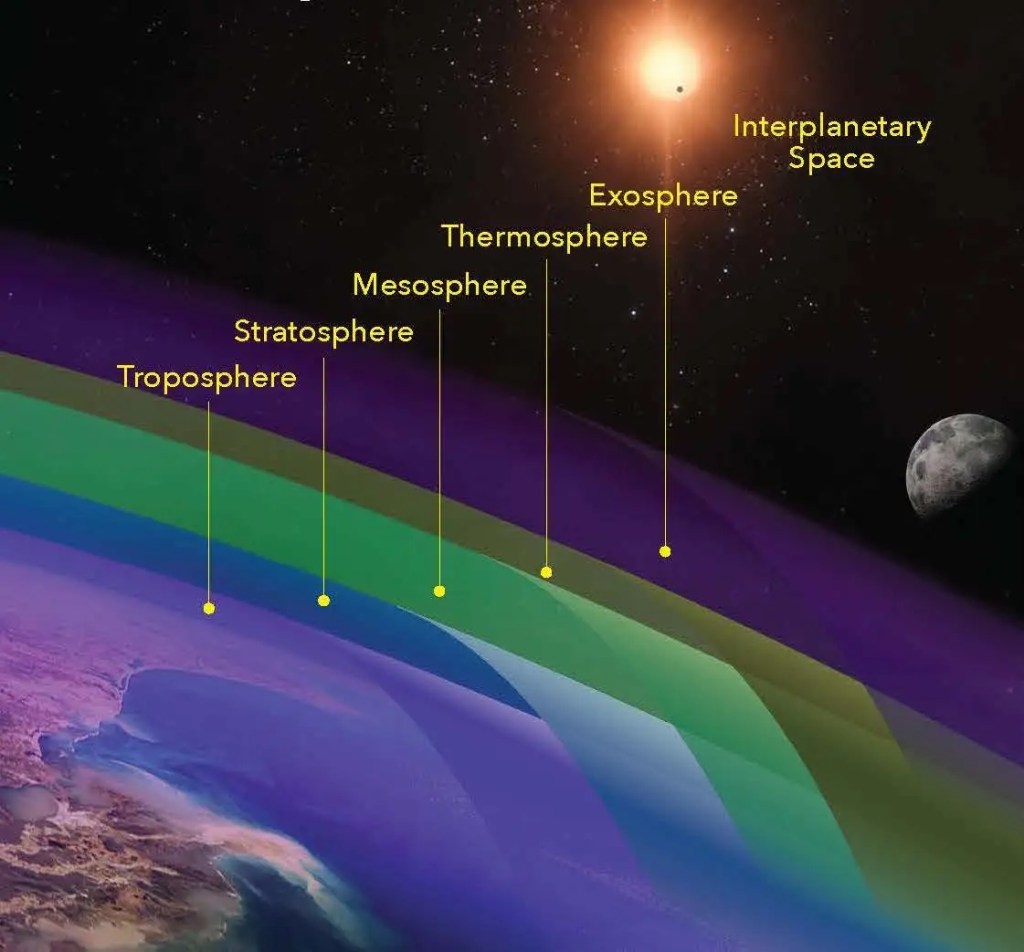
Atmosphere
What should learners know about this topic at each level?
Introductory: Our atmosphere consists of 21% oxygen, 78% nitrogen and 0.9% argon. There is also an important trace gas called carbon dioxide. Without it, our planet would be too cold for liquid water and life.
Intermediate: The atmosphere is a gaseous envelope surrounding and protecting our planet from the intense radiation of the Sun and serves as a key interface between the terrestrial and ocean cycles. Its inner layers closest to the surface are responsible for clouds and weather, while the outer layers above the stratosphere include the ozone layer, which protects life from ultraviolet light. Our atmosphere shields us from all solar radiation in the x-ray and gamma-ray bands of the EM spectrum, and some of the ultraviolet light. It also shields us from many forms of infrared and radio wavelength light.
Advanced: Our atmosphere does not have the same density and temperature at all heights. It is heated by absorbing radiation from the sun, and its ozoine layer blocks nearly all ultraviolet light. The upper stratosphere is strongly affected and heated by solar activity that produces x-rays. Its temperature and thickness is highest during sunspot maximum when the sun is most active.
Aurora
What should learners know about this topic at each level?
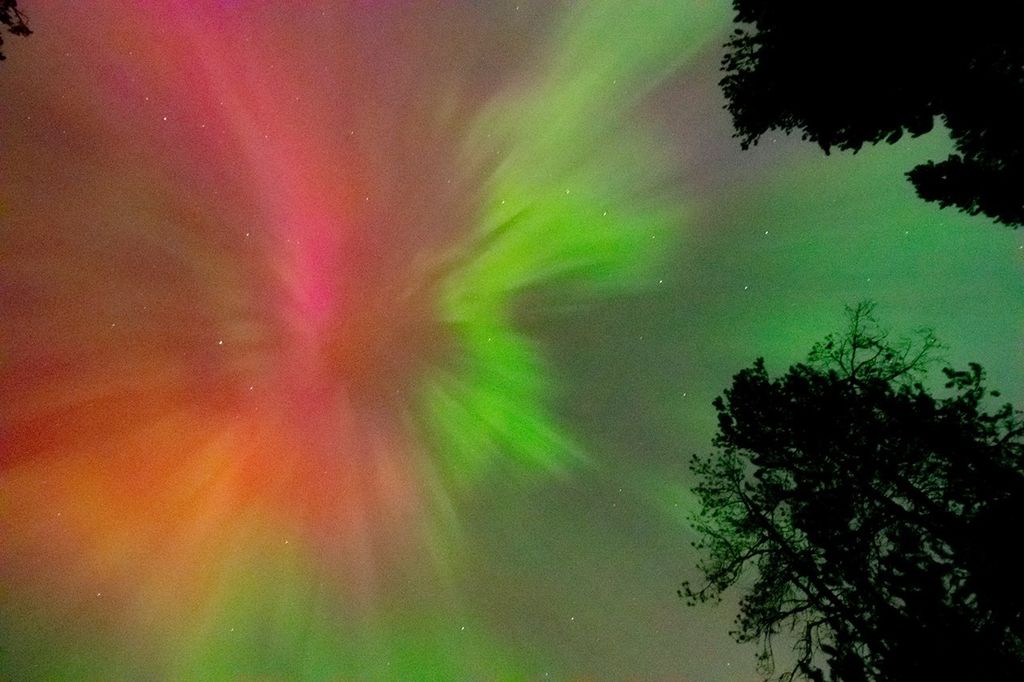
Introductory: Aurora are colored lights in the sky that appear over the Arctic Region (Aurora Borealis) and the Antarctic Region (Aurora Australis) during days when the Sun produces storms. These stormy periods follow the sunspot cycle and are most numerous when many sunspots are present.
Intermediate: Auroras are caused by currents of charged particles that are accelerated within Earth’s magnetosphere. These particles, usually electrons, follow Earth's magnetic field into the polar regions and cause atoms of oxygen and nitrogen to give off specific colors of light. Solar storms called coronal mass ejections or CMEs, interact with Earth's magnetosphere cause temporary disturbances in Earth's magnetosphere. These disturbances are called "geomagnetic storms."
Advanced: Glowing auroras are the result of millions of individual particle collisions, colliding with atoms of oxygen and nitrogen, and lighting up Earth's magnetic field lines over the Polar Regions. When CMEs reach Earth's magnetosphere, they can cause magnetic reconnection, which transfers magnetic energy into accelerating electrons in the magnetiosphere. This causes electrons trapped in Earth’s magnetic field to rain down toward Earth's poles. Along the way, these electrons can collide with atoms and molecules in Earth's upper atmosphere, which provides the atoms with extra energy, which they release as a burst of light. These interactions continue at lower and lower altitudes until all the excess energy is lost. Studying auroras offers insights on how our magnetosphere reacts to near-Earth space weather.
Coronal Mass Ejection
What should learners know about this topic at each level?
Introductory: Magnetic reconnection occurs across the universe, including on the Sun, near black holes, and around Earth. Particles launched by magnetic reconnection near Earth can travel down along magnetic field lines into the atmosphere, where they can spark auroras.
Intermediate: When magnetic field lines become mixed, they can explosively snap and realign, flinging away nearby particles at high speeds in a process called magnetic reconnection. Coronal mass ejections, or CMEs, are large clouds of solar plasma and embedded magnetic fields released into space after a solar eruption. They are created when smaller-sized fields reconnect together to form progressively larger ones that contain enough energy to be launched from the Sun.
Advanced: Coronal mass ejections, or CMEs, expand as they sweep through space, often measuring millions of miles across, and can collide with planetary magnetic fields. When directed at Earth, a CME can produce geomagnetic disturbances that ignite bright aurora, short-circuit satellites and power grids on Earth, or at their worst, even endanger astronauts in orbit. When launched from the Sun, CME magnetic fields at first become compressed, which causes the trapped particles such as protons to be accelerated to very high energies. These solar proton events produce radiation that is a severe hazard for astronauts in space.