









Suggested Searches

SWERV: Introduction to Space Weather
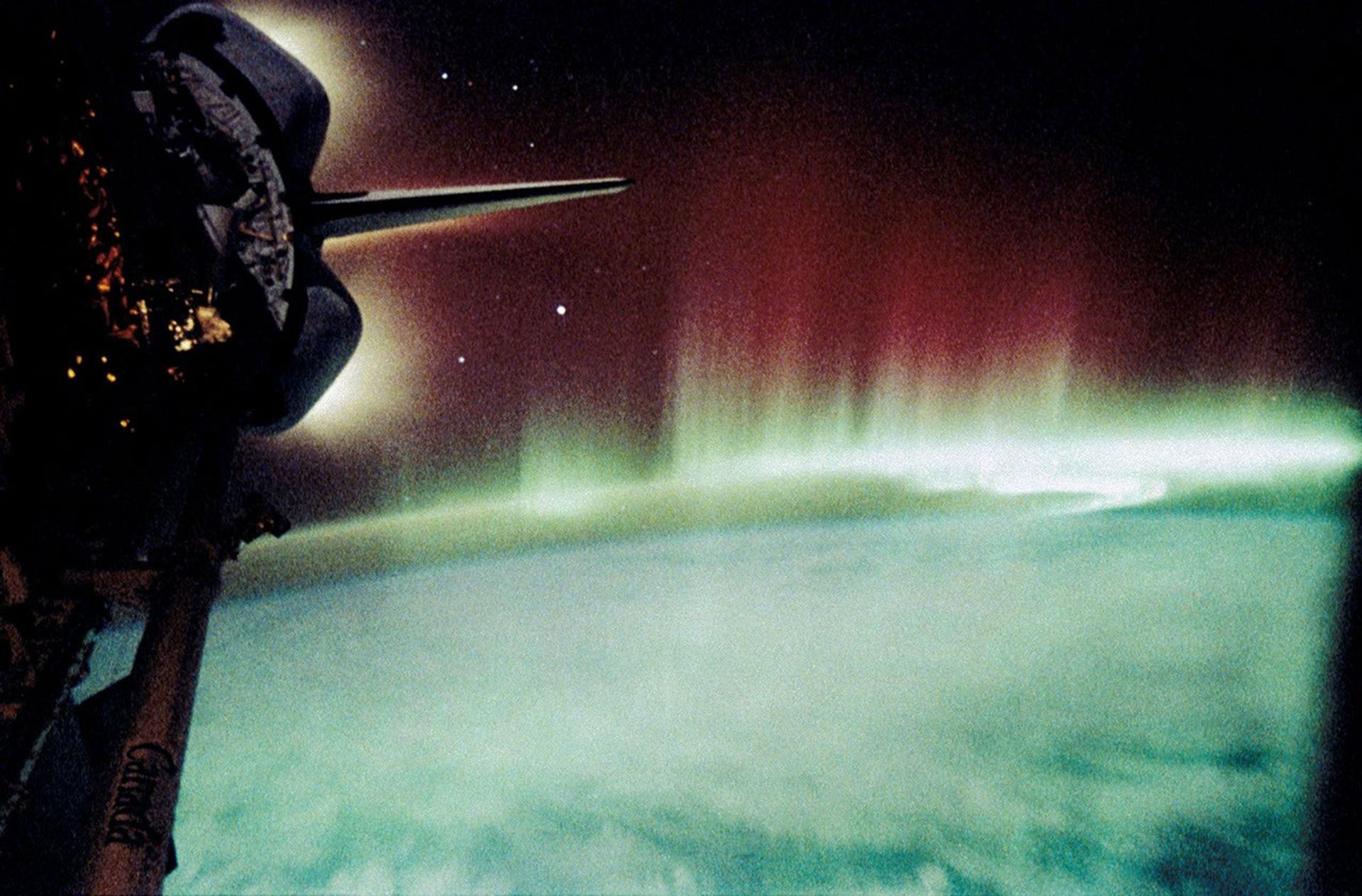
STS039-342-026 (28 April-6 May 1991) — This view of the Aurora Australis, or Southern Lights, shows a band of airglow above the limb of Earth. Photo experts at NASA studying the mission photography identify the airglow as being in the 80-120 kilometer altitude region and attribute its existence to atomic oxygen (wavelength of 5,577 Angstroms), although other atoms can also contribute. The atomic oxygen airglow is usually most intense at altitudes around 65 degrees north and south latitude, and is most intense in the spring and fall of the year. The aurora phenomena is due to atmospheric oxygen and nitrogen being excited by the particles from the Van Allen Radiation belts which extend between the two geomagnetic poles. The red and green rays appear to extend upward to 200-300 kilometers, much higher than the usual upper limits of about 110 kilometers.
Material Type
  • Presentation/Lecture
Math Skills
  • Data Analysis
Heliophysics Big Ideas
  • Big Idea 1.2 – The Sun is active…
  • Big Idea 2.2 – The Sun defines the space…
  • Big Idea 3.1 – The Sun is made of churning plasma…
  • Big Idea 3.3 - Our Sun, like all stars, has a life cycle.
Heliophysics Topics
  • Aurora
  • Coronal Mass Ejection
  • Van Allen Belts
  • Sun
  • Space Weather
  • Solar Flare
  • Technology
  • Magnetotail
  • Magnetosphere
  • Magnetic Reconnection
  • Magnetic Field
  • Plasma
  • Geomagnetic Storm
  • Electromagnetism
  • Geomagnetic Field
  • Solar Cycle
  • Heliosphere
Heliophysics Missions
  • ACE
  • Solar Dynamics Observatory (SDO)
  • Solar and Heliospheric Observatory (SOHO)
Material Cost per Learner Free
Language English

NASA Space Weather Event Response & Vulnerability Introduction to Space Weather 

This comprehensive presentation provides a broad overview of space weather, beginning with the above historical disaster to set the stage for understanding future impact. Educators and professionals may use this tool to explore the Sun's activity, the plasma it's composed of, and its life cycle, as well as how understanding these phenomena help other professionals define routes for mitigation.

Users can apply this resource by following the structured slide deck to deliver an engaging lecture or to support professional learning on solar cycles, magnetic fields, and space weather events.

This resource was produced by M2M-SWAO and Melissa Kane.

Download PDF file below.