


















Are we really made of star stuff?
Core learning question 1.1 from the Astrobiology Learning Progressions
Astrobiology Learning Progressions Navigation

Next
1.2. How did our Solar System form?
Grades K-2 or Adult Naive Learner
Have you ever wondered what we’re made of? Would you believe that you and me and all of the plants and all of the animals that we can see are all made of the same kind of stuff that makes up books and rocks and mountains and the ocean? We’re all made from the same kind of stuff, and we call that stuff “matter”.
Can you guess where all of that matter came from? It was all made in space! A lot of that stuff, that matter, that makes up you and me and the place we live was made inside of stars long, long ago. So long ago that it’s older than your parents, it’s older than the dinosaurs, and it’s even older than the Sun!
We’re all made of the stuff from stars!
Disciplinary Core Ideas
PS1.A: Structure and Properties of Matter:
- Different kinds of matter exist and many of them can be either solid or liquid, depending on temperature. Matter can be described and classified by its observable properties. (2-PS1-1)
- Different properties are suited to different purposes. (2-PS1-2, 2-PS1-3)
- A great variety of objects can be built up from a small set of pieces. (2-PS1-3)
ESS1.A: The Universe and Its Stars: Patterns of the motion of the Sun, moon, and stars in the sky can be observed, described, and predicted. (1-ESS1-1)
ESS1.B: Earth and the Solar System: Seasonal patterns of Sunrise and Sunset can be observed, described, and predicted. (1-ESS1-2)
ESS1.C: The History of Planet Earth: Some events happen very quickly; others occur very slowly, over a time period much longer than one can observe. (2-ESS1-1)
Crosscutting Concepts
Patterns in the natural world can be observed, used to describe phenomena, and used as evidence. (K-LS1-1)
Big Ideas: The solar system consists of Earth and seven other planets spinning around the Sun. The Sun and planets formed from a huge cloud of gas and dust. Everything is made of matter. Much of the matter that makes up people and planets was made inside of stars long ago.
Boundaries: By the end of 2nd grade, students can understand/describe the patterns of the Sun, the Moon, and the stars as viewed from Earth, and make observations/predictions about them. Students will also understand seasonal patterns of Sunrise and Sunset. Grade level appropriate observations include: the Sun and moon appear to rise and set in different parts of the sky, and star visibility at night, but not in the day (except for our Sun). These observations can be used as evidence in supporting their understanding of Earth’s place in the universe.
No appropriate content for this grade level. Please use the navigation arrows to switch levels.

Grades 3-5 or Adult Emerging Learner
The story of where we came from begins in space, a long time ago, even before the Sun and the planets in our solar system formed. A lot of the stuff, the matter, that makes up you and me and everything we see on Earth was formed inside of stars long ago.
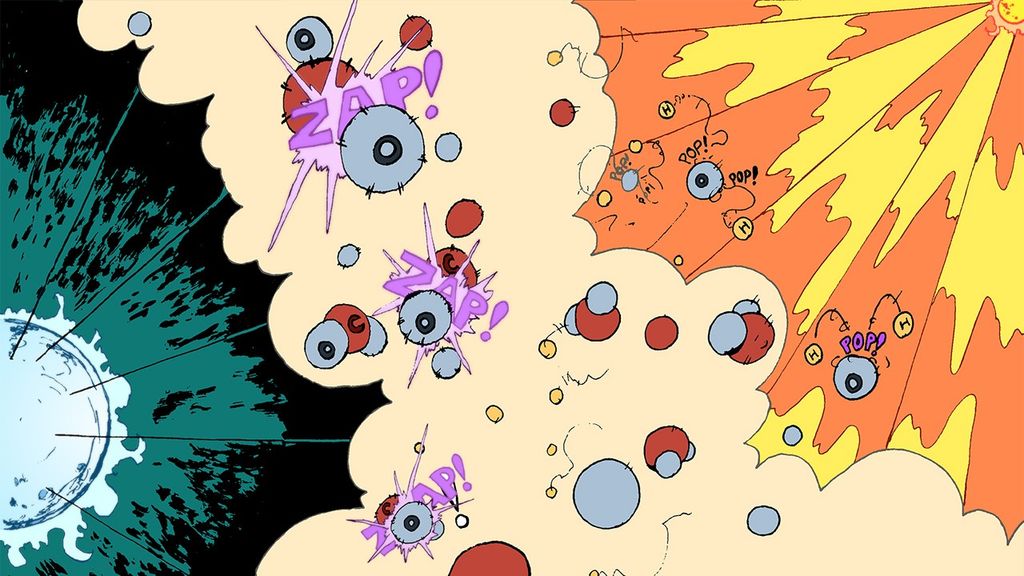
Sometimes when we talk about stars, we talk about them as if they’re living things. So, we’ll say that a star is born, it has a life, and then it dies, and we call this a “lifecycle.” A star can be born and start its lifecycle when a bunch of dust and ice in space comes together. Just like when you drop something and it falls because of gravity, when there’s a lot of ice and dust together in space, it can fall together because of gravity and make up an entire star. Once a star is born, it starts to make light and heat, just like our Sun, and, when that happens, it starts creating different kinds of matter inside. Even right now, our own Sun is making new kinds of matter inside of it from the other stuff that’s there.
So, how does all of that new matter that’s created inside of stars get out and end up inside of you and me and other stuff? Well, some stars, when they get old and are at the end of their life cycles, will explode and send all of that new matter out into space. Then, later on, when new stars and new planets are forming, some of that new matter ends up in them. So, a lot of the matter that’s inside of our Sun and inside of our planet and even inside of us was made within stars long, long ago. That means that you are made of star stuff!
Disciplinary Core Ideas
ESS1.A: The Universe and its Stars: The Sun is a star that appears larger and brighter than other stars because it is closer. Stars range greatly in their distance from Earth. (5-ESS1-1)
PS3.A: Definitions of Energy: The faster a given object is moving, the more energy it possesses. (4-PS3-1) Energy can be moved from place to place by moving objects or through sound, light, or electric currents. (4-PS3-2, 4-PS3-3)
PS3.B: Conservation of Energy and Energy Transfer: Energy is present whenever there are moving objects, sound, light, or heat. When objects collide, energy can be transferred from one object to another, thereby changing their motion. In such collisions, some energy is typically also transferred to the surrounding air; as a result, the air gets heated and sound is produced. (4-PS3-2, 4-PS3-3) *Light also transfers energy from place to place. (4-PS3-2)
Crosscutting Concepts
Patterns can be used as evidence to support an explanation. (4-ESS1-1, 4-ESS2-2)
Big Ideas: The planets of the solar system and the Sun all formed from a large cloud of gas and dust a long time ago. While there are many stars in the universe, the Sun is the closest one to Earth so it appears to be the largest. Stars vary in size and proximity to Earth. All stars have a life cycle and some produced the matter that makes up life here on Earth. Some of the patterns in the universe can be observed here on Earth. The gravitational force of Earth acting on an object near Earth’s surface pulls the object towards the planets center.
Boundaries: By the end of 5th grade, students will understand the Sun appears larger and brighter than other stars because of its proximity to Earth. References to time (i.e. “a long time ago”) emphasize relative time rather than a specific time. In this grade band, no attempt is made to give a precise or complete definition of energy.
3-5 SpaceMath Problem 541: How to Build a Planet. Students study planet growth by using a clay model of planetesimals combining to form a planet by investigating volume addition with spheres. [Topics: graphing; counting] Space Math VI
5-12 What are we made of? The Sun, the Earth and You. In this hands-on activity, students use a model of the particles in the solar wind as determined by the Genesis mission to compare the elements of the Sun and the Earth. This student-centered lesson supports the cosmic connection to life on Earth. http://genesismission.jpl.nasa.gov/educate/bead_activity/tg_bead_activ.pdf
Grades 6-8 or Adult Building Learner
The story of where we came from begins in space. All of the matter that makes up you and me and everything we see on Earth is composed of the chemical elements. If you think about all of the elements on the periodic table, things like oxygen and carbon and iron, almost all of those elements that we see and that make up the stuff around us formed inside of stars long ago.
When the universe was young, before there were any galaxies or stars or planets, the only elements that existed were hydrogen and helium and a little bit of lithium. These are the first and lightest elements on the periodic table. As time passed in the universe, some of the earliest matter, the hydrogen and helium and lithium, started to clump together. When this happened, it made the first stars.
Something really cool can happen inside of stars, where nuclear fusion causes some of the lighter elements to come together, or fuse, and make heavier elements. So, things like hydrogen and helium were fused together to make heavier elements, like carbon, and then those heavier elements could make even heavier elements. Stars are like big chemical element factories! Even our Sun is currently making new elements inside of it.
All stars will eventually burn out, but, for some of the stars, when they burn out, or reach the end of their “life cycles” they can explode and blow out all of the heavy elements that were inside. These explosions can also make new, even heavier elements. Then, later on, when new stars and new planets are forming from the matter in space clumping together, some of these heavier elements end up in them. So, a lot of the matter that’s inside of our Sun and inside of our planet and even inside of us was made within stars long, long ago. That means that you are made of star stuff!
Disciplinary Core Ideas
PS1.A: Structure and Properties of Matter:
- Substances are made from different types of atoms, which combine with one another in various ways. Atoms form molecules that range in size from two to thousands of atoms. (MS-PS1-1)
- Each pure substance has characteristic physical and chemical properties (for any bulk quantity under given conditions) that can be used to identify it. (MS-PS1-3)
- In a solid, atoms are closely spaced and may vibrate in position but do not change relative locations. (MS-PS1-4)
- Solids may be formed from molecules, or they may be extended structures with repeating subunits (e.g., crystals). (MS-PS1-1)
- The changes of state that occur with variations in temperature or pressure can be described and predicted using these models of matter. (MS-PS1-4)
PS1.C (only in Framework): Nuclear fusion can result in the merging of two nuclei to form a larger one, along with the release of significantly more energy per atom than any chemical process. It occurs only under conditions of extremely high temperature and pressure. Nuclear fusion taking place in the cores of stars provides the energy released (as light) from those stars and produced all of the more massive atoms from primordial hydrogen. Thus the elements found on Earth and throughout the universe (other than hydrogen and most of helium, which are primordial) were formed in the stars or supernovas by fusion processes.
Crosscutting Concepts
Time, space and energy phenomena can be observed at various scales using models to study systems that are too large or too small. (MS-PS1-1)
Big Ideas: The universe began with a period of extreme and rapid expansion known as the big bang. The Milky Way galaxy is one of many galaxies in the universe. Earth and its solar system are a part of the Milky Way. All of the elements that make up Earth have been formed over billions of years through the life cycle of stars. The process of producing elements inside of stars is called fusion. Through fusion, lighter elements combine to form heavier elements, releasing energy in the process. All of the elements in the universe were made this way and this process continues today.
Boundaries: By the end of 8th grade, students use models to observe, describe, predict and explain the motion of the Sun, the Moon, and the stars. Models can be physical, graphical, or conceptual. Forces that act at a distance (gravitational, electric, and magnetic) can be explained by force fields that extend through space and can be mapped by their effect on a test object (a ball, a charged object, or a magnet, respectively). Additionally, students at this level can understand atoms and the properties of elements.
4-6 SpaceMath Problem 294: Star Cluster Math. A simple counting exercise involving star classes lets students work with percentages and ratios. [Topics: counting; percentage; scaling] Space Math VI
5-12 What are we made of? The Sun, the Earth and You. In this hands-on activity, students use a model of the particles in the solar wind as determined by the Genesis mission to compare the elements of the Sun and the Earth. This student-centered lesson supports the cosmic connection to life on Earth. http://genesismission.jpl.nasa.gov/educate/bead_activity/tg_bead_activ.pdf
6-8 SpaceMath Problem 480: The Expanding Gas Shell of U Camelopardalis. Students explore the expanding U Camelopardalis gas shell imaged by the Hubble Space Telescope, to determine its age and the density of its gas. [Topics: scientific notation; distance = speed x time; density=mass/volume] https://spacemath.gsfc.nasa.gov/stars/9Page2.pdf
6-8 SpaceMath Problem 182: Our Neighborhood in the Milky Way. Students create a scale model of the local Milky Way and estimate distances and travel times for a series of voyages. [Topics: scale models; speed-distance-time] https://spacemath.gsfc.nasa.gov/stars/5Page30.pdf
6-8 SpaceMath Problem 544: The Composition of Planetary Atmospheres. Students study the composition of planetary atmospheres and compare the amounts of certain compounds in them [Topics: pie graphs; percentages; scientific notation] https://spacemath.gsfc.nasa.gov/Grade67/10Page7.pdf
6-8 Explore! Jupiter’s Family Secrets. In this one-hour lesson for formal or informal education, students connect their own life story to a cultural creation story and then the “life” story of Jupiter. This “life” story of Jupiter includes the Big Bang as the beginning of the universe, the creation of elements through stars and the creation of the solar system. JPL /NASA http://www.lpi.usra.edu/education/explore/solar_system/activities/birthday/
6-9 Rising Stargirls Teaching and Activity Handbook. Constellations (page 13). Introduces students to what constellations are, to their subjective nature, and to the range of cultures that have named constellations. In Make Your Own Constellation (page 15) students are given an introduction to some constellations in the night sky and create their own constellations. Rising Stargirls activities are a part of a 10-day workshop dedicated to encouraging girls of all backgrounds to learn, explore, and discover the universe through interactive astronomy using theater, writing, and visual art. This provides an avenue for individual self-expression and personal exploration that is interwoven with scientific engagement and discovery. together, both science and the arts can create enlightened future scientists and imaginative thinkers. Rising Stargirls. https://static1.squarespace.com/static/54d01d6be4b07f8719d7f29e/t/5748c58ec2ea517f705c7cc6/1464386959806/Rising_Stargirls_Teaching_Handbook.compressed.pdf
6-12 Formation of Galaxies: This engaging three-day lesson uses the 5E approach to have students explore gravity and the formation of galaxies through a variety of methods, including a gravity simulator. This lesson develops students’ understanding of the early universe and how galaxy formation is driven by initial conditions, gravity, and time. This sample lesson is part of the Voyages through Time Curriculum: Cosmic Evolution. SETI
6-12 Astrobiology Math. This collection of math problems provides an authentic glimpse of modern astrobiology science and engineering issues, often involving actual research data. Students explore concepts in astrobiology through calculations. Relevant topics that support the origin of the universe include Counting Galaxies with the Hubble Space Telescope (page 103) and Our Neighborhood in the Milky Way (page 113). NASA . https://www.nasa.gov/pdf/637832main_Astrobiology_Math.pdf
6-12 Dawn: Find a Meteorite. This online activity (45-90 minutes) introduces the importance of meteorites to the understanding of the origin of the Solar System. Learners use a key to determine if samples are meteorites. Finding meteorites can be difficult because most meteorites look like Earth rocks to the casual or untrained eye. These lessons require multiple computers for individuals, pairs, or small groups. JPL /NASA. https://dawn.jpl.nasa.gov/Meteorite/
7-12 Cosmic Times: In this blast from the past, students go through an online newspaper that chronicles the events surrounding the Big Bang. The articles and pictures provide a glimpse of the evidence and possible hypotheses involved in the Big Bang Theory in order to evaluate possible solutions. NASA
7-12 Cosmic Questions. This collection of eight 30-45 minute lessons was developed to support the information in the informal education exhibit Cosmic Questions. The lessons include subjects such as the Big Bang Theory and its evidence. Each lesson is stand-alone. The activity “Comparing Optical and X-Ray images” (page 31) provides students with the opportunity to compare shreds of an exploded star and a star ejecting matter as it expands. In the activity “Modeling the Expanding Universe,” students visualize the universe expanding in all directions during the Big Bang (page 39). Harvard-Smithsonian/NSF/NASA. https://www.cfa.harvard.edu/seuforum/exhibit/resources/CQEdGuide.pdf#page=18
8-10 SpaceMath Problem 416: Kepler probes the interior of red giant stars. Students use the properties of circular arcs to explore sound waves inside stars. [Topics: geometry of circles and arcs; distance=speed x time] https://spacemath.gsfc.nasa.gov/stars/7Page80.pdf
8-10 SpaceMath Problem 121: Ice on Mercury? Since the 1990’s, radio astronomers have mapped Mercury. An outstanding curiosity is that in the polar regions, some craters appear to have ‘anomalous reflectivity’ in the shadowed areas of these craters. One interpretation is that this is caused by subsurface ice. The MESSENGER spacecraft hopes to explore this issue in the next few years. In this activity, students measure the surface areas of these potential ice deposits and calculate the volume of water that they imply. [Topics: area of a circle; volume, density, unit conversion] https://spacemath.gsfc.nasa.gov/Geometry/4Page23.pdf
8-10 SpaceMath Problem 124: The Moon’s Atmosphere! Students learn about the moon’s very thin atmosphere by calculating its total mass in kilograms using the volume of a spherical shell and the measured density. [Topics: volume of sphere, shell; density-mass-volume; unit conversions] https://spacemath.gsfc.nasa.gov/moon/4Page26.pdf
Grades 9-12 or Adult Sophisticated Learner
Our planet and all of the living things on it are made from matter. Most of that matter was created during the big bang and the rest was mostly created within the cores of ancient stars. During the big bang, all of the hydrogen, most of the helium, and some of the lithium in our universe was created from subatomic particles, like protons and neutrons. Protons and neutrons are sometimes called “nucleons”, since they are in the nuclei of atoms. Since protons and neutrons came together to make the nuclei of these lighter elements during the big bang, we call this process “big bang nucleosynthesis.”
It was this earliest matter, composed of the three lightest elements on the periodic table, that made the very first stars. And these stars were big and bright and they burned out really fast. We call them the “first generation stars”. It was within the cores of these first stars that the process of nuclear fusion first started creating elements heavier than lithium. The hydrogen and the helium inside were squeezed so tightly and with so much energy, that they started forming things like carbon and nitrogen and oxygen. Much like big bang nucleosynthesis, where new elements had been formed, we call this process of forming new elements from nuclear fusion within stars “stellar nucleosynthesis.”
When those first stars “burned up” their elemental “fuel,” they went through a process called “supernova”, where the stars explode and send a lot of their matter out into space. Then, new stars were able to form from the matter that had clumped up in space, including these heavier elements that were made from stellar nucleosynthesis. In this way, each new generation of stars will have more and more of the heavier elements inside of them.
Something really interesting is that the process of stellar nucleosynthesis can make all of the atoms on the periodic table up to iron (element number 26), but it actually takes too much energy to make the elements that are heavier than iron inside of stars. Can you guess where the energy might come from, then, to make all of those other elements we see in nature that are heavier than iron? When a star goes supernova and explodes, there’s actually enough energy to make those heavier elements! We call this process of nucleosynthesis “supernova nucleosynthesis”. Together, all of the various nucleosynthesis reactions explain how all of the matter that makes up our world and living things came to be. That’s why you’ll often hear people exclaim that we are made of star stuff!
Disciplinary Core Ideas
ESS1.A: The Universe and its stars:
- The star called the Sun is changing and will burn out over a lifespan of approximately 10 billion years. (HS-ESS1-1) *The study of stars’ light spectra and brightness is used to identify compositional elements of stars, their movements, and their distances from Earth. (HS-ESS1-2, HS-ESS1-3)
- The big-bang theory is supported by observations of distant galaxies receding from our own, of the measured composition of stars and non-stellar gases, and of the maps of spectra of the primordial radiation (cosmic microwave background) that still fills the universe. (HS-ESS1-2)
- Other than the hydrogen and helium formed at the time of the big bang, nuclear fusion within stars produces all atomic nuclei lighter than and including iron, and the process releases electromagnetic energy. Heavier elements are produced when certain massive stars achieve a supernova stage and explode. (HS-ESS1-2, HS-ESS1-3)
ESS1.B: Earth and the Solar System: Kepler’s laws describe common features of the motions of orbiting objects, including their elliptical paths around the Sun. Orbits may change due to the gravitational effects from, or collisions with, other objects in the solar system. (HS-ESS1-4)
PS1.C: Nuclear Processes: Nuclear processes, including fusion, fission, and radioactive decays of unstable nuclei, involve release or absorption of energy. The total number of neutrons plus protons does not change in any nuclear process. (HS-PS1-8)
PS3.D: Energy in Chemical Processes and Everyday Life: Nuclear Fusion processes in the center of the Sun release the energy that ultimately reaches Earth as radiation.
Crosscutting Concepts
The significance of a phenomenon is dependent on the scale, proportion, and quantity at which it occurs. (HS-ESS1-1)
Big Ideas: The solar system formed from a large cloud of gas and dust drawn together by gravitational forces. Nearly all of the observable matter in the universe is made up of hydrogen and helium formed during the big bang. Stars go through a sequence of developmental stages — they are formed; evolve in size, mass, and brightness; and eventually burn out. Material from earlier stars that exploded as supernovas is recycled to form younger stars and their planetary systems. Most of the other elements have been born from the life cycle, or evolution, of stars where lighter elements such as hydrogen and helium combine into heavier elements like oxygen and carbon through fusion. The heaviest elements are formed when stars go supernova, creating enough energy to fuse molecules together into carbon, oxygen, and even gold. The solar system and much of the matter in it, has been formed inside of stars that have gone through their life cycle.
Boundaries: By the end of 12th grade, Newton’s law of universal gravitation and Coulomb’s law provide the mathematical models to describe and predict the effects of gravitational and electrostatic forces between distant objects. Students learn to distinguish between different types of energy (ie chemical, mechanical, electrical). Emphasis is on the way nucleosynthesis, and therefore the different elements created, varies as a function of the mass of a star and the stage of its lifetime. Does not include details of the atomic and subatomic processes involved with the Sun’s nuclear fusion. Additionally, students at this level can understand atoms and how their position on the periodic table predicts the properties of elements. (HS-ESS1-1)
6-9 Rising Stargirls Teaching and Activity Handbook. Constellations (page 13). Introduces students to what constellations are, to their subjective nature, and to the range of cultures that have named constellations. In Make Your Own Constellation (page 15) students are given an introduction to some constellations in the night sky and create their own constellations. Rising Stargirls activities are a part of a 10-day workshop dedicated to encouraging girls of all backgrounds to learn, explore, and discover the universe through interactive astronomy using theater, writing, and visual art. This provides an avenue for individual self-expression and personal exploration that is interwoven with scientific engagement and discovery. together, both science and the arts can create enlightened future scientists and imaginative thinkers. Rising Stargirls. https://static1.squarespace.com/static/54d01d6be4b07f8719d7f29e/t/5748c58ec2ea517f705c7cc6/1464386959806/Rising_Stargirls_Teaching_Handbook.compressed.pdf
6-12 Formation of Galaxies: This engaging three-day lesson uses the 5E approach to have students explore gravity and the formation of galaxies through a variety of methods, including a gravity simulator. This lesson develops students’ understanding of the early universe and how galaxy formation is driven by initial conditions, gravity, and time. This sample lesson is part of the Voyages through Time Curriculum: Cosmic Evolution. SETI
6-12 Astrobiology Math. This collection of math problems provides an authentic glimpse of modern astrobiology science and engineering issues, often involving actual research data. Students explore concepts in astrobiology through calculations. Relevant topics that support the origin of the universe include Counting Galaxies with the Hubble Space Telescope (page 103) and Our Neighborhood in the Milky Way (page 113). NASA . https://www.nasa.gov/pdf/637832main_Astrobiology_Math.pdf
6-12 Dawn: Find a Meteorite. This online activity (45-90 minutes) introduces the importance of meteorites to the understanding of the origin of the Solar System. Learners use a key to determine if samples are meteorites. Finding meteorites can be difficult because most meteorites look like Earth rocks to the casual or untrained eye. These lessons require multiple computers for individuals, pairs, or small groups. JPL /NASA. https://dawn.jpl.nasa.gov/Meteorite/
7-12 Cosmic Times: In this blast from the past, students go through an online newspaper that chronicles the events surrounding the Big Bang. The articles and pictures provide a glimpse of the evidence and possible hypotheses involved in the Big Bang Theory in order to evaluate possible solutions. NASA
7-12 Cosmic Questions. This collection of eight 30-45 minute lessons was developed to support the information in the informal education exhibit Cosmic Questions. The lessons include subjects such as the Big Bang Theory and its evidence. Each lesson is stand-alone. The activity “Comparing Optical and X-Ray images” (page 31) provides students with the opportunity to compare shreds of an exploded star and a star ejecting matter as it expands. In the activity “Modeling the Expanding Universe,” students visualize the universe expanding in all directions during the Big Bang (page 39). Harvard-Smithsonian/NSF/NASA. https://www.cfa.harvard.edu/seuforum/exhibit/resources/CQEdGuide.pdf#page=18
8-10 SpaceMath Problem 416: Kepler probes the interior of red giant stars. Students use the properties of circular arcs to explore sound waves inside stars. [Topics: geometry of circles and arcs; distance=speed x time] https://spacemath.gsfc.nasa.gov/stars/7Page80.pdf
8-10 SpaceMath Problem 121: Ice on Mercury? Since the 1990’s, radio astronomers have mapped Mercury. An outstanding curiosity is that in the polar regions, some craters appear to have ‘anomalous reflectivity’ in the shadowed areas of these craters. One interpretation is that this is caused by subsurface ice. The MESSENGER spacecraft hopes to explore this issue in the next few years. In this activity, students measure the surface areas of these potential ice deposits and calculate the volume of water that they imply. [Topics: area of a circle; volume, density, unit conversion] https://spacemath.gsfc.nasa.gov/Geometry/4Page23.pdf
8-10 SpaceMath Problem 124: The Moon’s Atmosphere! Students learn about the moon’s very thin atmosphere by calculating its total mass in kilograms using the volume of a spherical shell and the measured density. [Topics: volume of sphere, shell; density-mass-volume; unit conversions] https://spacemath.gsfc.nasa.gov/moon/4Page26.pdf
9-11 SpaceMath Problem 181: Extracting Oxygen from Moon Rocks. Students use a chemical equation to estimate how much oxygen can be liberated from a sample of lunar soil. [Topics: ratios; scientific notation; unit conversions] https://spacemath.gsfc.nasa.gov/moon/5Page28.pdf
9-12 SpaceMath Problem 483: The Radioactive Dating of a Star in the Milky Way! Students explore Cayrel’s Star, whose age has been dated to 12 billion years using a radioisotope dating technique involving the decay of uranium-238. [Topics: half-life; exponential functions; scientific notation] https://spacemath.gsfc.nasa.gov/stars/9Page5.pdf
9-12 SpaceMath Problem 482: Exploring Density, Mass and Volume Across the Universe. Density is an important feature of matter. Students calculate the density of various astronomical objects and convert them into hydrogen atoms per cubic meter in order to compare how astronomical objects differ enormously in their densities. [Topics: density=mass/volume; scientific notation; unit conversion; metric math] https://spacemath.gsfc.nasa.gov/stars/9Page4.pdf
9-12 Kinesthetic Big Bang. In this one-hour activity students model the time after the Big Bang when the first nuclei of hydrogen and helium were created. The students move and display cards that show the elements that are formed. The creation of these initial elements is the foundation for later star and planet evolution. NASA . https://www.nasa.gov/pdf/190387main_Cosmic_Elements.pdf#page=22
9-12 Cosmology and Big Bang Primer. This website presents foundational information and concepts about Cosmology and our current understanding of the Universe. This is more useful for educators than most students. The information includes the Big Bang theory and evidence for it. NASA . http://wmap.gsfc.nasa.gov/universe/
9-12 Dying Stars and the Birth of Elements. In this student software-based interactive lesson, students use a simulator of an orbiting X-ray observatory to observe a supernova remnant, the expanding gas from an exploded star. They take X-ray spectral data, analyze them, and answer questions based on that data. Supernovas create elements that make up planets and life, so this lesson supports the study of the origins of the universe. XMM -Newton Education and Outreach Sonoma State University. http://xmm.sonoma.edu/edu/clea/XRaySNR_Manual.pdf
Storyline Extensions
Organic molecules are made in space:
Simple organic molecules, some of which are the building blocks in the biochemical pathways of life, can be produced in space! Astrochemists can use telescopes to observe a large variety of organic molecules within the dusty clouds in our galaxy. Researchers have discovered organic molecules on the surfaces of asteroids and comets. Even some meteorites have a large number of organic molecules within them, showing us that they formed in space. Also, some astrobiologists working in laboratories can emulate the energetically dynamic conditions in interstellar space. For instance, they can take icy mixtures of water, methanol, carbon dioxide, ammonia, and other simple compounds and expose them to UV radiation (as they would be exposed to from stars in space). What such scientists observe is the production of simple amino acids, which are the basic unit of proteins. Proteins are large biological molecules which serve as structural components in all life forms, as well as perform the majority of life’s functions including DNA replication and repair, metabolism (how a life form makes energy from food), and responding to stimuli: all of which are fundamental to an organism’s daily life. This work shows that chemistry that naturally occurs in space can lead to the production of biologically-relevant molecules. Since these reactions are thought to be occurring wherever new stars and planets are formed, this implies amino acids could be introduced to the surfaces of all newly formed planets, and this process could have played a key role in the origin of life on Earth.
We’re still learning about how nucleosynthesis works:
For a long time, it was thought that the only way to make elements heavier than iron was in supernova nucleosynthesis of the largest stars, but new research is suggesting that other types of supernovae and other types of stellar processes may also form many of the heavier elements. For instance, when neutron stars bounce into each other and merge (something we can observe using gravitational waves), the energy should be enough to form many of the larger elements as well. The astronomer Jennifer Johnson has recently updated a version of the periodic table of elements to show the potential stellar environments where elements form based on our current knowledge (The Origin of the Elements [ohio-state.edu]). However, as she points out, “we still don’t know everything.”
On top of other stellar ways to make heavy elements besides supernovae, we also know that some of the matter in our bodies and in rocks was formed more recently. For instance, cosmic ray spallation (or cosmic ray nucleosynthesis) is when cosmic rays bombard elements and cause them to make new elements. This is how a lot of our carbon-14 is formed. Cosmic rays that hit atoms of nitrogen-15 in our atmosphere can make carbon-14. Sadly, there’s also a lot of carbon-14 in our bodies and our atmosphere that came from nuclear weapons testing. This carbon is sometimes called “bomb carbon”.
Most of the hydrogen and helium in the universe was created in about 5 minutes:
Our current models of how the first elements formed tell us that all of the hydrogen and almost all of the helium in our known universe was all formed (in nuclei form) within about the first five minutes after the Big Bang and as the universe cooled, the nuclei gained their electrons and formed into atomic H and He. Even though nucleosynthesis inside of stars and from supernovae (and probably from other stellar events) has formed a lot of other elements since the Big Bang, most of the matter that we see in all of the stars and the galaxies we can observe is composed of those primordial atoms of hydrogen and helium.