








5.2. How did the first cells arise?
A core learning question from the Astrobiology Learning Progressions
Astrobiology Learning Progressions Navigation


Grades K-2 or Adult Naive Learner
No appropriate content for this grade level. Please use the navigation arrows to switch levels.
No appropriate content for this grade level. Please switch levels.

Grades 3-5 or Adult Emerging Learner
No appropriate content for this grade level. Please use the navigation arrows to switch levels.
No appropriate content for this grade level. Please switch levels.
Grades 6-8 or Adult Building Learner
One thing that is common to all of life that we know of is cellular structure. From single-celled organisms like many bacteria to organisms that are giant colonies of cells like fungi and the Portuguese man o’ war to multicellular organisms like us, polar bears, and tardigrades, all of life as we know it relies on cells as the basic unit of a living thing.
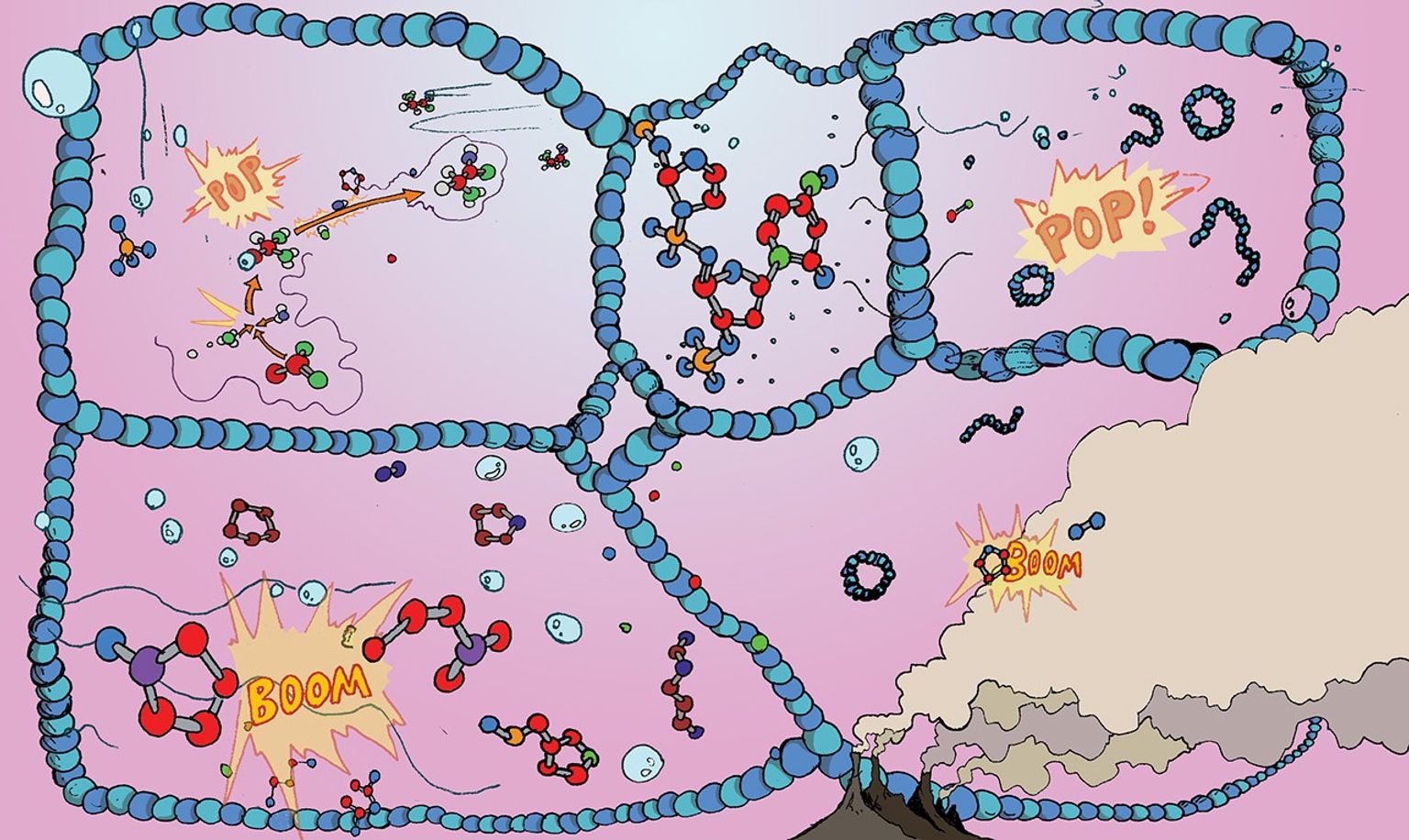
Cells are necessary for life as we know it. One of the big questions to answer about life is when the very first cells arose on Earth. Studies of the DNA in living creatures imply that all life on Earth shares a common ancestor, and we know from our studies of fossilized cells that cells have been around for a very long time. However, the cell membranes of today are probably too complex to have been the first step in forming a cell membrane. For instance, these membranes in modern cells are often composed of two or more layers of molecules and will have lots of enzymes and other proteins stuck within them. This leads some scientists to think the first cell membranes were simpler.
Simple membranes actually form spontaneously in nature, without any help from living things. For instance, certain mixtures of lipids in a solvent like water will self-organize into cell-like structures (called vesicles). It’s possible that these kinds of simple membranes were what made up the first cells for living things on Earth.
Once simple cells were established, some incredible changes happened in the oceans. Perhaps the most important was the Great Oxidation Event ( GOE ) occurring between 2.5 and 2.3 billion years ago helped created an oxygen rich ocean for life to thrive. Recent research suggests that stromatolites like those found in Shark Bay in Western Australia contributed to the life giving build-up of oceanic oxygen, even before the GOE .
Disciplinary Core Ideas
ESS1.C: The history of Planet Earth: The geologic time scale interpreted from rock strata provides a way to organize Earth’s history. Analyses of rock strata and the fossil record provide only relative dates, not an absolute scale. (MS-ESS1-4)
ESS2.A: Earth’s Materials and Systems: The planet’s systems interact over scales that range from microscopic to global in size, and they operate over fractions of a second to billions of years. These interactions have shaped Earth’s history and will determine its future. (MS-ESS2-2)
LS4.A: Evidence of Common Ancestry and Diversity: The collection of fossils and their placement in chronological order (e.g., through the location of the sedimentary layers in which they are found or through radioactive dating) is known as the fossil record. It documents the existence, diversity, extinction, and change of many life forms throughout the history of life on Earth. (MS-LS4-1) ▪Anatomical similarities and differences between various organisms living today and between them and organisms in the fossil record, enable the reconstruction of evolutionary history and the inference of lines of evolutionary descent. (MS-LS4-2)
LS1.A: Structure and Function: All living things are made up of cells, which is the smallest unit that can be said to be alive. An organism may consist of one single cell (unicellular) or many different numbers and types of cells (multicellular). (MS-LS1-1) ▪Within cells, special structures are responsible for particular functions, and the cell membrane forms the boundary that controls what enters and leaves the cell. (MS-LS1-2) ▪In multicellular organisms, the body is a system of multiple interacting subsystems. These subsystems are groups of cells that work together to form tissues and organs that are specialized for particular body functions. (MS-LS1-3)
LS4.C: Adaptation: Adaptation by natural selection acting over generations is one important process by which species change over time in response to changes in environmental conditions. Traits that support successful survival and reproduction in the new environment become more common; those that do not become less common. Thus, the distribution of traits in a population changes. (MS-LS4-6)
Crosscutting Concepts
Cause and Effect: Phenomena may have more than one cause, and some cause and effect relationships in systems can only be described using probability. (MS-LS4-4, MS-LS4-6)
Structure and Function: Complex and microscopic structures and systems can be visualized, modeled, and used to describe how their function depends on the relationships among its parts, therefore complex natural structures/systems can be analyzed to determine how they function. (MS-LS1-2)
Big Ideas: Living organisms on Earth are made of cells. Complex life developed from simple organic compounds. The fossil record documents the existence of cells for a signicant amount of Earth’s history. Simple membranes possibly made up the first cells for living things on Earth. The fossil record and comparisons of anatomical similarities between organisms enables the inference of common ancestry.
Boundaries: In this grade band, emphasis is placed on developing evidence that living things are made of cells, distinguishing between living and non-living things, and understanding that living things may be made of one cell or many and varied cells. (MS-LS1-1)
6-12 Exploring Life’s Origins: Building a Protocell. In this module, students explore the theoretical protocell made up of only two components: RNA replicase and a fatty acid membrane. Through video clips, illustrations, animation and interactives, students can explore the origins of life. This resource includes three modules: Timeline of Life’s Evolution, Understanding the RNA World, and Building a Protocell. An educator resource guide is included. NSF http://exploringorigins.org/index.html
6-12 Astrobiology Math. This collection of math problems provides an authentic glimpse of modern astrobiology science and engineering issues, often involving actual research data. Students explore concepts in astrobiology through calculations. Relevant topics include The Evolution of Nucleotides and Genes (page 19) and The Tree of Life and the most Primitive Ancestor (page 1). NASA . https://www.nasa.gov/pdf/637832main_Astrobiology_Math.pdf
6-12 Ask An Astrobiologist: Episode 25: Astrobiologist Dr. Laurie Barge. In this episode, Dr. Barge discusses her current research including investigating the emergence of life on early Earth and hydrothermal vents. Once a month, SAGAN et (www.saganet.org) and the NASA Astrobiology Program host a program called “Ask an Astrobiologist”, where the public is invited to interact with a high-profile astrobiologist, who replies to Twitter, Facebook, and chat questions live on video. NASA . SAGAN et. https://www.youtube.com/watch?v=UTILC0vHux8
8-10 SpaceMath Problem 392: Exploring the DNA of an organism based upon arsenic. Students estimate the increase in the mass of the DNA from an arsenic-loving bacterium in which phosphorus atoms have been replaced with arsenic. [Topics: integer math; percentages] https://spacemath.gsfc.nasa.gov/astrob/7Page57.pdf
Grades 9-12 or Adult Sophisticated Learner
One thing that is common to all of life that we know of is the cell. From single-celled organisms like many bacteria to organisms that are giant colonies of cells like fungi and the Portuguese man o’ war to multicellular organisms like us, polar bears, and tardigrades; all of life as we know it relies on cells as the basic unit of a living thing. Even viruses, which we sometimes have a hard time figuring out if we should consider living or not, rely on cells. A virus needs host cells in order to replicate and to evolve.
Cells are so important for life as we know it that one of the big questions to answer about life is when the very first cells arose on Earth. Studies of the DNA in living creatures imply that all life on Earth shares a common ancestor, and we know from our studies of fossilized cells that cells have been around for a very long time. However, the cell membranes of today are probably too complex to have been the first step in forming a cell membrane. For instance, these membranes in modern cells are often composed of two or more layers of molecules and will have lots of enzymes and other proteins stuck within them. This leads some scientists to think the first cell membranes were simpler.
Simple membranes actually form spontaneously in nature, without any help from living things. For instance, certain mixtures of lipids in a solvent like water will self-organize into cell-like structures (called vesicles). It’s possible that these kinds of simple membranes were what made up the first cells for living things on Earth. These first cells would likely then have become the containers for holding the molecules involved in storing genetic information as well as the chemical reactions of metabolism. Actually, in current studies of the origin of life, there is an active debate as to whether the storage and passing on of information for life came first or if the chemical reactions for storing and using energy for life came first. Either way, the first cells would have provided little microenvironments for concentrating and protecting the molecules that life needed for storing information and for catalyzing chemical reactions.
Once simple cells were established, some incredible changes happened in the oceans. Perhaps the most important was the Great Oxidation Event ( GOE ) occurring between 2.5 and 2.3 billion years ago helped created an oxygen rich ocean for life to thrive. Recent research suggests that stromatolites like those found in Shark Bay in Western Australia contributed to the life giving build-up of oceanic oxygen, even before the GOE .
One other interesting place of study in the origin of life research is whether or not there was one origin of life on Earth or possibly many. When we discuss the common ancestor for life as we know it, we call this common ancestor “LUCA ” (for the Last Universal Common Ancestor). However, that doesn’t mean that LUCA was a single organism or even a single type of organism, but was potentially a group of organisms who happened to be the most successful out of a larger group that were present on ancient Earth. There could have been several competing types of life, perhaps all fairly similar, but that what made LUCA special was that it was able to outcompete the other forms of life for resources at some period of time in Earth’s history. In fact, some people have even considered whether there are modern attempts for new origins of life on Earth. What do you think would be a problem if that were to happen? If you guessed that all of the things that live here already would eat that new form of life, you might be right. We think that one thing that stops new types of life from forming on Earth is that there’s already a rich biosphere full of life here.
Looking for life elsewhere may one day truly help us to better understand ourselves and our own biosphere. Will other life out there be cellular life? Will it be something different? We really don’t know yet.
Disciplinary Core Ideas
ESS1.C: The History of Planet Earth: Continental rocks, which can be older than 4 billion years, are generally much older than the rocks of the ocean floor, which are less than 200 million years old. (HS-ESS1-5) Although active geologic processes, such as plate tectonics and erosion, have destroyed or altered most of the very early rock record on Earth, other objects in the solar system, such as lunar rocks, asteroids, and meteorites, have changed little over billions of years. Studying these objects can provide information about Earth’s formation and early history. (HS-ESS1-6)
ESS2.C: The Roles of Water in Earth’s Surface Processes: The abundance of liquid water on Earth’s surface and its unique combination of physical and chemical properties are central to the planet’s dynamics. These properties include water’s exceptional capacity to absorb, store, and release large amounts of energy, transmit sunlight, expand upon freezing, dissolve and transport materials, and lower the viscosities and melting points of rocks. (HS-ESS2-5)
ESS2.E: Biogeology: The many dynamic and delicate feedbacks between the biosphere and other Earth systems cause a continual coevolution of Earth’s surface and the life that exists on it. (HS-ESS2-7)
LS3.A: Inheritance of Traits: Each chromosome consists of a single very long DNA molecule, and each gene on the chromosome is a particular segment of that DNA . The instructions for forming species’ characteristics are carried in DNA . (HS-LS3-1)
LS3.B: Variation of Traits: Environmental factors also affect expression of traits, and hence affect the probability of occurrences of traits in a population. Thus the variation and distribution of traits observed depends on both genetic and environmental factors. (HS-LS3-2, HS-LS3-3)
ESS1.C: The History of Planet Earth: Continental rocks, which can be older than 4 billion years, are generally much older than the rocks of the ocean floor, which are less than 200 million years old. (HS-ESS1-5) *Although active geologic processes, such as plate tectonics and erosion, have destroyed or altered most of the very early rock record on Earth, other objects in the solar system, such as lunar rocks, asteroids, and meteorites, have changed little over billions of years. Studying these objects can provide information about Earth’s formation and early history. (HS-ESS1-6)
PS1.B: Chemical Reactions: Chemical processes, their rates, and whether or not energy is stored or released can be understood in terms of the collisions of molecules and the rearrangements of atoms into new molecules, with consequent changes in the sum of all bond energies in the set of molecules that are matched by changes in kinetic energy. (HS-PS1-4, HS-PS1-5)
LS1.A: Structure and Function: Systems of specialized cells within organisms help them perform the essential functions of life. (HS-LS1-1) All cells contain genetic information in the form of DNA molecules. Genes are regions in the DNA that contain the instructions that code for the formation of proteins, which carry out most of the work of cells. (HS-LS1-1)
LS1.C: Organization for Matter and Energy Flow in Organisms: The process of photosynthesis converts light energy to stored chemical energy by converting carbon dioxide plus water into sugars plus released oxygen. (HS-LS1-5) *The sugar molecules thus formed contain carbon, hydrogen, and oxygen: their hydrocarbon backbones are used to make amino acids and other carbon-based molecules that can be assembled into larger molecules (such as proteins or DNA ), used for example to form new cells. (HS-LS1-6)
LS2.A: Interdependent Relationships in Ecosystems: Ecosystems have carrying capacities, which are limits to the numbers of organisms and populations they can support. These limits result from such factors as the availability of living and nonliving resources and from such challenges such as predation, competition, and disease. Organisms would have the capacity to produce populations of great size were it not for the fact that environments and resources are finite. This fundamental tension affects the abundance (number of individuals) of species in any given ecosystem. (HS-LS2-1, HS-LS2-2)
LS4.A: Evidence of Common Ancestry and Diversity: Genetic information provides evidence of evolution. DNA sequences vary among species, but there are many overlaps; in fact, the ongoing branching that produces multiple lines of descent can be inferred by comparing the DNA sequences of different organisms. Such information is also derivable from the similarities and differences in amino acid sequences and from anatomical and embryological evidence. (HS-LS4-1)
LS4.C: Adaptation: Evolution is a consequence of the interaction of four factors: (1) the potential for a species to increase in number, (2) the genetic variation of individuals in a species due to mutation and sexual reproduction, (3) competition for an environment’s limited supply of the resources that individuals need in order to survive and reproduce, and (4) the ensuing proliferation of those organisms that are better able to survive and reproduce in that environment. (HS-LS4-2) *Natural selection leads to adaptation, that is, to a population dominated by organisms that are anatomically, behaviorally, and physiologically well suited to survive and reproduce in a specific environment. That is, the differential survival and reproduction of organisms in a population that have an advantageous heritable trait leads to an increase in the proportion of individuals in future generations that have the trait and to a decrease in the proportion of individuals that do not. (HS-LS4-3, HS-LS4-4)
Crosscutting Concepts
Stability and Change: Much of science deals with constructing explanations of how things change and how they remain stable. (HS-ESS1-6)
Big Ideas: Living organisms on Earth are made of cells. Complex life on early Earth likely arose from basic organic compounds to more complex compounds, amino acids, and cells. The fossil record documents the existence, diversity, extinction, and change of many life forms and their environments through Earth’s history. The fossil record and comparisons of anatomical similarities between organisms enables the inference of common ancestry. “LUCA ” (Last Universal Common Ancestor) represents the common ancestor for life on Earth. LUCA may have been a single organism, a single type of organism, or a group of organisms. Looking for life beyond Earth will help to increase understanding of Earth and its biosphere.
Boundaries: Students in this grade band use empirical evidence to support common ancestry and biological evolution. Grade level appropriate examples of evidence include similarities in DNA sequences, anatomical structures, and order of appearance of structures in embryological development. (HS-LS4-1)
6-12 Exploring Life’s Origins: Building a Protocell. In this module, students explore the theoretical protocell made up of only two components: RNA replicase and a fatty acid membrane. Through video clips, illustrations, animation and interactives, students can explore the origins of life. This resource includes three modules: Timeline of Life’s Evolution, Understanding the RNA World, and Building a Protocell. An educator resource guide is included. NSF http://exploringorigins.org/index.html
6-12 Astrobiology Math. This collection of math problems provides an authentic glimpse of modern astrobiology science and engineering issues, often involving actual research data. Students explore concepts in astrobiology through calculations. Relevant topics include The Evolution of Nucleotides and Genes (page 19) and The Tree of Life and the most Primitive Ancestor (page 1). NASA . https://www.nasa.gov/pdf/637832main_Astrobiology_Math.pdf
6-12 Ask An Astrobiologist: Episode 25: Astrobiologist Dr. Laurie Barge. In this episode, Dr. Barge discusses her current research including investigating the emergence of life on early Earth and hydrothermal vents. Once a month, SAGAN et (www.saganet.org) and the NASA Astrobiology Program host a program called “Ask an Astrobiologist”, where the public is invited to interact with a high-profile astrobiologist, who replies to Twitter, Facebook, and chat questions live on video. NASA . SAGAN et. https://www.youtube.com/watch?v=UTILC0vHux8
8-10 SpaceMath Problem 392: Exploring the DNA of an organism based upon arsenic. Students estimate the increase in the mass of the DNA from an arsenic-loving bacterium in which phosphorus atoms have been replaced with arsenic. [Topics: integer math; percentages] https://spacemath.gsfc.nasa.gov/astrob/7Page57.pdf
11-12 SpaceMath Problem 265: Estimating Maximum Cell Sizes. Students estimate the maximum size of spherical cells based on the rates with which they create waste and remove it through their cell walls. [Topics: differential calculus, unit conversion] https://spacemath.gsfc.nasa.gov/Calculus/Astro14.pdf