














1 min read
Interstellar Comet 3I/ATLAS (NIRSpec IFU)
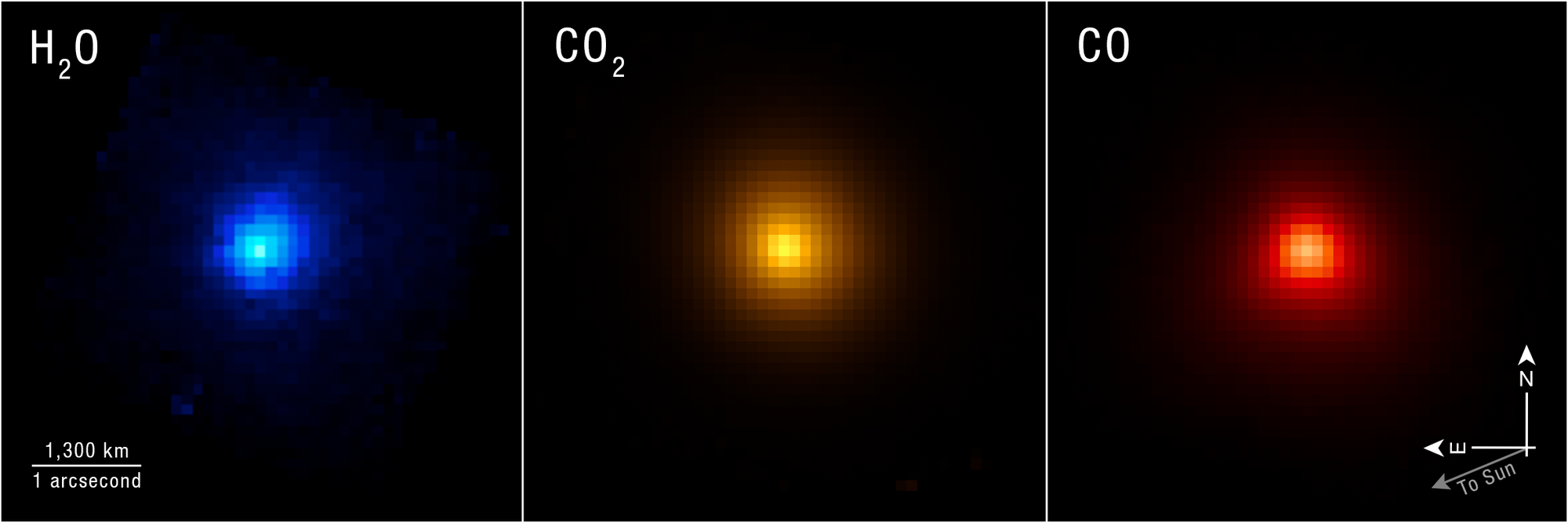
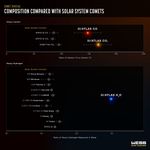
The NIRSpec (Near-Infrared Spectrograph) instrument on NASA’s James Webb Space Telescope can map specific chemical and molecular signatures, as seen here in its three images of comet 3I/ATLAS, each highlighting a part of the comet’s contents.
Researchers use NIRSpec’s Integral Field Unit, which provides a spectrum of every image pixel, to dive deeper into the details of cosmic objects than they can with the telescope’s imaging instruments alone. This is crucial for a rare object like 3I/ATLAS, which is only the third comet from outside the solar system ever studied, and the first to be observed by an instrument capable of capturing as much detail as NIRSpec. With NIRSpec’s data, researchers can build a picture of where the comet may have come from and what its home system was like and then compare that to familiar conditions in the solar system.
About the Data
- Data DescriptionData DescriptionProposal: A description of the observations, their scientific justification, and the links to the data available in the science archive.
Science Team: The astronomers who planned the observations and analyzed the data. "PI" refers to the Principal Investigator.This image was created with Webb data from proposal: 5094 (M.Cordiner)
- InstrumentInstrumentThe science instrument used to produce the data.NIRSpec
- Exposure DatesExposure DatesThe date(s) that the telescope made its observations and the total exposure time.06 Aug. 2025, 22-23 Dec. 2025
- FiltersFiltersThe camera filters that were used in the science observations.G325H, G395H
- Object NameObject NameA name or catalog number that astronomers use to identify an astronomical object.Comet 3I/ATLAS
- Object DescriptionObject DescriptionThe type of astronomical object.Interstellar comet
- Release DateJune 22, 2026
- Science ReleaseNASA’s Webb Finds Clues to Ancient, Distant Origin of Comet 3I/ATLAS
- CreditImage: NASA, ESA, CSA, STScI, Martin Cordiner (CUA, NASA-GSFC); Image Processing: Alyssa Pagan (STScI)
These images were acquired by the NIRSpec IFU Instrument on the James Webb Space Telescope. The color results from assigning a color map to each monochromatic (grayscale) image. In this case, the assigned color is: Blue: H2O (2.55–2.90 microns), Orange/Yellow: CO2 (4.188–4.500 microns), Red: CO (4.50–4.85 microns)
Related Images & Videos
Share
Details
Laura Betz
NASA’s Goddard Space Flight Center
Greenbelt, Maryland
laura.e.betz@nasa.gov