












Suggested Searches

1 min read

3I/ATLAS Compared to Solar System Comets
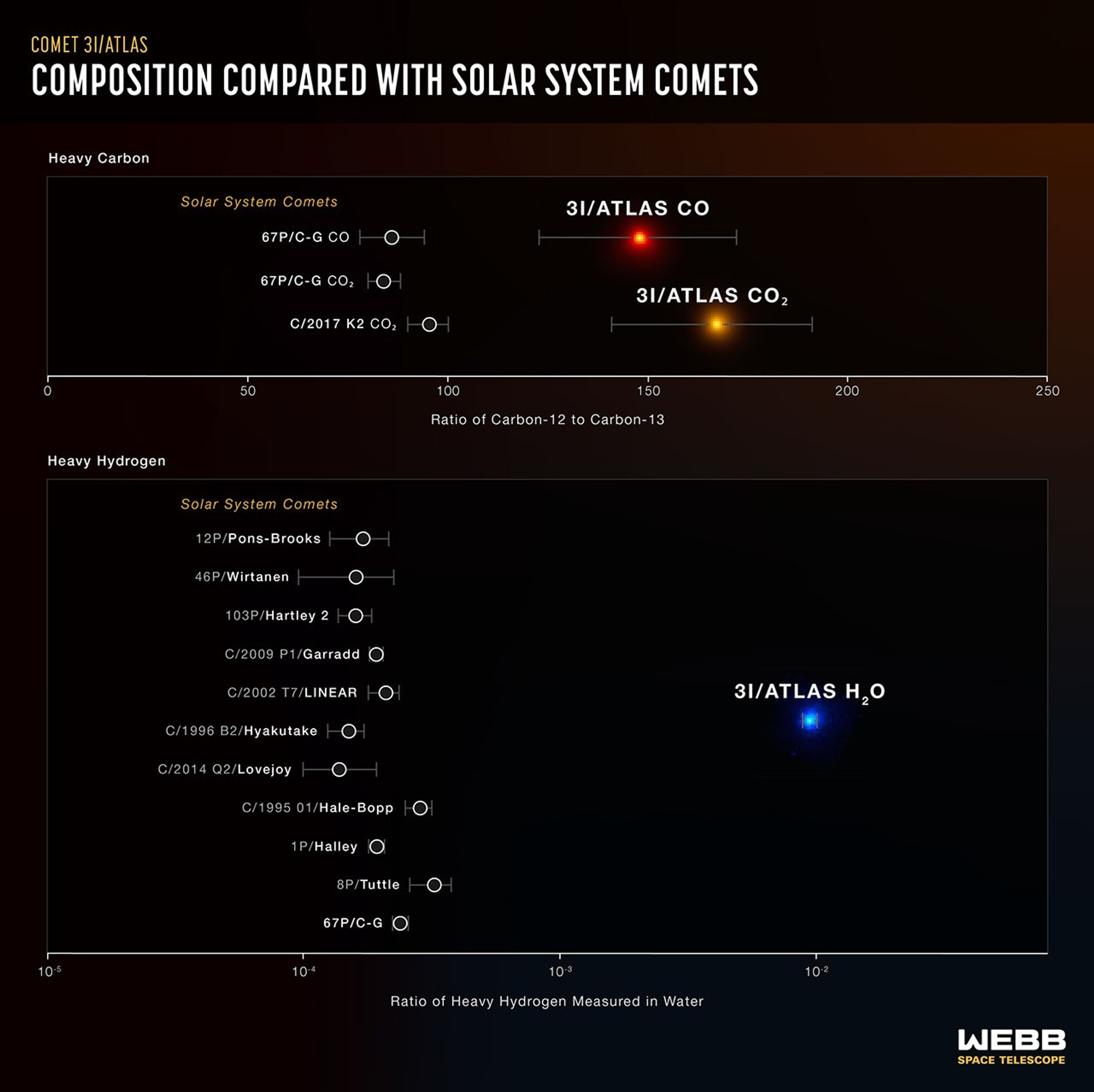
Infographic showing differences in measured ratios of heavy carbon and heavy hydrogen between solar system comets and interstellar comet 3I/ATLAS. Title text reads Comet 3I/ATLAS, Composition Compared With Solar System Comets. Top portion of the infographic has headline Heavy Carbon, plus a horizontal scale in increments of 50 ranging from zero to 250 measuring the ratio of Carbon-12 to Carbon-13. Three solar system comets appear just below 100 on the scale, while 3I/ATLAS appears above 150 for carbon monoxide and about 170 for carbon dioxide.  
Bottom portion of infographic has headline Heavy Hydrogen and a horizontal scale ranging from 10 to the negative fifth power on the left to approximately 10 to the negative first power on the right, though 10 to the first is not labeled. This scale is labeled Ratio of Heavy Hydrogen Measured in Water. Eleven solar system comets appear on the graph, all falling to the right of 10 to the negative fourth power. Comet 3I/ATLAS appears at 10 to the negative second power.

Measurements of specific element varieties by the NIRSpec (Near-Infrared Spectrograph) instrument on NASA’s James Webb Space Telescope show how different the interstellar comet 3I/ATLAS is from comets originating in our own solar system. Researchers used NIRSpec to measure carbon-13, which contains an extra neutron, relative to the more common carbon-12. They also measured the abundance of heavy hydrogen, which is a hydrogen atom with an added neutron.

Webb’s NIRSpec found surprisingly high ratios of heavy hydrogen and heavy carbon, indicating that 3I/ATLAS came from a place very different from our solar system. Researchers say early analysis of these results indicates that 3I/ATLAS was ejected from its origin system billions of years ago. 

  • Release Date
    June 22, 2026
  • Science Release
    NASA’s Webb Finds Clues to Ancient, Distant Origin of Comet 3I/ATLAS
  • Credit
    Illustration: NASA, ESA, CSA, Martin Cordiner (CUA, NASA-GSFC), Leah Hustak (STScI)
Downloads

  • Full Res (For Display), 3840x3834, 3840 × 3835
    jpg (1016.48 KB)
  • Full Res (For Print), 3840x3834, 3840 × 3834
    tif (12.28 MB)
  • 2000x1997, 2000 × 1997
    jpg (456.23 KB)

Share

Details

Last Updated
Jun 22, 2026
Contact
Media

Laura Betz
NASA’s Goddard Space Flight Center
Greenbelt, Maryland
laura.e.betz@nasa.gov