


















1 min read
Europa (NIRCam Image)
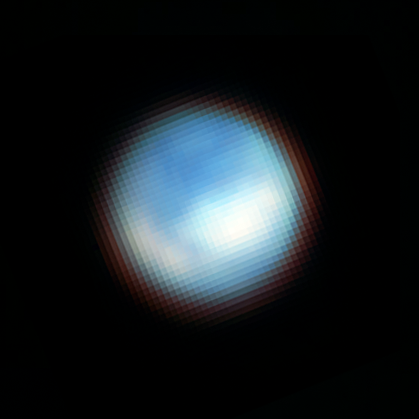
NIRCam (the Near Infrared Camera) on NASA’s James Webb Space Telescope captured this picture of the surface of Jupiter’s moon Europa. Webb identified carbon dioxide on the icy surface of Europa that likely originated in the moon’s subsurface ocean. This discovery has important implications for the potential habitability of Europa’s ocean. The moon appears mostly blue because it is brighter at shorter infrared wavelengths. The white features correspond with the chaos terrain Powys Regio (left) and Tara Regio (center and right), which show enhanced carbon dioxide ice on the surface.
About the Data
- Data DescriptionData DescriptionProposal: A description of the observations, their scientific justification, and the links to the data available in the science archive.
Science Team: The astronomers who planned the observations and analyzed the data. "PI" refers to the Principal Investigator.This image was created with Webb data from proposal: 1250 (G. Villanueva)
- InstrumentInstrumentThe science instrument used to produce the data.NIRCam
- Exposure DatesExposure DatesThe date(s) that the telescope made its observations and the total exposure time.9 Nov 2022, 23 Nov 2022
- FiltersFiltersThe camera filters that were used in the science observations.F070W, F140M, F212N, F250M, F335M, F460M
- Object NameObject NameA name or catalog number that astronomers use to identify an astronomical object.Europa
- Object DescriptionObject DescriptionThe type of astronomical object.One of Jupiter's moons
- Release DateSeptember 21, 2023
- Science ReleaseNASA’s Webb Finds Carbon Source on Surface of Jupiter’s Moon Europa
- CreditNASA, ESA, CSA, Gerónimo Villanueva (NASA-GSFC), Samantha Trumbo (Cornell University); Image Processing: Gerónimo Villanueva (NASA-GSFC), Alyssa Pagan (STScI)
This image is a composite of separate exposures acquired by the James Webb Space Telescope using the NIRCam instrument. Several filters were used to sample specific wavelength ranges. The color results from assigning different hues (colors) to each monochromatic (grayscale) image associated with an individual filter. In this case, the assigned colors are: Blue: F070W+F140M, Green: F212N+F250M, Red: F335M+F460M
Related Images & Videos
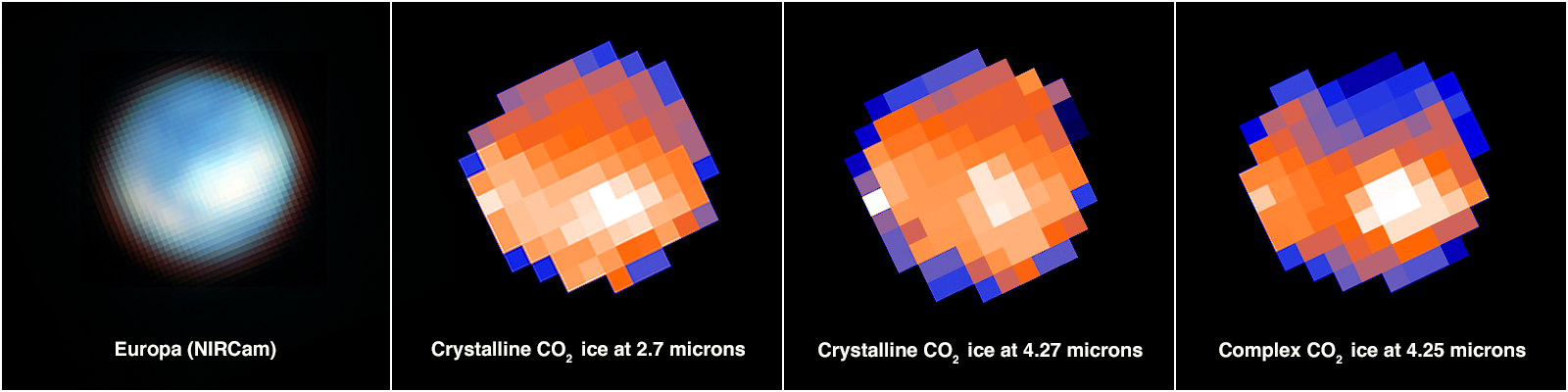
Europa Carbon Dioxide Distribution (NIRCam and NIRSpec IFU Image)
This graphic shows a map of Europa’s surface with NIRCam (Near Infrared Camera) on NASA’s James Webb Space Telescope in the first panel and compositional maps derived from Webb’s NIRSpec/IFU (Near Infrared Spectrograph’s Integral Field Unit) data in the following three panels....
Share
Details
Laura Betz
NASA’s Goddard Space Flight Center
Greenbelt, Maryland
laura.e.betz@nasa.gov
NASA, ESA, CSA, Gerónimo Villanueva (NASA-GSFC), Samantha Trumbo (Cornell University)
Gerónimo Villanueva (NASA-GSFC), Alyssa Pagan (STScI)