





















1 min read
Titan (NIRCam)
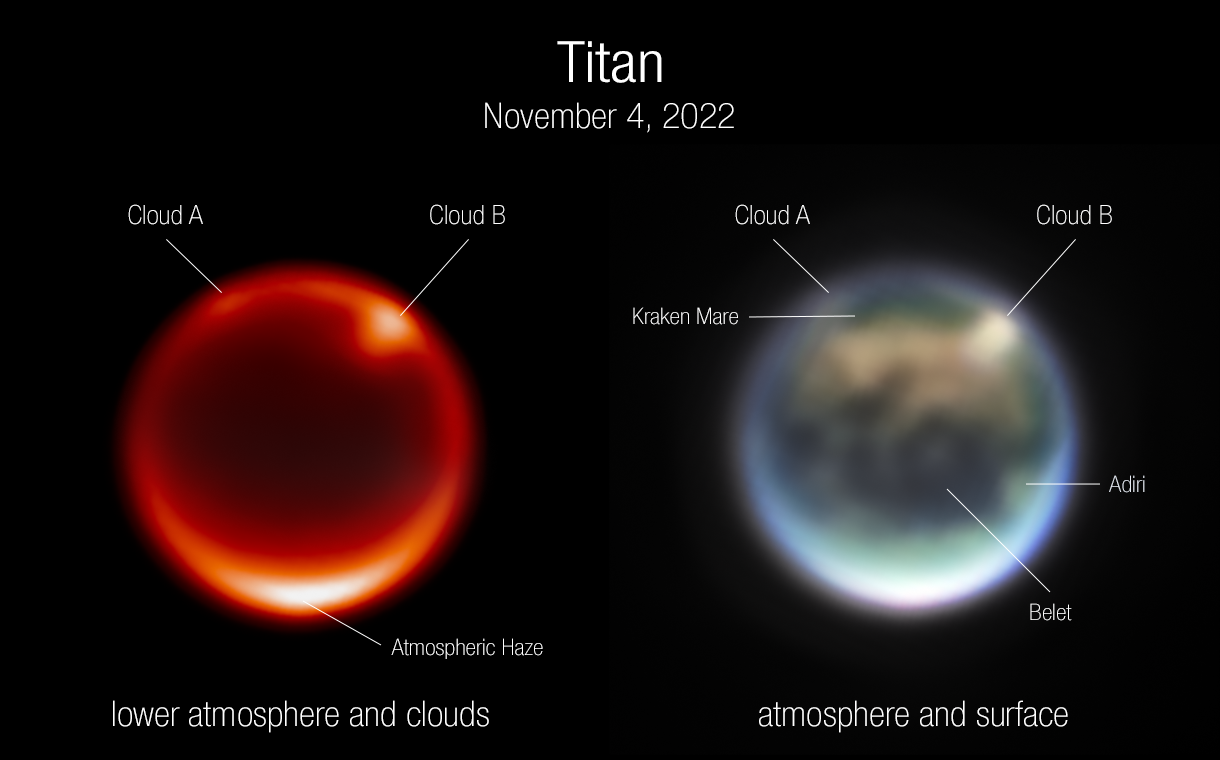
Images of Saturn’s moon Titan, captured by the James Webb Space Telescope’s NIRCam instrument Nov. 4, 2022. Left: Image using F212N, a 2.12-micron filter sensitive to Titan’s lower atmosphere. The bright spots are prominent clouds in the northern hemisphere. Right: Color composite image using a combination of NIRCam filters: Blue=F140M (1.40 microns), Green=F150W (1.50 microns), Red=F200W (1.99 microns), Brightness=F210M (2.09 microns). Several prominent surface features are labeled: Kraken Mare is thought to be a methane sea; Belet is composed of dark-colored sand dunes; Adiri is a bright albedo feature.
About the Data
- Data DescriptionData DescriptionProposal: A description of the observations, their scientific justification, and the links to the data available in the science archive.
Science Team: The astronomers who planned the observations and analyzed the data. "PI" refers to the Principal Investigator.This image was created with Webb data from proposal 1251(C. Nixon)
- InstrumentInstrumentThe science instrument used to produce the data.NIRCam
- Exposure DatesExposure DatesThe date(s) that the telescope made its observations and the total exposure time.4 Nov 2022
- FiltersFiltersThe camera filters that were used in the science observations.Right: F212N Left: F140M, F150W, F200W, F210M
- Object NameObject NameA name or catalog number that astronomers use to identify an astronomical object.Titan
- Object DescriptionObject DescriptionThe type of astronomical object.Saturn's moon
- Release DateDecember 1, 2022
- CreditNASA, ESA, CSA, Webb Titan GTO Team; Image Processing: Alyssa Pagan (STScI)
Both images were aquired by the James Webb Space Telescope using the NIRCam instrument. The image on the left was made using a single filter: F212N. The image on the right is a composite of separate exposures with different filters used to sample different infrared wavelength ranges. The color results from assigning different hues (colors) to each monochromatic (grayscale) image associated with an individual filter. Blue=F140M, Green=F150W, Red=F200W, Luminosity=F210M
Share
Details
Laura Betz
NASA’s Goddard Space Flight Center
Greenbelt, Maryland
laura.e.betz@nasa.gov
NASA, ESA, CSA, Webb Titan GTO Team
Alyssa Pagan (STScI)