





![Request for Information – Potential [Placeholder for Prize]](https://assets.science.nasa.gov/dynamicimage/assets/science/missions/a-step/FFR_Earth_Background_20251120%20.png?w=1024)







1 min read
Infrared Universe: Lagoon Nebula (M8)
At the heart of the Lagoon Nebula, a vast stellar nursery located 4,000 light-years away and visible in binoculars simply as a smudge of light with a bright core. The giant star, called Herschel 36, is bursting out of its cocoon of material, unleashing blistering radiation and torrential stellar winds (streams of subatomic particles) that push dust away in curtain-like sheets. Herschel 36’s violent activity has blasted holes in the bubble-shaped cloud.
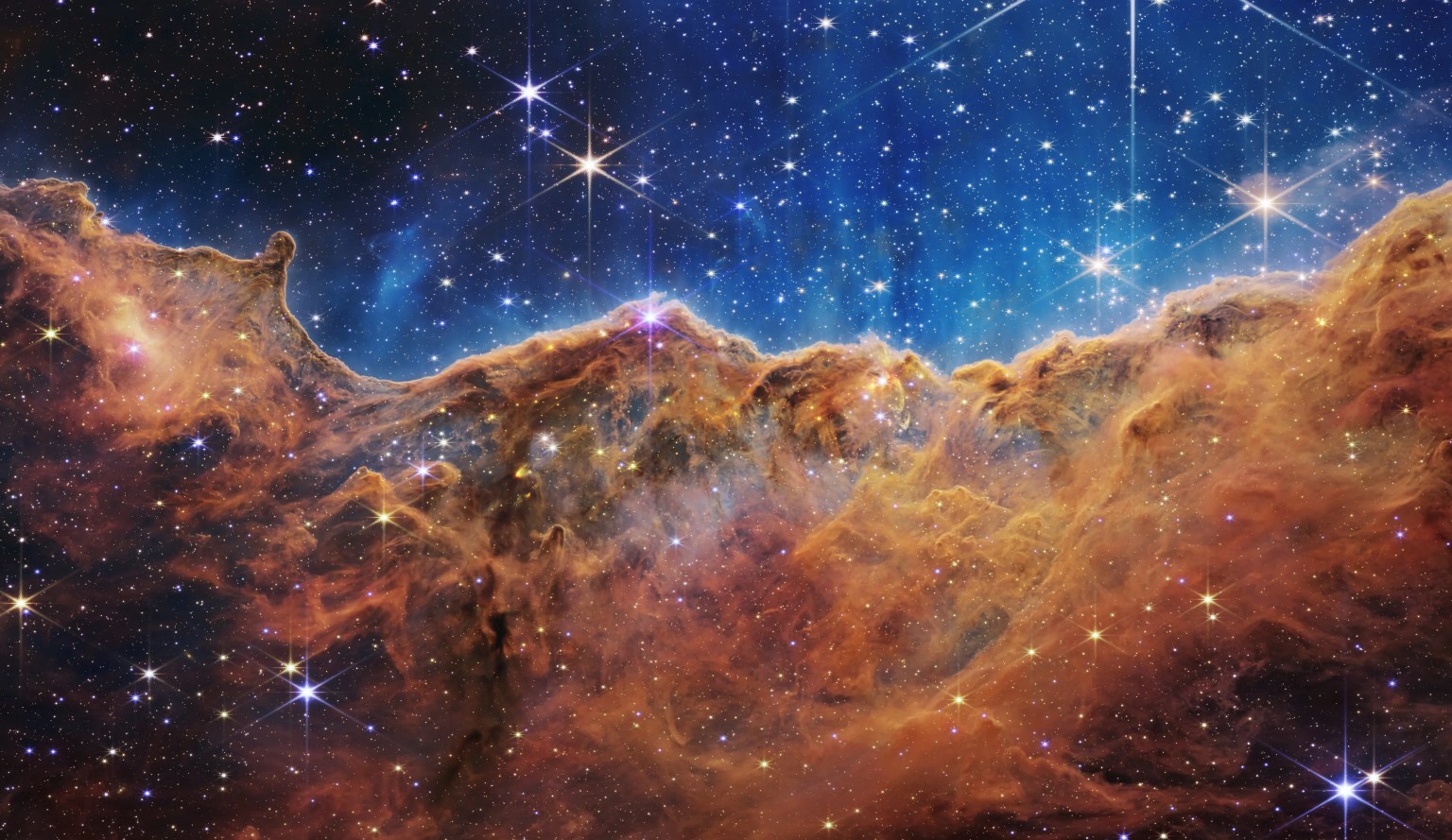
Optical: A landscape of ridges, canyons, pillars, and mountains of gas and dust surround a very hot newborn star.
Credit: NASA, ESA, and STScI
Near-infrared: An abundance of stars fills the field of view.
Credit: NASA, ESA, and STScI
About the Infrared Universe Collection
The human eye can only see visible light, but objects give off a variety of wavelengths of light. To see an object as it truly exists, we would ideally look at its appearance through the full range of the electromagnetic spectrum. Telescopes show us objects as they appear emitting different energies of light, with each wavelength conveying unique information about the object. The Webb Space Telescope will study infrared light from celestial objects with much greater clarity and sensitivity than ever before. Explore the Infrared Universe. Adapted from Cool Cosmos by IPAC, with additional contributions from Bruno Merin and Miguel Merin (Pludo).
- Release DateMay 22, 2018
- CreditVideo: NASA, ESA, Gregory Bacon (STScI)
Downloads
Share
Details
Laura Betz
NASA’s Goddard Space Flight Center
Greenbelt, Maryland
laura.e.betz@nasa.gov
NASA, ESA, Gregory Bacon (STScI)