














1 min read
Bulge Fossil Fragment Terzan 5 (Webb and Hubble Image)
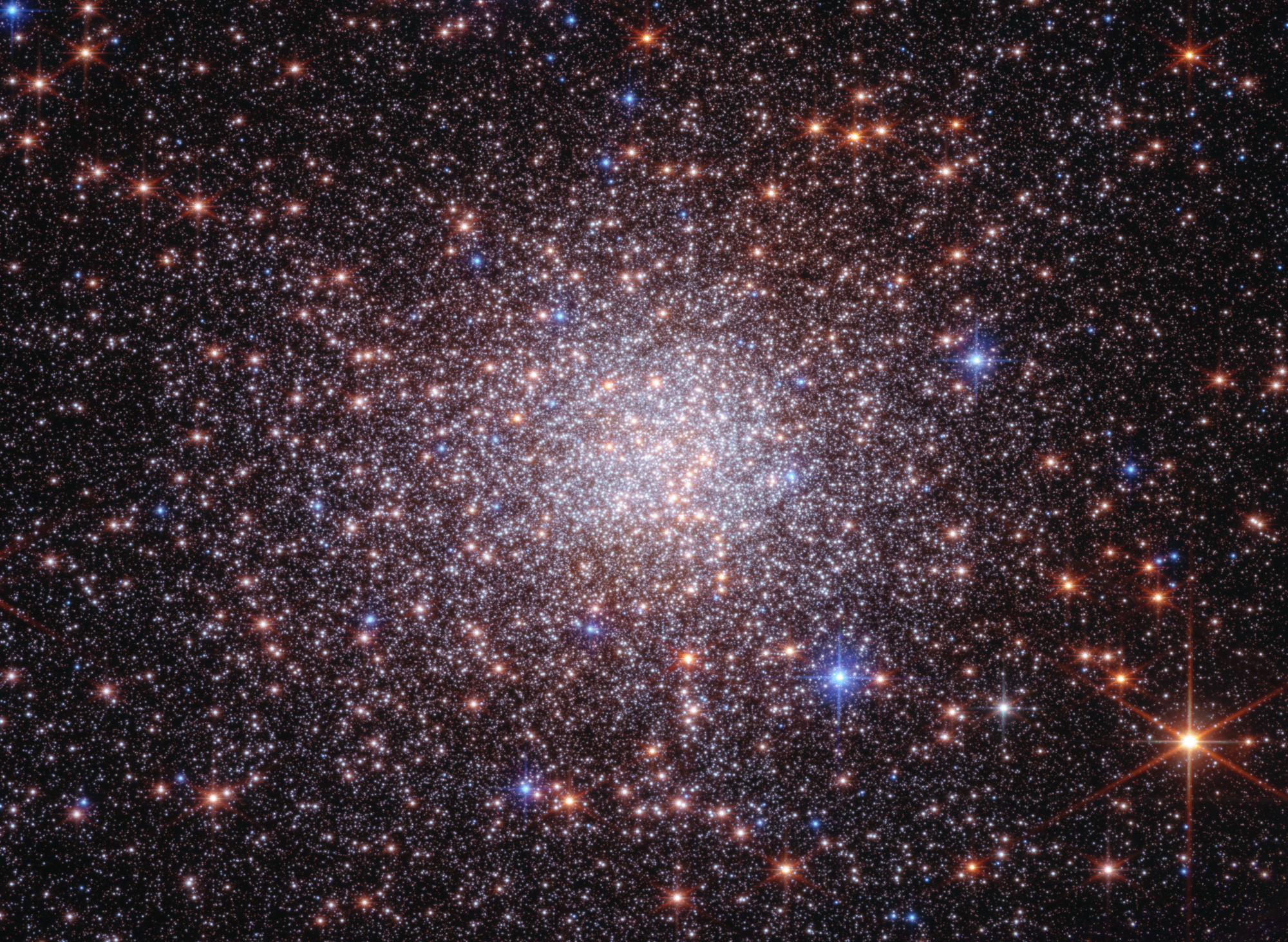
Terzan 5 is a stellar system orbiting within the Milky Way galaxy’s bulge, which is an incredibly bright, crowded central region of the galaxy. Not only are stars within the bulge tightly packed together — every bit of this region is laced with thick clouds of gas and dust.
NASA’s James Webb and Hubble Space Telescopes joined forces to study Terzan 5. Astronomers already knew that this star cluster was unusual in that it contained two stellar populations of very different ages. New research found strong evidence for two more stellar populations, one that formed 3.8 billion years ago and another only 2.5 billion years ago. The research team also was able to determine the ages of the previously known stellar populations with unprecedented precision, finding that they formed 12.5 billion and 4.7 billion years ago.
This finding proved that Terzan 5 is not a globular star cluster, as originally classified. Instead, Terzan 5 belongs to a new category, known as a bulge fossil fragment — a self-contained, self-enriching stellar system with multiple star populations of different ages and with different iron abundances.
Terzan 5 is 22,000 light-years away in the constellation Sagittarius. It contains about 2 million times the Sun's mass packed into a stellar system only a few tens of light-years across, making it one of the most massive and densely populated globular-cluster-like systems in the Milky Way.
About the Object
- R.A. PositionR.A. PositionRight ascension – analogous to longitude – is one component of an object's position.17:48:05.00
- Dec. PositionDec. PositionDeclination – analogous to latitude – is one component of an object's position.-24:46:48.0
- ConstellationConstellationOne of 88 recognized regions of the celestial sphere in which the object appears.Sagittarius
- DistanceDistanceThe physical distance from Earth to the astronomical object. Distances within our solar system are usually measured in Astronomical Units (AU). Distances between stars are usually measured in light-years. Interstellar distances can also be measured in parsecs.22,000 light-years away
- DimensionsDimensionsThe physical size of the object or the apparent angle it subtends on the sky.This image is about 2.1 arcminutes across (13 light-years)
About the Data
- Data DescriptionData DescriptionProposal: A description of the observations, their scientific justification, and the links to the data available in the science archive.
Science Team: The astronomers who planned the observations and analyzed the data. "PI" refers to the Principal Investigator. - InstrumentInstrumentThe science instrument used to produce the data.Hubble> ACS/WFC Webb> NIRCam
- Exposure DatesExposure DatesThe date(s) that the telescope made its observations and the total exposure time.19 Sept. 2024, 30 April-18 August 2013
- FiltersFiltersThe camera filters that were used in the science observations.F606W, F814W, F115W, F200W
- Object NameObject NameA name or catalog number that astronomers use to identify an astronomical object.Terzan 5
- Object DescriptionObject DescriptionThe type of astronomical object.Bulge fossil fragment stellar group
- Release DateJune 16, 2026
- Science ReleaseNASA Webb, Hubble Reveal History of Relic of Milky Way’s Formation
- CreditImage: NASA, ESA, CSA, STScI, Giorgia Zullo (University of Bologna), Francesco Ferraro (University of Bologna); Image Processing: Alyssa Pagan (STScI)
These images were acquired by the ACS/WFC instrument on Hubble and the NIRCam instrument on Webb. The color results from assigning different hues (colors) to a monochromatic (grayscale) image. In this case, the assigned colors are: Blue: F606W, Cyan: F814W, Orange: F115W, Red: F200W
Related Images & Videos
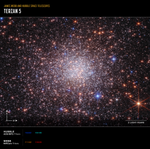
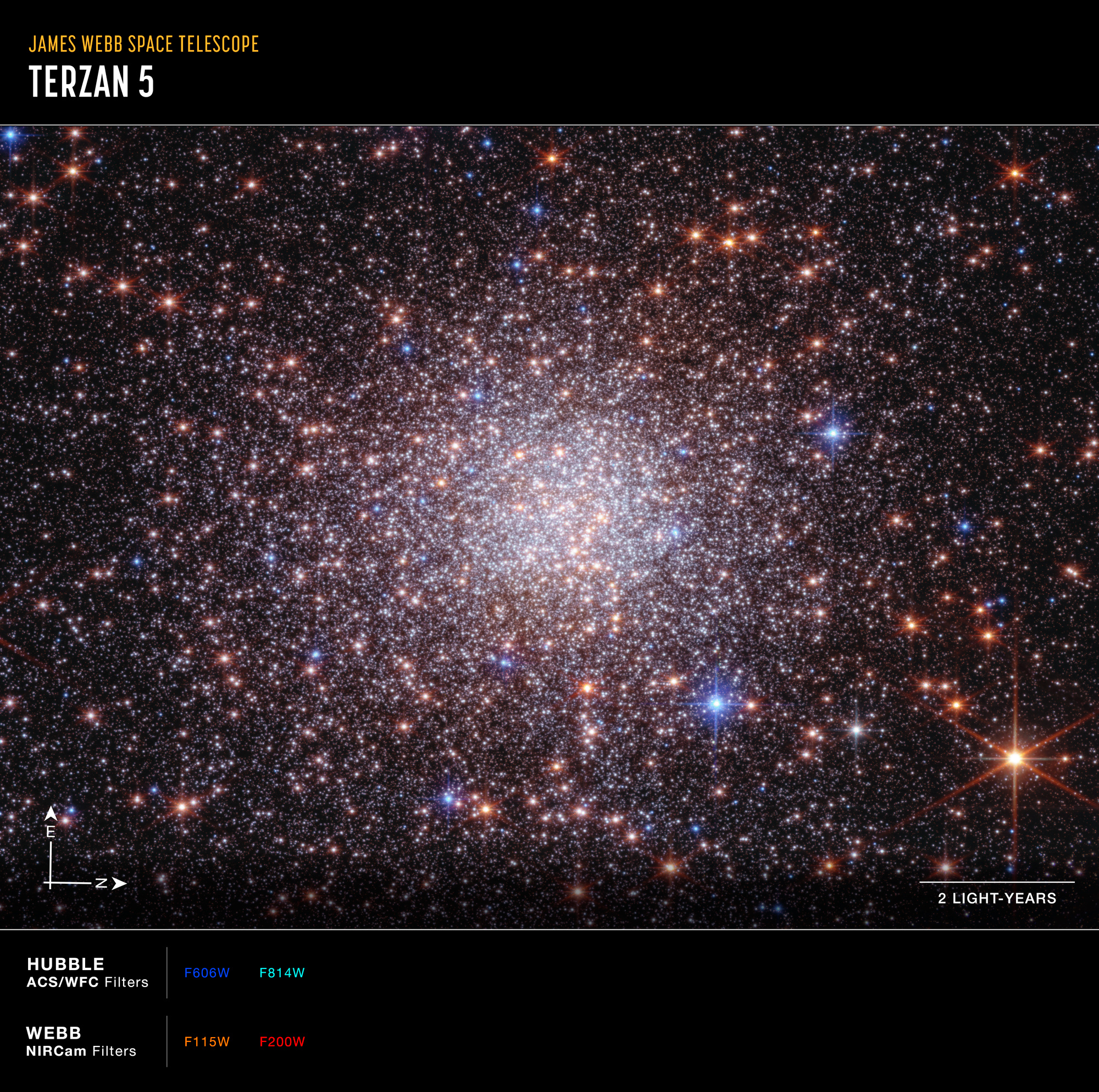
Terzan 5 (Webb and Hubble Compass Image)
This image of bulge fossil fragment Terzan 5 was captured by the James Webb and Hubble space telescopes. Webb’s data are from its NIRCam (Near-Infrared Camera) and Hubble’s from its Advanced Camera for Surveys (ACS). The image shows a scale bar, compass arrows, and co...
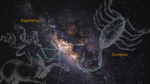
Zoom to See Terzan 5 Near Our Milky Way Galaxy’s Bulge
Zoom in to Terzan 5, a star cluster that lies within the crowded central region of our Milky Way galaxy known as the bulge. The scene starts with a ground-based image of our Milky Way bulge and zooms in on and circles Terzan 5, ending with the composite image of the star system f...
Share
Details
Laura Betz
NASA’s Goddard Space Flight Center
Greenbelt, Maryland
laura.e.betz@nasa.gov