
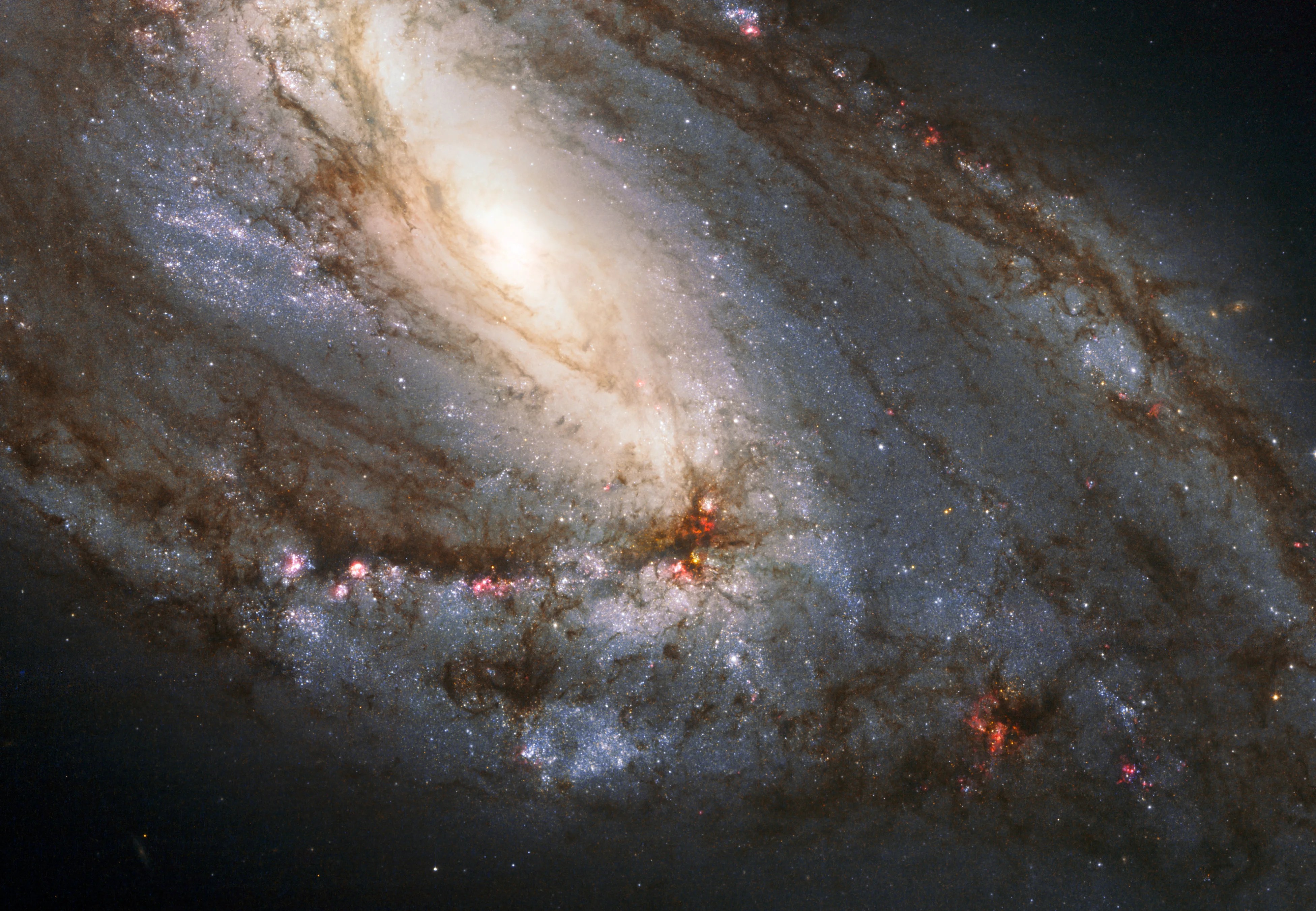
















1 min read
Circinus Galaxy (Hubble and Webb)
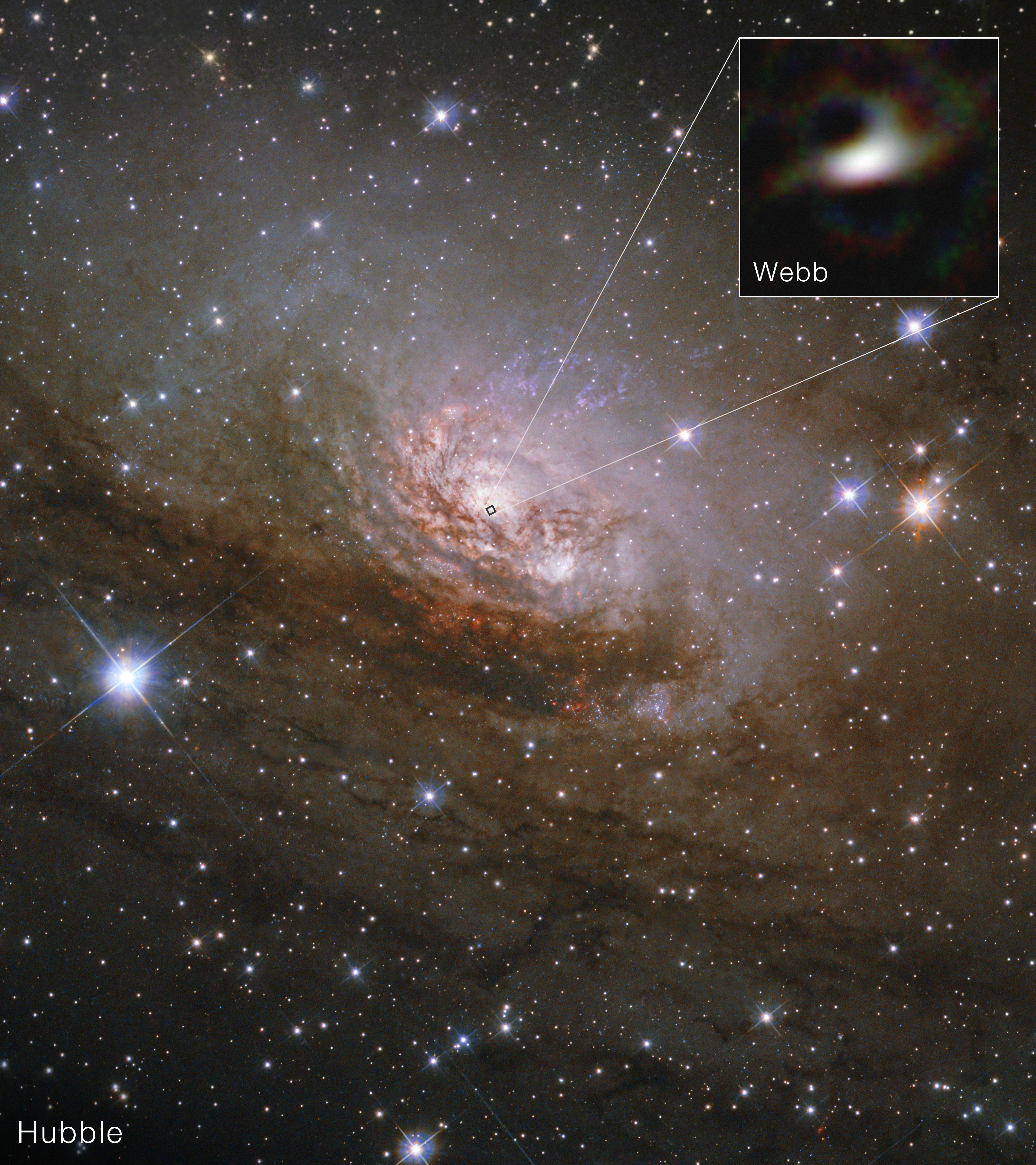
This image from NASA’s Hubble Space Telescope shows a full view of the Circinus galaxy, a nearby spiral galaxy about 13 million light-years away. The inset highlights a Webb close-up of the galaxy’s core, where infrared observations pierce through dust to reveal hot material feeding its central supermassive black hole. Webb’s image, made using the Aperture Masking Interferometer (AMI) tool on its NIRISS (Near-Infrared Imager and Slitless Spectrograph) instrument, isolates hot dust in the immediate surroundings of the supermassive black hole, revealing that most of the infrared emission comes from a compact, dusty structure feeding the black hole rather than from outflowing material. In the Webb image, the inner face of the torus glows in infrared light, while the darker areas represent where the outer ring is blocking light.
About the Object
- R.A. PositionR.A. PositionRight ascension – analogous to longitude – is one component of an object's position.14:13:09.91
- Dec. PositionDec. PositionDeclination – analogous to latitude – is one component of an object's position.-65 20 20.5
- ConstellationConstellationOne of 88 recognized regions of the celestial sphere in which the object appears.Circinus
- DistanceDistanceThe physical distance from Earth to the astronomical object. Distances within our solar system are usually measured in Astronomical Units (AU). Distances between stars are usually measured in light-years. Interstellar distances can also be measured in parsecs.About 13 million light-years
- DimensionsDimensionsThe physical size of the object or the apparent angle it subtends on the sky.Hubble image is 2.15 arcminutes across (about 8,000 light-years)
About the Data
- Data DescriptionData DescriptionProposal: A description of the observations, their scientific justification, and the links to the data available in the science archive.
Science Team: The astronomers who planned the observations and analyzed the data. "PI" refers to the Principal Investigator. - InstrumentInstrumentThe science instrument used to produce the data.Webb > NIRISS Hubble> WFPC2, WFC3/UVIS Blanco/CTIO> DECam
- Exposure DatesExposure DatesThe date(s) that the telescope made its observations and the total exposure time.Hubble>11 Aug. 1996, 07 Nov. 2009, 26 July 2025 Webb>15 July 2024
- FiltersFiltersThe camera filters that were used in the science observations.Webb> F380W, F430W, F480W Hubble> F475W, F606W, F625W, F656N, F814W DECam> F473W, F642W, F784W (for color fill)
- Object NameObject NameA name or catalog number that astronomers use to identify an astronomical object.Circinus Galaxy, ESO 97-G13
- Object DescriptionObject DescriptionThe type of astronomical object.Type II Seyfert galaxy
- Release DateJanuary 13, 2026
- Science ReleaseNASA’s Webb Delivers Unprecedented Look Into Heart of Circinus Galaxy
- CreditImage: NASA, ESA, CSA, Enrique Lopez-Rodriguez (University of South Carolina), Deepashri Thatte (STScI); Image Processing: Alyssa Pagan (STScI); Acknowledgment: NSF's NOIRLab, CTIO
Downloads
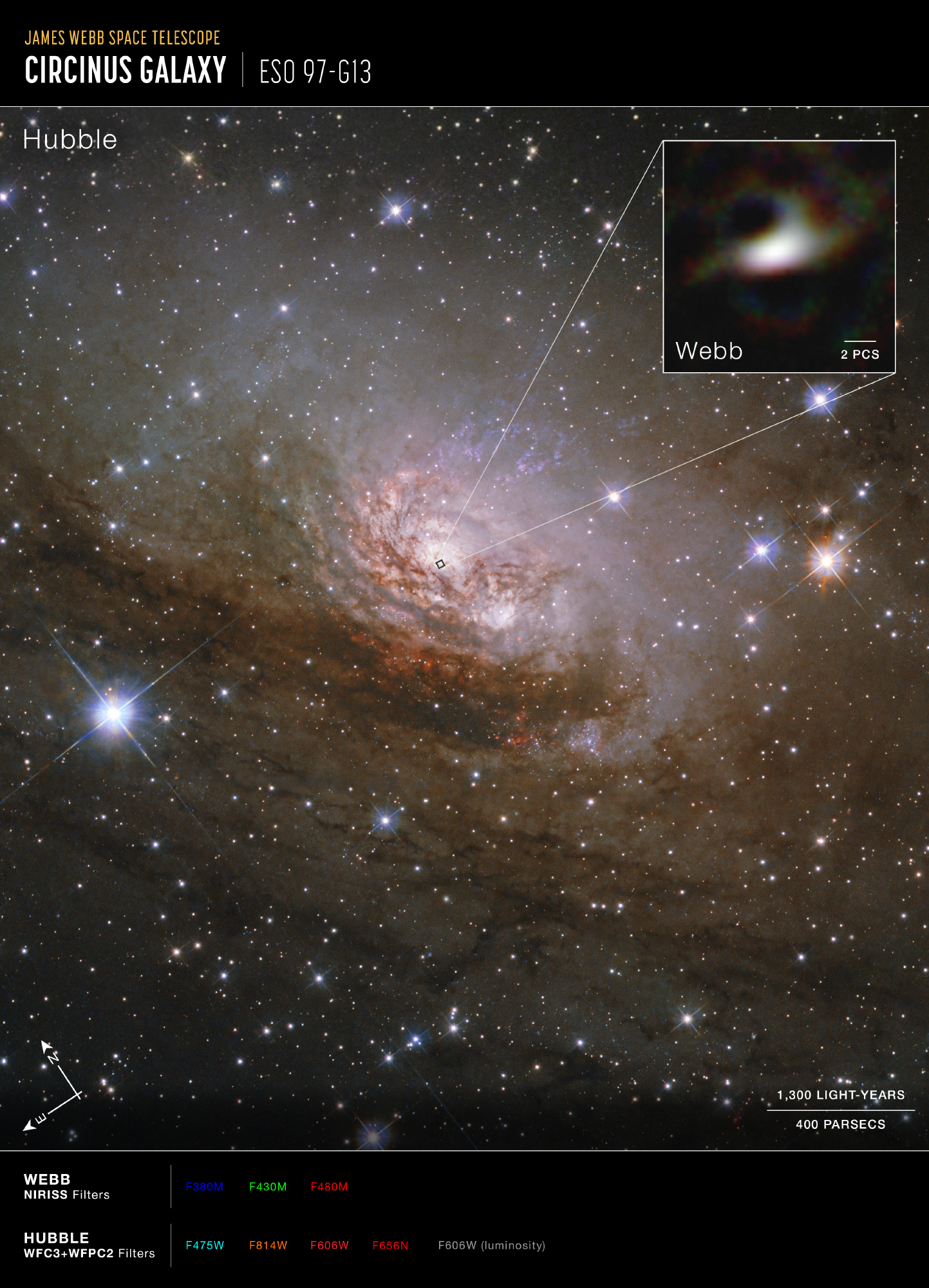
These images were acquired by the NIRISS instrument on the Webb Space Telescope, the WFC3/UVIS and WFPC2 Instrument on the Hubble Space Telescope, and the DECam instrument on the Victor M. Blanco 4m Telescope. The color results from assigning different hues (colors) to a monochromatic (grayscale) image. In this case, the assigned colors are: Webb> Blue: F380W, Green: F430W, Red: F480W Hubble> Cyan: F475W, Orange: F625W, Red: F606W + F656N Chip gaps filled with F656N and F814W Top portion of Hubble image uses DECam for color (Blue: F475W, Green: F642W, Red: F784W) and F606W for luminosity.
Related Images & Videos


Circinus Galaxy (Hubble and Webb Compass Image)
This image shows two views of the Circinus galaxy, one captured by the Hubble Space Telescope and the other by the James Webb Space Telescope’s NIRISS (Near-Infrared Imager and Slitless Spectrograph. It shows compass arrows, scale bar, and color key for reference.
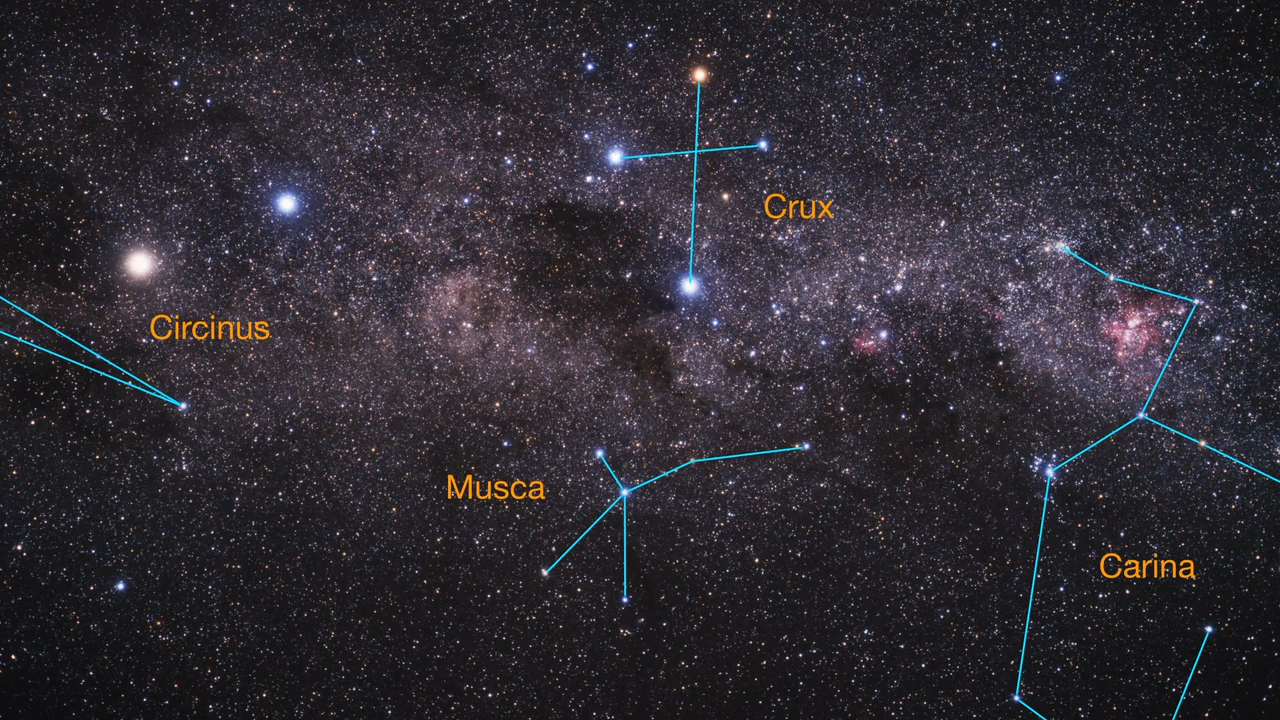
Circinus Galaxy Zoom
This zoom-in video shows the location of the Circinus galaxy on the sky. It begins with a ground-based photo of the constellation Circinus by the late astrophotographer Akira Fujii. The video closes in on the Circinus galaxy, using views from the Digitized Sky Survey and the Dark...
Share
Details
Laura Betz
NASA’s Goddard Space Flight Center
Greenbelt, Maryland
laura.e.betz@nasa.gov