











1 min read
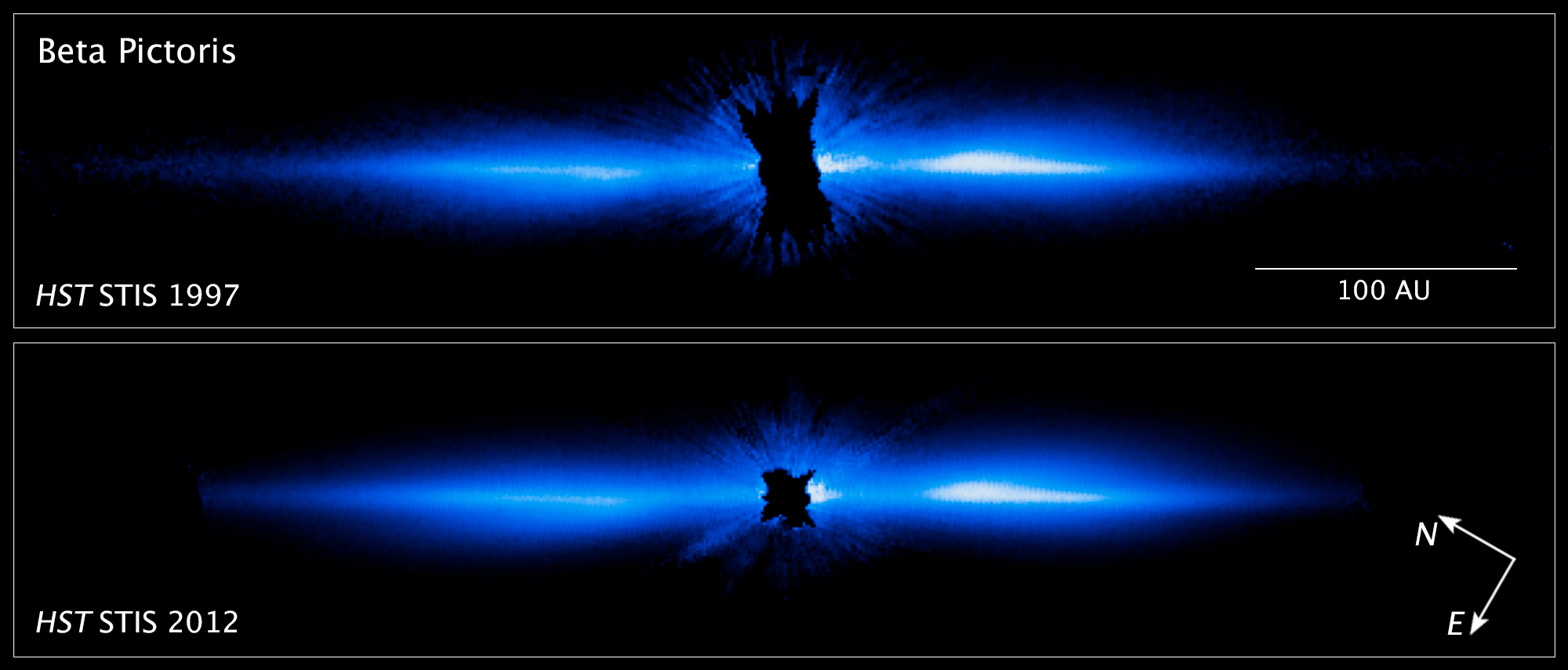
Debris Disk Around Star Beta Pictoris (Hubble)

A debris disk, which includes comets, asteroids, rocks of various sizes, and plenty of dust, orbits the star Beta Pictoris, which is blocked at the center of this 2012 image by a coronagraph aboard the Hubble Space Telescope. This is the visible-light view of the system. NASA’s James Webb Space Telescope will view Beta Pictoris in infrared light, both using its coronagraphs and capturing data known as spectra to allow researchers to learn significantly more about the gas and dust in the debris disk, which includes lots of smaller bodies like exocomets.
About the Object
- R.A. PositionR.A. PositionRight ascension – analogous to longitude – is one component of an object's position.05:47:17.08
- Dec. PositionDec. PositionDeclination – analogous to latitude – is one component of an object's position.-51:03:59.43
- ConstellationConstellationOne of 88 recognized regions of the celestial sphere in which the object appears.Pictor
- DistanceDistanceThe physical distance from Earth to the astronomical object. Distances within our solar system are usually measured in Astronomical Units (AU). Distances between stars are usually measured in light-years. Interstellar distances can also be measured in parsecs.63 light-years
About the Data
- Data DescriptionData DescriptionProposal: A description of the observations, their scientific justification, and the links to the data available in the science archive.
Science Team: The astronomers who planned the observations and analyzed the data. "PI" refers to the Principal Investigator.The image was created from Hubble data from the following proposals: 7125 PI: S. Heap (Eureka Scientific and NASA/GSFC) and 12551 PI: D. Apai (University of Arizona). The science team includes: D. Apai and G. Schneider (University of Arizona), C. Grady (Eureka Scientific and NASA/GSFC), M. Wyatt (University of Cambridge), A.-M. Lagrange (CNRS, Grenoble, France), M. Kuchner and C. Stark (NASA/GSFC), and S. Lubow (STScI).
- InstrumentInstrumentThe science instrument used to produce the data.STIS
- Exposure DatesExposure DatesThe date(s) that the telescope made its observations and the total exposure time.6 March 2012
- Object NameObject NameA name or catalog number that astronomers use to identify an astronomical object.Beta Pictoris
- Object DescriptionObject DescriptionThe type of astronomical object.Star with Circumstellar Disk
- Release DateJuly 21, 2021
- Science ReleaseNASA’s Webb to Explore a Neighboring, Dusty Planetary System
- CreditImage: NASA, ESA, Daniel Apai (University of Arizona), Glenn Schneider (University of Arizona)
Share
Details
Laura Betz
NASA’s Goddard Space Flight Center
Greenbelt, Maryland
laura.e.betz@nasa.gov
NASA, ESA, Daniel Apai (University of Arizona), Glenn Schneider (University of Arizona)