

















1 min read
Galaxies in CEERS Field (NIRCam image)
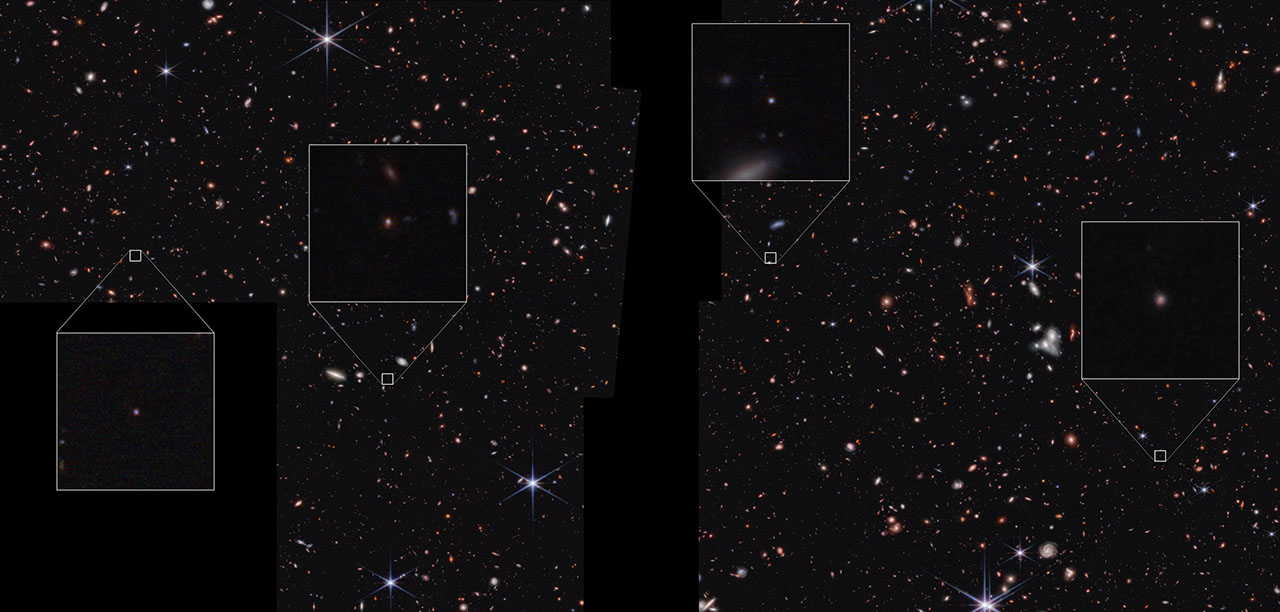
Four of the nine galaxies in the newly identified “platypus” sample were discovered in NASA’s James Webb Space Telescope’s Cosmic Evolution Early Release Science Survey (CEERS). One key feature that makes them distinct is their point-like appearance, even to a telescope that can capture as much detail as Webb.
About the Object
- R.A. PositionR.A. PositionRight ascension – analogous to longitude – is one component of an object's position.14:19:46
- Dec. PositionDec. PositionDeclination – analogous to latitude – is one component of an object's position.+52:53:37
- ConstellationConstellationOne of 88 recognized regions of the celestial sphere in which the object appears.Boötes
- DimensionsDimensionsThe physical size of the object or the apparent angle it subtends on the sky.Image is about 8.8 arcminutes across.
About the Data
- Data DescriptionData DescriptionProposal: A description of the observations, their scientific justification, and the links to the data available in the science archive.
Science Team: The astronomers who planned the observations and analyzed the data. "PI" refers to the Principal Investigator.This image was created with Webb data from proposal: 1345 (S. Finkelstein).
- InstrumentInstrumentThe science instrument used to produce the data.NIRCam
- Exposure DatesExposure DatesThe date(s) that the telescope made its observations and the total exposure time.20-21 Dec 2022, 24 Dec 2022
- FiltersFiltersThe camera filters that were used in the science observations.F115W, F150W, F200W, F277W, F356W, F444W
- Object NameObject NameA name or catalog number that astronomers use to identify an astronomical object.CEERS Survey, Extended Groth Strip
- Object DescriptionObject DescriptionThe type of astronomical object.New population of galaxies
- Release DateJanuary 6, 2026
- Science ReleaseScientists Identify ‘Astronomy’s Platypus’ with NASA’s Webb Telescope
- CreditImage: NASA, ESA, CSA, Steve Finkelstein (UT Austin); Image Processing: Alyssa Pagan (STScI)
Color Info These images are a composite of separate exposures acquired by the James Webb Space Telescope using the NIRCam instrument. Several filters were used to sample wide wavelength ranges. The color results from assigning different hues (colors) to each monochromatic (grayscale) image associated with an individual filter. In this case, the assigned colors are: Blue: F115W+F150W Green: F200W + F277W Red: F356W + F444W
Related Images & Videos
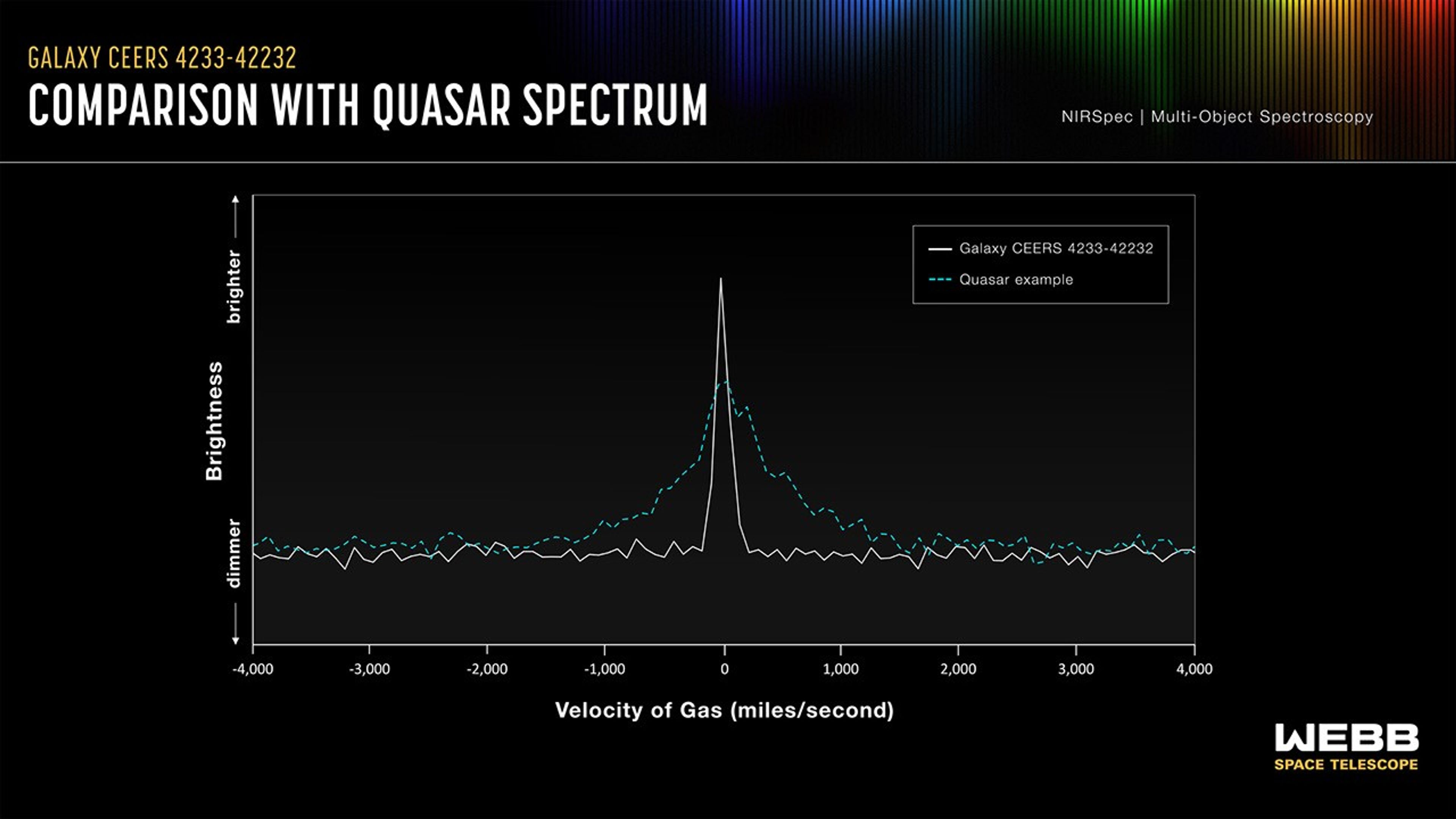
Galaxy CEERS 4233-42232: Comparison With Quasar Spectrum
This graphic illustrates the pronounced narrow peak of the spectra that caught researchers’ attention in a small sample of galaxies, represented here by galaxy CEERS 4233-42232. Typically, distant point-like light sources are quasars, but quasar spectra have a much broader shape.
Share
Details
Laura Betz
NASA’s Goddard Space Flight Center
Greenbelt, Maryland
laura.e.betz@nasa.gov