



















1 min read
Galaxies’ Spectra: Detailed Information Delivered by Light
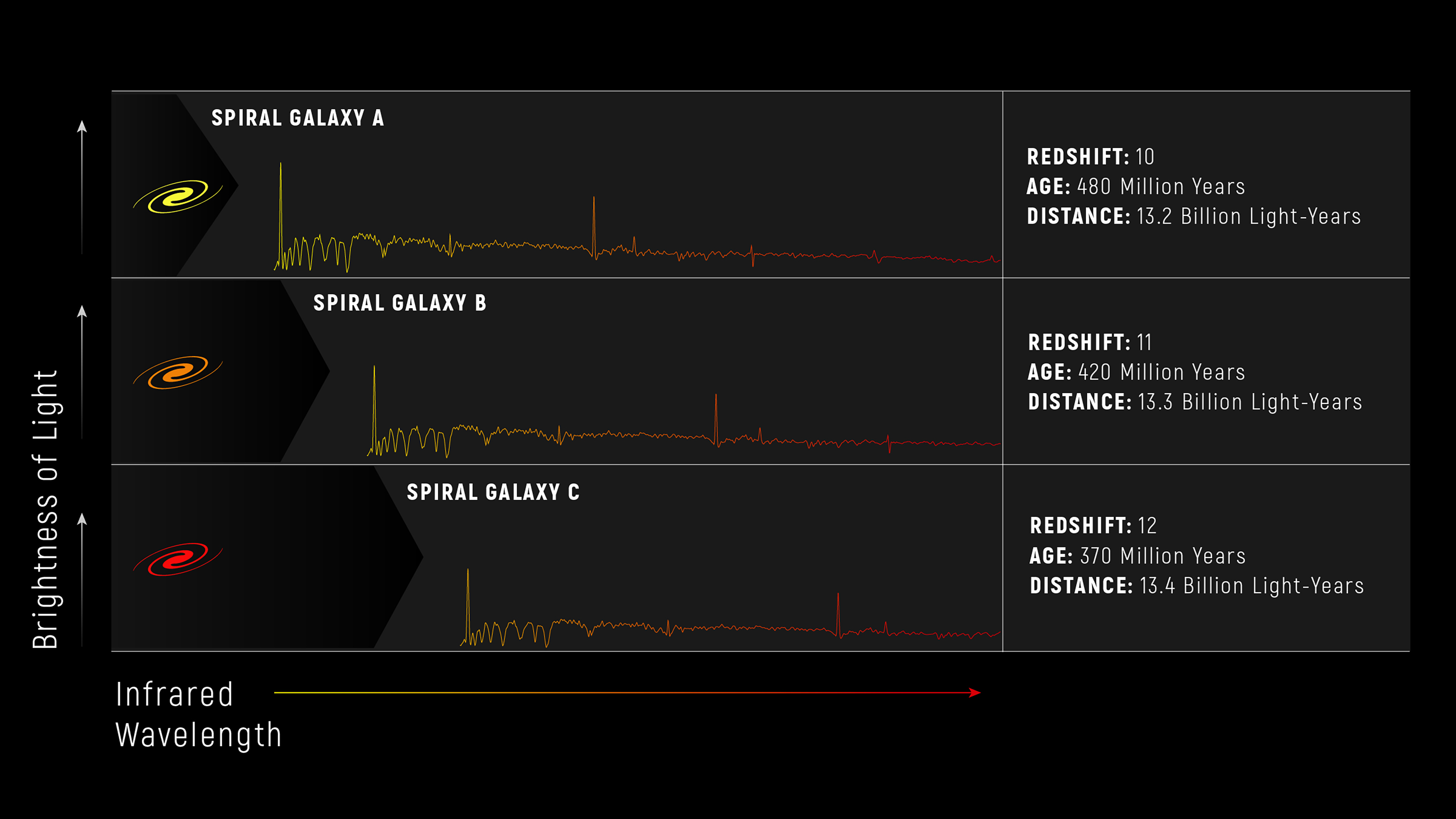
Spectra also tell us an immense amount about galaxies, including very distant galaxies as they existed in the early universe. In the graphs below, we’ve plotted the light gathered from three spiral galaxies. The large black arrows at the left of each spectrum emphasize how far the light from each galaxy has redshifted, or stretched into longer, redder wavelengths due to the expansion of the universe, before reaching the telescope.
The first sample spiral galaxy at the top is the closest to Earth. Its light existed a mere 480 million years after the big bang, which happened more than 13.8 billion years ago. The light observed in the second shows it as it existed only 420 million years after the big bang. The third is the most distant. Its light reflects this spiral galaxy as it existed only 370 million years after the big bang. Although the light from each galaxy was redshifted, we still observe the galaxies as they were when that light was emitted—when the galaxies were young. By comparing galaxies that existed at various times in the universe we can understand how they change over time.
Webb’s microshutter array is not only designed to capture these longer wavelengths of light, known as infrared, but will also be able to accurately sample the light from each galaxy simultaneously to help researchers identify their type (spiral, elliptical, or irregular), their distances from Earth, their ages, and their redshifts.
About the Data
- Data DescriptionData DescriptionProposal: A description of the observations, their scientific justification, and the links to the data available in the science archive.
Science Team: The astronomers who planned the observations and analyzed the data. "PI" refers to the Principal Investigator.
Share
Details
Laura Betz
NASA’s Goddard Space Flight Center
Greenbelt, Maryland
laura.e.betz@nasa.gov
NASA, ESA, CSA, Andi James (STScI)