











1 min read
JADES Transients (NIRCam Image)
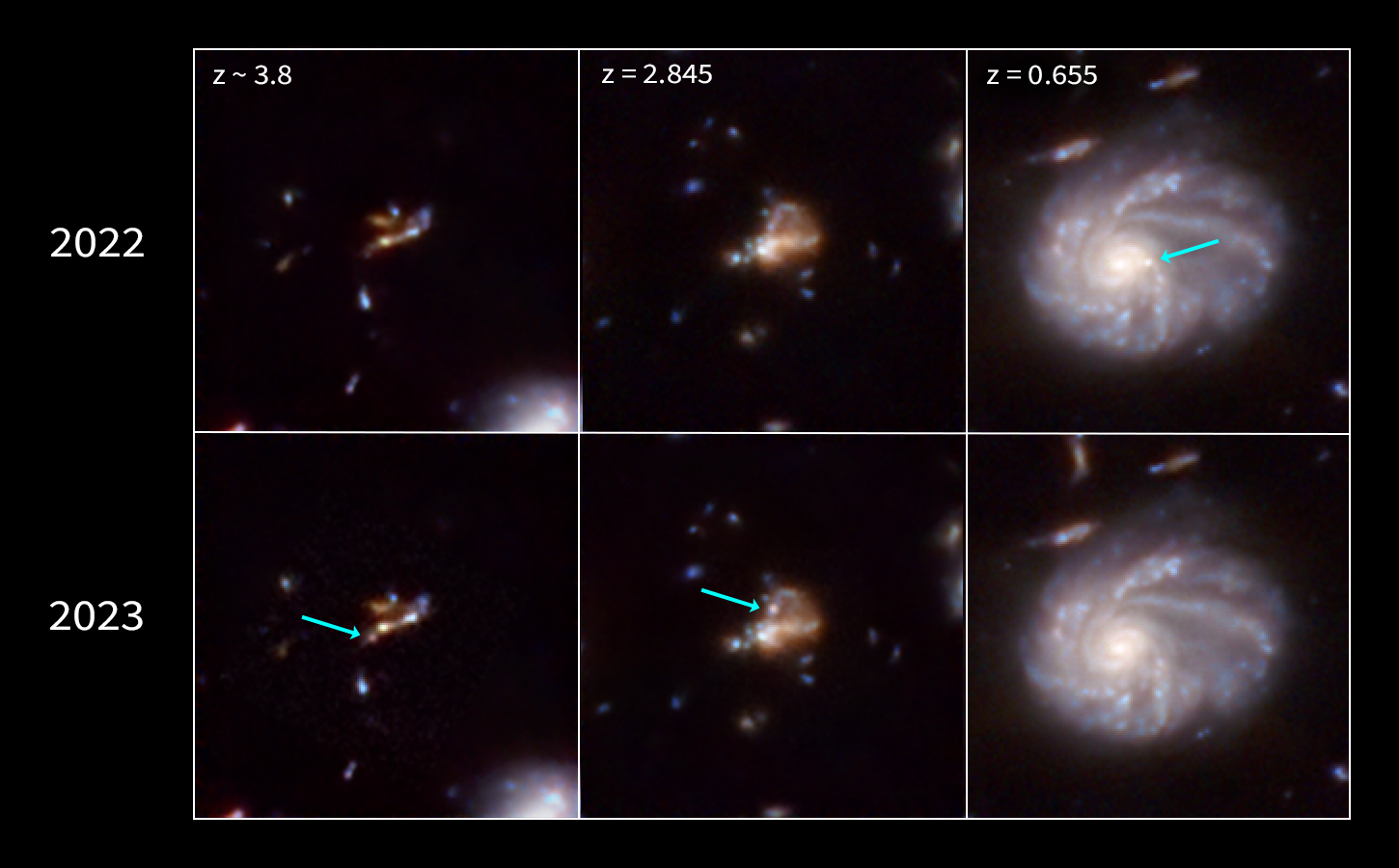
This mosaic displays three of about 80 transients, or objects of changing brightness, identified in data from the JADES (JWST Advanced Deep Extragalactic Survey) program. Most of the transients are the result of exploding stars or supernovae. By comparing images taken in 2022 and 2023, astronomers could locate supernovae that, from our perspective, recently exploded (like the examples shown in the first two columns), or supernovae that had already exploded and whose light was fading away (third column).
The age of each supernova can be determined from its redshift (designated by ‘z’). The light of the most distant supernova, at a redshift of 3.8, originated when the universe was only 1.7 billion years old. A redshift of 2.845 corresponds to a time 2.3 billion years after the big bang. The closest example, at a redshift of 0.655, shows light that left its galaxy about 6 billion years ago, when the universe was just over half its current age.
About the Object
- R.A. PositionR.A. PositionRight ascension – analogous to longitude – is one component of an object's position.03:32:36.89
- Dec. PositionDec. PositionDeclination – analogous to latitude – is one component of an object's position.-27:46:49.33
- ConstellationConstellationOne of 88 recognized regions of the celestial sphere in which the object appears.Fornax
- DimensionsDimensionsThe physical size of the object or the apparent angle it subtends on the sky.Image is about 6 arcminutes across
About the Data
- Data DescriptionData DescriptionProposal: A description of the observations, their scientific justification, and the links to the data available in the science archive.
Science Team: The astronomers who planned the observations and analyzed the data. "PI" refers to the Principal Investigator.This image was created with Webb data from proposal: 1180 (D. Eisenstein). Image processing: Alyssa Pagan (STScI).
- InstrumentInstrumentThe science instrument used to produce the data.NIRCam
- Exposure DatesExposure DatesThe date(s) that the telescope made its observations and the total exposure time.29 Sept. - 10 Oct. 2022, 2023
- FiltersFiltersThe camera filters that were used in the science observations.F090W, F115W, F150W, F200W, F277W, F335M, F356W, F410M, F444W
- Object NameObject NameA name or catalog number that astronomers use to identify an astronomical object.JWST Advanced Deep Extragalactic Survey, GOODS-S
- Object DescriptionObject DescriptionThe type of astronomical object.Deep Field Survey
- Release DateJune 10, 2024
- Science ReleaseNASA’s Webb Opens New Window on Supernova Science
- CreditImage: NASA, ESA, CSA, STScI, JADES Collaboration, Christa DeCoursey (University of Arizona)
These images are a composite of separate exposures acquired by the James Webb Space Telescope using the NIRCam instrument. Several filters were used to sample wide wavelength ranges. The color results from assigning different hues (colors) to each monochromatic (grayscale) image associated with an individual filter. In this case, the assigned colors are: Blue: F090W + F115W + F150W Green: F200W + F277W + F335M Red: F356W + F410M + F444W
Related Images & Videos
JADES Transient Survey (NIRCam Image)
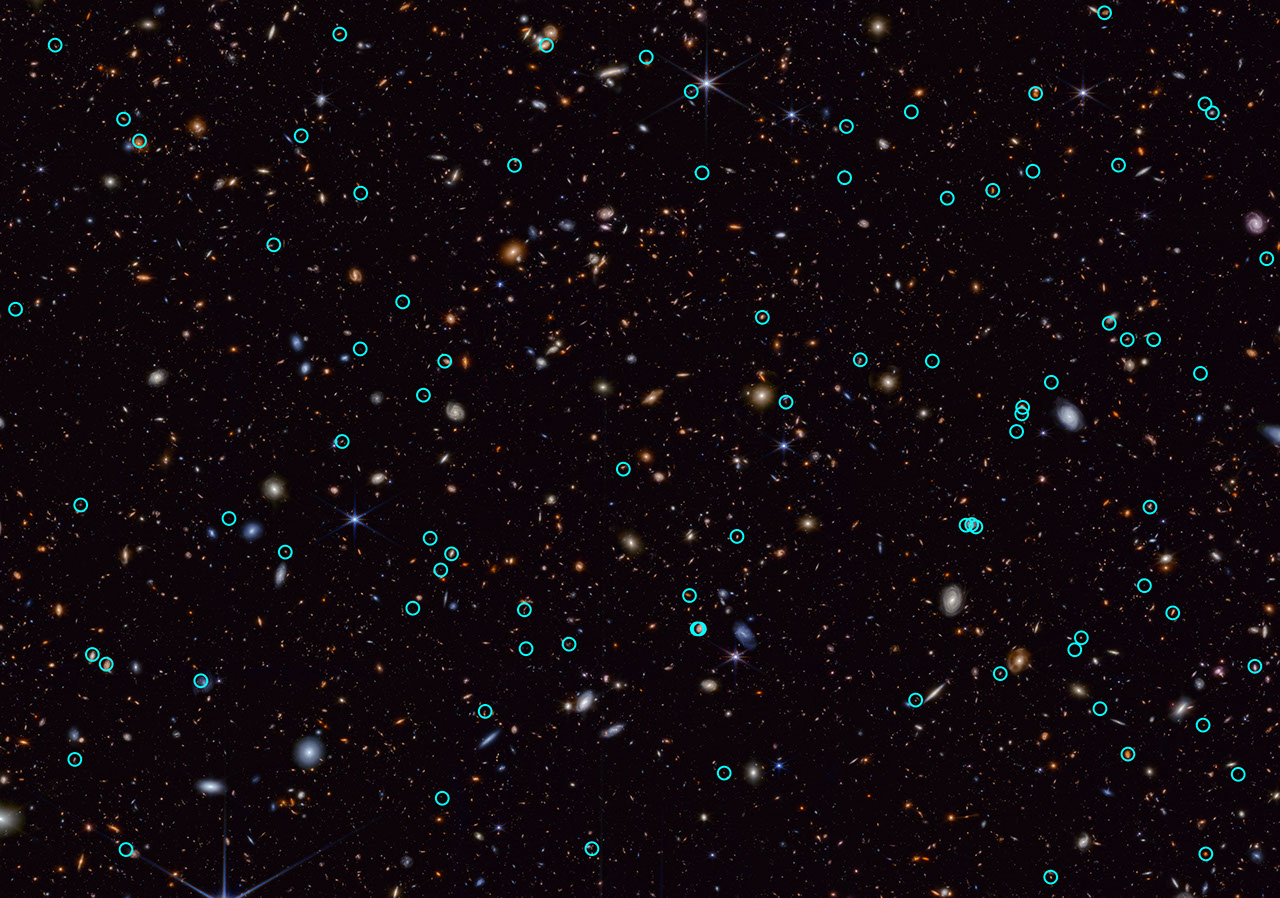
The JADES Deep Field uses observations taken by NASA’s James Webb Space Telescope (JWST) as part of the JADES (JWST Advanced Deep Extragalactic Survey) program. A team of astronomers studying JADES data identified about 80 objects (circled in green) that changed in brightness...
Share
Details
Laura Betz
NASA’s Goddard Space Flight Center
Greenbelt, Maryland
laura.e.betz@nasa.gov
NASA, ESA, CSA, STScI, JADES Collaboration, Christa DeCoursey (University of Arizona)