













1 min read
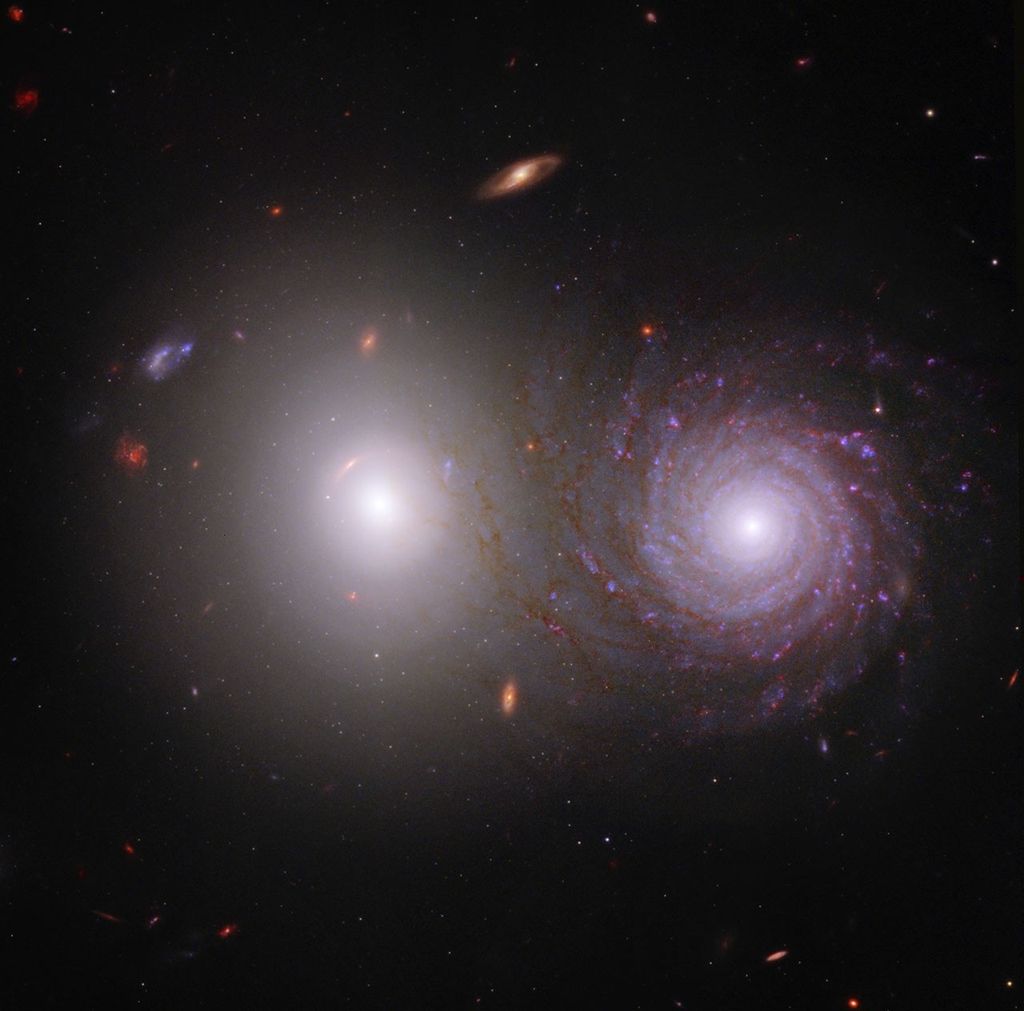
Lensed Galaxies in VV 191 (Webb and Hubble Composite Image)

Editor’s Note: This post highlights data from Webb science in progress, which has not yet been through the peer-review process.
Researchers identified a previously unknown lensed galaxy for the first time in new near-infrared data from NASA’s James Webb Space Telescope.
Examine the white elliptical galaxy at left. A faint red arc appears in the inset at 10 o’clock. This is a very distant galaxy whose appearance is warped in Webb’s image. Its light is bent by the gravity of the elliptical foreground galaxy. Plus, its appearance is duplicated. The stretched red arc reappears – as a dot – at 4 o’clock.
These images of the lensed galaxy are so faint and so red that they went unrecognized in Hubble data, but are unmistakable in Webb’s near-infrared image. Simulations of gravitationally lensed galaxies like this help researchers reconstruct how much mass is in individual stars, along with how much dark matter is in the core of this galaxy.
This image includes ultraviolet and visible data from NASA’s Hubble Space Telescope.
Webb’s NIRCam was built by a team at the University of Arizona and Lockheed Martin’s Advanced Technology Center.
About the Object
- R.A. PositionR.A. PositionRight ascension – analogous to longitude – is one component of an object's position.13 48 22.367
- Dec. PositionDec. PositionDeclination – analogous to latitude – is one component of an object's position.+25 40 49.66
- ConstellationConstellationOne of 88 recognized regions of the celestial sphere in which the object appears.Boötes
About the Data
- Data DescriptionData DescriptionProposal: A description of the observations, their scientific justification, and the links to the data available in the science archive.
Science Team: The astronomers who planned the observations and analyzed the data. "PI" refers to the Principal Investigator. - InstrumentInstrumentThe science instrument used to produce the data.HST>WFC3/UVISJWST>NIRCam
- Exposure DatesExposure DatesThe date(s) that the telescope made its observations and the total exposure time.19 June 2015, 16 Dec 2018, 2 July 2022
- FiltersFiltersThe camera filters that were used in the science observations.HST> F336W, F606WJWST> F356W, F150W, F090W
- Object NameObject NameA name or catalog number that astronomers use to identify an astronomical object.VV 191
- Object DescriptionObject DescriptionThe type of astronomical object.Overlapping galaxies
- Release DateOctober 5, 2022
- CreditNASA, ESA, CSA, JWST PEARLS Team, Rogier Windhorst (ASU), William Keel (University of Alabama), Stuart Wyithe; Image Processing: Alyssa Pagan (STScI)
These images are a composite of separate exposures acquired by the James Webb Space Telescope and the Hubble Space Telescope using the NIRCam and WFC3/UVIS instruments respectively. Several filters were used to sample infrared, visible and ultraviolet wavelength ranges. The color results from assigning different hues (colors) to each monochromatic (grayscale) image associated with an individual filter. In this case, the assigned colors are: Red: F356W Yellow: F150W, Green: F090W, Blue: F336W + F606W
Share
Details
Laura Betz
NASA’s Goddard Space Flight Center
Greenbelt, Maryland
laura.e.betz@nasa.gov
NASA, ESA, CSA, JWST PEARLS Team, Rogier Windhorst (ASU), William Keel (University of Alabama), Stuart Wyithe
Alyssa Pagan (STScI)