








1 min read
M82 Cigar Galaxy (Webb + Hubble)
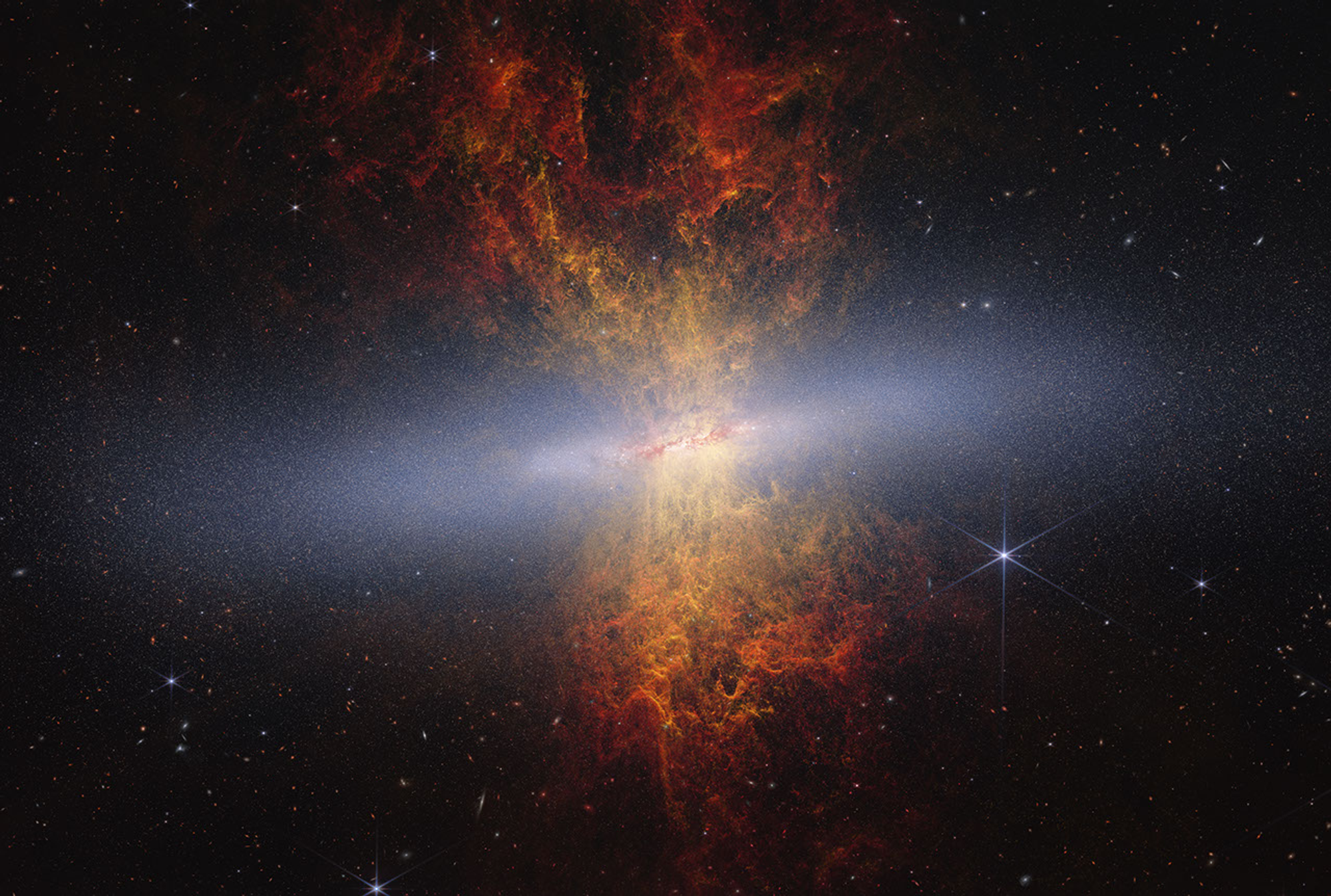
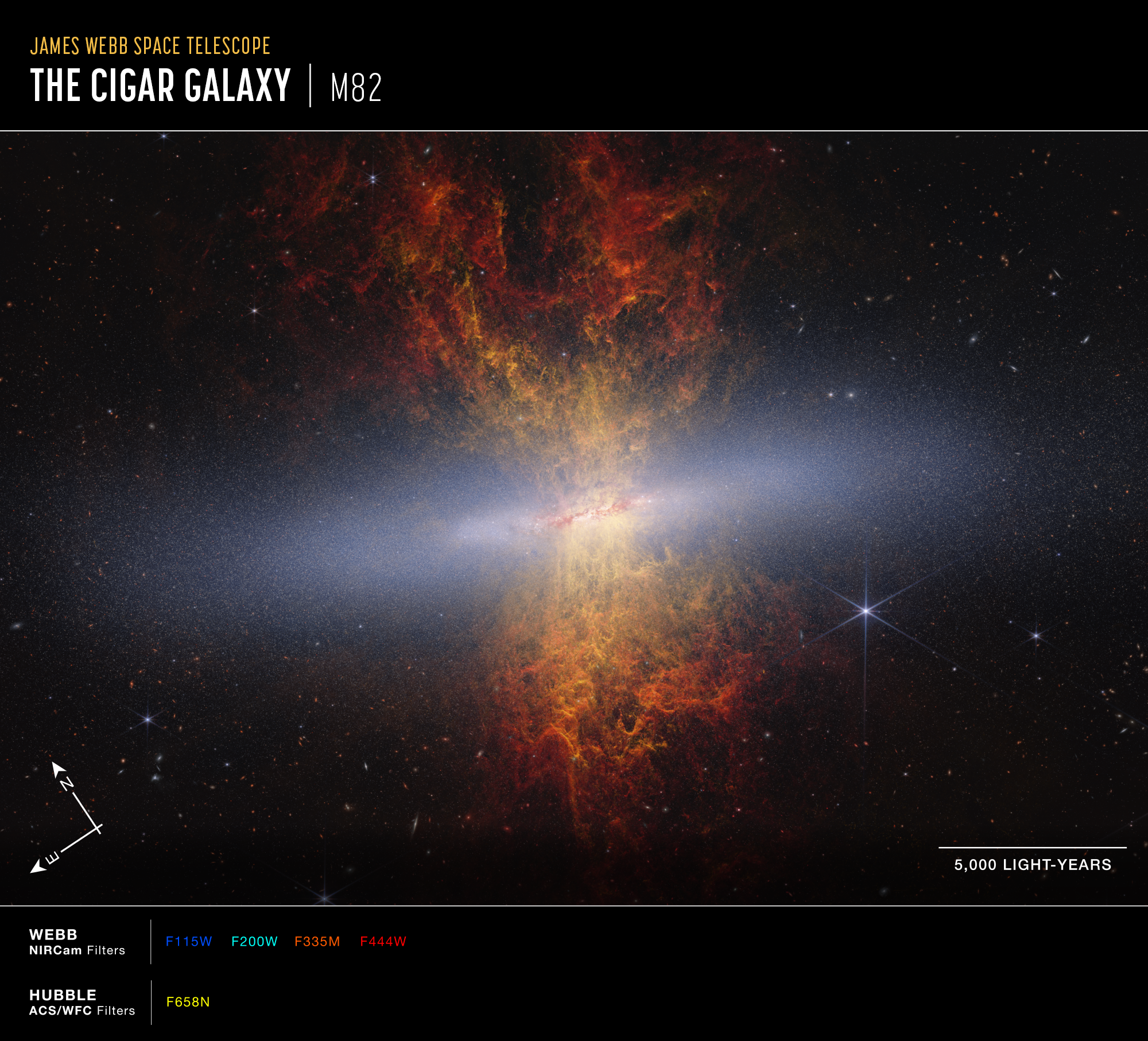
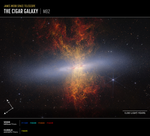
NASA’s James Webb Space Telescope recently observed edge-on starburst galaxy Messier 82 (M82), nicknamed the Cigar Galaxy. Webb’s near-infrared data combined with Hubble visible-light archival data (assigned the color yellow) create a more comprehensive understanding of M82. With Webb’s near-infrared imagery, astronomers can see the galaxy’s distended disk structure and millions of individual stars — approximately 16.5 million — for the first time.
Depicted as luminous blue granules, these stars are only a small portion of the total amount astronomers think reside in a galaxy like M82. The extreme star formation occurring within M82, which will eventually cause star formation to cease in the future, is causing bipolar plumes of material to be ejected above and below the galaxy’s disk.
Archival data from the Hubble Space Telescope adds another aspect to the lively scene: yellow tendrils of material, which represent ionized hydrogen gas, are closest to the galaxy’s disk. The red-orange material farther away imaged by Webb depicts small dust grains. These grains are called polycyclic aromatic hydrocarbons and are helpful in tracing material in the space between the galaxy’s stars, also known as the interstellar medium.
Webb’s detailed observation of the galaxy, specifically of the main plane of the galactic disk, is aiding astronomers as they seek to uncover the formation history of M82. The telescope data will also help scientists understand the current processes occurring within the starburst galaxy.
About the Object
- R.A. PositionR.A. PositionRight ascension – analogous to longitude – is one component of an object's position.09:55:52.0
- Dec. PositionDec. PositionDeclination – analogous to latitude – is one component of an object's position.69:40:48.99
- ConstellationConstellationOne of 88 recognized regions of the celestial sphere in which the object appears.Ursa Major
- DistanceDistanceThe physical distance from Earth to the astronomical object. Distances within our solar system are usually measured in Astronomical Units (AU). Distances between stars are usually measured in light-years. Interstellar distances can also be measured in parsecs.12 million light-years
- DimensionsDimensionsThe physical size of the object or the apparent angle it subtends on the sky.This image is 9 arcminutes across (about 32,000 light-years)
About the Data
- Data DescriptionData DescriptionProposal: A description of the observations, their scientific justification, and the links to the data available in the science archive.
Science Team: The astronomers who planned the observations and analyzed the data. "PI" refers to the Principal Investigator.This image was created with Webb data from proposal: 5145 (A. Smercina) and HST data from proposal: 10776 (M. Mountain (STScI), J. Gallagher (University of Wisconsin-Madison), P. Puxley (NSF), K. Noll, H. Bond, C. Christian, L. Frattare, F. Hamilton, Z. Levay, M. Mutchler, W. Januszewski, and T. Royle (Hubble Heritage Team/STScI/AURA))
- InstrumentInstrumentThe science instrument used to produce the data.JWST>NIRCam HST>ACS/WFC
- Exposure DatesExposure DatesThe date(s) that the telescope made its observations and the total exposure time.JWST> 15 March 2025 HST> 27-29 March 2006, 5 Janurary 2024
- FiltersFiltersThe camera filters that were used in the science observations.JWST> F115W, F200W, F335M, F444W HST> F658N
- Object NameObject NameA name or catalog number that astronomers use to identify an astronomical object.M82, The Cigar Galaxy
- Object DescriptionObject DescriptionThe type of astronomical object.Starburst Galaxy
- Release DateJune 23, 2026
- Science ReleaseNASA’s Webb Pinpoints Millions of Stars Within Cigar Galaxy
- CreditImage: NASA, ESA, CSA, Adam Smercina (STScI, Tufts), Thomas Williams (University of Manchester); Image Processing: Alyssa Pagan (STScI)
This image is a composite of separate exposures acquired by the James Webb Space Telescope using the NIRCam instrument and the Hubble Space Telescope using the ACS/WFC instrument. Several filters were used to sample varying wavelength ranges. The color results from assigning different hues (colors) to each monochromatic (grayscale) image associated with an individual filter. In this case, the assigned colors are: Blue: F115W, Cyan: F200W, Orange: F335M, Yellow: F658N, Red: F444W
Related Images & Videos
M82 Cigar Galaxy (Hubble/Webb Side-by-Side)
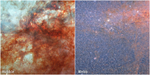
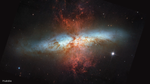
Side-by-side comparison of a portion of starburst galaxy Messier 82 (M82) as seen by NASA’s Hubble (left) and James Webb (right) space telescopes. Hubble detailed M82’s gas and dust structure, while Webb pierced through the dust and resolved millions of stars in infrared light.
M82 Cigar Galaxy (Webb + Hubble Fade)
NASA’s James Webb Space Telescope’s near-infrared observation of M82 is the most recent addition to overall data on this starburst galaxy. The Hubble Space Telescope is one observatory that has previously looked at M82, detailing the gas and dust structure seen in visible light.
Share
Details
Laura Betz
NASA’s Goddard Space Flight Center
Greenbelt, Maryland
laura.e.betz@nasa.gov