
















1 min read
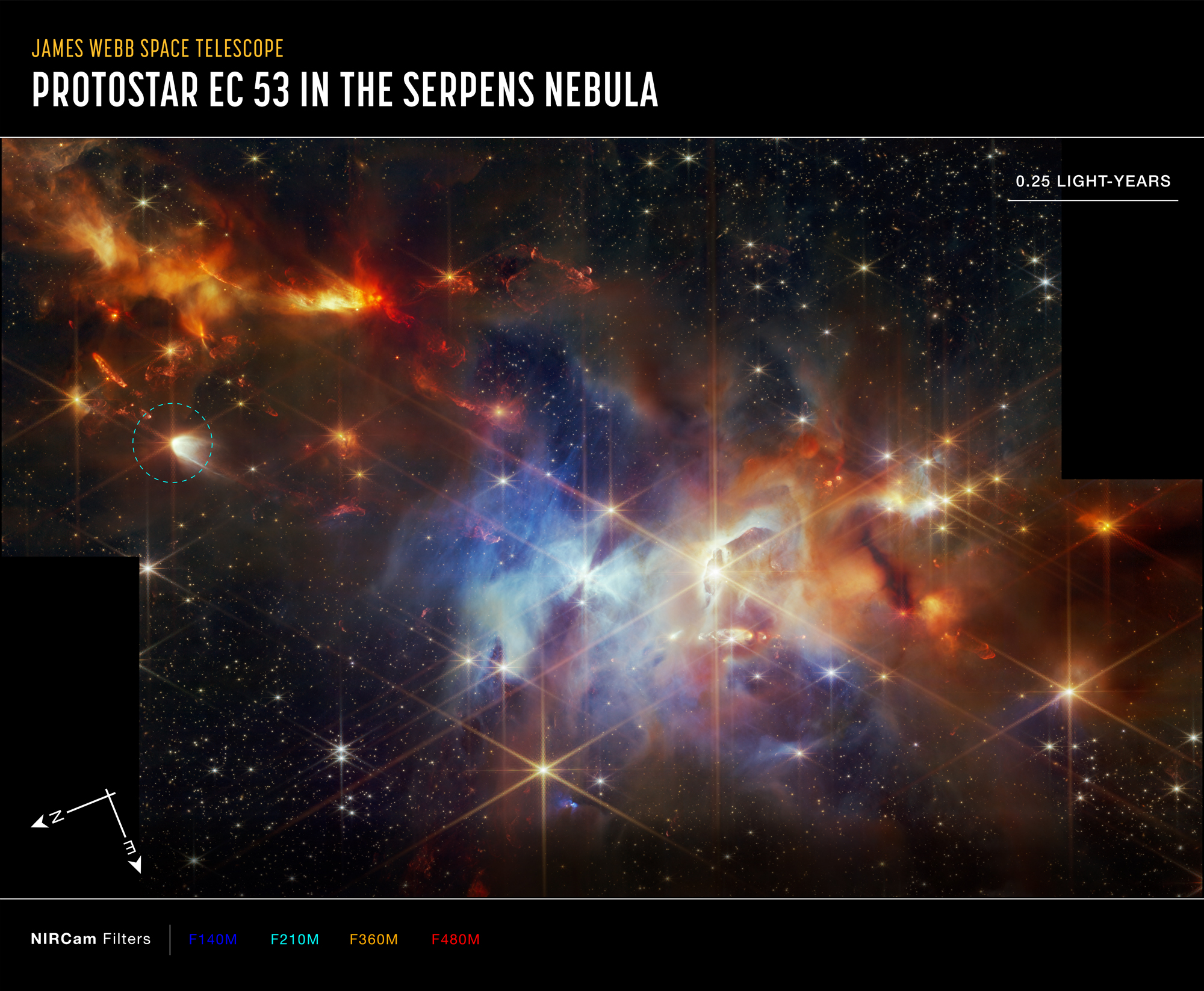
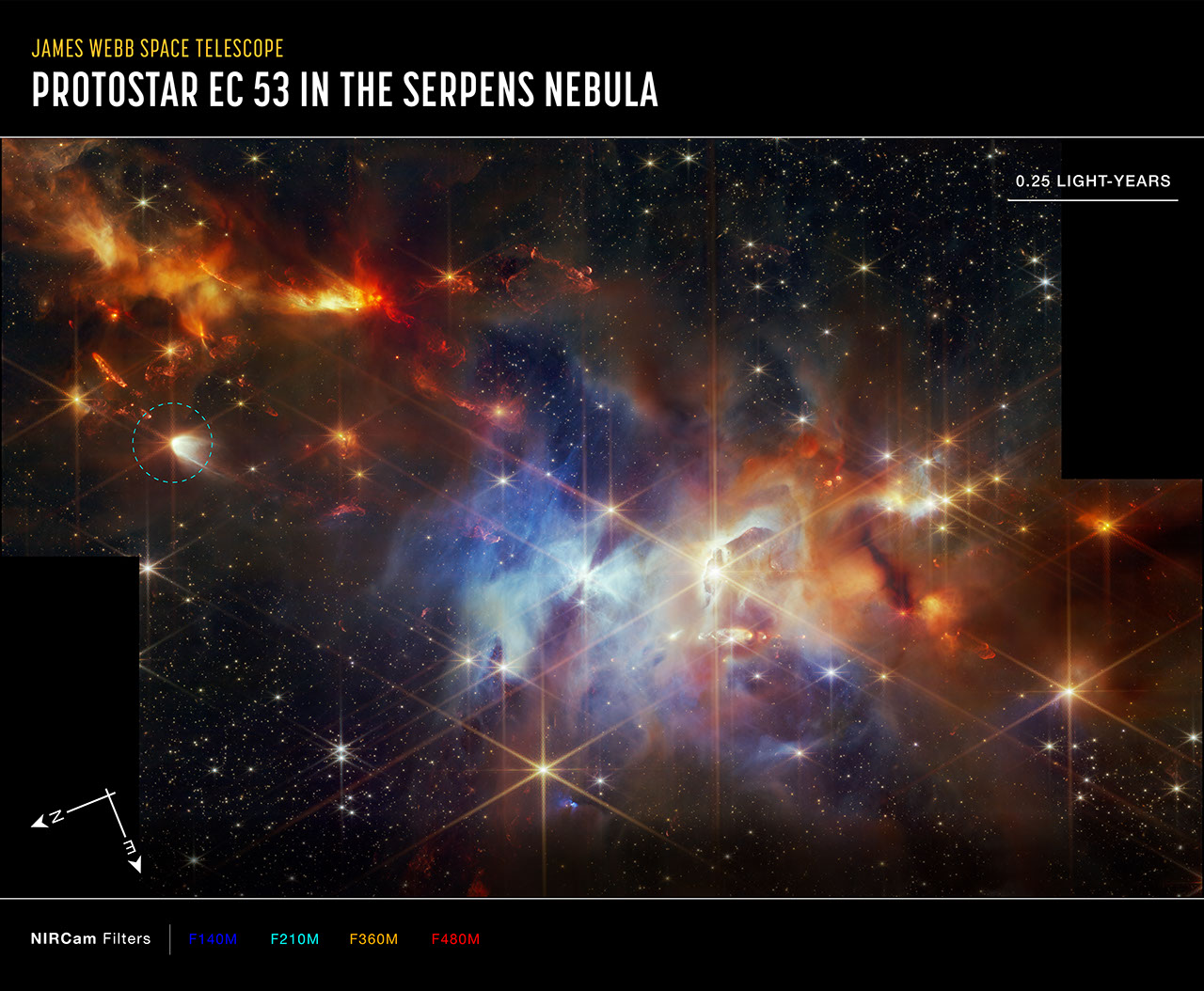
Protostar EC 53 in the Serpens Nebula (NIRCam Image)

This image, taken by NIRCam (Near-Infrared Camera) on NASA’s James Webb Space Telescope, shows the actively forming protostar EC 53 (circled) in the Serpens Nebula. EC 53 is surrounded by a protoplanetary disk where planets and comets may eventually form. (That disk isn’t an obvious feature for two reasons: It’s tiny from a distance, and dark dust obscures the area.)
Researchers took additional observations of EC 53 using Webb’s MIRI (Mid-Infrared Instrument) to observe the star and its system when it was “quiet” and during its “party-like” burst phase. The team, led by Jeong-Eun Lee of Seoul National University in South Korea, discovered a slew of silicates all across the star’s disk of gas and dust.
MIRI’s spectra turned up crystalline forsterite and enstatite, and amorphous olivine and pyroxene near the star and throughout its protoplanetary disk. Webb’s data also mapped the star’s narrow, high-velocity jets near its poles, its slightly cooler and slower outflows, and the star’s wider and weaker stellar winds.
By showing precisely what is present — and where everything is — the researchers proved that crystalline silicates are being forged in the hot, inner region of the disk of gas and dust around the star, before being shot out into far-flung locales.
Astronomers have long sought evidence to explain why comets at the edge of our own solar system contain crystalline silicates, since these minerals require intense heat to form and comets spend most of their orbits in the ultracold Kuiper Belt and Oort Cloud. This is the first direct evidence that can explain how that may have happened.
Also see what researchers reported finding about other stars in the Serpens Nebula in 2024.
About the Object
- R.A. PositionR.A. PositionRight ascension – analogous to longitude – is one component of an object's position.18:29:56.91
- Dec. PositionDec. PositionDeclination – analogous to latitude – is one component of an object's position.+1:14:45.77
- ConstellationConstellationOne of 88 recognized regions of the celestial sphere in which the object appears.Serpens
- DistanceDistanceThe physical distance from Earth to the astronomical object. Distances within our solar system are usually measured in Astronomical Units (AU). Distances between stars are usually measured in light-years. Interstellar distances can also be measured in parsecs.1,300 light-years
- DimensionsDimensionsThe physical size of the object or the apparent angle it subtends on the sky.Image is about 4.8 arcminutes across (1.4 light-years)
About the Data
- Data DescriptionData DescriptionProposal: A description of the observations, their scientific justification, and the links to the data available in the science archive.
Science Team: The astronomers who planned the observations and analyzed the data. "PI" refers to the Principal Investigator.The Webb observations include those from program 1611 (K. Pontoppidan).
- InstrumentInstrumentThe science instrument used to produce the data.NIRCam
- Exposure DatesExposure DatesThe date(s) that the telescope made its observations and the total exposure time.26 April 2023, 12 May 2023
- FiltersFiltersThe camera filters that were used in the science observations.F140M, F210M, F360M, F480M
- Object NameObject NameA name or catalog number that astronomers use to identify an astronomical object.EC 53, Serpens Nebula, HBC 672, [EC 92] 82
- Object DescriptionObject DescriptionThe type of astronomical object.Variable, bursting proto-star
- Release DateJanuary 21, 2026
- Science ReleaseNASA Webb Finds Young Sun-Like Star Forging, Spewing Common Crystals
- CreditImage: NASA, ESA, CSA, STScI, Klaus Pontoppidan (NASA-JPL), Joel Green (STScI); Image Processing: Alyssa Pagan (STScI)
This image is a composite of separate exposures acquired by the James Webb Space Telescope using the NIRCam instrument. Several filters were used to sample medium wavelength ranges. The color results from assigning different hues (colors) to each monochromatic (grayscale) image associated with an individual filter. In this case, the assigned colors are: Blue: F140M, Cyan: F210M, Orange: F360M, Red: 480M
Related Images & Videos
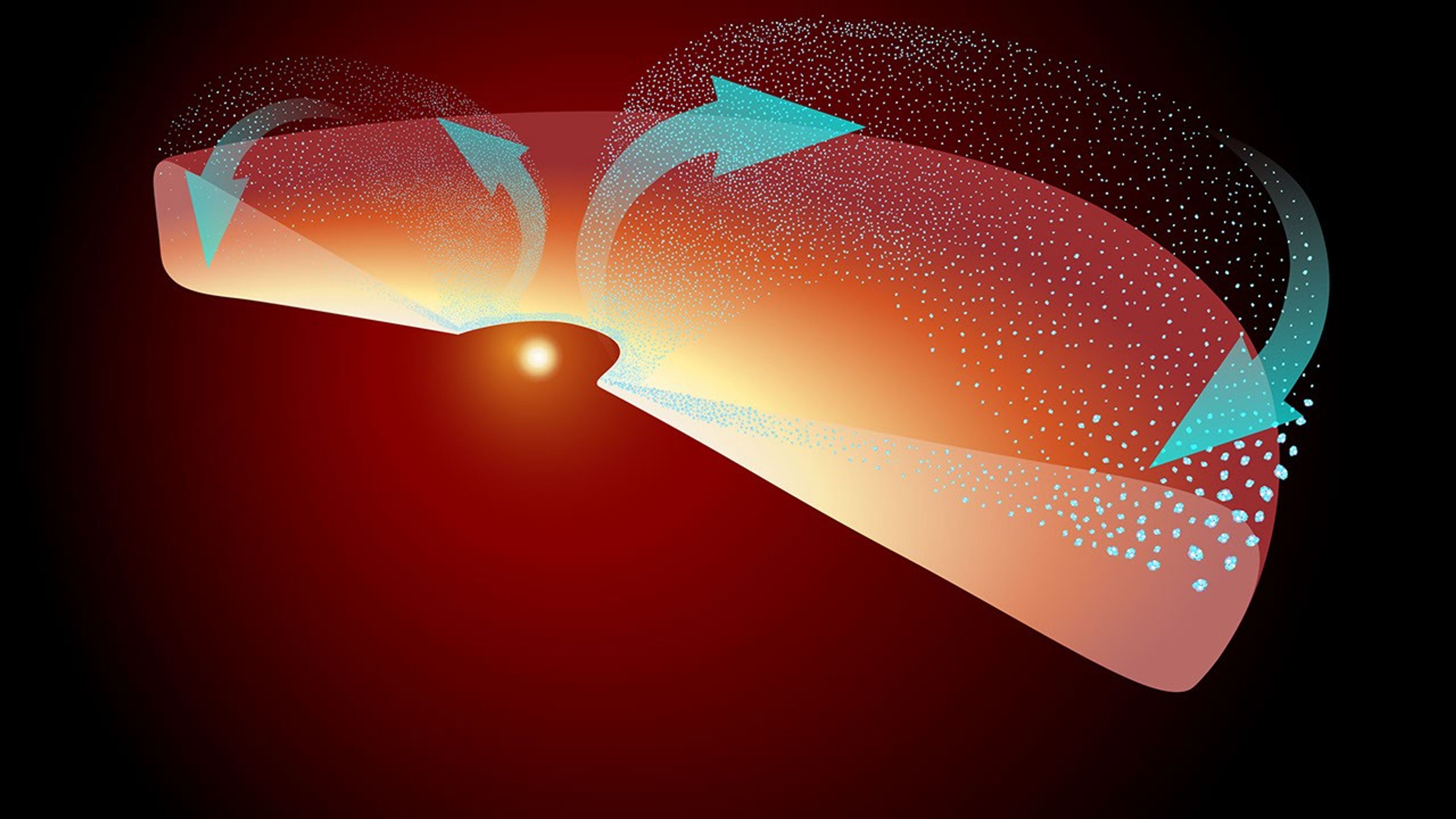
Silicate Crystallization and Movement Near Protostar EC 53 (Illustration)
This illustration represents half the disk of gas and dust surrounding the protostar EC 53. Stellar outbursts periodically form crystalline silicates, which are launched up and out to the edges of the system, where comets and other icy rocky bodies may eventually form.
Share
Details
Laura Betz
NASA’s Goddard Space Flight Center
Greenbelt, Maryland
laura.e.betz@nasa.gov