



















1 min read
Saguaro in GOODS-North Field (NIRCam)
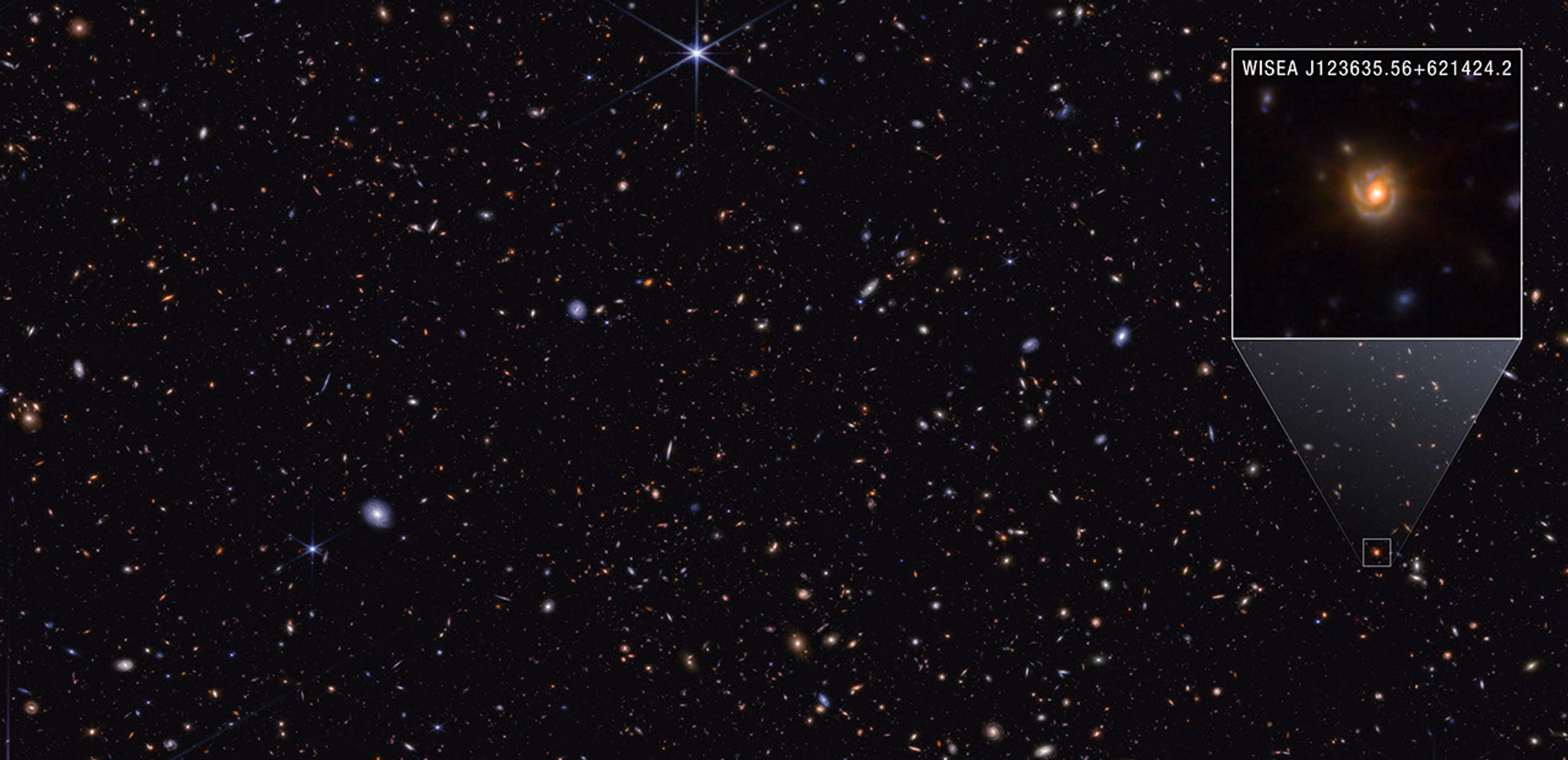
First discovered by NASA’s James Webb Space Telescope in 2022, little red dots (LRDs) have continued to perplex scientists. Although they appear abundant at high redshifts early in the universe, they rapidly decrease in number at lower redshifts.
To explore why LRDs decrease in number as the universe ages, researchers examined lower-redshift spiral galaxy WISEA J123635.56+621424.2. Nicknamed the “Saguaro” for its prominent arms, like the cactus native to the Sonoran Desert in the Southwestern United States, this redshift 2 galaxy contains an LRD-like center.
About the Object
- R.A. PositionR.A. PositionRight ascension – analogous to longitude – is one component of an object's position.12:36:35.56
- Dec. PositionDec. PositionDeclination – analogous to latitude – is one component of an object's position.+62:14:24.3
- ConstellationConstellationOne of 88 recognized regions of the celestial sphere in which the object appears.Ursa Major
- DimensionsDimensionsThe physical size of the object or the apparent angle it subtends on the sky.This image is about 8 arcminutes across.
About the Data
- Data DescriptionData DescriptionProposal: A description of the observations, their scientific justification, and the links to the data available in the science archive.
Science Team: The astronomers who planned the observations and analyzed the data. "PI" refers to the Principal Investigator.This image was created with Webb data from proposal: 1181 (D. Eisenstein)
- InstrumentInstrumentThe science instrument used to produce the data.NIRCam
- Exposure DatesExposure DatesThe date(s) that the telescope made its observations and the total exposure time.04-05 February 2023
- FiltersFiltersThe camera filters that were used in the science observations.F090W, F115W, F150W, F200W, F277W, F335M, F356W, F410M, F444W
- Object NameObject NameA name or catalog number that astronomers use to identify an astronomical object.Saguaro, WISEA J123635.56+621424.2
- Object DescriptionObject DescriptionThe type of astronomical object.z=2 distant, IR-Bright, galaxy
- Release DateJuly 29, 2026
- Science ReleaseNASA Webb Explores Family Tree of Newly Discovered Distant Objects
- CreditImage: NASA, ESA, CSA, STScI, Pierluigi Rinaldi (Steward Observatory); Image Processing: Alyssa Pagan (STScI)
These images are a composite of separate exposures acquired by the James Webb Space Telescope using the NIRCam instrument. Several filters were used to sample specific wavelength ranges. The color results from assigning different hues (colors) to each monochromatic (grayscale) image associated with an individual filter. In this case, the assigned colors are: Blue: F090W+F115W+F150W, Green: F200W+F277W+F335M, Red: F356W+F410M+F444W
Related Images & Videos
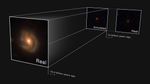
Little Red Dot at Redshift 2: Real and Simulated Graphic
Scientists synthetically shifted the Saguaro, a lower-redshift spiral galaxy, to a higher redshift to find out how it would appear if it was in the early universe. Its compact red appearance suggests that little red dots are a phase of highly active supermassive black holes.
Share
Details
Laura Betz
NASA’s Goddard Space Flight Center
Greenbelt, Maryland
laura.e.betz@nasa.gov