
















1 min read
Uranus – New Moon (Annotated)
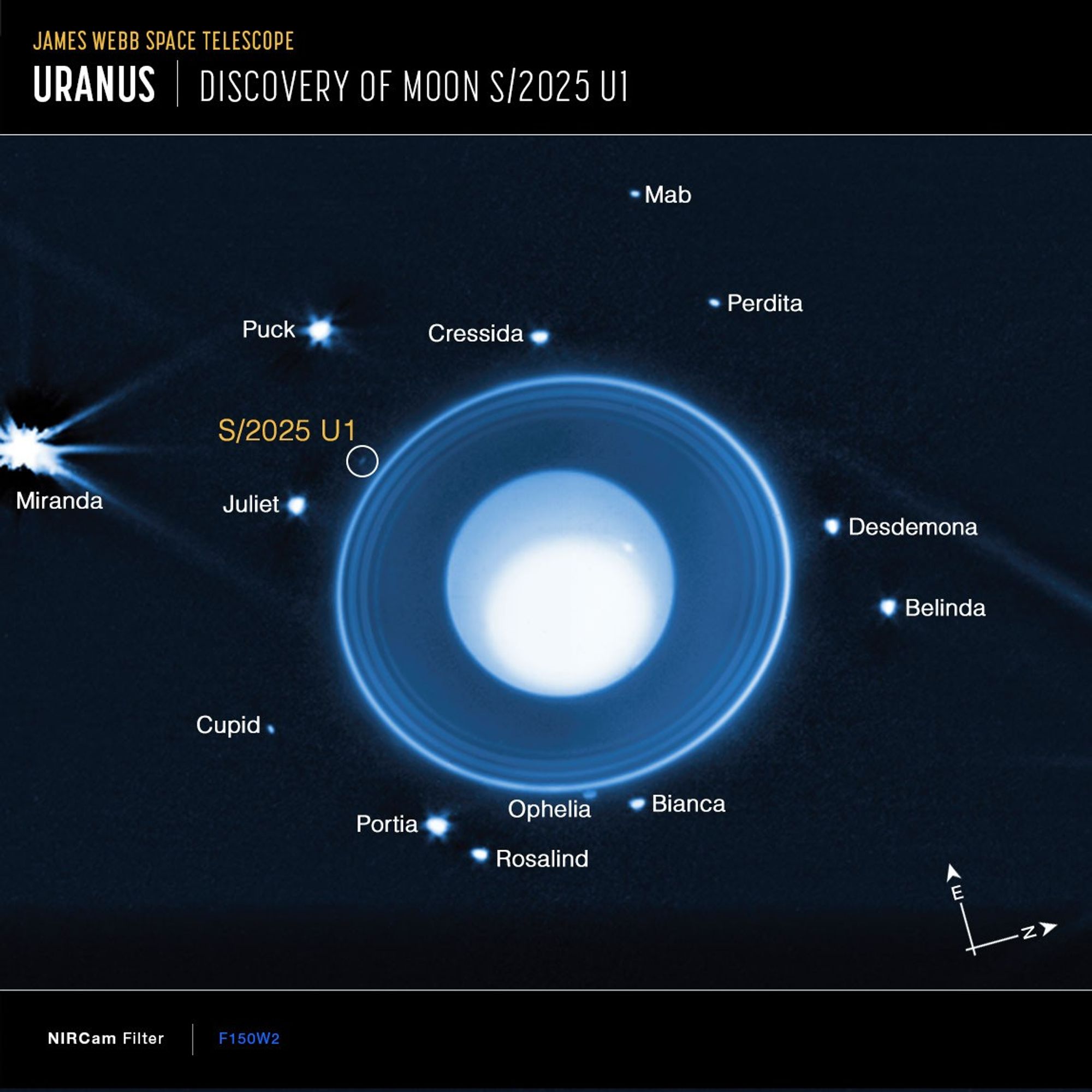
Astronomers using NASA’s James Webb Space Telescope discovered a new moon orbiting Uranus in images taken by Webb’s NIRCam (Near-Infrared Camera). This image shows the moon, designated S/2025 U1, as well as 13 of the 28 other known moons orbiting the planet. (The small moon Cordelia orbits just inside the outermost ring, but is not visible in these views due to glare from the rings.) Due to the drastic differences in brightness levels, the image is a composite of three different treatments of the data, allowing the viewer to see details in the planetary atmosphere, the surrounding rings, and the orbiting moons. The data was taken with NIRCam’s wide band F150W2 filter that transmits infrared wavelengths from about 1.0 to 2.4 microns.
About the Object
- DistanceDistanceThe physical distance from Earth to the astronomical object. Distances within our solar system are usually measured in Astronomical Units (AU). Distances between stars are usually measured in light-years. Interstellar distances can also be measured in parsecs.At the time of the observations on February 2, 2025, Uranus was located at a distance of about 19.8 AU from Earth (1.8 billion miles or 2.9 billion km)
About the Data
- Data DescriptionData DescriptionProposal: A description of the observations, their scientific justification, and the links to the data available in the science archive.
Science Team: The astronomers who planned the observations and analyzed the data. "PI" refers to the Principal Investigator.This image was created with Webb data from proposal: 6379 (M. El Moutamid). Image processing: Joseph DePasquale (STScI).
- InstrumentInstrumentThe science instrument used to produce the data.NIRCam
- Exposure DatesExposure DatesThe date(s) that the telescope made its observations and the total exposure time.February 2, 2025
- FiltersFiltersThe camera filters that were used in the science observations.F150W2
- Object NameObject NameA name or catalog number that astronomers use to identify an astronomical object.Uranus
- Object DescriptionObject DescriptionThe type of astronomical object.Gas giant planet
- Release DateAugust 19, 2025
- CreditImage: NASA, ESA, CSA, Maryame El Moutamid (SwRI), Matthew Hedman (University of Idaho); Image Processing: Joseph DePasquale (STScI)
This image is acquired by the NIRCam instrument on the James Webb Space Telescope. The color results from assigning a blue color map to a monochromatic (grayscale) image.
Share
Details
Laura Betz
NASA’s Goddard Space Flight Center
Greenbelt, Maryland
laura.e.betz@nasa.gov