
















View an animation from the Extreme ultraviolet Imaging Telescope (EIT).
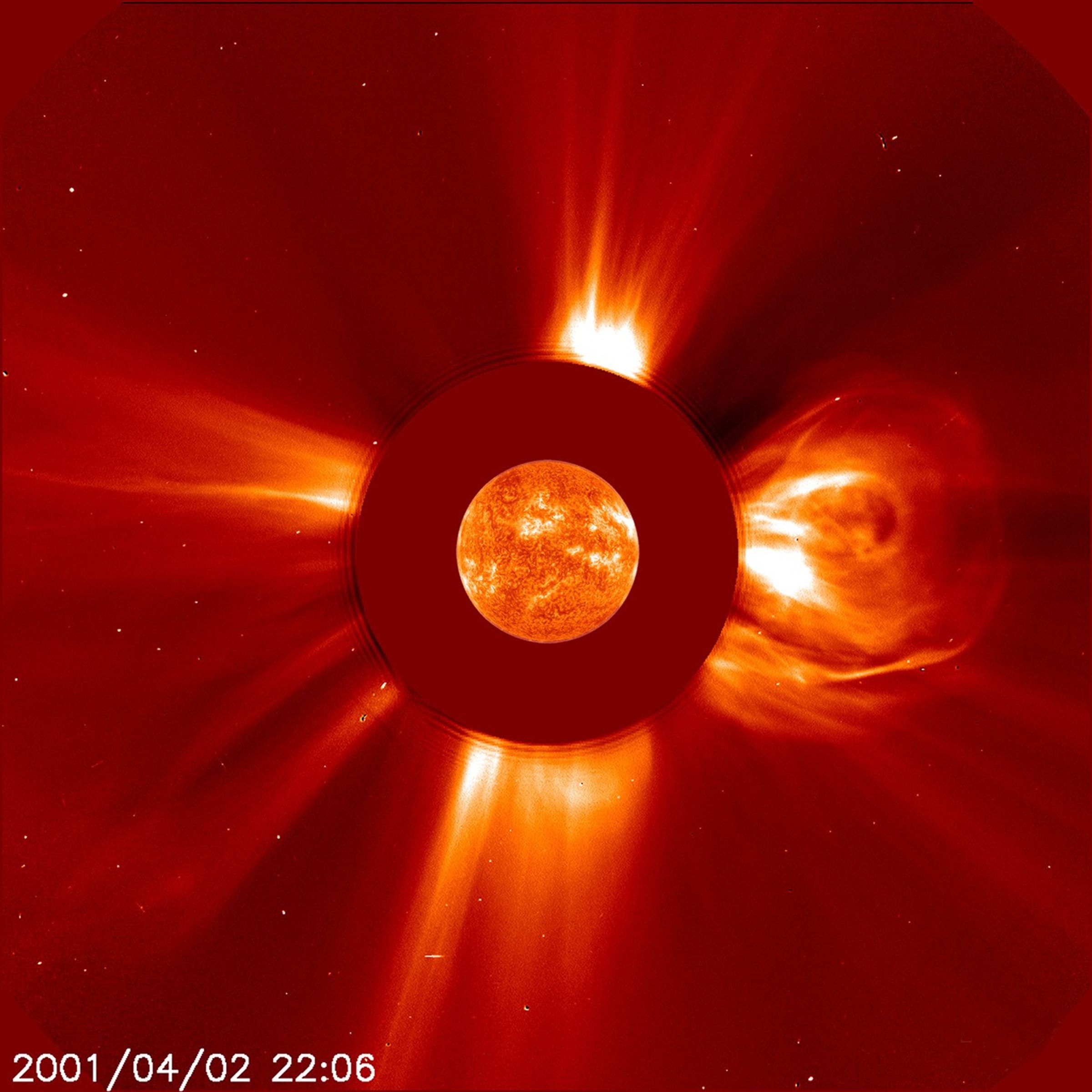
At 4:51 p.m. EDT, on Monday, April 2, 2001, the sun unleashed thebiggest solar flare ever recorded, as observed by the Solar andHeliospheric Observatory (SOHO) satellite. The flare was definitelymore powerful than the famous solar flare on March 6, 1989, which wasrelated to the disruption of power grids in Canada. This recentexplosion from the active region near the sun's northwest limb hurled acoronal mass ejection into space at a whopping speed of roughly 7.2million kilometers per hour. Luckily, the flare was not aimed directlytowards Earth.
Solar flares, among the solar system's mightiest eruptions, aretremendous explosions in the atmosphere of the Sun capable of releasingas much energy as a billion megatons of TNT. Caused by the suddenrelease of magnetic energy, in just a few seconds flares can acceleratesolar particles to very high velocities, almost to the speed of light,and heat solar material to tens of millions of degrees.
Solar ejections are often associated with flares and sometimes occurshortly after the flare explosion. Coronal mass ejections are clouds ofelectrified, magnetic gas weighing billions of tons ejected from the Sunand hurled into space with speeds ranging from 12 to 1,250 miles persecond. Depending on the orientation of the magnetic fields carried bythe ejection cloud, Earth-directed coronal mass ejections cause magneticstorms by interacting with the Earth's magnetic field, distorting itsshape, and accelerating electrically charged particles (electrons andatomic nuclei) trapped within.
Severe solar weather is often heralded by dramatic auroral displays,northern and southern lights, and magnetic storms that occasionallyaffect satellites, radio communications and power systems. The flare andsolar ejection has also generated a storm of high-velocity particles,and the number of particles with ten million electron-volts of energy inthe space near Earth is now 10,000 times greater than normal. Theincrease of particles at this energy level still poses no appreciablehazard to air travelers, astronauts or satellites, and the NOAA SECrates this radiation storm as a moderate S2 to S3, on a scale that goesto S5.
Monday's solar flare produced an R4 radio blackout on the sunlit side ofthe Earth. An R4 blackout, rated by the NOAA SEC, is second to the mostsevere R5 classification. The classification measures the disruption inradio communications. X-ray and ultraviolet light from the flare changedthe structure of the Earth's electrically charged upper atmosphere(ionosphere). This affected radio communication frequencies that eitherpass through the ionosphere to satellites or are reflected by it totraverse the globe.
The SOHO mission is being conducted collaboratively between the EuropeanSpace Agency and NASA.
References & Resources
Images courtesy SOHO Project, NASA's Goddard Space Flight Center