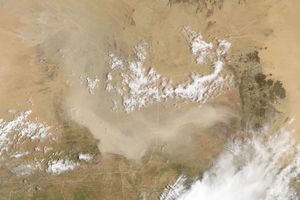

















A combination of dust and clouds swirled over the Taklimakan Desert in early March 2009. The Moderate Resolution Imaging Spectroradiometer (MODIS) on NASA’s Aqua satellite took this picture on March 10, 2009.
The dust plumes in this image appear as beige arcs over the western half of the desert. The rippled plume surfaces have a vaguely popcorn-like appearance. In the east, clouds obscure the view of both the desert and the dust plumes below. In the northeast, the clouds form wave patterns, and the faint beige tint of some of the waves suggests that dust mingles with the clouds.
The Taklimakan Desert rests the Tarim Basin, a bowl sandwiched between the mountain ranges of the Tien Shan (or Tian Shan) in the north and the Kunlun Shan in the south. This desert qualifies as China’s biggest, hottest, and driest. It also qualifies as one of the world’s largest shifting sand deserts, with dunes reaching a height of as much as 200 meters (656 feet).
References & Resources
- World Wildlife Fund, McGinley, M. (2007). Taklimakan Desert. Encyclopedia of Earth. Accessed March 10, 2009.
NASA image by Jeff Schmaltz, MODIS Rapid Response Team, Goddard Space Flight Center. Caption by Michon Scott.