




















Although plants do not sleep in the same way that humans do, they do have more and less active times and they have circadian rhythms—internal clocks that tell them when it is night and when it is day. And like many people, plants are less active at night. When the Sun comes up, however, they awake to the day. An instrument mounted on the International Space Station can see this leafy wake-up call.
Plants absorb sunlight to convert carbon dioxide and water into food, a process called photosynthesis. They also “sweat” excess water through pores in their leaves to cool themselves down, a process called evapotranspiration. NASA’s Ecosystem Spaceborne Thermal Radiometer on Space Station (ECOSTRESS) instrument has observed plants beginning these processes in the morning.
Mounted on the outside of the International Space Station, ECOSTRESS provides insight into the health of vegetation by essentially taking its temperature. Using a radiometer to measure the thermal infrared energy emitted by plants, ECOSTRESS can measure how much they are transpiring and how they are responding to weather and climate stresses.
The images above, built from ECOSTRESS data, show plants waking up west of Lake Superior, near the U.S.–Canada border. Each color (red/orange, blue, and purple) represents the time (7, 8, and 9 a.m.) when plants and trees were observed to start transpiring. The darker the shading, the more intense the transpiration activity. The image below shows what the study area looks like at midday to most visible light satellite sensors. It was acquired by the Moderate Resolution Imaging Spectroradiometer (MODIS) on NASA’s Aqua satellite on July 30, 2019.
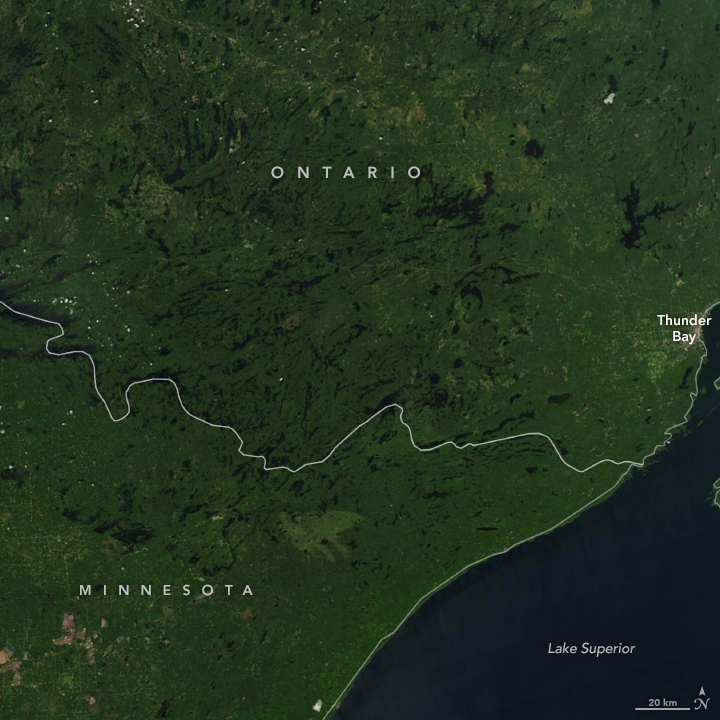
The space station’s unique orbit enables ECOSTRESS to capture data over the same areas of Earth at different times of day. For the wake-up observations, scientists team collected and averaged all of their morning observations in the region from June 1 to August 30, 2019. In doing so, they observed that the earliest risers were near the lake, with plant activity spreading gradually northwestward as the morning progressed.
The ability to detect plant behavior in this way could be especially helpful to resource managers and farmers, who might use the data to determine how much water their crops need, which ones are most water-efficient, and which ones are not getting enough water—even before plants show visible signs of dehydration. The instrument can provide such data on a global scale and within areas as small as a football field.
References & Resources
- NASA (2020) ECOSTRESS. Accessed February 24, 2020.
- NASA Earth Observatory (2019, November 14) Detecting Invisible Plant Stress.
- NASA Earth Observatory (2014, March 4) Why Is That Forest Red and That Cloud Blue? How to Interpret a False-Color Satellite Image.
NASA Earth Observatory images by Lauren Dauphin, using MODIS data from NASA EOSDIS/LANCE and GIBS/Worldview and evaporative stress data from the ECOSTRESS team. Story by Esprit Smith, NASA’s Earth Science News team, with Mike Carlowicz.