




The scenery changes quickly for the crew of the International Space Station. Traveling at a speed of 5 miles (8 kilometers) per second, the station completes one orbit of Earth about every 90 minutes.
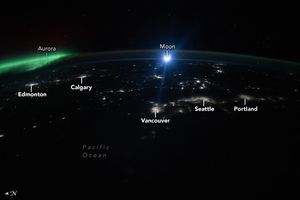
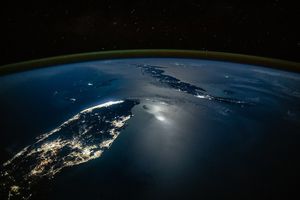
This time-lapse video offers a flavor of the earthly and celestial phenomena visible from about 400 kilometers (250 miles) above the surface in just over five minutes of travel time. It consists of 315 photographs taken by an astronaut aboard the station as it orbited over the eastern Pacific Ocean and North America on June 22, 2025.
Mexico comes into view in the first part of the video. The land is mostly dark in the early morning hours (about 2:30 a.m. Central Standard Time), but lights appear in developed areas and illuminate clouds from below. Some frames capture flashes of lightning. Later in the video, lights along the U.S. Gulf Coast and across southern states appear, and sunrise approaches.
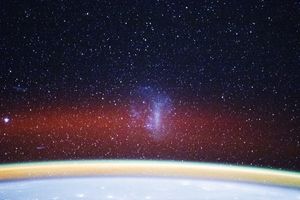
Above the lower atmosphere, where most of the planet’s weather occurs, a diffuse layer of green and orange arcs along the horizon. This band of light is airglow, produced when sunlight strikes atoms and molecules in the upper atmosphere and causes them to eject photons.
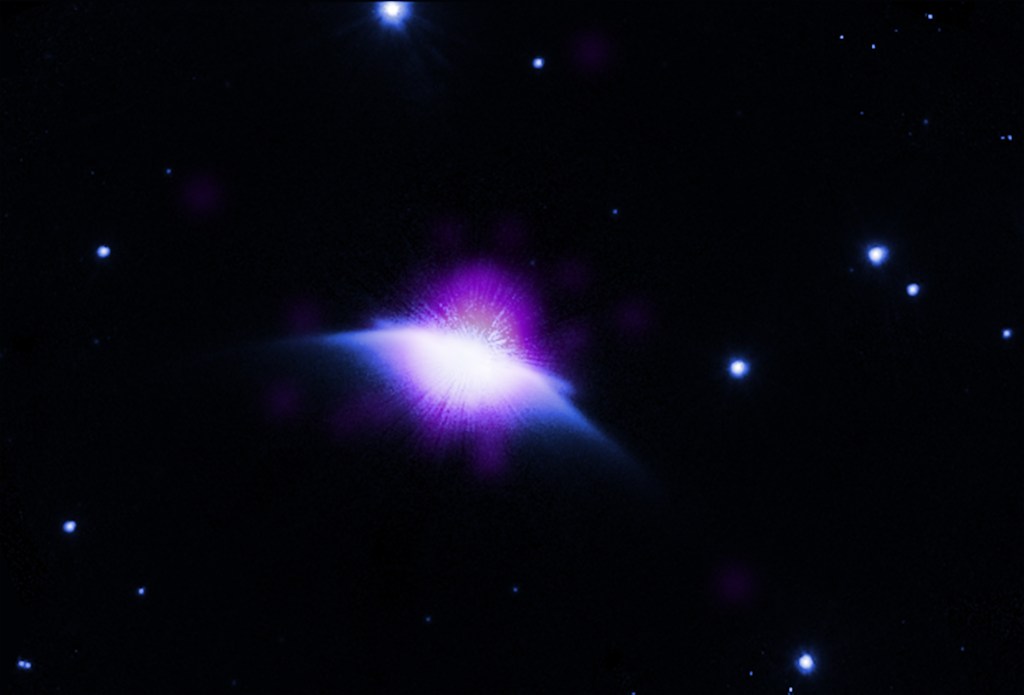
Stars fill the blackness of space above Earth’s limb, forming the backdrop for the appearance of several bright objects within our solar system. The Moon rises in the center of the scene in the waning crescent phase. Although the side facing Earth was only 13 percent lit, the crescent cannot be discerned in these images because of its relative brightness and the camera’s exposure settings. Shortly after moonrise, Venus emerges above the horizon to the right of the Moon. Objects on the left side of the video moving parallel to the horizon are satellites, which sometimes appear in astronaut time-lapses prior to sunrises.
Though the Moon appears exceptionally bright in this video, some astronaut photos depict its varied terrain. People on Earth’s surface can also observe these lunar details with the naked eye, through binoculars, or on a virtual tour, among other methods. International Observe the Moon Night offers many opportunities for lunar science and exploration. The next one occurs on October 4, 2025, when the Moon will be around first quarter and shadows will enhance its cratered surface.
Astronaut photographs ISS073-E-310920 through ISS073-E-311235 were acquired on June 22, 2025, with a Nikon Z9 digital camera using a focal length of 24 millimeters. They are provided by the ISS Crew Earth Observations Facility and the Earth Science and Remote Sensing Unit at NASA Johnson Space Center. The images were taken by a member of the Expedition 73 crew. The images have been cropped and enhanced to improve contrast, and lens artifacts have been removed. The International Space Station Program supports the laboratory as part of the ISS National Lab to help astronauts take pictures of Earth that will be of the greatest value to scientists and the public, and to make those images freely available on the Internet. Additional images taken by astronauts and cosmonauts can be viewed at the NASA/JSC Gateway to Astronaut Photography of Earth. NASA Earth Observatory video by Michala Garrison. Story by Lindsey Doermann.
References & Resources
- NASA (2025) International Observe the Moon Night. Accessed August 28, 2025.
- NASA (2025, June 2) What’s Up: June 2025 Skywatching Tips from NASA. Accessed August 28, 2025.
- NASA (2018, October 22) Why NASA Watches Airglow, the Colors of the (Upper Atmospheric) Wind. Accessed August 28, 2025.