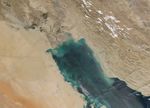



















In early December 2011, colors ranging from tan to peacock green dominated the Persian Gulf. The Moderate Resolution Imaging Spectroradiometer (MODIS) on NASA’s Aqua satellite captured this natural-color image of the gulf on December 12, 2011.
Multiple factors could account for the green hues. One is phytoplankton—tiny plant-like marine organisms living in the water. The chlorophyll content of phytoplankton often appears bright green or blue in natural-color satellite images, and phytoplankton may have been present. But this event occurred two days after a dust storm blew through Syria and Iraq. The same winds that carried the dust likely promoted waves that disturbed the sea floor in this region, suspending sediments in the water. The sediment would increase the amount of sunlight reflected out of the water, and might also enhance the green signal from chlorophyll-rich plankton.
References & Resources
NASA image courtesy LANCE/EOSDIS MODIS Rapid Response Team at NASA GSFC. Caption by Michon Scott based on image interpretation by Norman Kuring, Ocean Color Web.