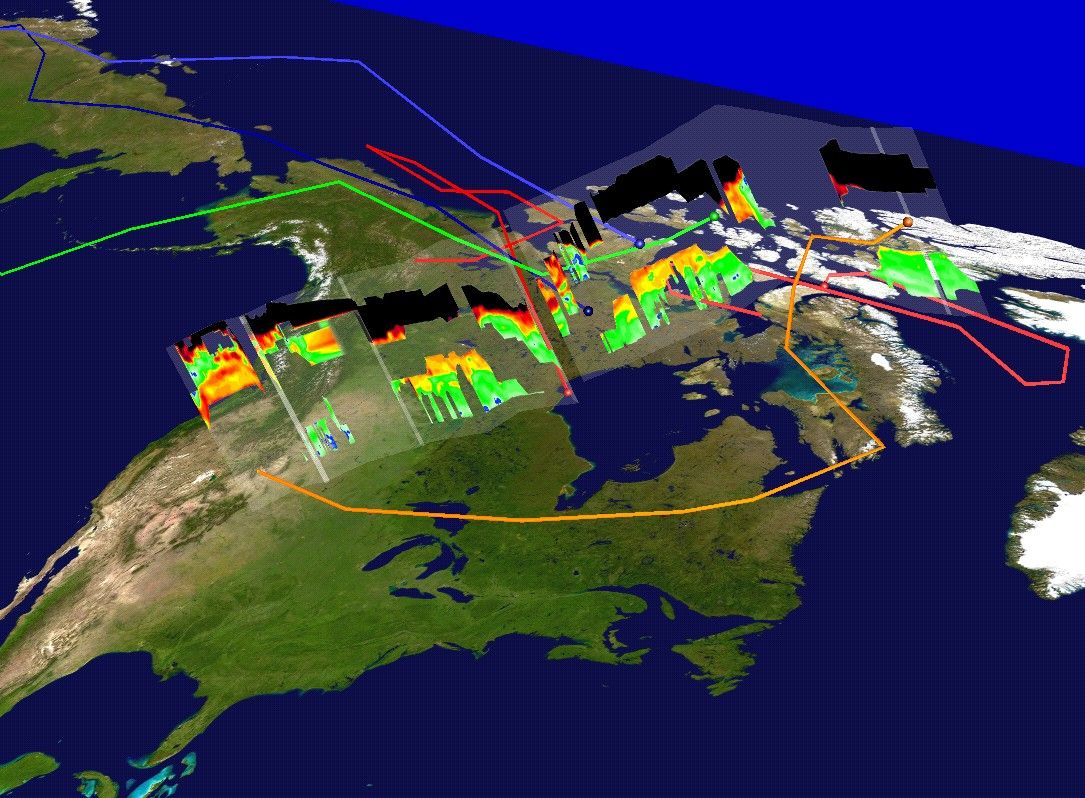














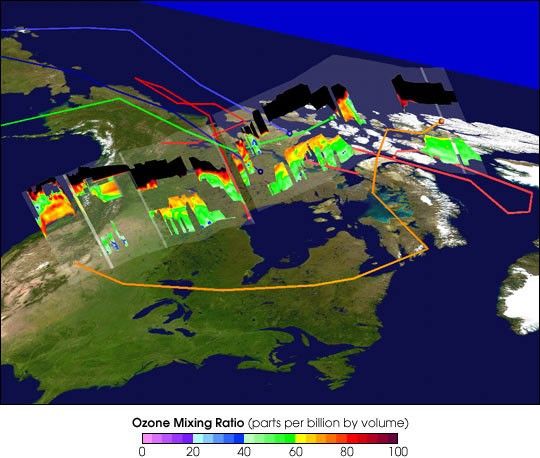
Atmospheric scientists made seven flights to high latitudes fromBroomfield, Colorado, with bases in Churchill, Canada, and Thule,Greenland, during the Tropospheric Ozone Production about the SpringEquinox (TOPSE) field experiment. Remote lidar (laser radar)measurements taken by the NASA Langley Research Center’s LidarApplications Group found high springtime ozone levels in the loweratmosphere along the aircraft’s flight path. The image, recently createdto better visualize ozone data from TOPSE, is a representation of allozone data during April 2000. Blue areas show regions of the atmospherewith little ozone. Yellow to red areas indicate high ozone levels, andblack areas represent the stratosphere, where ozone is very high. Thecolored lines are calculated paths the air mass took going back 10 daysin time. Blue and green trajectories show air masses coming frompolluted regions of Asia and are associated with high ozone levels inthe lower atmosphere.
Background levels of ozone exist in the lower atmosphere(troposphere) at all times, but a peak occurs during the springtime athigh northern latitudes. The timing of the peak is unusual because otherareas in the Northern Hemisphere, such as over most of the UnitedStates, experience their highest seasonal ozone levels during thesummer.
Springtime ozone levels in the high northern latitudes in the loweratmosphere have been increasing with time, and TOPSE scientists wantedto know the reason for the ozone peak. They determined that higherspringtime ozone amounts could not be explained only by an increase inthe natural transport process called stratosphere-troposphere exchange.This process mixes ozone-rich air from the upper atmosphere orstratosphere into the lower atmosphere.
Instead scientists concluded that long-range transport moved airpollution into remote Arctic areas during the winter and into thespring, causing the production of the highest seasonal ozone levels overCanada and the Arctic. Photochemical processes convert some of the airpollution into ozone in the troposphere during the spring when moresunlight reaches the Arctic. These processes begin when sunlight comesinto contact with chemically active molecules in the lower atmospherelike those found in air pollution.
This research stems from an investigation that was one of manystudies conducted from February to May 2000 during TOPSE, a fieldexperiment funded by the National Science Foundation and led by theNational Center for Atmospheric Research (NCAR). The Lidar ApplicationsGroup will participate in their next field campaign from January toFebruary 2003 in the SAGE III Ozone Loss and Validation Experiment(SOLVE) II.
For more information, see:
NASA Langley’s Lidar Applications Group
University Corporation for Atmospheric Research TOPSE site
References & Resources
Image courtesy Kurt Severance, NASA Langley Research Center