





















April 21, 2012
Sediment Plume in Northern Kazakhstan
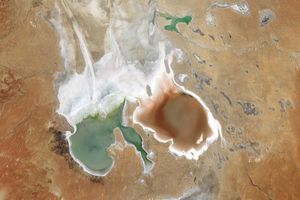
Between Hungary and Mongolia stretches a vast series of grassy plains, or steppes. These treeless plains extend across northern Kazakhstan, interrupted by numerous shallow lakes. One of the larger lakes is Ozero Siletiteniz, just south of the border between Kazakhstan and Russia.
Winds occasionally loft fine sediments from the lake perimeter into the air, and a plume of fine sediment blew southward from the lake in late April 2012. The Moderate Resolution Imaging Spectroradiometer (MODIS) on NASA’s Terra and Aqua satellites observed the progression of the plume on April 21. These images have been rotated so that north is to the left. The different colors in the landscape surrounding the lake likely result from different angles of sunlight.
The steppe of northern Kazakhstan is characterized by hot summers, bitter winters, and uneven precipitation. Although cold, winter rarely brings much snow to the region, and the area receives just 250 to 300 millimeters (10 to 12 inches) of precipitation a year. The precipitation in northern Kazakhstan is more abundant than in other parts of the country, but it is not enough to prevent dry sediments from accumulating.
For centuries people have used Kazakhstan’s northern steppe for pasture. But in the 1950s, the Soviet Union implemented intensive agricultural projects. Since it was not well suited to growing cereal, much of the land deteriorated and was eventually abandoned. Some of the steppe has since been recovered thanks to seeding with grasses and perennials. Today the region is once again prized for is pastures and natural resources. Lakes such as Ozero Siletiteniz provide key stopover points for migratory birds, and the region is home to diverse steppe flora.
References & Resources
- Asian Development Bank. 2010. Central Asia Atlas of Natural Resources. Accessed April 23, 2012.
- World Heritage. (2009). Saryarka - Steppe and Lakes of Northern Kazakhstan. United Nations Educational, Scientific, and Cultural Organization. Accessed April 23, 2012.
NASA image courtesy Jeff Schmaltz, MODIS Rapid Response Team, Goddard Space Flight Center. Caption by Michon Scott.