



























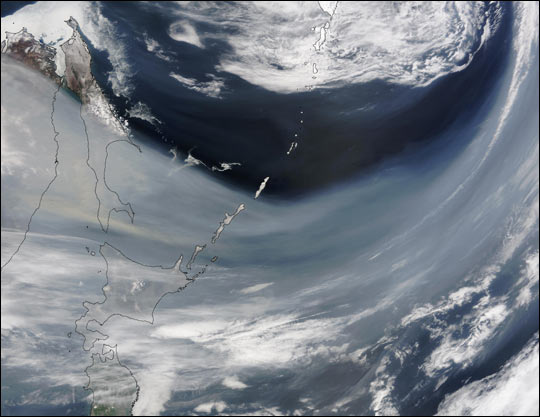
A river of smoke almost 1,500 kilometers (937 miles) wide is stretching more than 2,200 kilometers (1,375 miles) over the Pacific Ocean from fires in eastern and southern Russia. This Moderate Resolution Imaging Spectroradiometer (MODIS) image from the Terra satellite on May 7, 2003, shows the plume crossing over eastern Russia (left) and then over (top to bottom) Sakhalin Island, and Hokkaido and Honshu, Japan. An especially dense area of smoke can be seen as a tan streak across the southern tip of Sakhalin Island.
These fires occur each spring, although the intensity of the burning varies. The fires have a variety of causes. Some are wildfires started by lightning, and others are planned fires being used as an agricultural land management tool (clearing brush, renewing pasture and farmland). In some cases, these planned fires get out of control and invade nearby boreal forests. The boreal forest fires tend to produce a lot of smoke, as not only the trees burn, but also the thick layer of peat on the forest floor.
The high-resolution image provided above is 500 meters per pixel. The MODIS Rapid Response System provides this image at MODIS? maximum spatial resolution of 250 meters.
References & Resources
Image courtesy Jeff Schmaltz, MODIS Rapid Response Team, NASA GSFC