














Understanding Harmonized Landsat Sentinel-2 Vegetation Indices
In this explainer, each vegetation index includes a visualization, an example application, and a description of the index that highlights how HLS’s increased temporal revisit empowers new research.
This guide is part of an ongoing series covering nine vegetation indices; resources for each remaining index will be added upon completion.
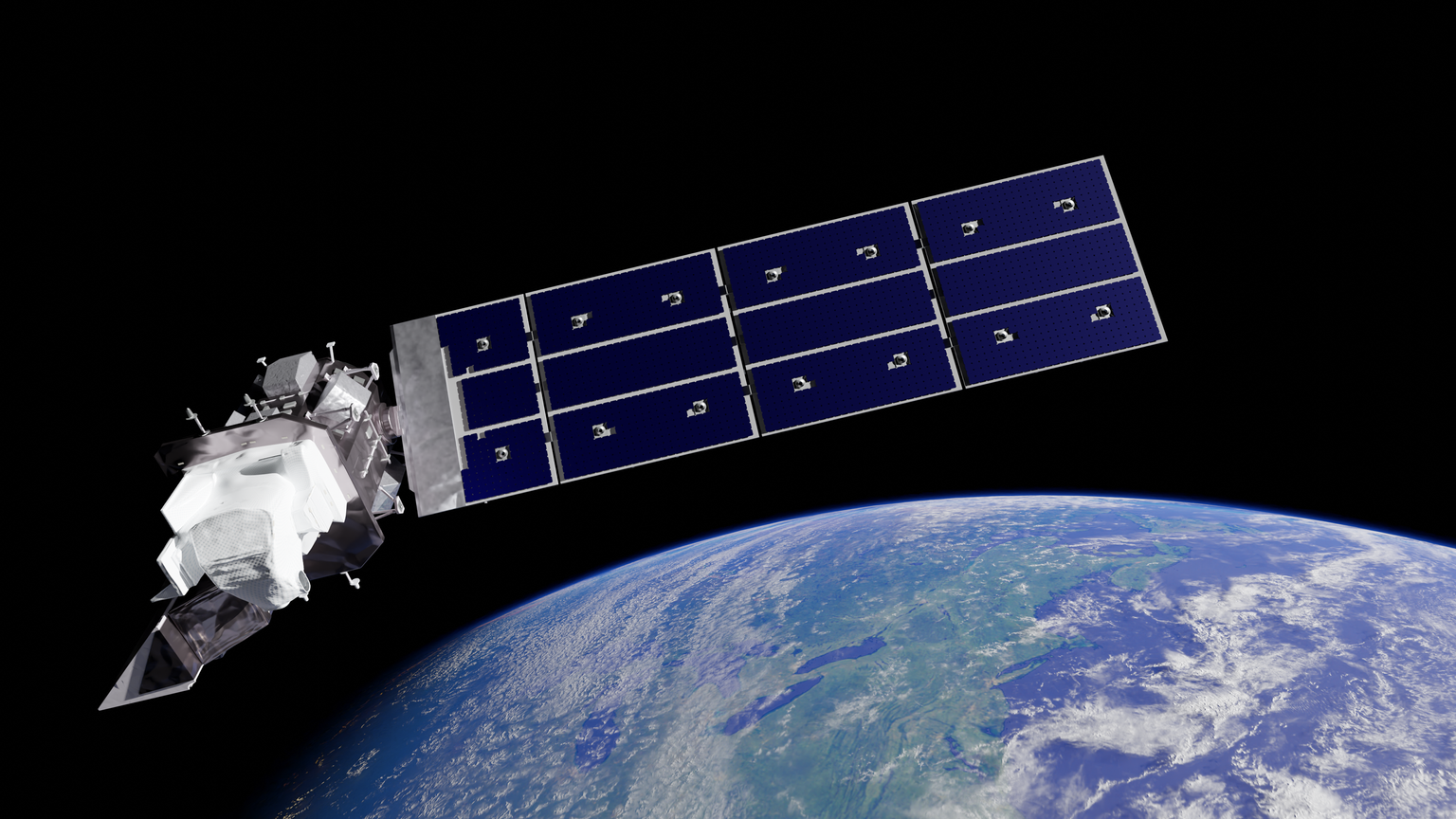
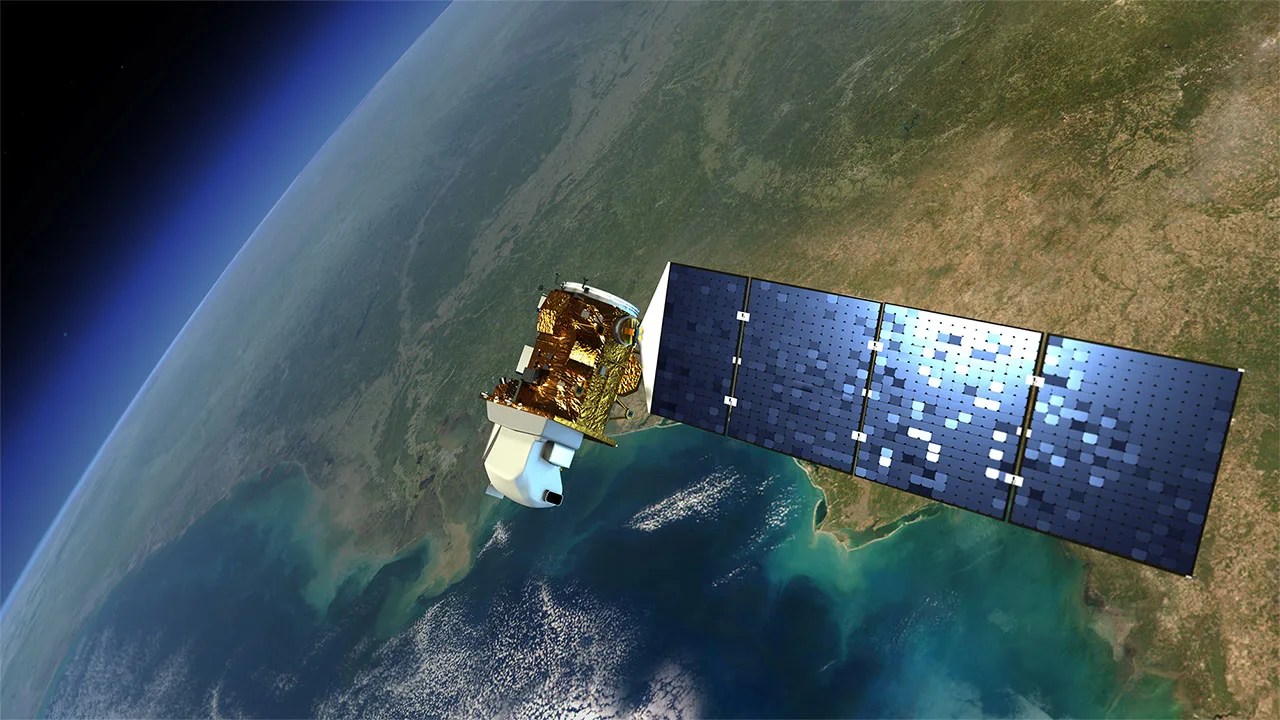
The Harmonized Landsat and Sentinel-2 vegetation index (HLS-VI) suite is a collection of nine indices that help scientists and land managers monitor the health and condition of vegetation across the entire planet. By combining data from NASA's Landsat 8 and 9 satellites and ESA’s Sentinel-2A, B, and C, the HLS product delivers 30-meter resolution snapshots of vegetation every 1-2 days, allowing users to track changes faster than with Landsat or Sentinel-2 imagery alone. These nine indices each have their own strengths: some measure overall plant health and greenness (NDVI, EVI), others detect water stress and moisture content (NDMI, NDWI), some are designed to work better in areas with exposed soil or sparse vegetation (SAVI, MSAVI), and others help assess damage from wildfires (NBR, NBR2) or monitoring changes in plant biomass and stress (TVI). By harmonizing data from Landsat and Sentinel-2, the HLS vegetation index products provide researchers with a powerful, consistent tool for applications ranging from tracking crop conditions and monitoring droughts to assessing wildfire damage and understanding how ecosystems respond to environmental change.
In this explainer, each vegetation index features a visualization, an example application, and a description of the index that highlights how HLS’s increased temporal revisit empowers new research. HLS is funded by NASA and is a deliverable of the Satellite Needs Working Group (SNWG), an interagency effort of the U.S. Government dedicated to identifying and addressing Earth observation needs across U.S. civilian federal agencies.
For more detailed technical information about the HLS-VI dataset, explore the Product User Guide.
NDVI
NDVI is the most popular vegetation index and is used to quantify crop health, assess forest density, and monitor vegetation stress.
NDVI = (NIR - Red) / (NIR + Red) [-1,1]
L30 = (B5 - B4) / (B5 + B4)
S30 = (B8A - B4) / (B8A + B4)
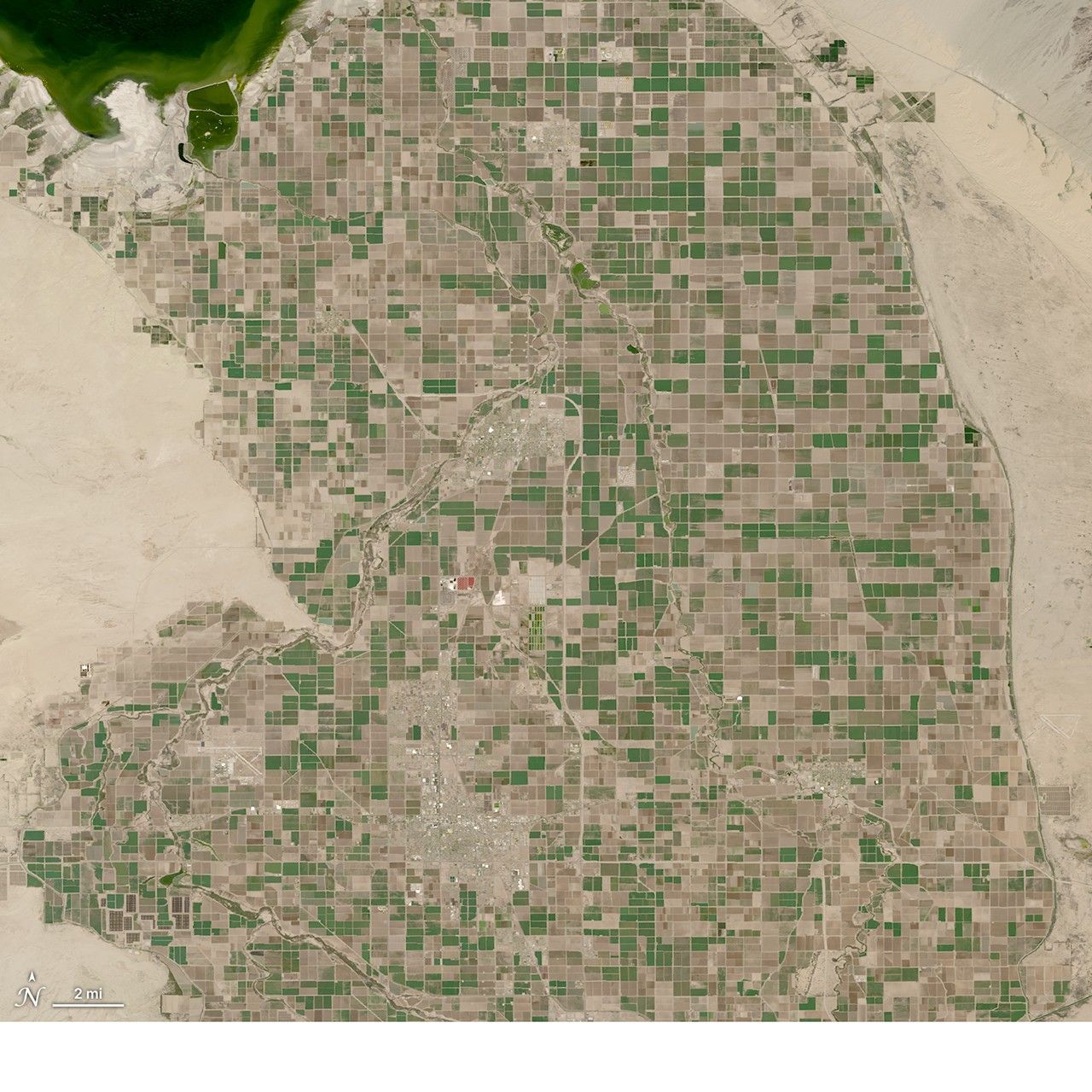
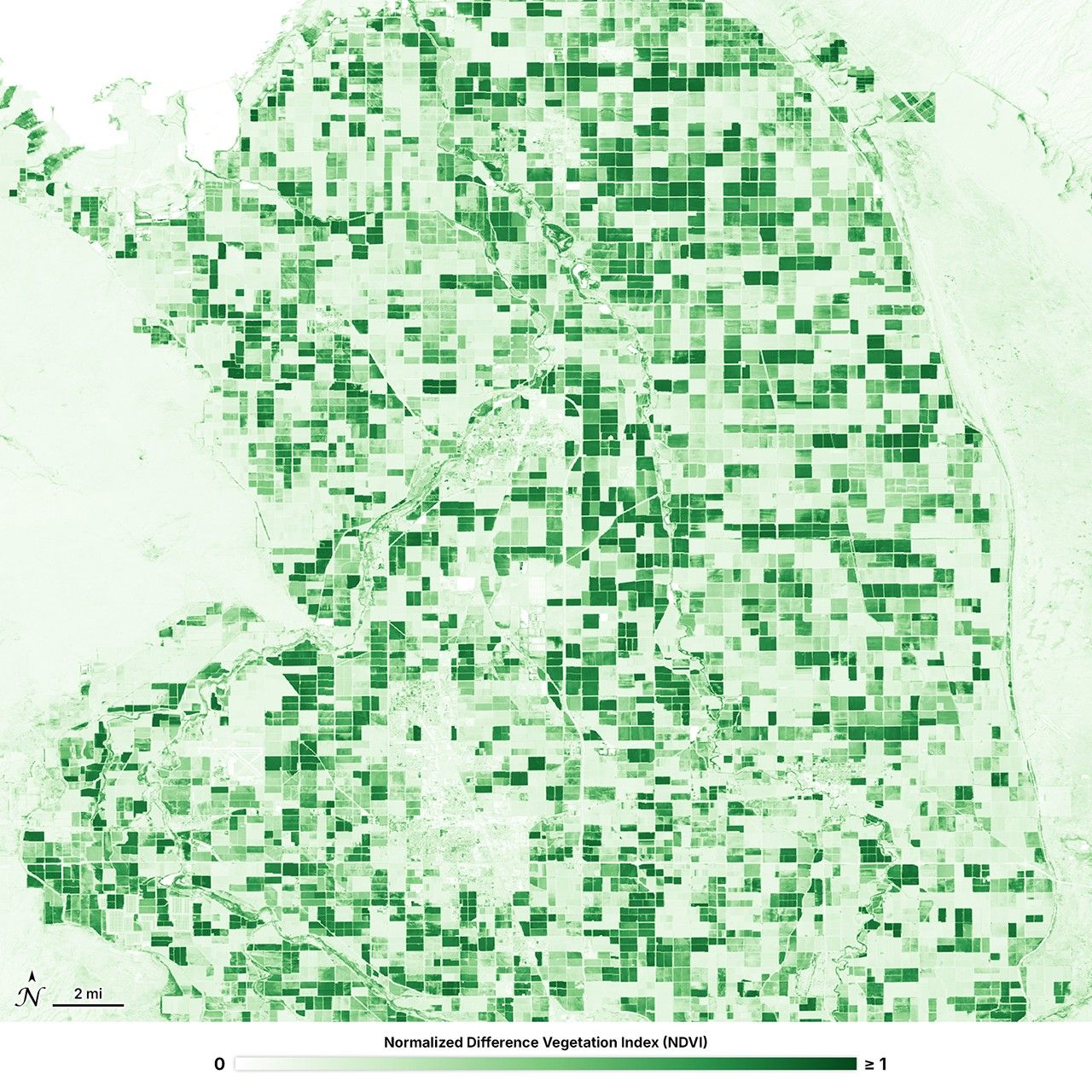
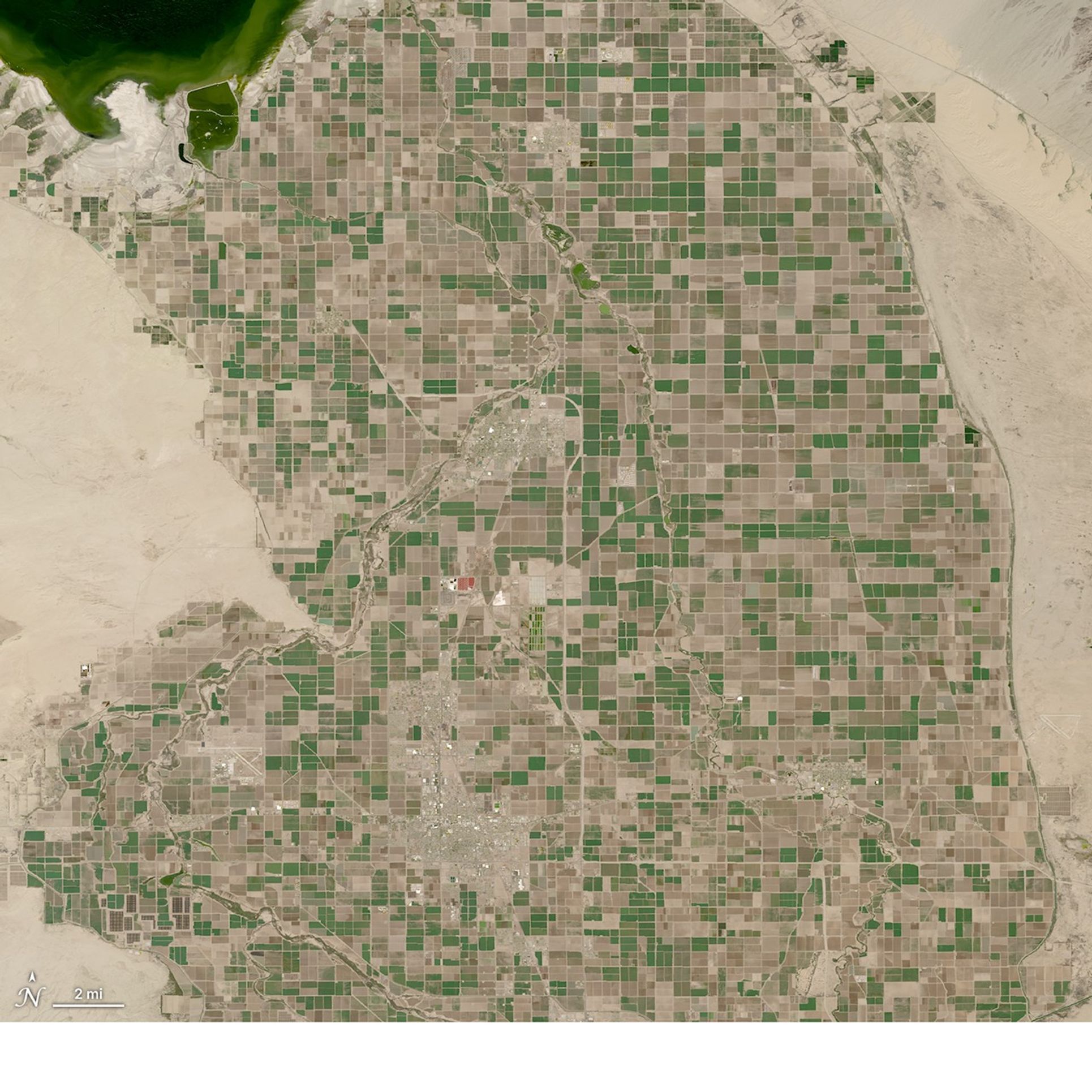
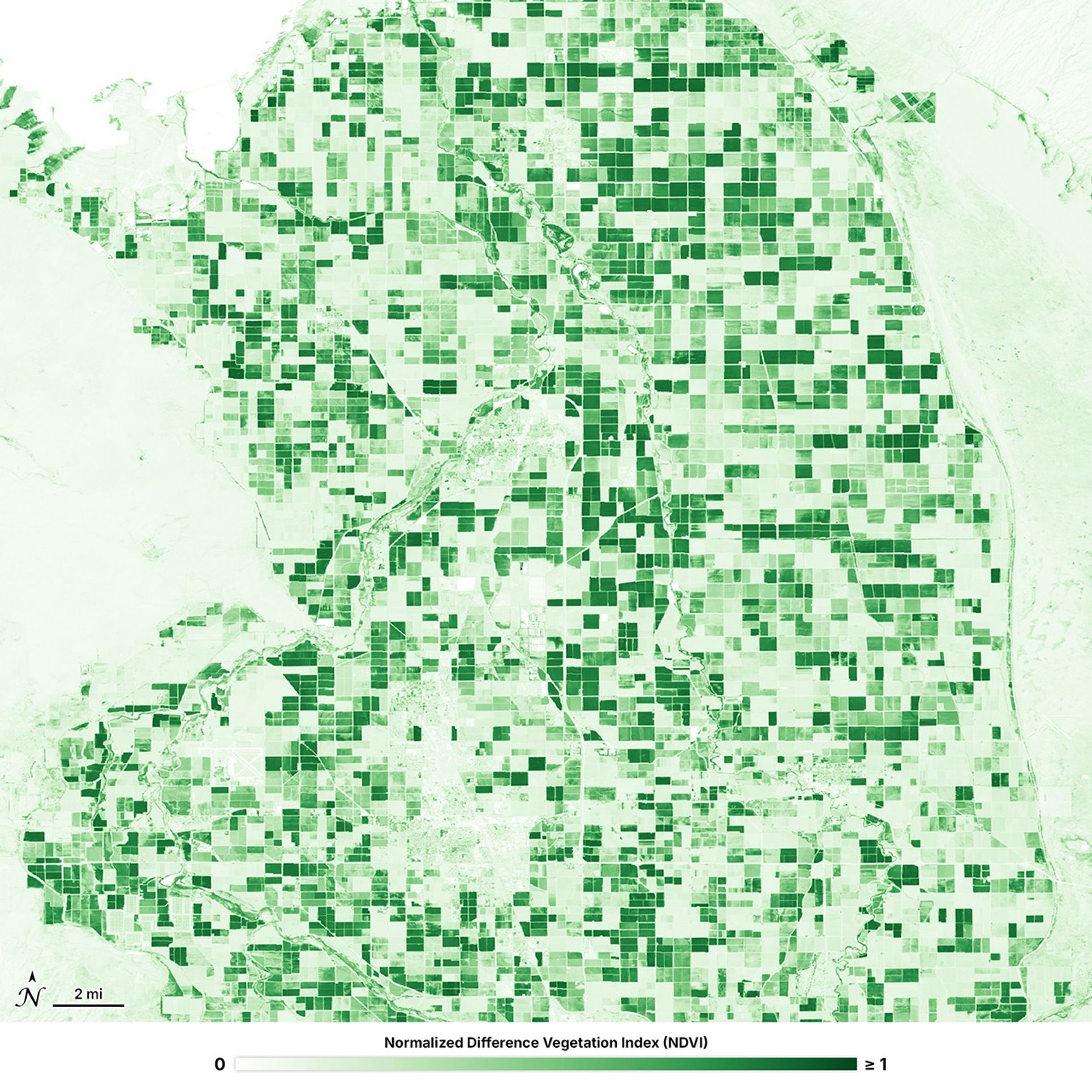
Against the background of the Sonoran Desert, agricultural fields flicker with life. This animation, which runs from October 12, 2024 to October 16, 2025, showcases crop cycles in the region with the Normalized Difference Vegetation Index (NDVI). Scientists use NDVI to assess vegetation presence, density, and stress levels by combining near-infrared (NIR) and red reflectance measurements from optical satellites. Darker green indicates healthier and denser vegetation, while lighter green indicates unhealthy or absent vegetation.
Over the course of one year, these rectangular fields flare dark green with each new crop planted before returning to light green after the harvest. The primary crop in this section of the Imperial Valley is alfalfa, which is planted and harvested three to four times a year. These shifting crop cycles occur just south of the Salton Sea, California’s largest inland water body. The Salton Sea is fed by agricultural runoff and has high concentrations of salt, as the lake’s only method of outflow is evaporation. Despite these conditions, the lake is a key stop for migratory birds passing through California. The animation is composed of images from Harmonized Landsat and Sentinel-2 vegetation indices (HLS-VI) product. HLS is a NASA product that combines imagery from the NASA/USGS Landsat 8 and Landsat 9 satellites and the European Space Agency’s Sentinel-2A, 2B, and 2C satellites.
Natural Color & NDVI
Cycles of Growth in the Imperial Valley
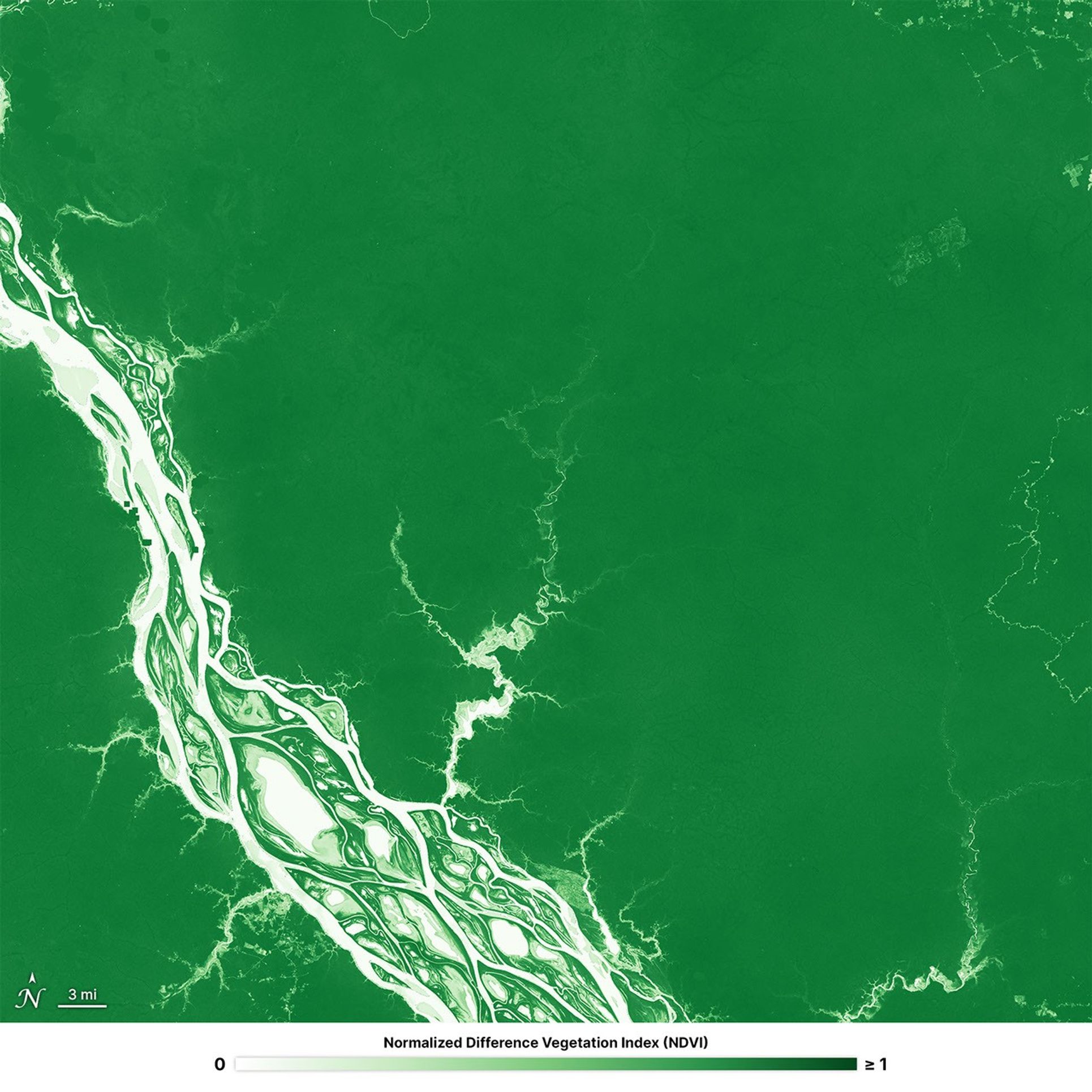
Values in the HLS-VI NDVI product range from -1 to 1, where values from 0.6 to 1 indicate healthier vegetation, values from to 0 to 0.6 indicate sparse or stressed vegetation, and values from -1 to 0 indicate non-vegetated features like water or bare soil.
Related Resources
- Normalized Difference Vegetation Index (NDVI) | NASA Earthdata
- Measuring Vegetation (NDVI & EVI) - NASA Science
- Salton Sea
- Background Information on the Salton Sea
EVI
The Enhanced Vegetation Index (EVI) is similar to NDVI, but adapted to correct for atmospheric interference, canopy background noise, and saturation. These enhancements make it optimized for analyzing dense vegetation, like in tropical rainforests.
EVI = (2.5 ∗ (NIR − Red)) / (NIR + 6 ∗ Red − 7.5 ∗ Blue + 1)
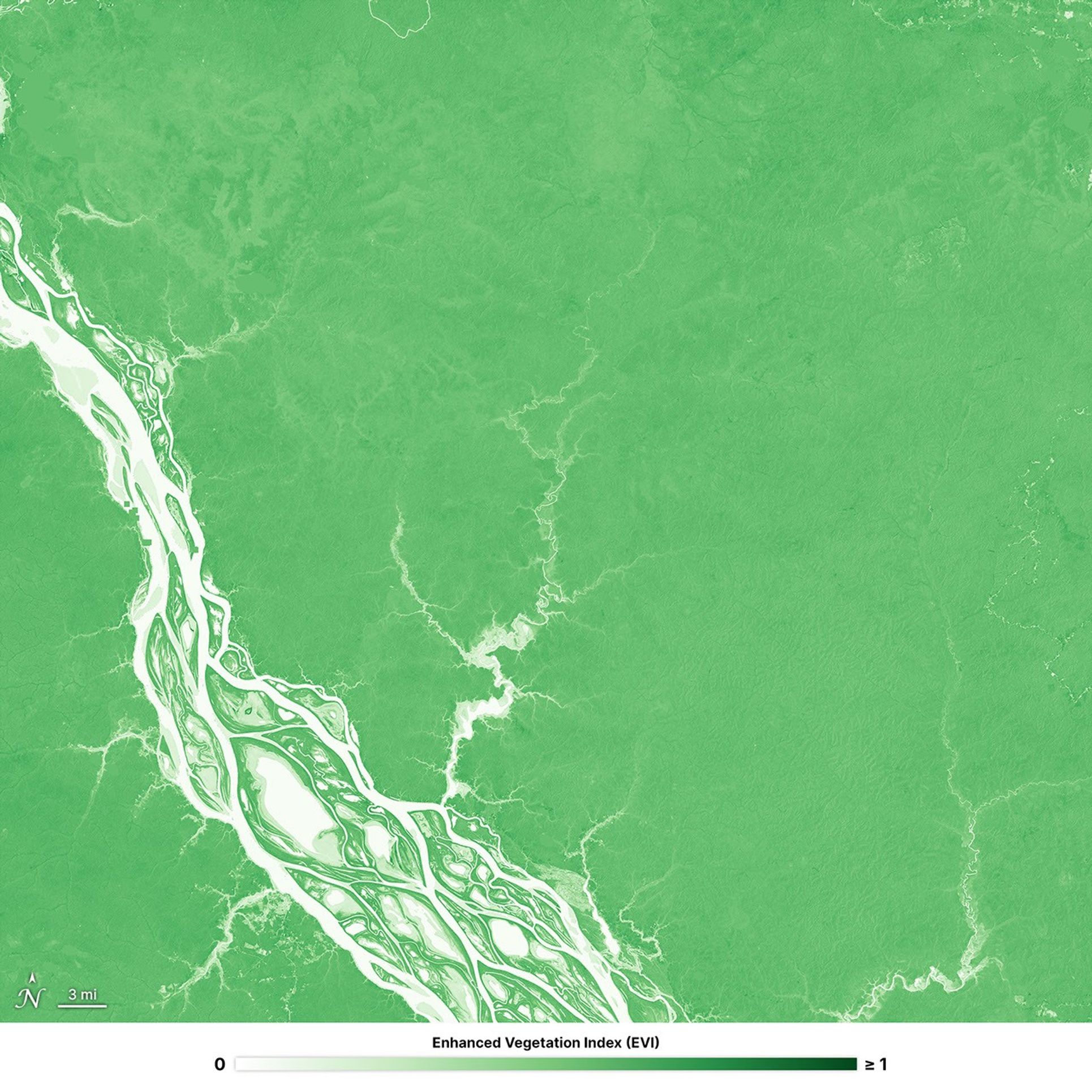
NDVI & EVI
Brazilian Amazon Rainforest
October 29, 2024
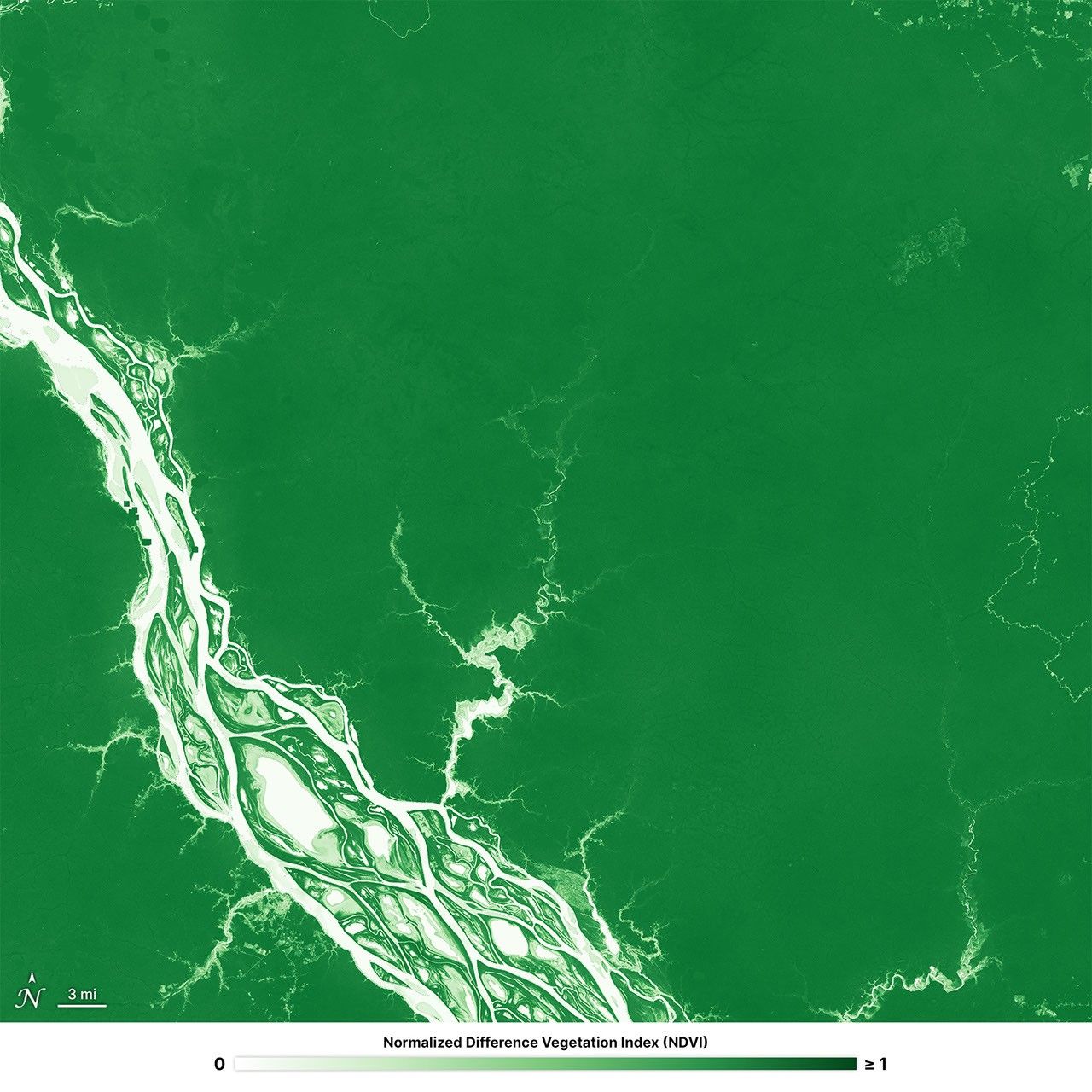
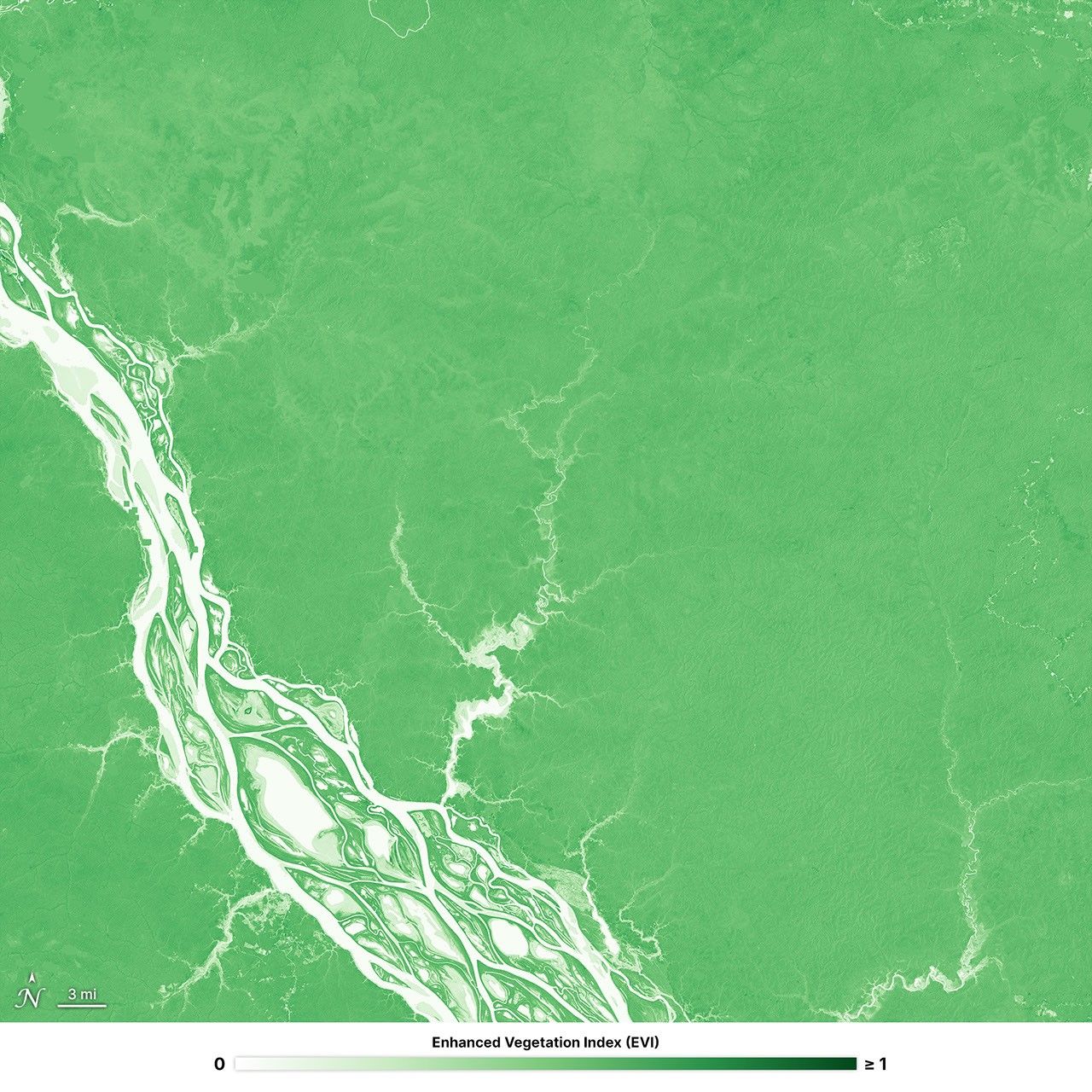
The Enhanced Vegetation Index (EVI) is used to quantify vegetation greenness and biomass by analyzing the reflection of near-infrared, red, and blue light from the Earth's surface. Unlike the Normalized Difference Vegetation Index (NDVI), EVI incorporates the blue band to correct for atmospheric distortions caused by aerosols and adjusts for variations in the canopy background signal to enhance assessment of plant health. EVI is especially useful for monitoring dense forests because, unlike NDVI, it does not saturate in high-biomass areas. This advantage is visible near the river in the top left corner of the above image: EVI shows subtle differences in leaf area and canopy structure, whereas NDVI shows the same dense forest as a uniform swath of green. The two vegetation indices can be used in tandem to achieve a more holistic view of global vegetation health.
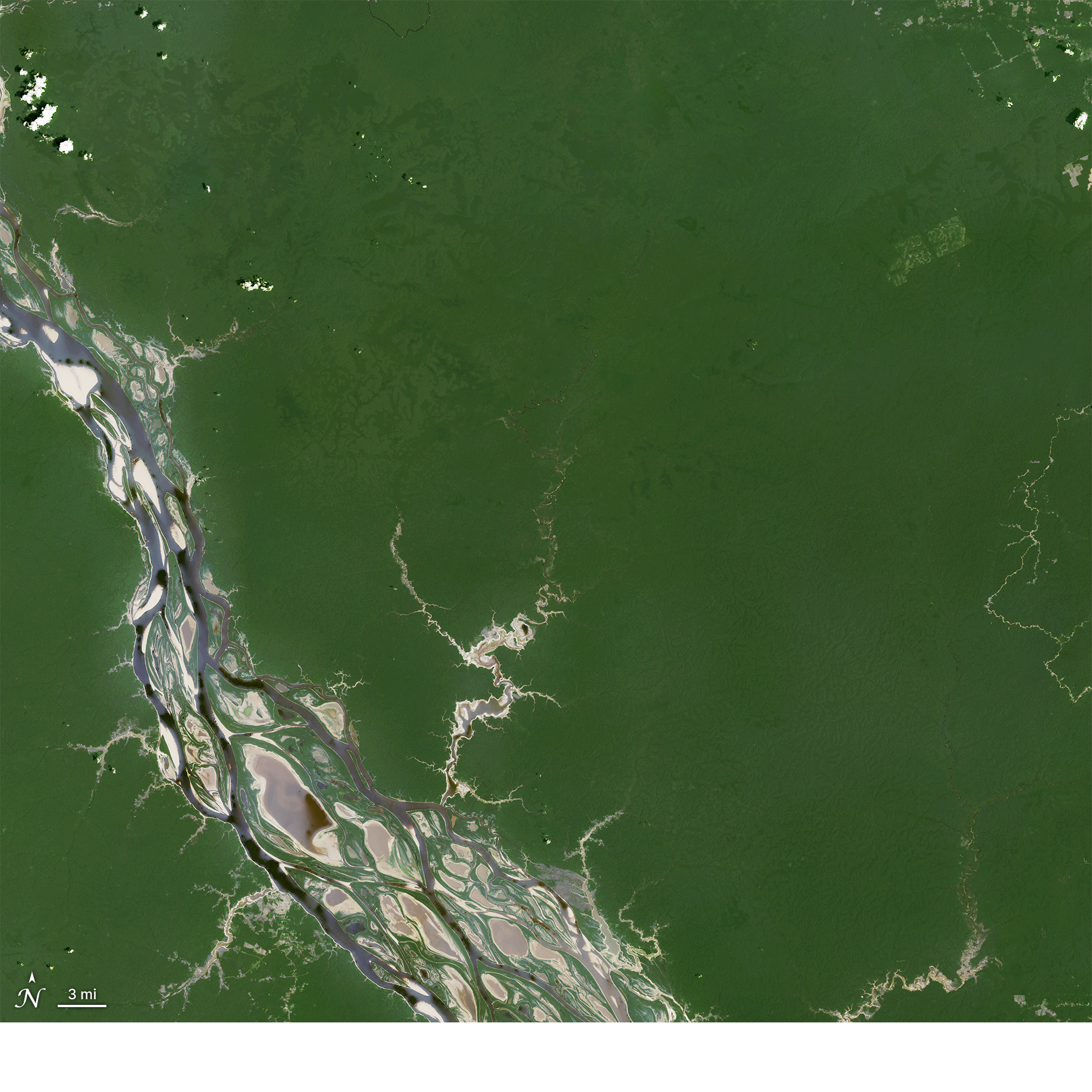
Natural Color & EVI
Brazilian Amazon Rainforest
October 29, 2024
These images capture the abundant vegetation of Brazil’s sprawling Amazon rainforest. Cutting through the green is the Rio Negro, a wide blackwater river and one of the largest tributaries of the Amazon River. This portion of the river, located in Parque Nacional de Anavilhanas, is home to the Anavilhanas Archipelago, one of the largest river archipelagos in the world. This complex array of water and land is constantly evolving, with islands emerging and submerging as the river’s channels change. The archipelago is home to rare and endangered species such as the Amazonian manatee, the black caiman, and the widest range of electric fish on the planet. The broader park hosts many diverse ecosystems, including the flooded igapó forests, the periodically flooded várzea forests, and the upland terra firme forests.
Values in the HLS-VI EVI product range from -1 to 1, where values from 0.2 to 0.8 indicate healthier, denser vegetation, values from to 0 to 0.2 indicate sparse or stressed vegetation, and values from -1 to 0 indicate non-vegetated features like water or bare soil.
Related Resources
- Measuring Vegetation (NDVI & EVI) - NASA Science, NASA’s Earth Observatory
- Landsat Enhanced Vegetation Index | U.S. Geological Survey, USGS
NBR
The Normalized Burn Ratio (NBR) is used to assess the impacts of disturbances on vegetated landscapes.
NBR = (NIR - SWIR2) / (NIR + SWIR2)
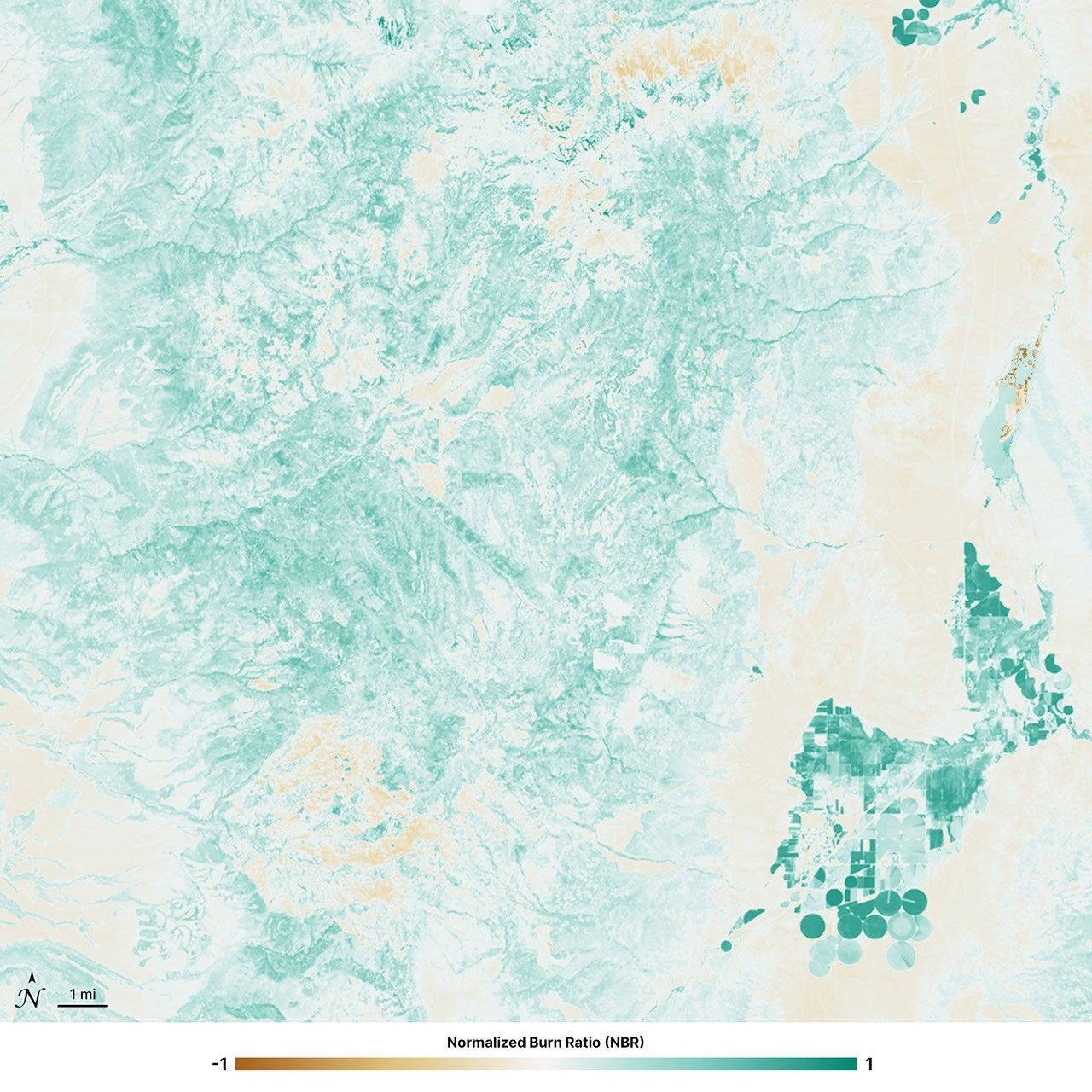
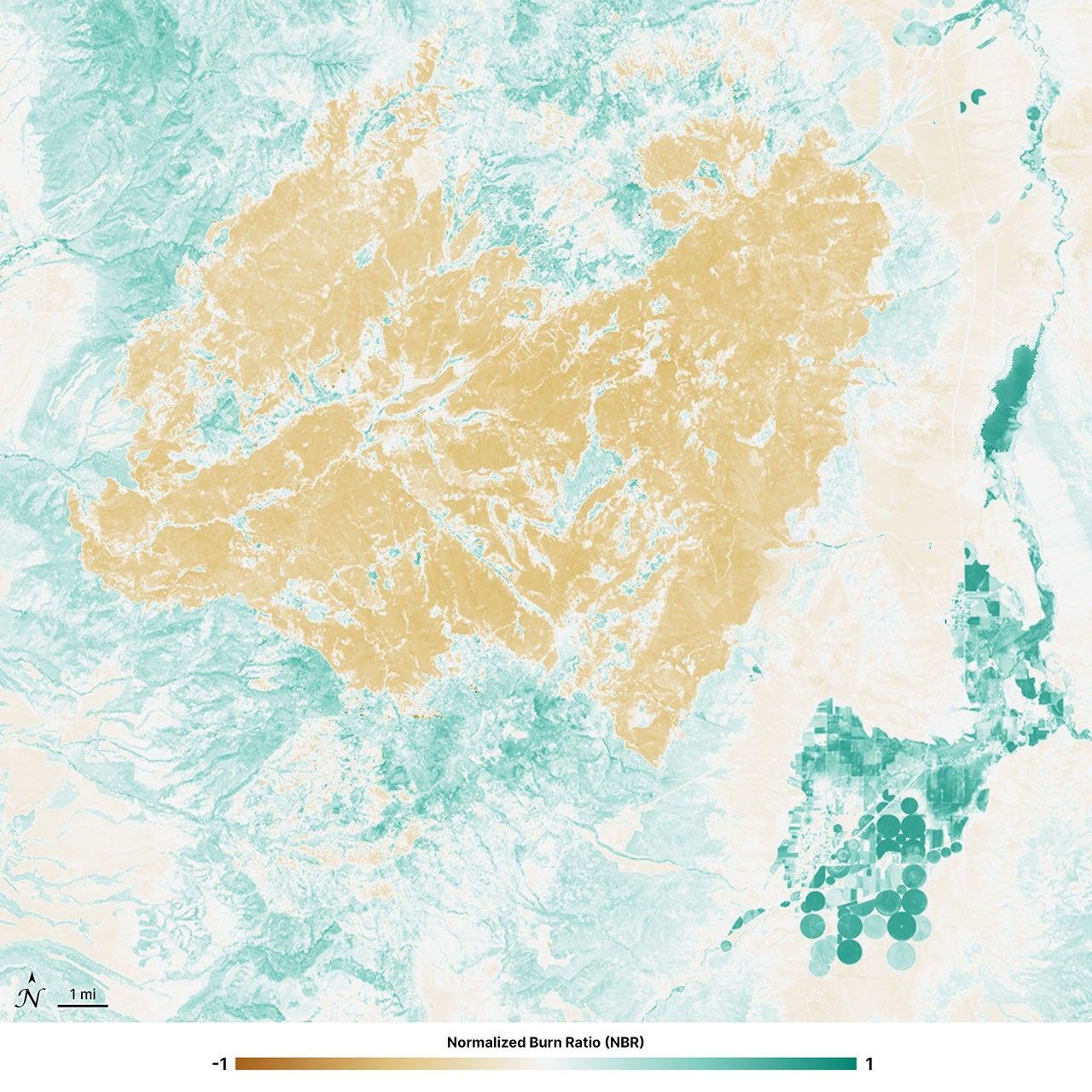
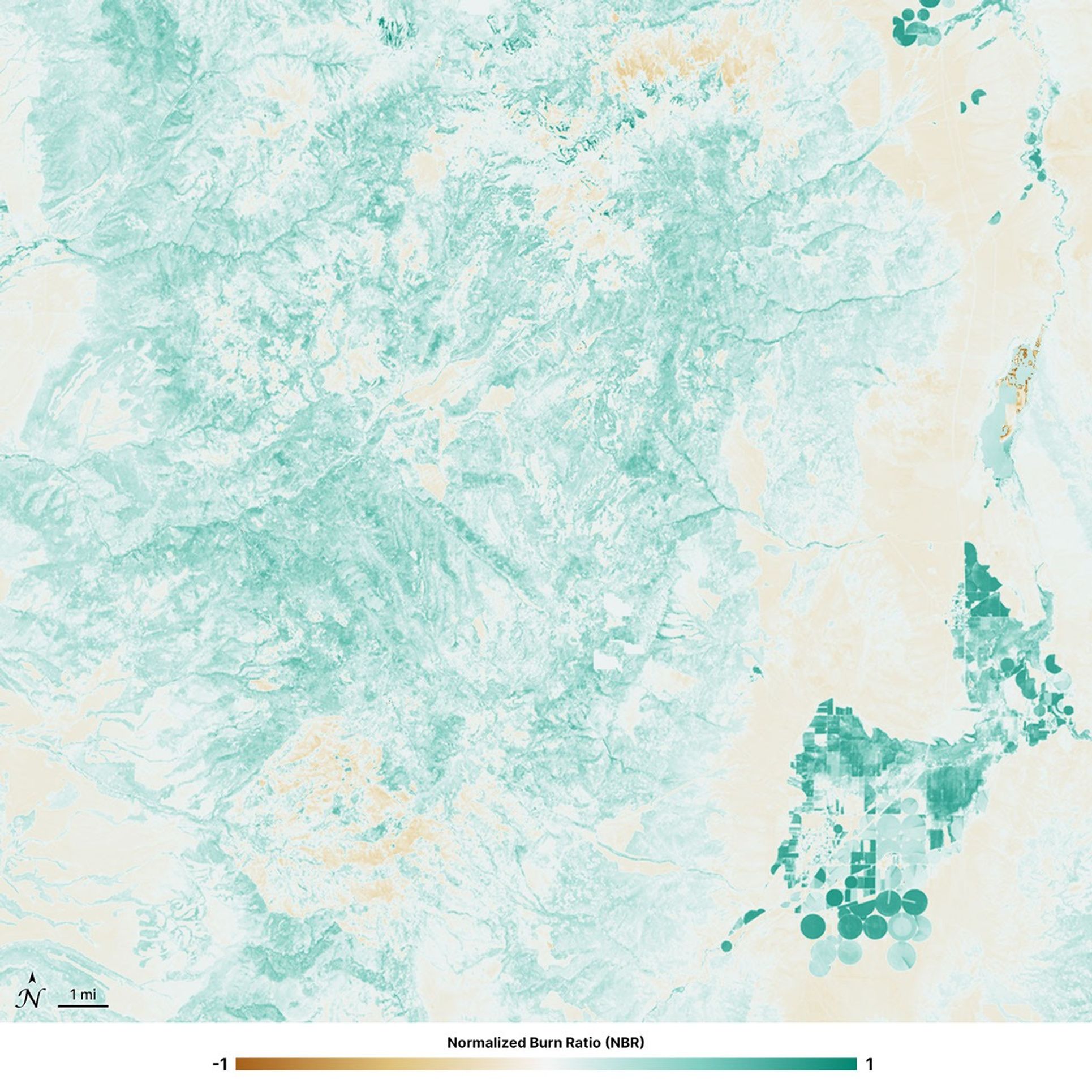
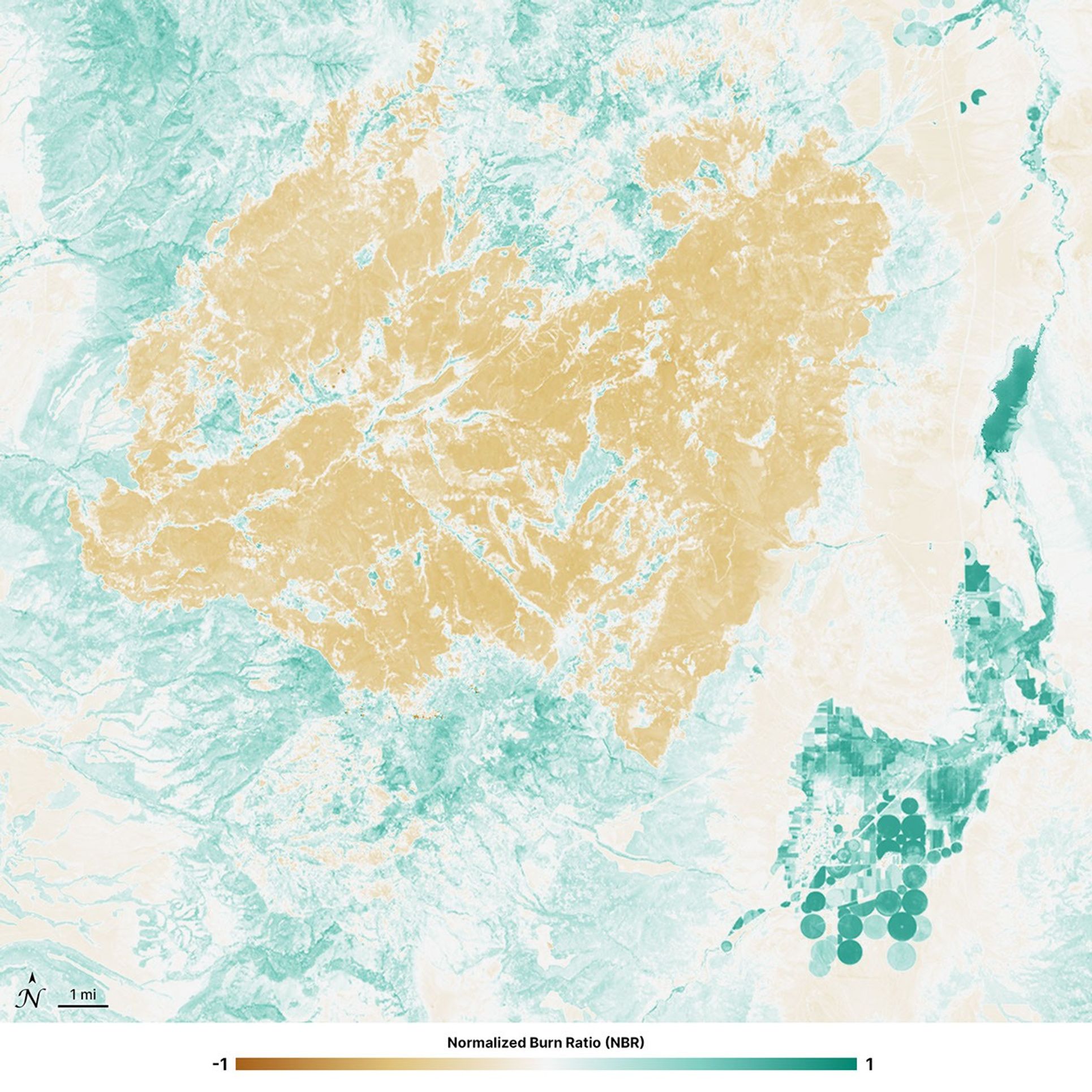
Before & After
Cottonwood Fire, Utah
June 5 & 29, 2026
The Normalized Burn Ratio (NBR) is designed to assess the impacts of disturbances on vegetation health. Positive NBR values indicate healthy vegetation, while negative values indicate recently stressed or burned vegetation, bare ground or ash. Unlike the more generalized NDVI, NBR is specifically tailored to detect changes in vegetation due to fire, drought, or other environmental disturbances.
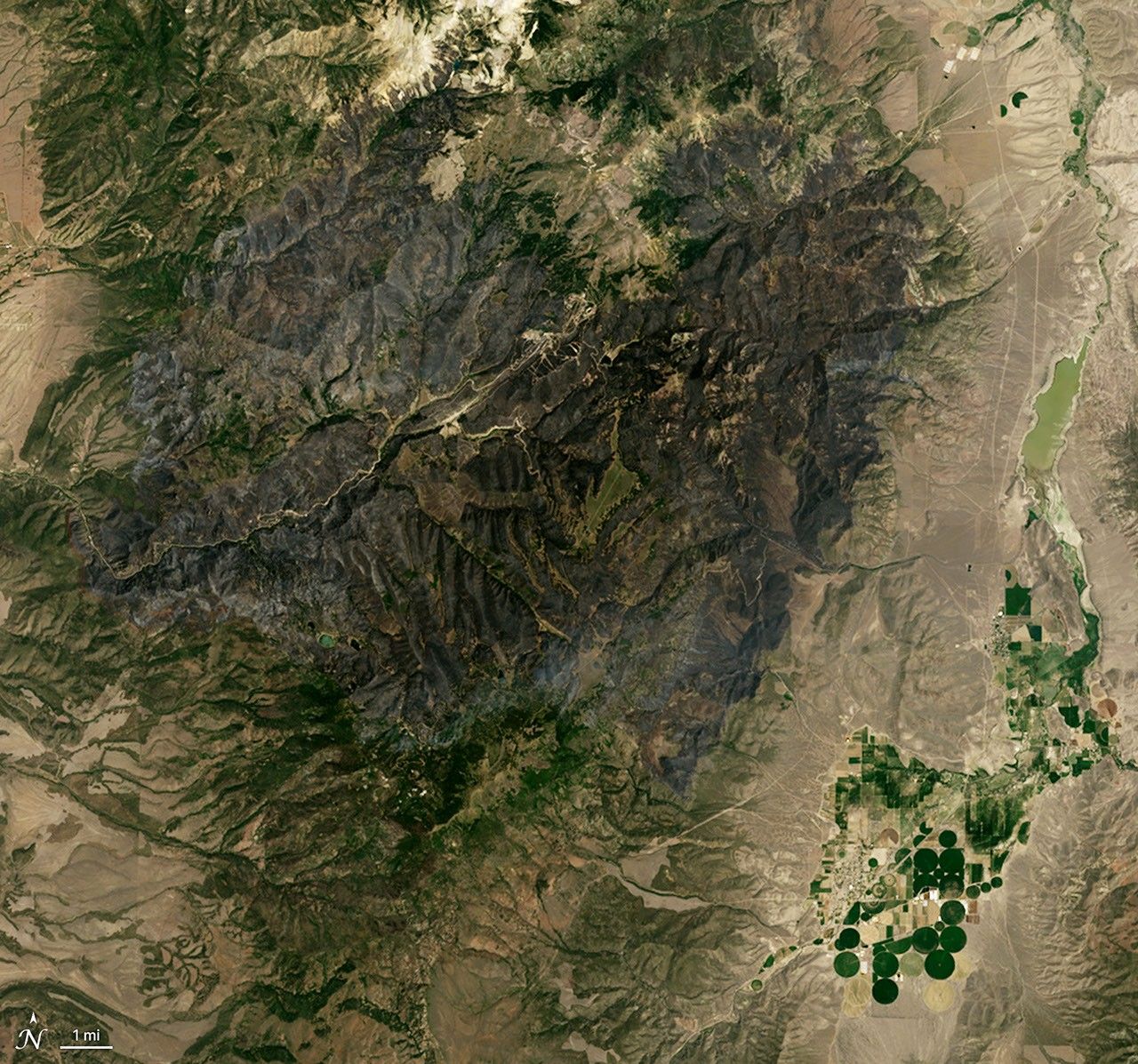
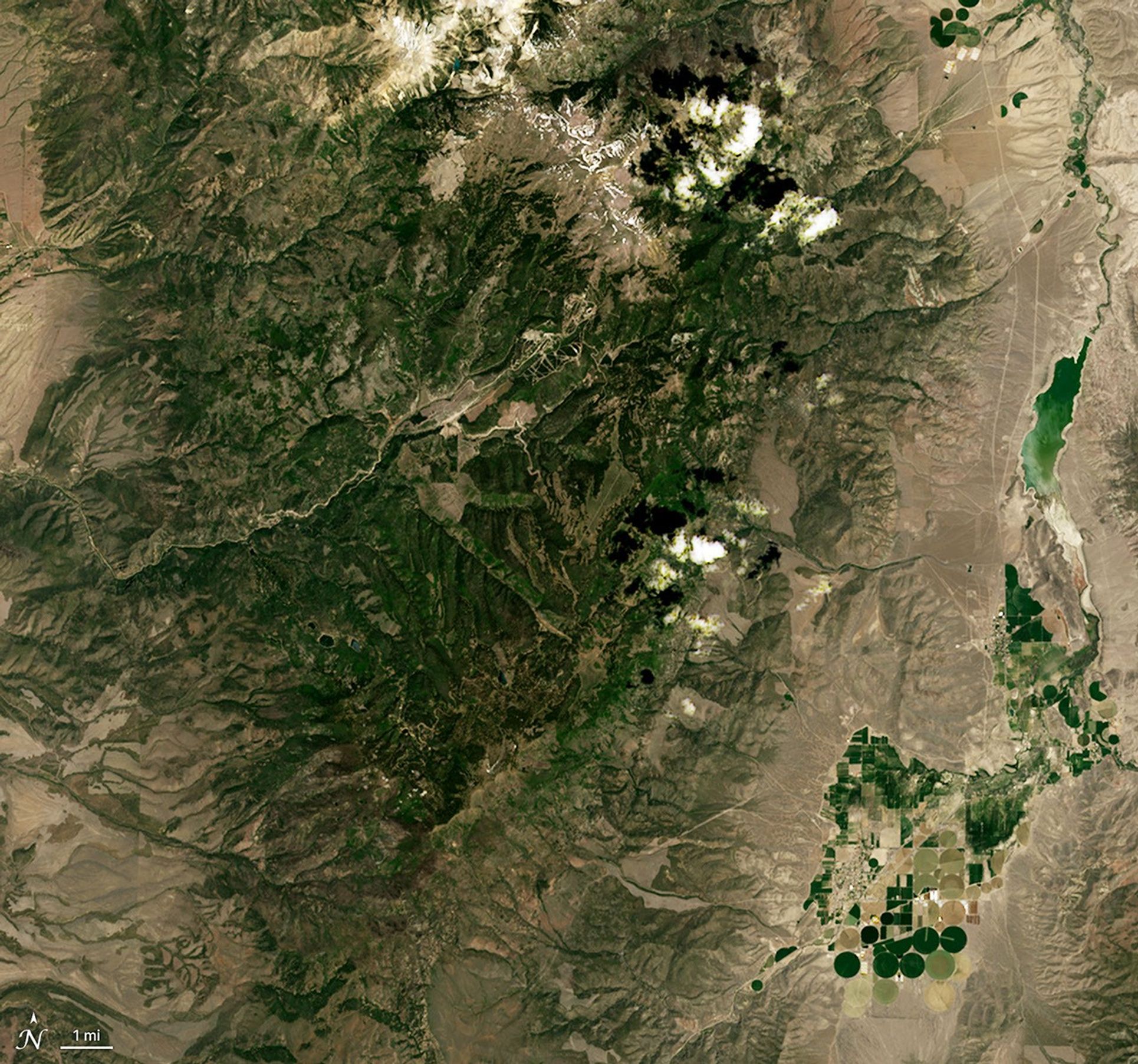
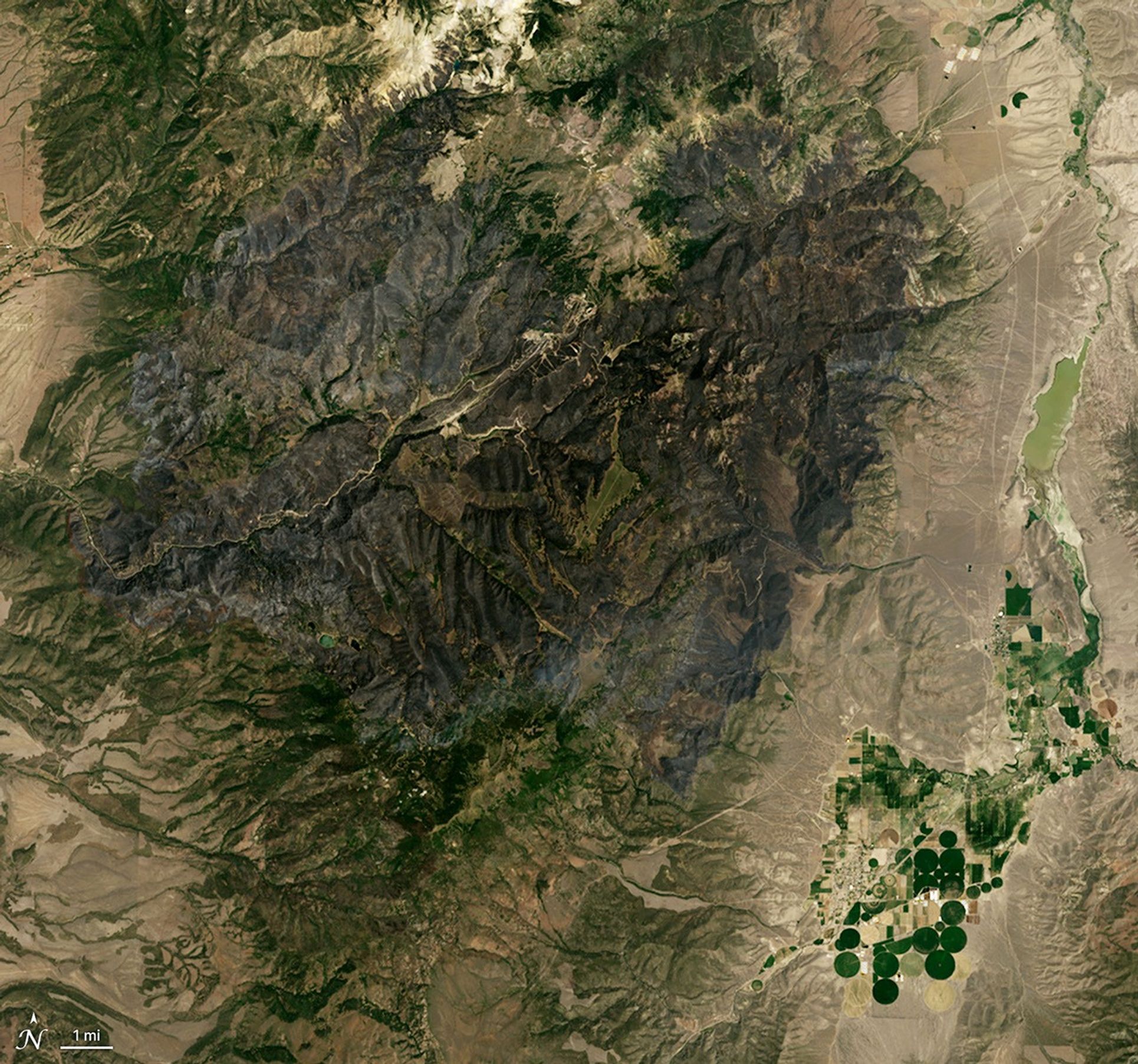
The above HLS L30 images show land in Southwest Utah before and after the start of the Cottonwood fire using the NBR index. Healthy vegetation appears in shades of teal, while burn scars appear brown and orange. Utah’s vegetation appears healthy on June 5, a few weeks before the fire. By June 29, the Cottonwood fire had left an enormous scar on the landscape, visible as a large tan blotch against the surviving surrounding forests. NBR compares the amount of near-infrared and shortwave-infrared light reflected from Earth’s surface. Healthy vegetation reflects more near-infrared than shortwave-infrared light, while burned areas reflect more shortwave-infrared. By analyzing the two, NBR reveals where a landscape is fire-scarred and where its vegetation is thriving.
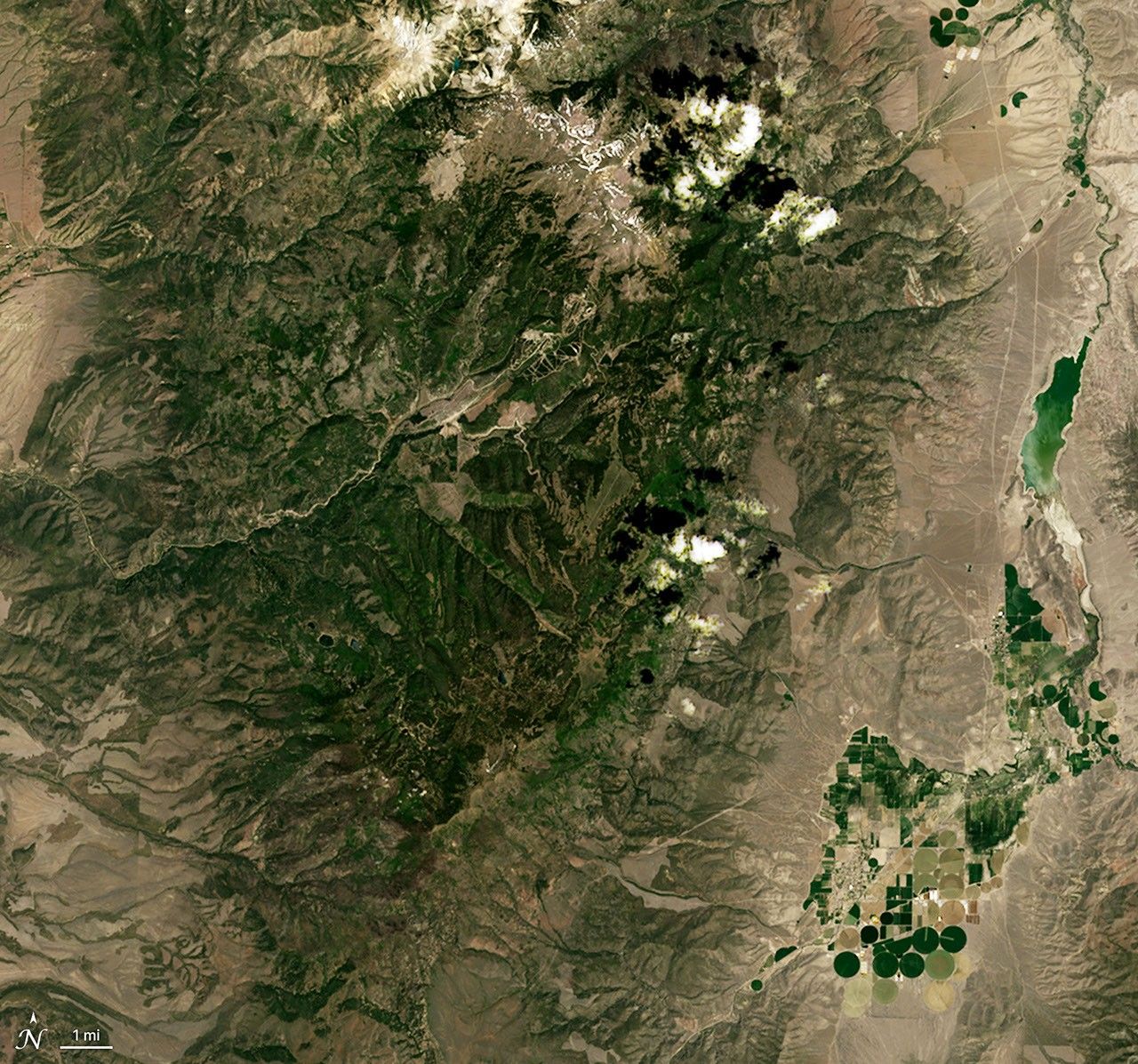
Before & AFter
Cottonwood Fire, Utah
June 5th & June 29, 2026
The Cottonwood fire tore through Utah’s unusually dry vegetation during a spell of particularly high temperatures. Firefighters rushed to contain the massive early-season blaze, which destroyed numerous homes and burned the region’s grass, sage brush, oak, and Ponderosa pines. Small patches survived in the midst of widespread damage, including the forests around Tushar campground. As wildfires grow larger and more common in much of the Western U.S., quantifying their spread and tracking their recovery becomes ever more important.
Values in the HLS-VI NBR product range from -1 to 1, where values closer to 1 indicate healthier, denser vegetation, values close to 0 indicate sparse or stressed vegetation, and values from -1 to 0 indicate non-vegetated features like water or bare soil.
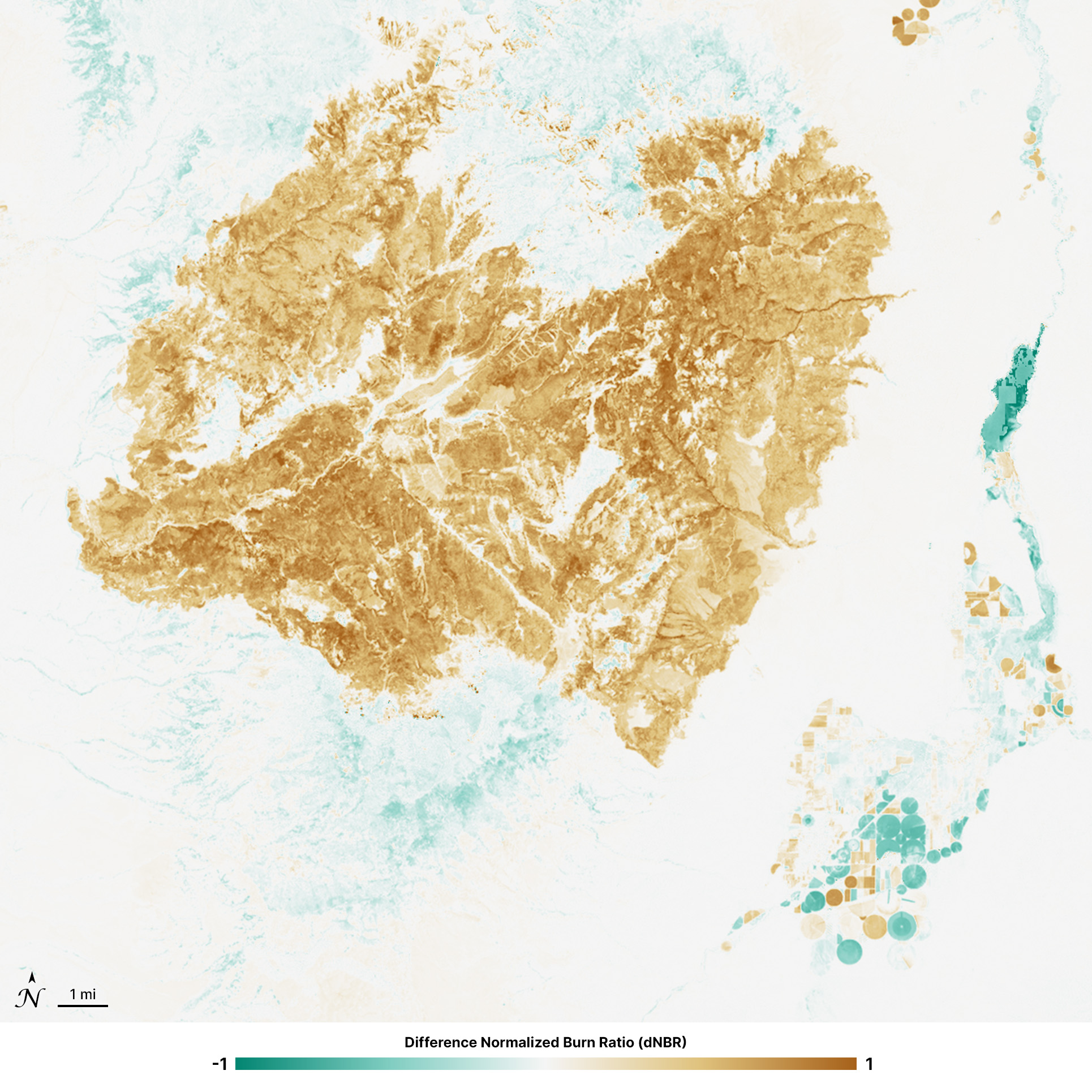
While NBR provides information about vegetation health at a single moment in time, scientists often use the Difference Normalized Burn Ratio (dNBR or ΔNBR) to quantify change in vegetation conditions before and after a disturbance. dNBR offers an assessment of the severity and extent of vegetation damage by comparing NBR values before and after a fire.
dNBR values from -0.5 to -0.1 indicate areas of regrowth, values from -0.1 to 0.1 indicate unburned areas, values from 0.1 to 0.66 indicate areas of low to moderate burn severity, and values above 0.66 indicate areas of high burn severity.
Related Resources
NBR2
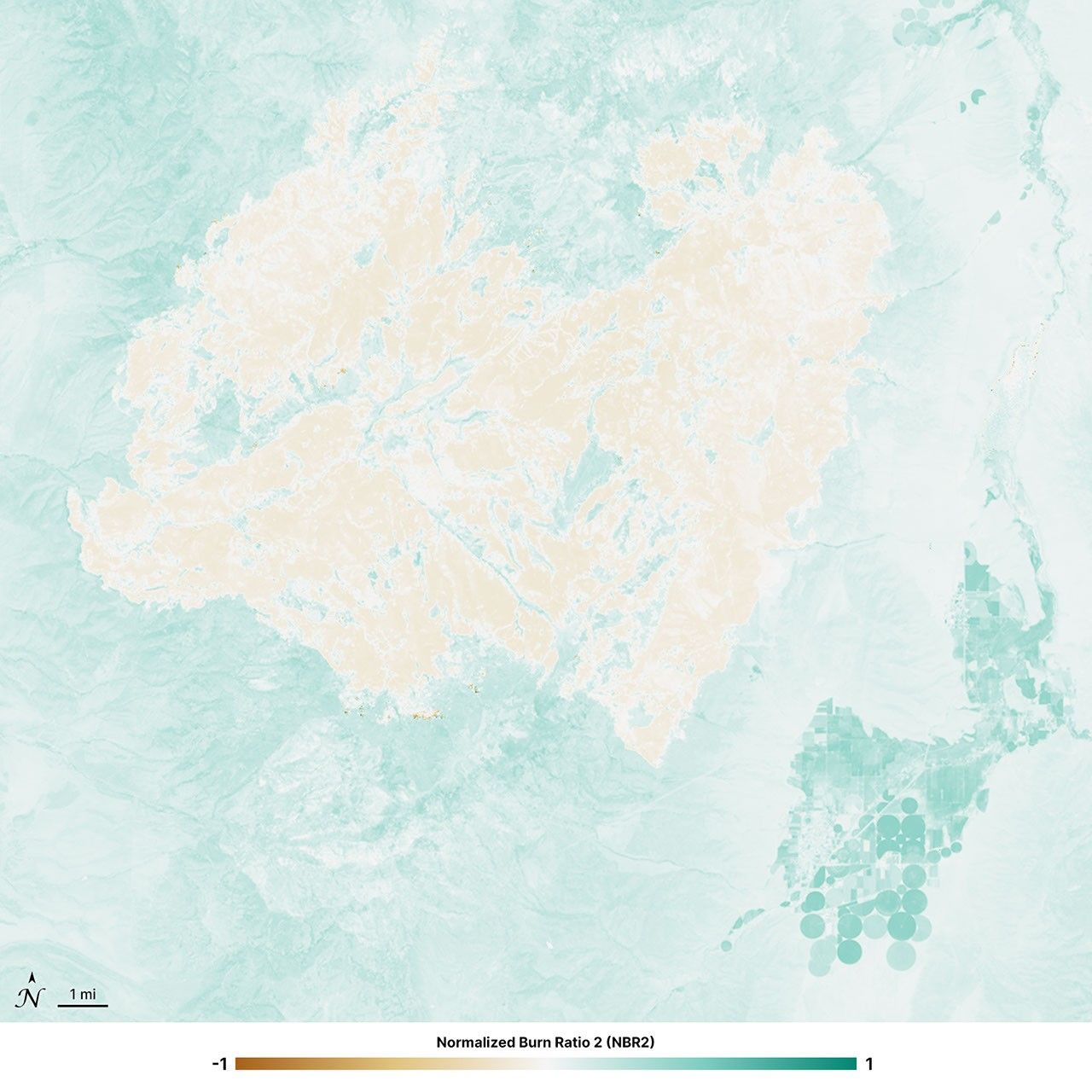
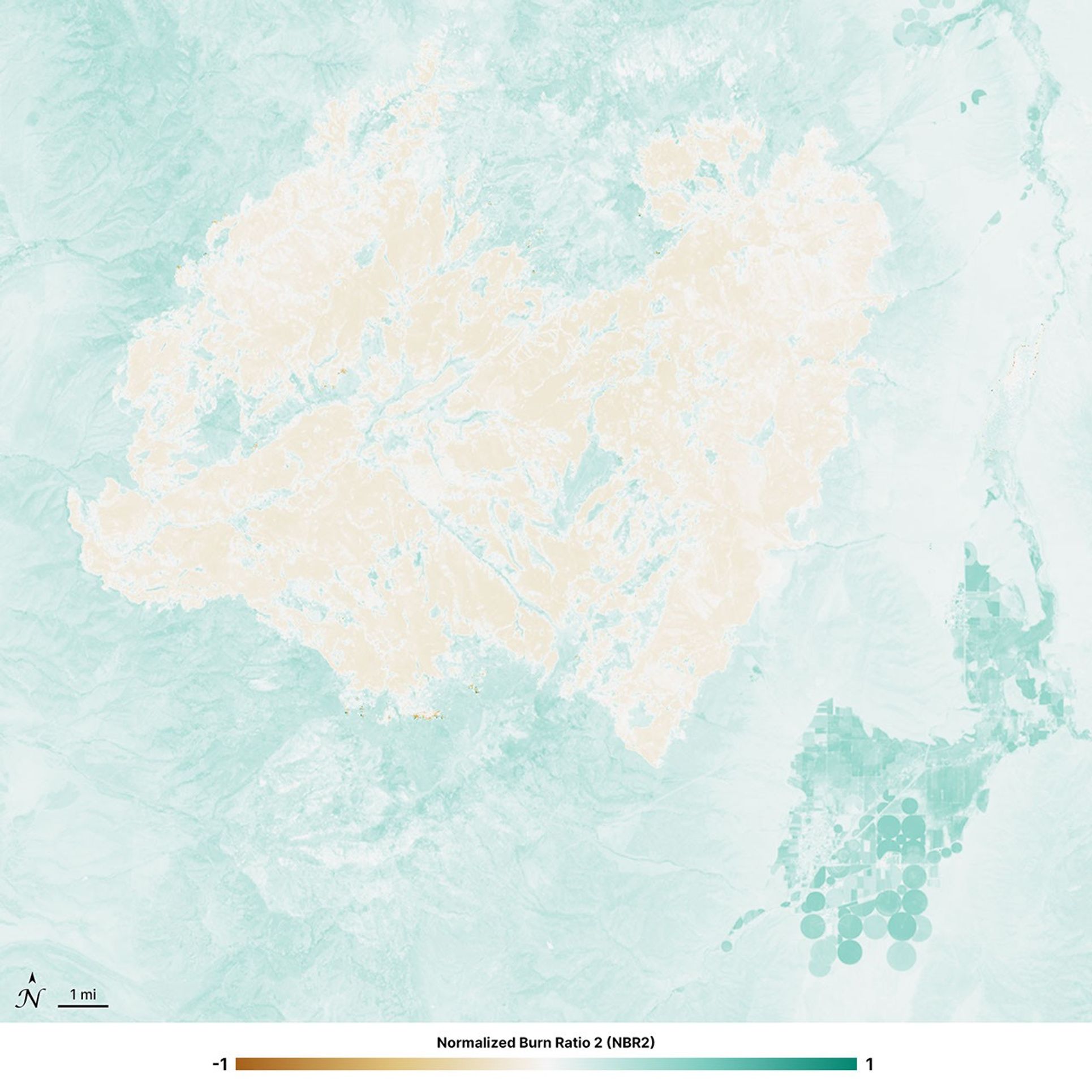
The Normalized Burn Ratio 2 (NBR2) is similar to NBR, but its increased sensitivity to moisture content in vegetation makes it more suitable for distinguishing vegetation from burned areas.
NBR2 = (SWIR1 - SWIR2) / (SWIR1 + SWIR2)
NBR & NBR2
Cottonwood Fire, Utah
June 29, 2026
These HLS L30 images show Utah after the Cottonwood fire using the Normalized Burn Ratio (NBR) and NBR2 indices. NBR2 is a refined version of NBR, substituting the near-infrared band with a shortwave-infrared band. NBR2’s increased sensitivity to moisture content in vegetation means that it marks a clearer delineation between living vegetation and burn scars than NBR, which mislabels some dry vegetation as burned. NBR2 provides estimates of burn severity that are helpful in evaluating the impact of wildfires.
Values in the HLS-VI NBR2 product range from -1 to 1, where negative values indicate recently burned areas, values near zero indicate unburned areas, and higher positive values indicate healthy vegetation.