
























Explore the Roman Ground Systems
Roman will communicate through large radio antennas across the globe. Roman's ground systems will support mission and science operations, providing the necessary capabilities to process and archive Roman's data. These systems will be spread across multiple institutions.
Antennas
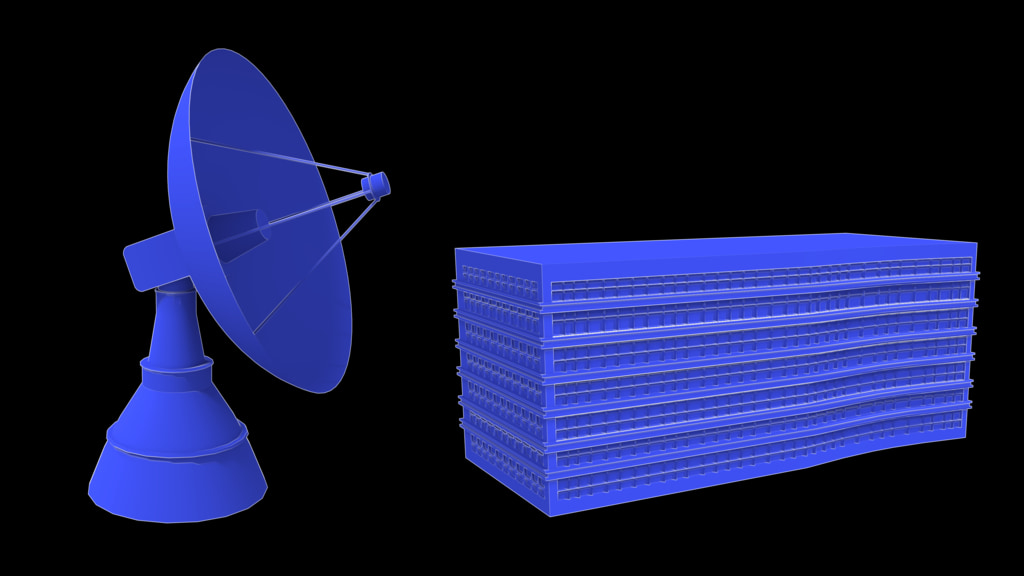
The antennas will relay information between the observatory and ground stations on Earth. The ground stations will send commands via S band (2 GHz) radio signals at speeds up to 32 kilobits per second. They will also receive science data at Ka band (26 GHz) at speeds up to 500 megabits per second, and engineering data at S band up to 680 kilobits per second. Using multiple contacts for several hours from each station, 1.4 terabytes of science data will be downlinked from the observatory each day. Along with radio antennas at NASA's White Sands, JAXA and ESA will contribute the use of antennas they maintain around the globe.
Partner(s): Japanese Aerospace Exploration Agency (JAXA) | European Space Agency (ESA) | NASA White Sands
Mission Operations Center (MOC)
The MOC will command the spacecraft and perform observatory planning and scheduling. It will ingest, archive, and distribute spacecraft telemetry and monitor the health and safety of the observatory.
Partner(s): NASA's Goddard Space Flight Center
Science Operations Center (SOC)
The SOC will plan and schedule science observations, archive mission science data, process images taken with the Wide Field Instrument, and perform initial grism and prism data processing. It is also responsible for calibrating the Wide Field Instrument and supporting the mission's launch and commissioning period. Finally, the SOC will provide science community engagement and public outreach support services to the project-led outreach program.
Partner(s): European Space Agency (ESA) | Space Telescope Science Institute (STScI)
Science Support Center (SSC)
The SSC will plan observations for the Coronagraph Instrument and perform the initial data processing steps. It will also process data for the Wide Field Instrument microlensing program, as well as complete the processing of the grism/prism science data. It will support the mission's commissioning period and lead the solicitation and review of science proposals. Finally, the SSC will provide science community engagement and public outreach support services to the project-led outreach program.
Partner(s): Infrared Processing and Analysis Facility (IPAC) | Laboratoire d'Astrophysique de Marseille (LAM)
Coronagraph Technology Center (CTC)
The CTC will work with the Science Support Center and the Community Participation Program to perform the Coronagraph Instrument technology demonstration.
Partner(s): NASA's Jet Propulsion Lab (JPL)
Flight Dynamics Operations Area (FDOA)
The FDOA will determine Roman’s position and velocity to accuracies that allow for contact with the ground stations and activities like planning maneuvers and determining the observatory's orbit. It will also develop support software for the ground systems so FDOA information can be delivered to the MOC, SOC, and SSC.
Partner(s): NASA's Goddard Space Flight Center