
























1 min read
Silicate Crystallization and Movement Near Protostar EC 53 (Illustration)

This illustration represents half the disk of gas and dust surrounding the protostar EC 53. The actively forming star is represented by the central yellow sphere. Stellar outbursts periodically heat the inner disk, forming a variety of crystalline silicates (represented by teal dots) where it’s hotter, closer to the protostar.
Once forged, the crystalline silicates shoot up and out (following the teal arrows), launched by winds from the protostar’s disk. These silicates often end up at the edges of the system, where comets and other icy rocky bodies may eventually form.
- Release DateJanuary 21, 2026
- Science ReleaseNASA Webb Finds Young Sun-Like Star Forging, Spewing Common Crystals
- CreditIllustration: NASA, ESA, CSA, Elizabeth Wheatley (STScI)
Related Images & Videos

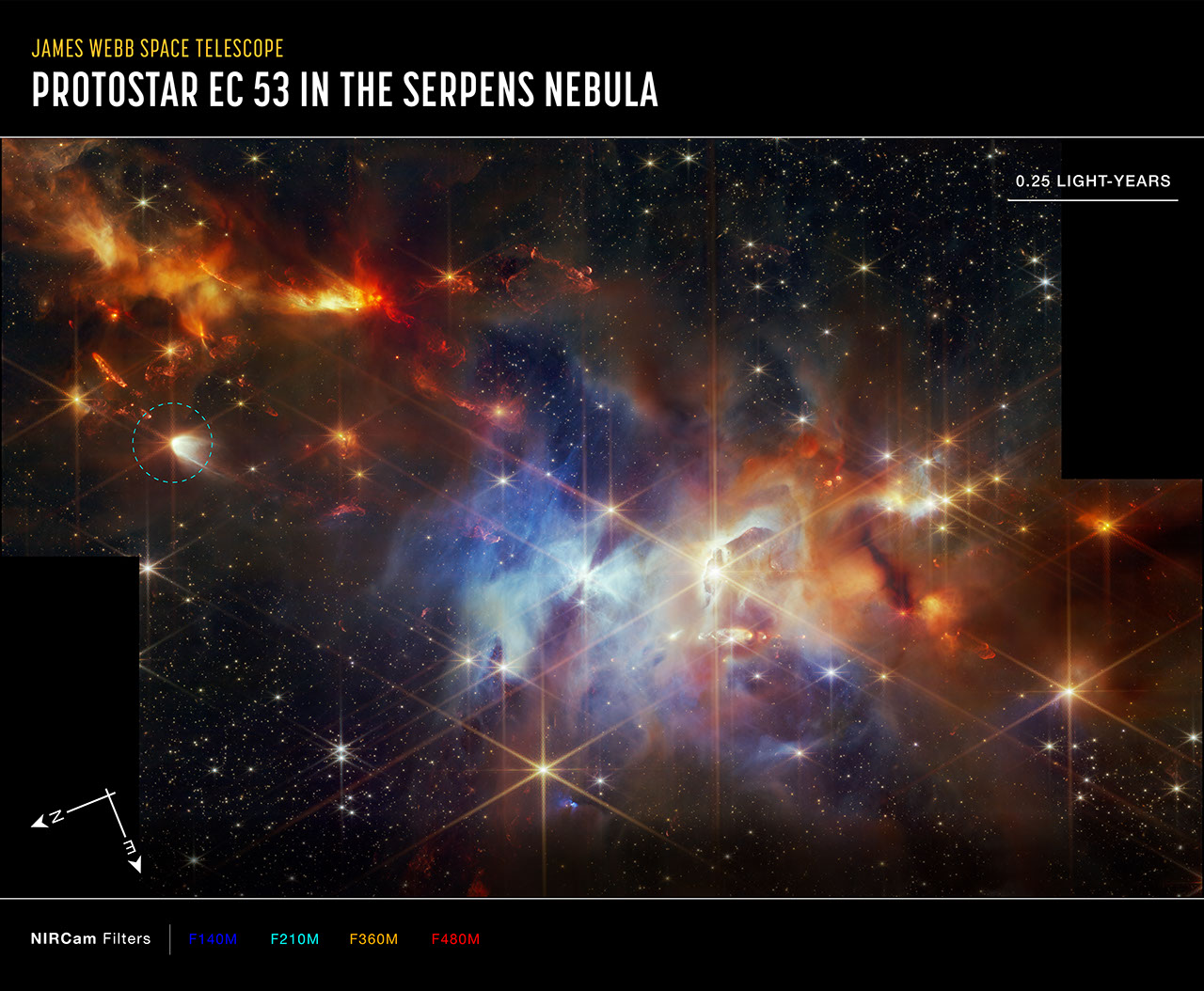
Protostar EC 53 in the Serpens Nebula (NIRCam Image)
NASA’s James Webb Space Telescope’s 2024 NIRCam image shows protostar EC 53 circled. Researchers using new data from Webb’s MIRI proved that crystalline silicates form in the hottest part of the disk of gas and dust surrounding the star — and may be shot to the system’s edges.
Share
Details
Laura Betz
NASA’s Goddard Space Flight Center
Greenbelt, Maryland
laura.e.betz@nasa.gov