















Suggested Searches

1 min read

Saturn (Webb NIRCam and Hubble WFC3/UVIS)
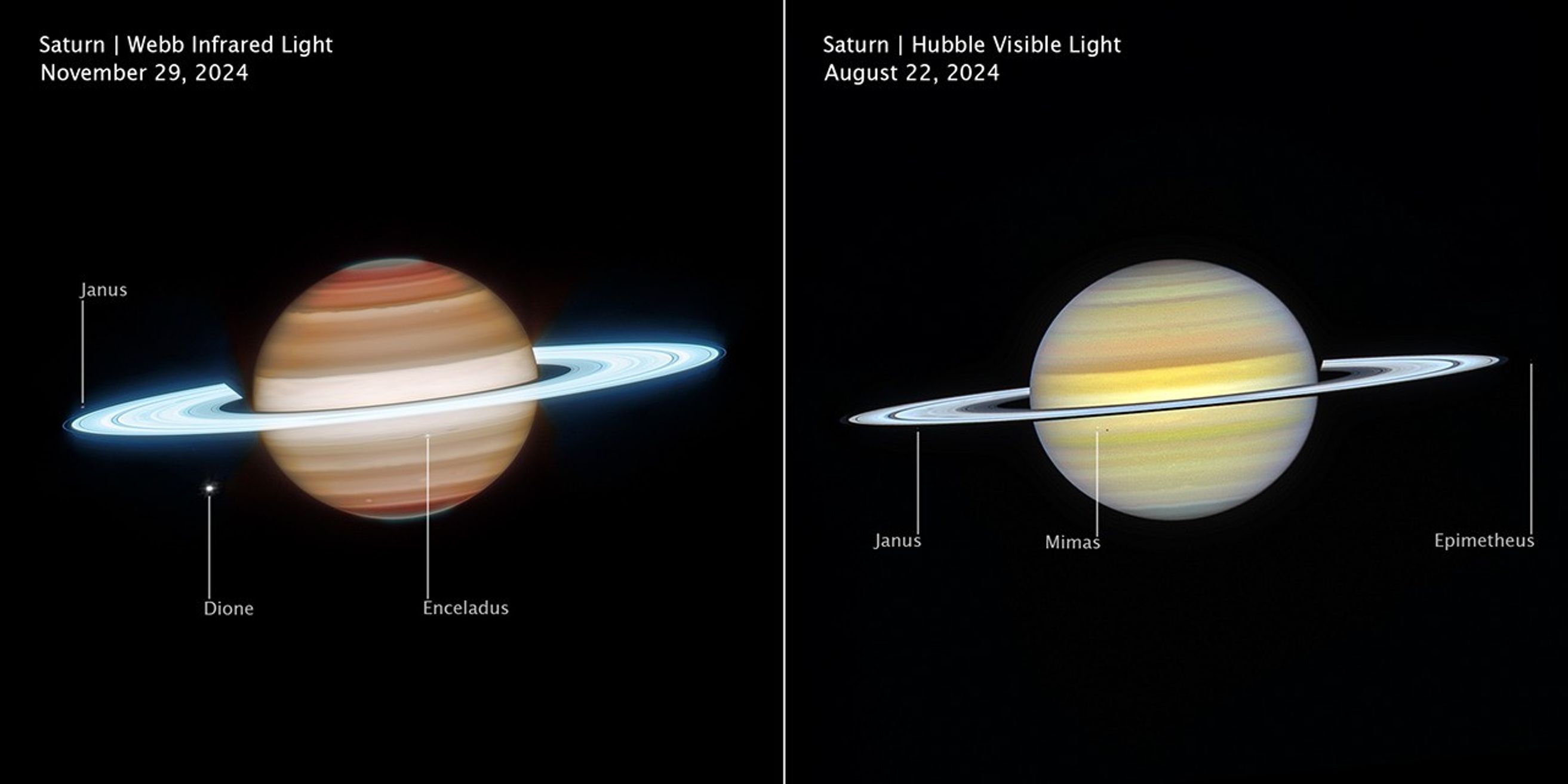
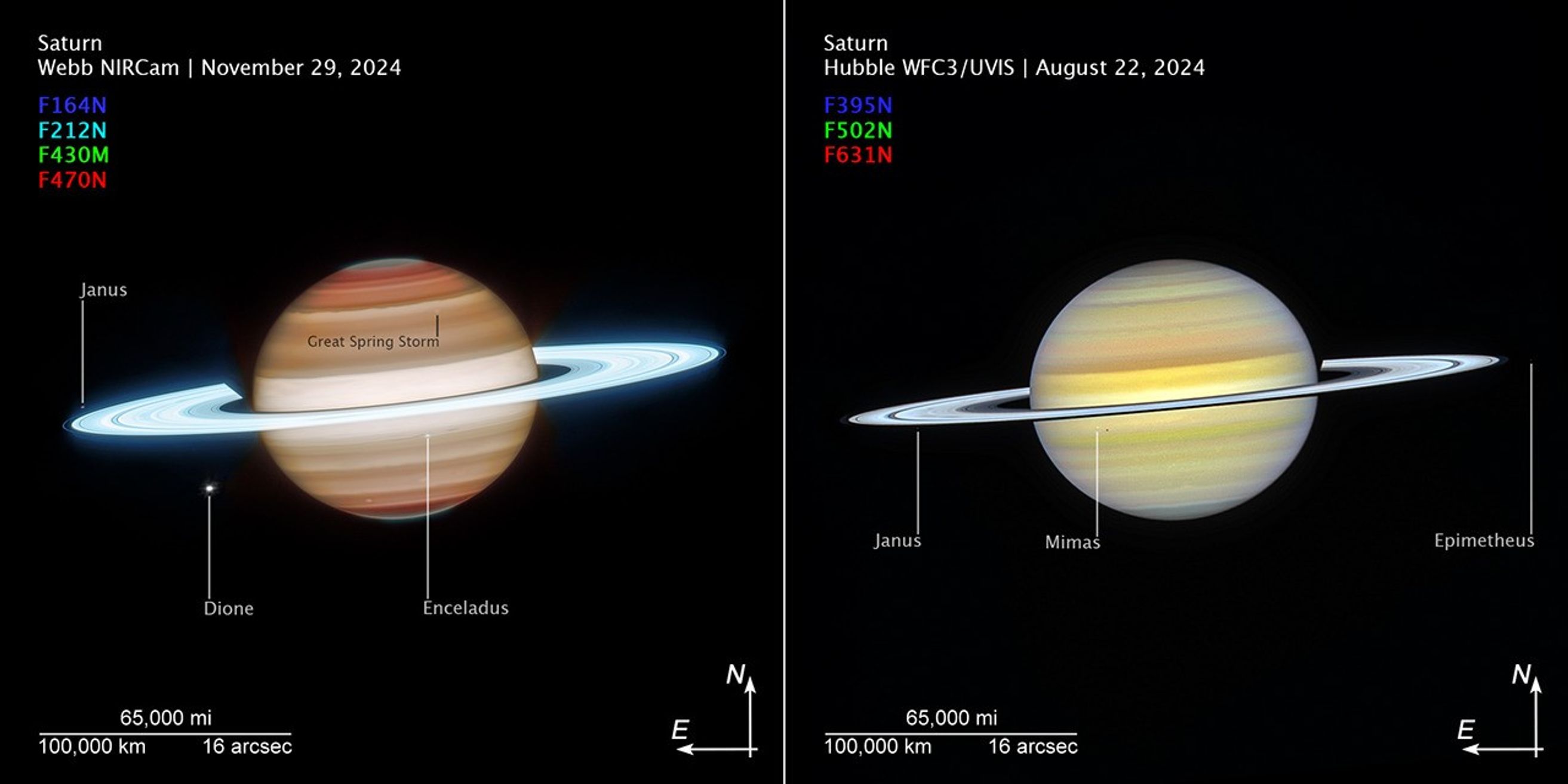
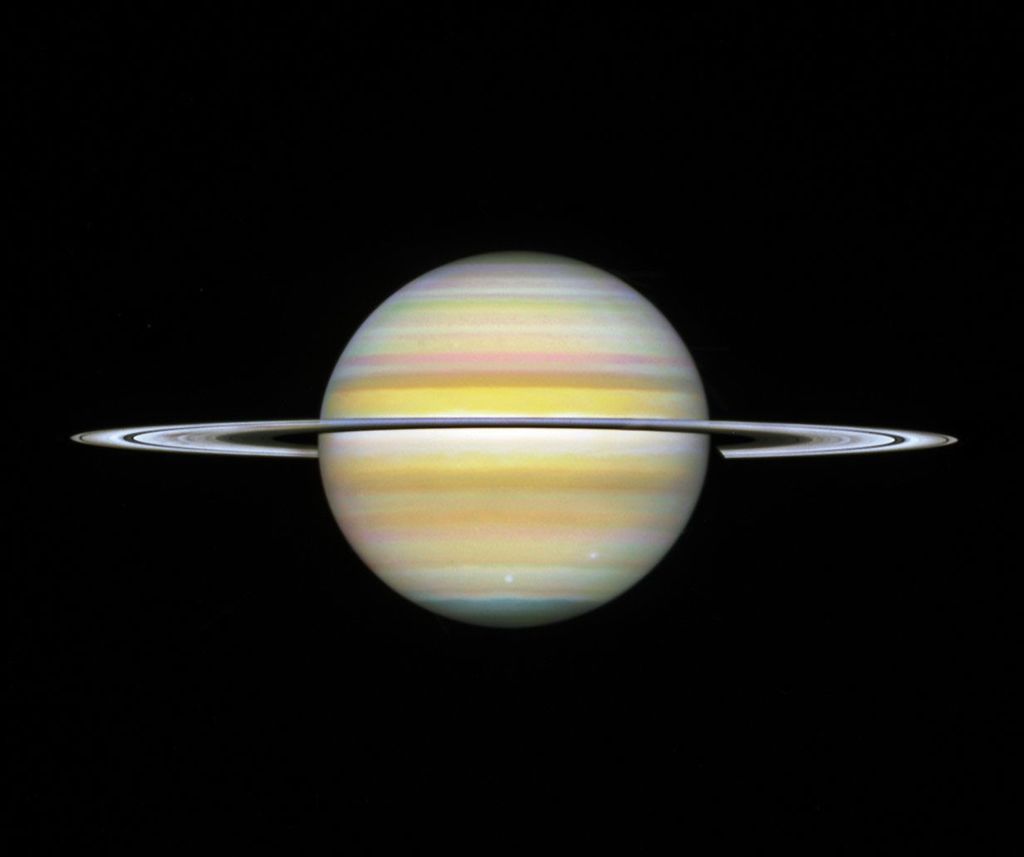
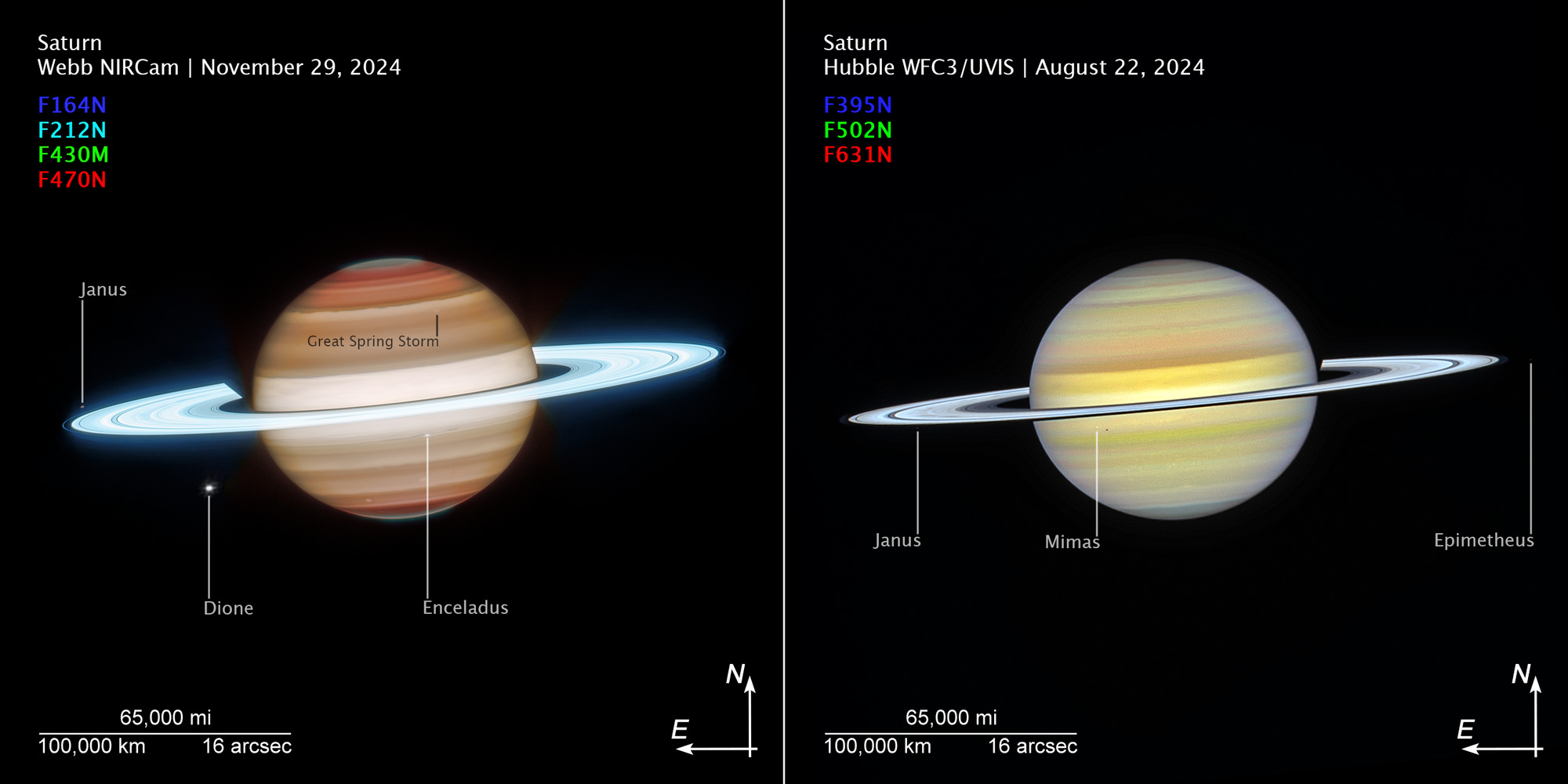
Side-by-side comparison of Saturn observed at different wavelengths and times show how differently it appears in infrared, on the left, versus visible light, on the right. Left image is labeled Saturn, Webb Infrared Light, November 29, 2024. Right image is labeled Saturn, Hubble Visible Light, August 22, 2024.
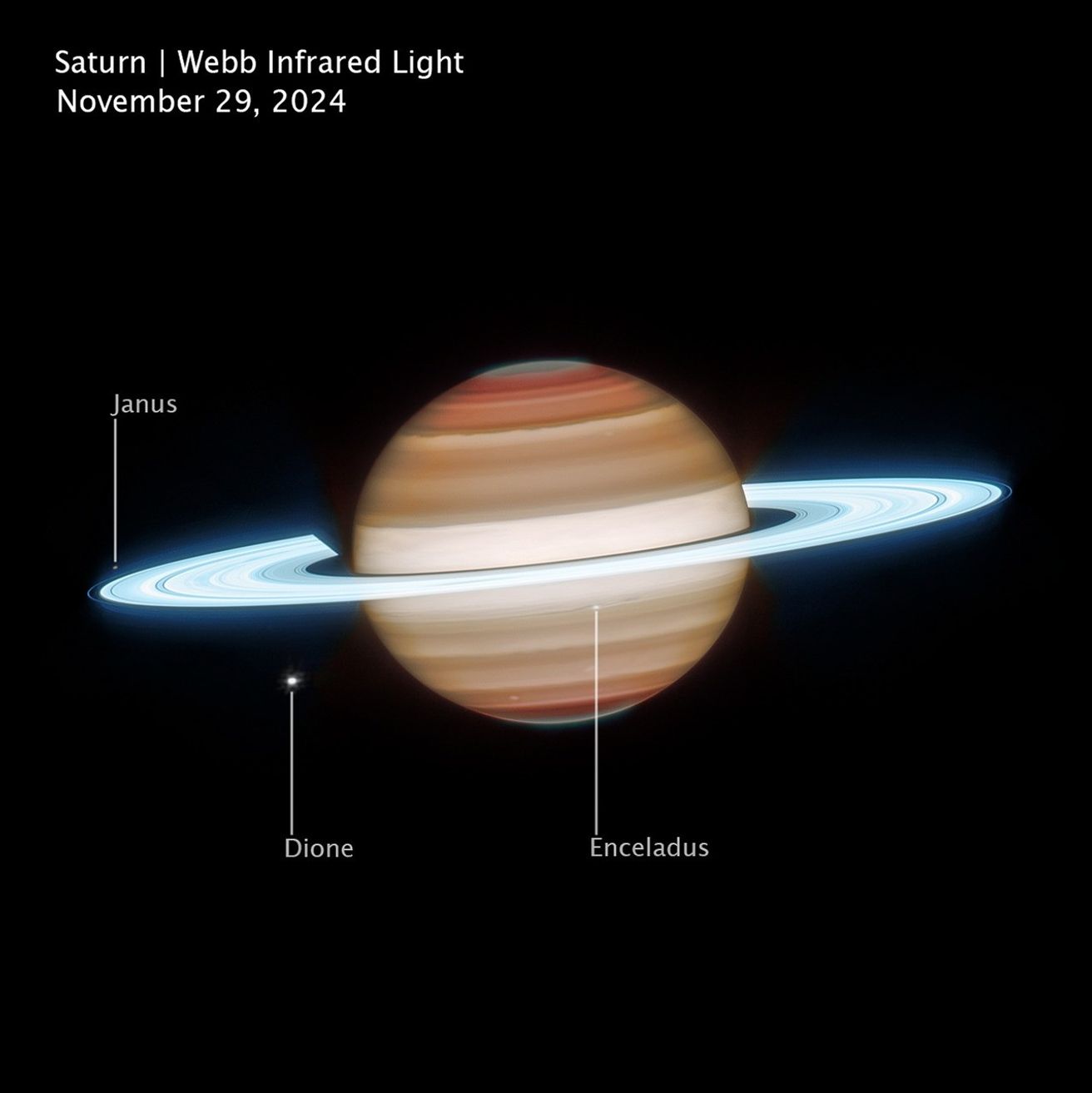
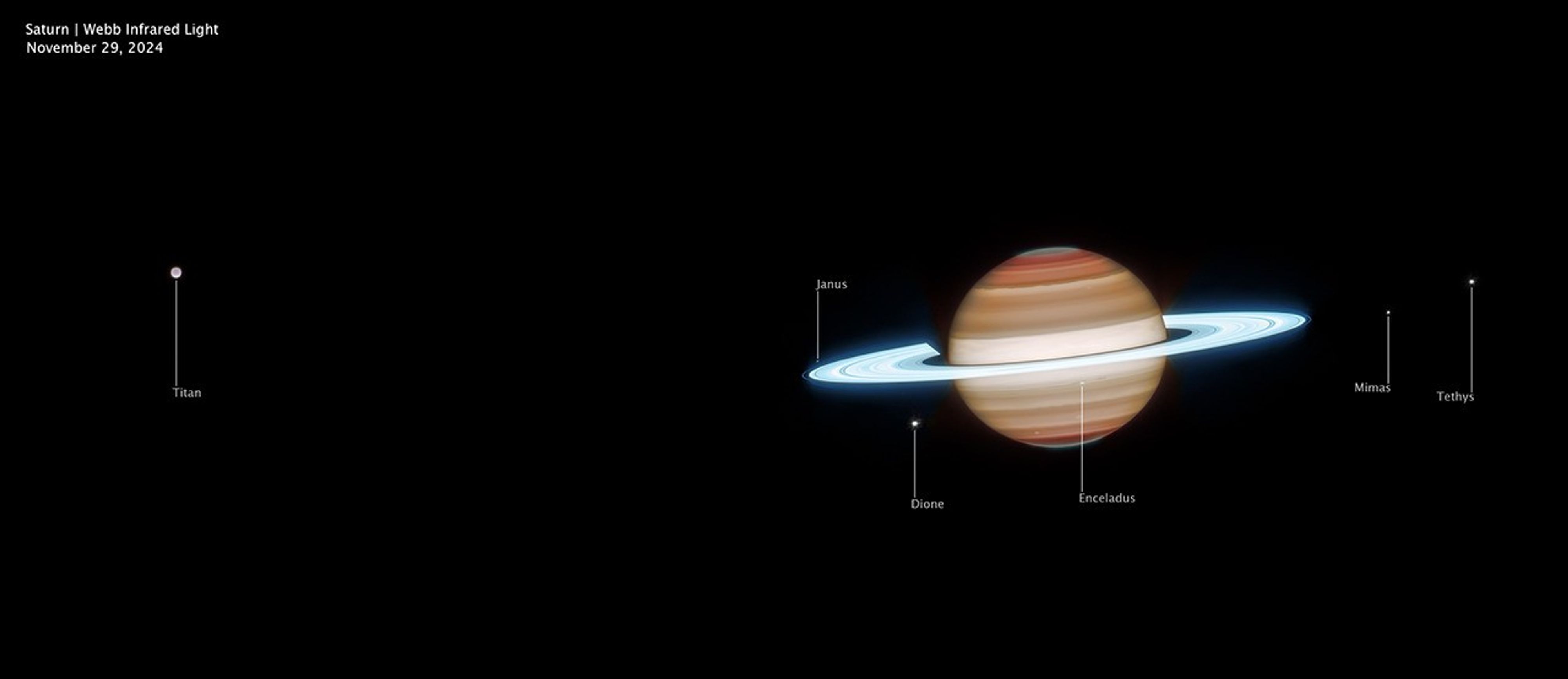
In infrared, Saturn has horizontal bands, with bands at the north and south poles appearing darker orange and lightening to tan as they approach the equator. The north and south poles glow a greenish-grey. The rings appear in an icy neon white. White dots, representing several of Saturn’s moons, are labeled Janus, Dione, and Enceladus.
In visible, Saturn’s horizontal bands appear pale yellow, with some bands towards the north and south pole having a light blue hue. The rings appear bright white, glowing slightly less than Webb’s infrared image. White dots, representing several of Saturn’s moons, are labeled Janus, Mimas, and Epimetheus.

Side-by-side views of Saturn from NASA’s James Webb Space Telescope (left) and Hubble Space Telescope (right) reveal the planet in infrared and visible light. Hubble highlights subtle cloud banding and color variations, while Webb’s infrared vision probes different atmospheric layers, bringing out storms, waves, and glowing ring structures in striking detail.

About the Data

  • Data Description
    Data DescriptionProposal: A description of the observations, their scientific justification, and the links to the data available in the science archive.
    Science Team: The astronomers who planned the observations and analyzed the data. "PI" refers to the Principal Investigator.

    These images were created with Webb and Hubble data from proposals: 9219 (M. Garcia Marin) and 17294 (A. Simon) respectively.

  • Instrument
    InstrumentThe science instrument used to produce the data.
    Webb: NIRCam; Hubble: WFC3/UVIS
  • Exposure Dates
    Exposure DatesThe date(s) that the telescope made its observations and the total exposure time.
    Webb: November 29, 2024; Hubble; August 22, 2024
  • Filters
    FiltersThe camera filters that were used in the science observations.
    Webb: F164N, F212N, F430M, F470N; Hubble: F395N, F502N, F631N
  • Object Name
    Object NameA name or catalog number that astronomers use to identify an astronomical object.
    Saturn
  • Object Description
    Object DescriptionThe type of astronomical object.
    Ringed Gas Giant
  • Release Date
    March 25, 2026
  • Science Release
    NASA Webb, Hubble Share Most Comprehensive View of Saturn to Date
  • Credit
    Image: NASA, ESA, CSA, STScI, Amy Simon (NASA-GSFC), Michael Wong (UC Berkeley); Image Processing: Joseph DePasquale (STScI)

Downloads

  • Full Res (For Display), 2626 × 1313
    png (2.21 MB)
  • Full Res (For Print), 2626 × 1313
    tif (2.19 MB)
  • Full Res (JPG), 2626 × 1313
    jpg (262.51 KB)
  • 2000 × 1000
    jpg (168.31 KB)
  • Full Res - Unannotated (For Display), 2626 × 1313
    png (2.19 MB)
  • Full Res - Unannotated (For Print), 2626 × 1313
    tif (2.16 MB)
  • Full Res - Unannotated (JPG), 2626 × 1313
    jpg (249.71 KB)
  • Full Res - Unannotated, 2000 × 1000
    jpg (158.72 KB)
Side-by-side comparison of Saturn observed at different wavelengths and times show how differently it appears in infrared, on the left, versus visible light, on the right. Left image is labeled Saturn, Webb Infrared Light, November 29, 2024. Right image is labeled Saturn, Hubble Visible Light, August 22, 2024.
In infrared, Saturn has horizontal bands, with bands at the north and south poles appearing darker orange and lightening to tan as they approach the equator. The north and south poles glow a greenish-grey. The rings appear in an icy neon white. White dots, representing several of Saturn’s moons, are labeled Janus, Dione, and Enceladus.
In visible, Saturn’s horizontal bands appear pale yellow, with some bands towards the north and south pole having a light blue hue. The rings appear bright white, glowing slightly less than Webb’s infrared image. White dots, representing several of Saturn’s moons, are labeled Janus, Mimas, and Epimetheus.
Color Info
Color InfoA brief description of the methods used to convert telescope data into the color image being presented.

These images were acquired by the NIRCam instrument on Webb and WFC3/UVIS instrument on Hubble. The color results from assigning different hues (colors) to a monochromatic (grayscale) image. In this case, the assigned colors for Webb are: Blue: F164N, Cyan: F212N, Green: F430M, Red: F470N, and for Hubble are: Blue: F395N, Green: F502N, Red: F631N
Compass and Scale
Compass and ScaleAn astronomical image with a scale that shows how large an object is on the sky, a compass that shows how the object is oriented on the sky, and the filters with which the image was made.

Share

Details

Last Updated
Mar 25, 2026
Contact
Media

Laura Betz
NASA’s Goddard Space Flight Center
Greenbelt, Maryland
laura.e.betz@nasa.gov