














4.3. What are the sources of life's building blocks outside the Earth?
A core learning question from the Astrobiology Learning Progressions
Astrobiology Learning Progressions Navigation


Grades K-2 or Adult Naive Learner
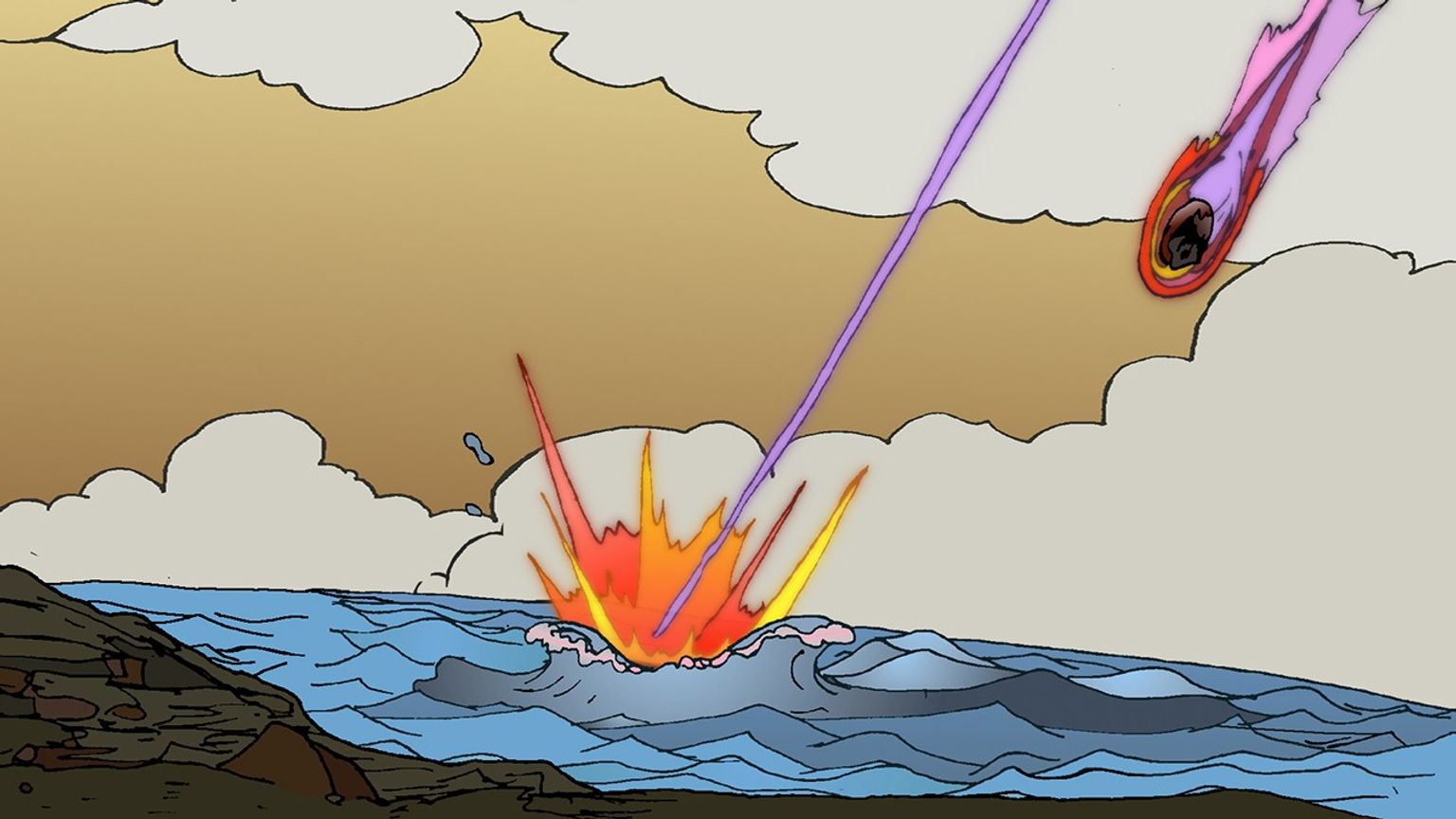
Have you ever seen a shooting star? People sometimes say to wish for something when a shooting star goes across the night sky. But did you know that a shooting star is actually not a star at all, but instead a piece of rock or ice landing on Earth from space? When a rock or a piece of ice falls onto Earth from space, it makes a glowing light in the sky at night. Sometimes, these things from space can even fall onto the ground and become part of our planet. Since living things need Earth to live and grow, there is a connection between these pieces of rock and ice in space and living things on Earth.
Disciplinary Core Ideas
ESS1.A: The Universe and its Stars: Patterns of the motion of the Sun, moon, and stars in the sky can be observed, described, and predicted. (1-ESS1-1)
ESS3.A: Natural Resources: Living things need water, air, and resources from the land, and they live in places that have the things they need. Humans use natural resources for everything they do. (K-ESS3-1)
Crosscutting Concepts
Systems and System Models: Systems in the natural and designed world have parts that work together.(K-ESS2-2),(K-ESS3-1)
Big Ideas: Sometimes rocks fall from space and land on Earth. Meteorites are made of rocks or ice and become a part of Earth when they land. This creates a connection between objects from space that become a part of Earth and living things that rely on Earth.
Boundaries: Students in this grade band make observations to construct an evidence-based account of how an object made of a small set of pieces can be disassembled and made into a new object. Examples of pieces could include blocks, building bricks, or other assorted small objects. Additionally, each student adding small amounts of clay of varying colors to a larger mass illustrates the cumulative affects over time. (2-PS1-3)
No appropriate content for this grade level. Please use the navigation arrows to switch levels.

Grades 3-5 or Adult Emerging Learner
Have you ever seen a shooting star? People sometimes say to wish for something when a shooting star goes across the night sky. But did you know that a shooting star is actually not a star at all, but instead a piece of rock or ice falling from space? When a rock or a piece of ice falls onto Earth from space, it makes a glowing light in the sky at night. These pieces of space stuff have been falling onto Earth for a really long time. Sometimes, these things from space can even fall onto the ground and get mixed in with the rocks and the dirt on our planet. Since living things need Earth to live and grow, there is a connection between these pieces of rock and ice in space and living things on Earth. So it’s important for scientists to study these pieces of stuff from space.
Disciplinary Core Ideas
LS1.C: Organization for Matter and Energy Flow in Organisms: Plants acquire their material for growth chiefly from air and water. (5-LS1-1)
ESS1.C: The History of Planet Earth: Local, regional, and global patterns of rock formations reveal changes over time due to earth forces, such as earthquakes. The presence and location of certain fossil types indicate the order in which rock layers were formed. (4-ESS1-1)
LS2.B:Cycles of Matter and Energy Transfer in Ecosystems: Matter cycles between the air and soil and among plants, animals, and microbes as these organisms live and die. Organisms obtain gases, and water, from the environment, and release waste matter (gas, liquid, or solid) back into the environment. (5-LS2-1)
PS3.D: Energy in Chemical Processes and Everyday Life: The energy released [from] food was once energy from the Sun that was captured by plants in the chemical process that forms plant matter (from air and water). (5-PS3-1)
LS2.A: Interdependent Relationships in Ecosystems: The food of almost any kind of animal can be traced back to plants. Organisms are related in food webs in which some animals eat plants for food and other animals eat the animals that eat plants. (5-LS2-1)
Crosscutting Concepts
Cause and Effect: Cause and effect relationships are routinely identified and used to explain change. (4-ESS3-1)
Big Ideas: Meteorites are made up of rock or ice. When they fall from space, they can land on Earth, and then become a part of Earth. This mixes materials from space with the ingredients needed for life on Earth.
Boundaries: Grade level appropriate examples of the particles that make up matter that are too small to be seen could include adding air to expand a basketball, compressing air in a syringe, dissolving sugar in water, and evaporating salt water. (5-PS1-1)
3-12 A Guide to Collecting Micrometeorites. This lesson on identification and measurement of micrometeorites could be used as a rich hands-on investigation of the solar system origins, the formation of the Earth, the interaction of Earth and space and/or the delivery of the ingredients necessary for life ( CHNOPS ). ScienceSouth.org/NASA. http://www.sciencesouth.org/wp-content/uploads/2011/06/2016VF-A-Guide-to-Collecting-Micrometeorites- JMM -1.pdf
4-12 Finding Life beyond Earth, Activity 3: Basic Ingredients for Life (p. 19). Students make impact craters to gain insight into how comets and asteroids deliver water and chemicals to the Earth and other places in the solar system. https://d43fweuh3sg51.cloudfront.net/media/assets/wgbh/nvfl/nvfl_doc_collection/nvfl_doc_collection.pdf
5-12 Exploring Meteorite Mysteries: Building Blocks of Life (12.1). The team activities in this lesson explore the important materials carbonaceous chondrites brought to Earth. A jumbled letter activity leads students to look at the amino acids found in carbonaceous chondrites as the building blocks of life. Students also experiment with growing yeast in mediums that represent carbonaceous chondrite material. NASA . https://er.jsc.nasa.gov/seh/Exploring_Meteorite_Mysteries.pdf
5-12 Exploring Meteorite Mysteries: The Meteorite Asteroid Connection (4.1). This lesson allows students to understand how meteorites get from the asteroid belt to Earth and how rare it is for the Earth to be hit by a large asteroid. The students build an exact-scale model of the inner solar system; the scale allows the model to fit within a normal classroom and also allows the representation of Earth to be visible without magnification. Students chart where most asteroids are, compared to the Earth, and see that a few asteroids come close to the Earth. Students see that the solar system is mostly empty space unlike the way it appears on most charts and maps. NASA . https://er.jsc.nasa.gov/seh/Exploring_Meteorite_Mysteries.pdf
5-12 Exploring Meteorite Mysteries: Looking at Asteroids (5.1). This lesson is about the connection between meteorites and asteroids. The activities in this lesson focus on ways to look at asteroids because some scientists think that some meteorites are fragments of asteroids. The lesson centers on remote sensing techniques using light. Students consider the brightness (reflectivity), textures, and colors of materials. NASA . https://er.jsc.nasa.gov/seh/Exploring_Meteorite_Mysteries.pdf
Grades 6-8 or Adult Building Learner
When Earth and the other planets were forming in the solar nebula around 4.5 billion years ago, not all of the material ended up inside of the planets and all of the moons. There were a lot of smaller pieces leftover; from itty, bitty microscopic stuff to pieces of rock and ice that can be many miles across. These are things like the asteroids and the comets in our solar system.
Throughout Earth’s history these pieces of rock and ice have continued to rain down from space to Earth’s surface. We often use the word “meteoroid” to describe these pieces of space stuff that can fall onto Earth. Once in our atmosphere, the piece of rock or ice will burn up and produce a streak of light. It’s that light that we call a “meteor” or a “shooting star”. Sometimes the chunks of material are so big that they even hit the ground. In that case, we call it a “meteorite.”
Meteorites of all shapes and sizes have impacted Earth. Investigations of the material in meteorites have shown that the chemical elements needed for life can be found inside of these space rocks. These elements are known as the CHNOPS elements (carbon, hydrogen, nitrogen, oxygen, phosphorous, and sulfur). In fact, scientists who do research on meteorites have even found that many of the types of molecules made up of CHNOPS elements that are used by living things on Earth are inside of those space rocks as well. These molecules include things like sugars and amino acids. Amino acids are the building blocks of proteins for all living things. Not only have we found the basic building blocks of life in meteorites, but we’ve also now used spacecraft to show that we can find them on the surfaces of asteroids and comets. We’ve even detected molecules made up of the CHNOPS elements within the dust of the interstellar medium – the material that exists between the stars in our galaxy.
All of this tells us that the CHNOPS elements and some of the basic building block molecules for life as we know it are actually quite common in the universe. Research on the connection between these materials from space and the presence of life on Earth will need to continue in order to better understand the history of life on Earth and to figure out if there could be other life somewhere out there.
Disciplinary Core Ideas
ESS1.C: The History of Planet Earth: The geologic time scale interpreted from rock strata provides a way to organize Earth’s history. Analyses of rock strata and the fossil record provide only relative dates, not an absolute scale. (MS-ESS1-4)
ESS2.A: Earth’s Materials and Systems: The planet’s systems interact over scales that range from microscopic to global in size, and they operate over fractions of a second to billions of years. These interactions have shaped Earth’s history and will determine its future. (MS-ESS2-2)
ESS2.B: Plate Tectonics and Large-Scale System Interactions: Maps of ancient land and water patterns, based on investigations of rocks and fossils, make clear how Earth’s plates have moved great distances, collided, and spread apart. (MS-ESS2-3)
ESS1.A: The Universe and Its Stars: Earth and its solar system are part of the Milky Way galaxy, which is one of many galaxies in the universe. (MS-ESS1-2)
ESS1.B: Earth and the Solar System: The solar system consists of the Sun and a collection of objects, including planets, their moons, and asteroids that are held in orbit around the Sun by its gravitational pull on them. (MS-ESS1-2, MS-ESS1-3)
Crosscutting Concepts
Scale, Proportion, and Quantity: Time, space, and energy phenomena can be observed at various scales using models to study systems that are too large or too small. (MS-ESS1-3)
Systems and System Models: Models can be used to represent systems and their interactions. (MS-ESS1-2)
Big Ideas: Material left over from the creation of the solar system sometimes enters Earth’s atmosphere adding material to the planet. When they fall from space, they can land on Earth, and then become a part of Earth. This mixes materials from space with the ingredients of life on Earth. Many bring the materials necessary for life, “CHNOPS ”, with them frozen in their ice. Detection of CHNOPS from material beyond Earth indicates the building block molecules for life are common in the universe.
Boundaries: In this grade band, students are using models to describe the atomic composition of simple molecules and extended structures that vary in complexity. Examples of molecular-level models could include drawings, 3D ball and stick structures, or computer representations showing different molecules with different types of atoms. Does not include a complete depiction of all individual atoms in a complex molecule or extended structure. (MS-PS1-1)
3-12 A Guide to Collecting Micrometeorites. This lesson on identification and measurement of micrometeorites could be used as a rich hands-on investigation of the solar system origins, the formation of the Earth, the interaction of Earth and space and/or the delivery of the ingredients necessary for life ( CHNOPS ). ScienceSouth.org/NASA. http://www.sciencesouth.org/wp-content/uploads/2011/06/2016VF-A-Guide-to-Collecting-Micrometeorites- JMM -1.pdf
4-12 Finding Life beyond Earth, Activity 3: Basic Ingredients for Life (p. 19). Students make impact craters to gain insight into how comets and asteroids deliver water and chemicals to the Earth and other places in the solar system. https://d43fweuh3sg51.cloudfront.net/media/assets/wgbh/nvfl/nvfl_doc_collection/nvfl_doc_collection.pdf
5-12 Exploring Meteorite Mysteries: Building Blocks of Life (12.1). The team activities in this lesson explore the important materials carbonaceous chondrites brought to Earth. A jumbled letter activity leads students to look at the amino acids found in carbonaceous chondrites as the building blocks of life. Students also experiment with growing yeast in mediums that represent carbonaceous chondrite material. NASA . https://er.jsc.nasa.gov/seh/Exploring_Meteorite_Mysteries.pdf
5-12 Exploring Meteorite Mysteries: The Meteorite Asteroid Connection (4.1). This lesson allows students to understand how meteorites get from the asteroid belt to Earth and how rare it is for the Earth to be hit by a large asteroid. The students build an exact-scale model of the inner solar system; the scale allows the model to fit within a normal classroom and also allows the representation of Earth to be visible without magnification. Students chart where most asteroids are, compared to the Earth, and see that a few asteroids come close to the Earth. Students see that the solar system is mostly empty space unlike the way it appears on most charts and maps. NASA . https://er.jsc.nasa.gov/seh/Exploring_Meteorite_Mysteries.pdf
5-12 Exploring Meteorite Mysteries: Looking at Asteroids (5.1). This lesson is about the connection between meteorites and asteroids. The activities in this lesson focus on ways to look at asteroids because some scientists think that some meteorites are fragments of asteroids. The lesson centers on remote sensing techniques using light. Students consider the brightness (reflectivity), textures, and colors of materials. NASA . https://er.jsc.nasa.gov/seh/Exploring_Meteorite_Mysteries.pdf
6-12 Astrobiology Math. This collection of math problems provides an authentic glimpse of modern astrobiology science and engineering issues, often involving actual research data. Students explore concepts in astrobiology through calculations. Relevant topics include Death Stars (page 59) and A Mathematical Model of Water Loss from Comet Tempel-1 (page 55). NASA . https://www.nasa.gov/pdf/637832main_Astrobiology_Math.pdf
Grades 9-12 or Adult Sophisticated Learner
When Earth and the other planets were forming in the solar nebula around 4.5 billion years ago, not all of the material ended up inside of the planets and all of the moons. There were a lot of smaller pieces leftover; from itty, bitty microscopic stuff to pieces of rock and ice that can be many miles across. These are things like the asteroids and the comets in our solar system.
Throughout Earth’s history these pieces of rock and ice have continued to rain down from space to Earth’s surface. We often use the word “meteoroid” to describe these pieces of space stuff that can fall onto Earth. Once in our atmosphere, the piece of rock or ice will burn up and produce a streak of light. It’s that light that we call a “meteor” or a “shooting star”. Sometimes the chunks of material are so big that they even hit the ground. In that case, we call it a “meteorite”.
Meteorites of all shapes and sizes have impacted Earth. Investigations of the material in meteorites have shown that the chemical elements needed for life can be found inside of these space rocks. These elements are known as the CHNOPS elements (for carbon, hydrogen, nitrogen, oxygen, phosphorous, and sulfur). In fact, scientists who do research on meteorites have even found that many of the types of molecules made up of CHNOPS elements that are used by living things on Earth are inside of those space rocks as well. These molecules include things like sugars and amino acids. Amino acids are the building blocks of proteins for all living things. Not only have we found the basic building blocks of life in meteorites, but we’ve also now used spacecraft to show that we can find them on the surfaces of asteroids and comets. We’ve even detected molecules made up of the CHNOPS elements within the dust of the interstellar medium (the material that exists between the stars in our galaxy).
The molecules that include carbon are often referred to as “organic molecules”. These include a lot of the molecules made up of CHNOPS elements that are important for life. Sometimes when we talk about these organic molecules that can come to Earth from space, we call the “exogenous” materials. That means that they came from somewhere else (as compared to something that is “endogenous”). Our research has told us that the early solar system had a lot more rocks and ice orbiting about that could crash into Earth and other worlds. Just as today, those materials likely had a lot of exogenous organic molecules on and in them. So, in the early history of Earth, there were a lot more meteorites falling to Earth and bringing along these exogenous organic molecules. We don’t yet know if these meteorites were an important source of materials for Earth life, but it seems likely that they could have brought a lot of the CHNOPS elements to Earth for living things to later use.
So we know that the CHNOPS elements and even some of the basic building block molecules for life as we know it are actually quite common in the universe. Research on the connection between these materials from space and the presence of life on Earth will need to continue in order to better understand the history of life on Earth and to figure out if there could be other life somewhere out there.
Disciplinary Core Ideas
ESS1.C: The History of Planet Earth: Continental rocks, which can be older than 4 billion years, are generally much older than the rocks of the ocean floor, which are less than 200 million years old. (HS-ESS1-5) Although active geologic processes, such as plate tectonics and erosion, have destroyed or altered most of the very early rock record on Earth, other objects in the solar system, such as lunar rocks, asteroids, and meteorites, have changed little over billions of years. Studying these objects can provide information about Earth’s formation and early history. (HS-ESS1-6)
Crosscutting Concepts
Scale, Proportion, and Quantity: The significance of a phenomenon is dependent on the scale, proportion, and quantity at which it occurs. (HS-LS2-1) * Using the concept of orders of magnitude allows one to understand how a model at one scale relates to a model at another scale. (HS-LS2-2)
Big Ideas: Material left over from the creation of the solar system sometimes enters Earth’s atmosphere adding material to the planet. When they fall from space, they can land on Earth, and then become a part of Earth. This mixes materials from space with the ingredients of life on Earth. Many bring the materials necessary for life, “CHNOPS ”, with them frozen in ice.. Detection of CHNOPS from material beyond Earth indicates the building block molecules for life are common in the universe. Finding CHNOPS and amino acids beyond Earth helps with the search for life beyond Earth.
Boundaries: In this grade band, students use the periodic table as a model to predict the relative properties of elements. Examples of properties that could be predicted from patterns could include reactivity of metals, types of bonds formed, numbers of bonds formed, and reactions with oxygen. Focus is on main group elements. (HS-PS1-1)
3-12 A Guide to Collecting Micrometeorites. This lesson on identification and measurement of micrometeorites could be used as a rich hands-on investigation of the solar system origins, the formation of the Earth, the interaction of Earth and space and/or the delivery of the ingredients necessary for life ( CHNOPS ). ScienceSouth.org/NASA. http://www.sciencesouth.org/wp-content/uploads/2011/06/2016VF-A-Guide-to-Collecting-Micrometeorites- JMM -1.pdf
4-12 Finding Life beyond Earth, Activity 3: Basic Ingredients for Life (p. 19). Students make impact craters to gain insight into how comets and asteroids deliver water and chemicals to the Earth and other places in the solar system. https://d43fweuh3sg51.cloudfront.net/media/assets/wgbh/nvfl/nvfl_doc_collection/nvfl_doc_collection.pdf
5-12 Exploring Meteorite Mysteries: Building Blocks of Life (12.1). The team activities in this lesson explore the important materials carbonaceous chondrites brought to Earth. A jumbled letter activity leads students to look at the amino acids found in carbonaceous chondrites as the building blocks of life. Students also experiment with growing yeast in mediums that represent carbonaceous chondrite material. NASA . https://er.jsc.nasa.gov/seh/Exploring_Meteorite_Mysteries.pdf
5-12 Exploring Meteorite Mysteries: The Meteorite Asteroid Connection (4.1). This lesson allows students to understand how meteorites get from the asteroid belt to Earth and how rare it is for the Earth to be hit by a large asteroid. The students build an exact-scale model of the inner solar system; the scale allows the model to fit within a normal classroom and also allows the representation of Earth to be visible without magnification. Students chart where most asteroids are, compared to the Earth, and see that a few asteroids come close to the Earth. Students see that the solar system is mostly empty space unlike the way it appears on most charts and maps. NASA . https://er.jsc.nasa.gov/seh/Exploring_Meteorite_Mysteries.pdf
5-12 Exploring Meteorite Mysteries: Looking at Asteroids (5.1). This lesson is about the connection between meteorites and asteroids. The activities in this lesson focus on ways to look at asteroids because some scientists think that some meteorites are fragments of asteroids. The lesson centers on remote sensing techniques using light. Students consider the brightness (reflectivity), textures, and colors of materials. NASA . https://er.jsc.nasa.gov/seh/Exploring_Meteorite_Mysteries.pdf
6-12 Astrobiology Math. This collection of math problems provides an authentic glimpse of modern astrobiology science and engineering issues, often involving actual research data. Students explore concepts in astrobiology through calculations. Relevant topics include Death Stars (page 59) and A Mathematical Model of Water Loss from Comet Tempel-1 (page 55). NASA . https://www.nasa.gov/pdf/637832main_Astrobiology_Math.pdf