


















1 min read
Little Red Dot Abell2744-QSO1 (NIRCam Image)

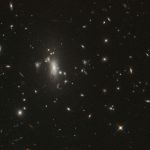
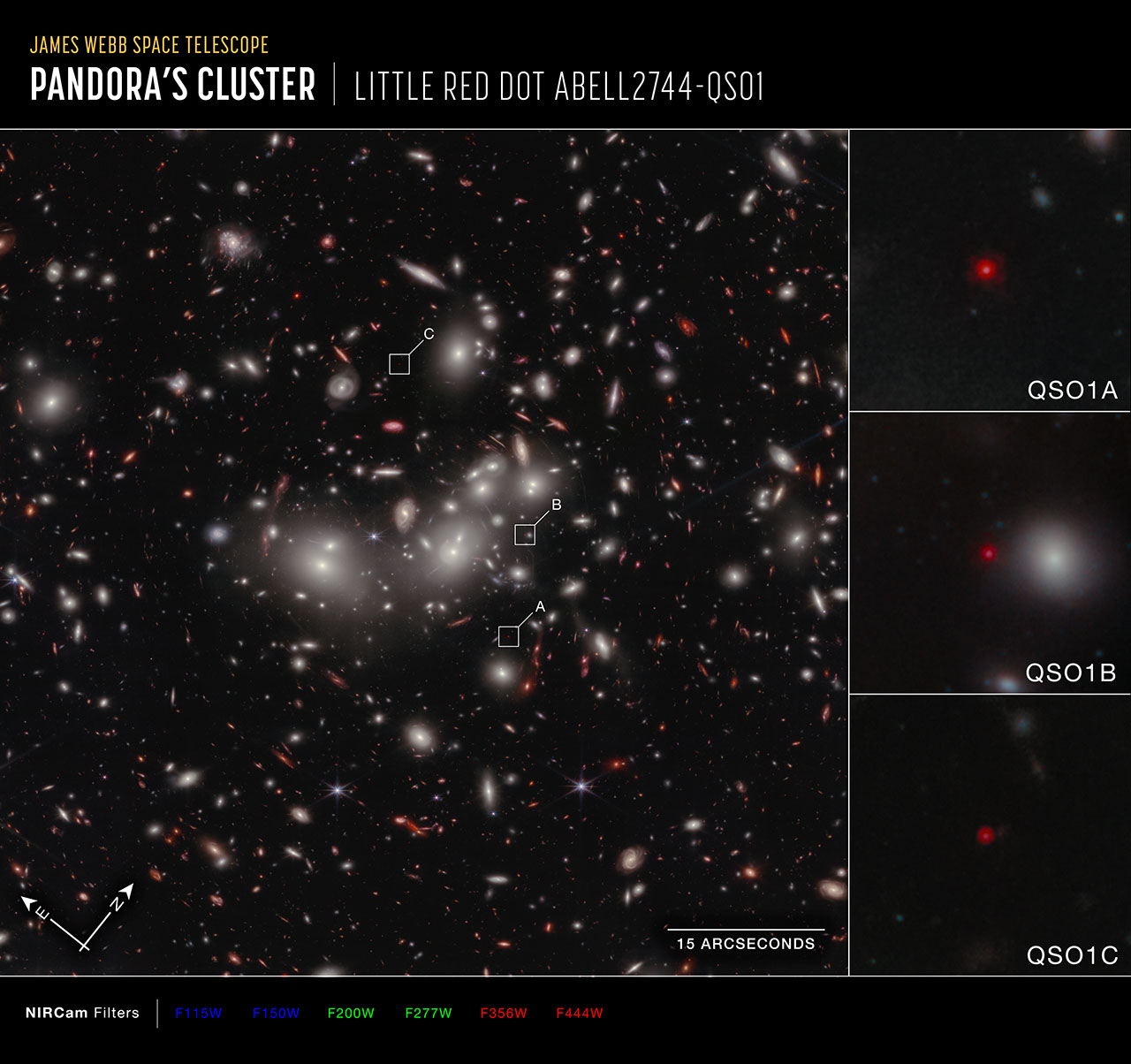
An image from NIRCam (the Near Infrared Camera) on NASA’s James Webb Space Telescope shows Abell2744-QSO1, magnified and triply imaged by galaxy cluster Abell 2744.
Abell2744-QSO1 (QSO1) is a prototypical Little Red Dot, one of the first of now hundreds of tiny glowing flecks of infrared light that Webb has found speckling the early universe. QSO1 is roughly 1,300 light-years across and with a cosmological redshift (z) of 7, its light dates back to just 700 million years after the big bang, when the universe was only 5% of its current age. QSO1 is ideal for study because it is gravitationally lensed, both magnified and triply imaged by Abell 2744, the intervening mega-cluster of galaxies that warps its surrounding space-time.
Detailed study of the brightest of the three lensed images, QSO1A (upper right), shows that the object consists of a central supermassive black hole 50 million times the mass of the Sun, surrounded by a cloud of hydrogen and helium gas with very small amounts of heavier elements like oxygen. Unlike supermassive black holes in nearby galaxies, which make up only a tiny fraction of their host galaxy’s total mass, QSO1’s black hole contains at least twice as much mass as the galactic material surrounding it.
Also known as Pandora’s Cluster, Abell 2744 was imaged in depth by NASA’s Hubble Space Telescope in 2013-2014 as part of the revolutionary Hubble Frontier Fields program, then as part of the Ultradeep NIRSpec and NIRCam ObserVations before the Epoch of Reionization (UNCOVER) program with Webb.
View the full NIRCam image and explore the observation on Space Telescope Live.
About the Object
- R.A. PositionR.A. PositionRight ascension – analogous to longitude – is one component of an object's position.00:14:18.25
- Dec. PositionDec. PositionDeclination – analogous to latitude – is one component of an object's position.-30:22:46.04
- ConstellationConstellationOne of 88 recognized regions of the celestial sphere in which the object appears.Sculptor
- DistanceDistanceThe physical distance from Earth to the astronomical object. Distances within our solar system are usually measured in Astronomical Units (AU). Distances between stars are usually measured in light-years. Interstellar distances can also be measured in parsecs.About 3.5 billion light-years to cluster and 13.1 billlion light-years to QSO1
- DimensionsDimensionsThe physical size of the object or the apparent angle it subtends on the sky.The image is 4.3 arcminutes across
About the Data
- Data DescriptionData DescriptionProposal: A description of the observations, their scientific justification, and the links to the data available in the science archive.
Science Team: The astronomers who planned the observations and analyzed the data. "PI" refers to the Principal Investigator.This image was created with Webb data from proposal: 2561 (I. Labbe).
- InstrumentInstrumentThe science instrument used to produce the data.NIRCam
- Exposure DatesExposure DatesThe date(s) that the telescope made its observations and the total exposure time.2 Nov 2022, 15 Nov 2022
- FiltersFiltersThe camera filters that were used in the science observations.F115W, F150W, F200W, F277W, F356W, F444W
- Object NameObject NameA name or catalog number that astronomers use to identify an astronomical object.Pandora’s Cluster, Abell 2744, Abell2744-QSO1
- Object DescriptionObject DescriptionThe type of astronomical object.Galaxy cluster and gravitational lens z=7 black hole
- Release DateMay 27, 2026
- Science ReleaseNASA’s Webb Reveals Black Hole That Formed Before Its Galaxy
- CreditImage: NASA, ESA, CSA, Lukas Furtak (Ben-Gurion University); Image Processing: Alyssa Pagan (STScI)
These images are a composite of separate exposures acquired by the James Webb Space Telescope using the NIRCam instrument. Several filters were used to sample specific wavelength ranges. The color results from assigning different hues (colors) to each monochromatic (grayscale) image associated with an individual filter. In this case, the assigned colors are: Blue: F115W+F150W, Green: F200W+F277W, Red: F356W+F444W
Related Images & Videos
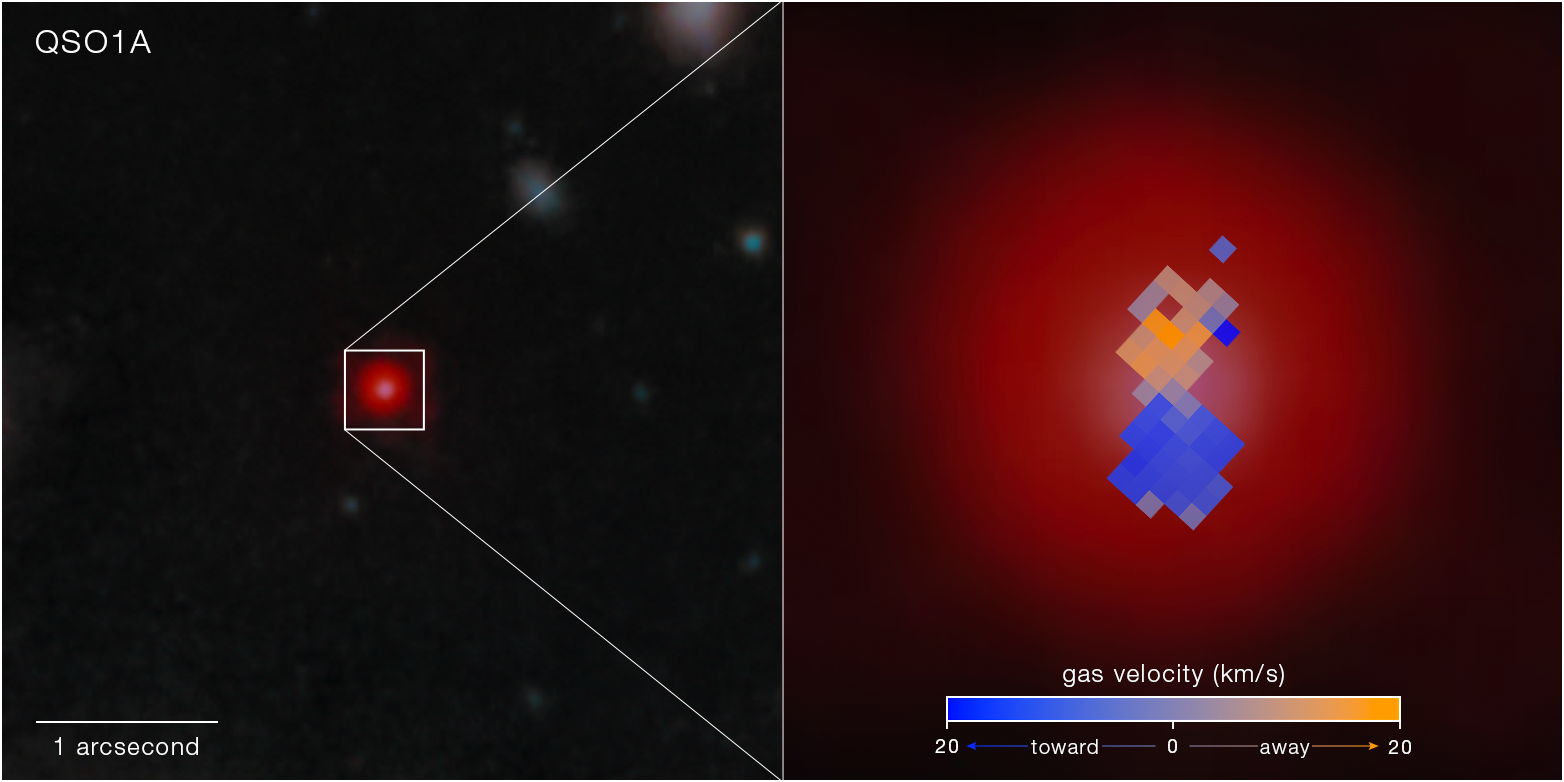
Little Red Dot Abell2744-QSO1a (NIRCam Image with NIRSpec IFU Velocity Map)
An image detail from NIRCam (left) on NASA’s James Webb Space Telescope shows Little Red Dot Abell2744-QSO1. A map of gas velocity in QSO1 (right), made using the IFU on NIRSpec, shows evidence for a 50-million-solar-mass black hole at the center.
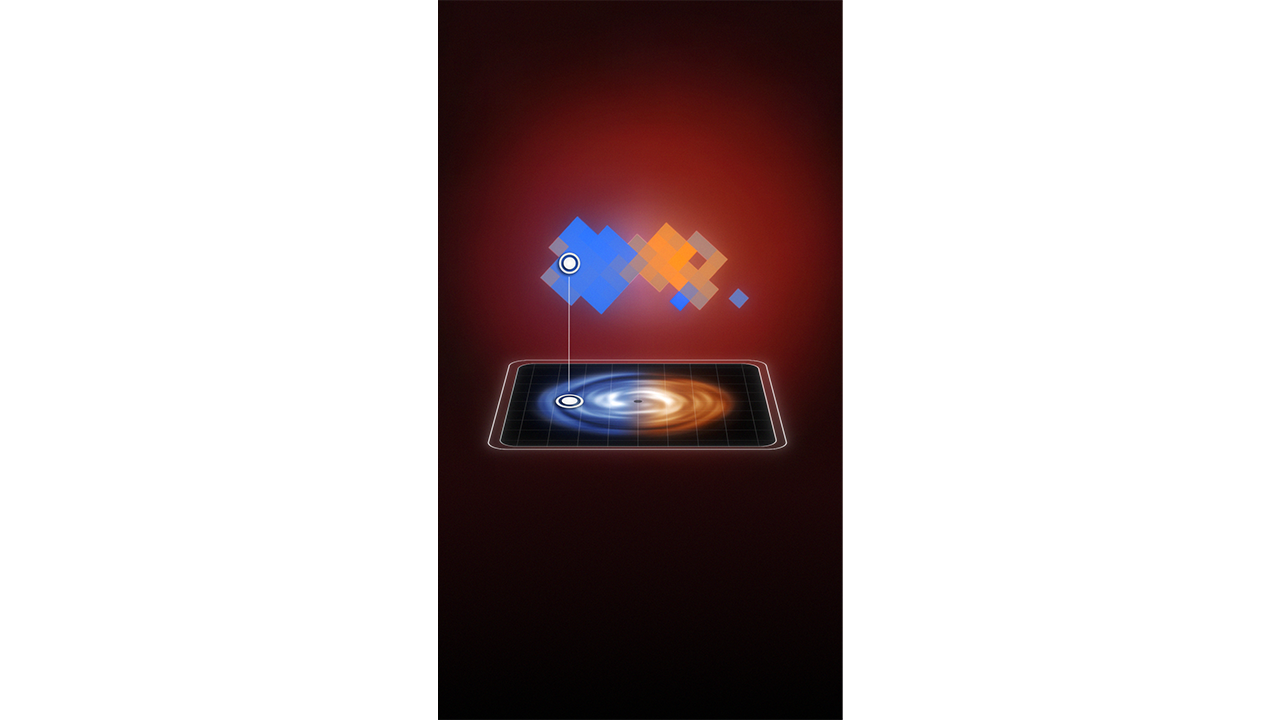
Little Red Dot Abell2744-QSO1: Sonification of Gas Velocity Around a Supermassive Black Hole (NIRCam and NIRSpec IFU)
A sonification is a translation of data into sound. In this sonification, the velocity of hydrogen gas moving around a black hole in the center of a Little Red Dot known as Abell2744-QSO1 (QSO1) is translated into sounds of varying pitch (or frequency). The faster the gas is movi...
Share
Details
Laura Betz
NASA’s Goddard Space Flight Center
Greenbelt, Maryland
laura.e.betz@nasa.gov