



















1 min read
Composition of Extreme Debris Disks Across Time
A team of researchers compiled the largest sample of extreme debris disks to date thanks to data from NASA’s Spitzer and James Webb space telescopes. These young stellar systems are a subclass of debris disks, which follows the juvenile protoplanetary disk stage.
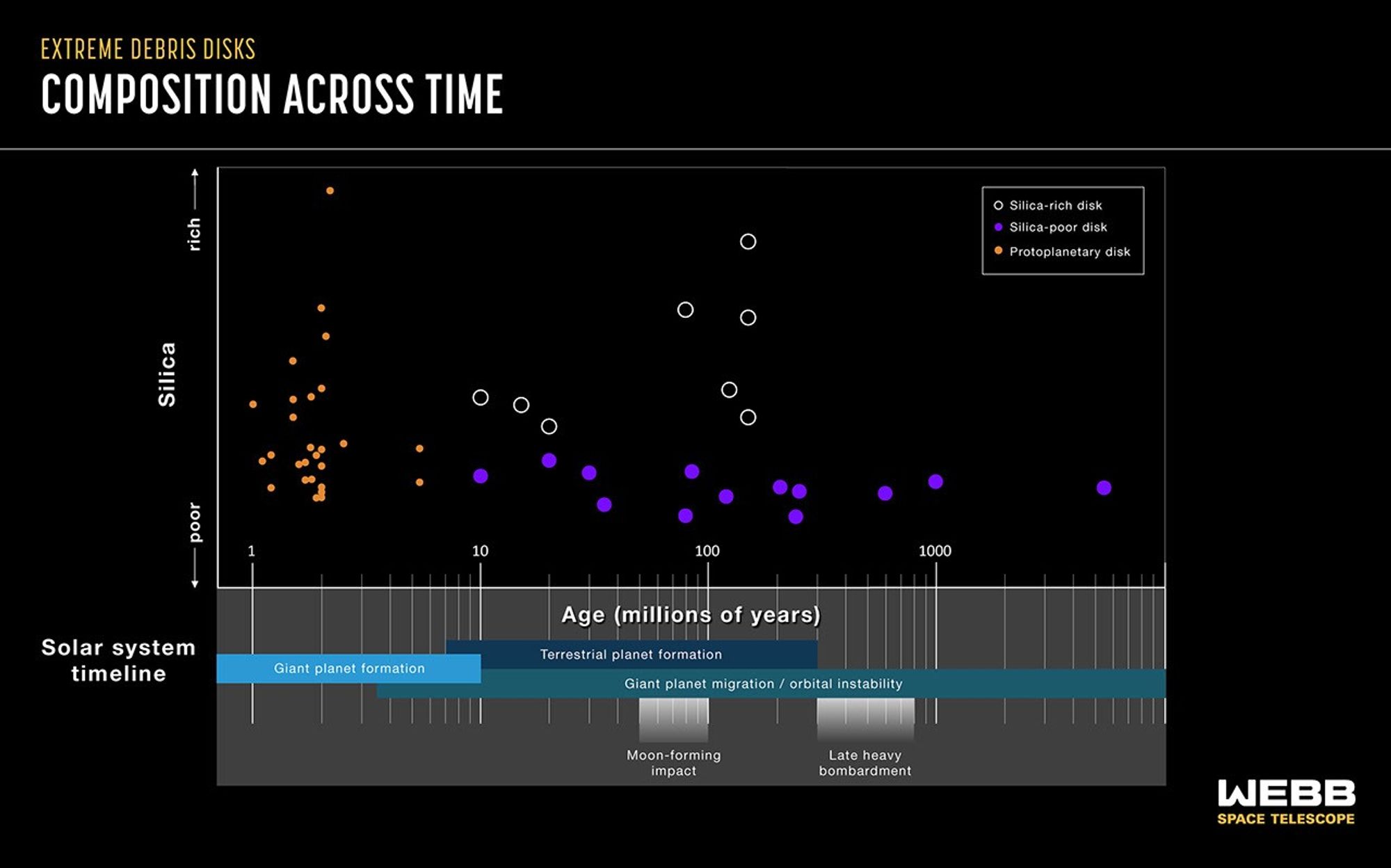
Interested in the mineralogical makeup of these young stellar systems, the team separated their sample into silica-rich and silica-poor. Based on their categorization, they were able to infer the type of collisions that are helping create these chaotic, dusty environments.
Of their sample, eight are silica-rich disks (black dots), suggesting that they are produced by high-energy impacts between Mars-sized bodies where a substantial amount of the material is vaporized. 13 disks fall into the silica-poor category (purple dots), indicating that the collisions within these disks are less intense in nature and occur between Moon-sized objects. The team also noted the corresponding age of each disk’s star and spotted an interesting trend: The silica-rich disks in their sample are found only around stars younger than 300 million years. The stars with silica-poor disks span a broad range of ages.
The study’s findings are shaping scientists’ understanding of our own solar system, which may have experienced more than one extreme debris disk phase. Simulations suggest that terrestrial planets should form within the first few hundred million years. This period aligns with the distribution of the silica-rich extreme debris disks and with astronomers’ estimation that Earth and the Moon formed around 100 million years after the Sun formed, with the Moon likely being the result of a collision between Earth and a Mars-sized object.
The distribution of the silica-poor disks is broadly consistent with the Late Heavy Bombardment hypothesis for our solar system, which proposes that the gas giant planets migrated significant distances and gravitationally disrupted the orbits of smaller bodies. Due to their movements, catastrophic collisions occurred and generated the short-lived, dust-rich phases observed in extreme debris disks.
- Release DateOctober 1, 2026
- Science ReleaseNASA’s Webb Provides Crash Course on Planet-Shattering Collisions
- CreditIllustration: NASA, ESA, CSA, Joseph Olmsted (STScI)
Related Images & Videos

Extreme Debris Disk (Artist’s Concept)
The types of collisions within young stellar systems known as extreme debris disks are relevant to scientists’ understanding of our own solar system, which is thought to have undergone similar impact events that created our Moon and shaped Earth’s initial state.
Share
Details
Laura Betz
NASA’s Goddard Space Flight Center
Greenbelt, Maryland
laura.e.betz@nasa.gov