




















1 min read
Observations of the Exposed Cranium Nebula
This video compares infrared views of the PMR 1 “Exposed Cranium” nebula taken by NASA’s retired Spitzer Space Telescope, as well as NASA’s James Webb Space Telecope’s NIRCam (Near-Infrared Camera) and MIRI (Mid-Infrared Instrument).
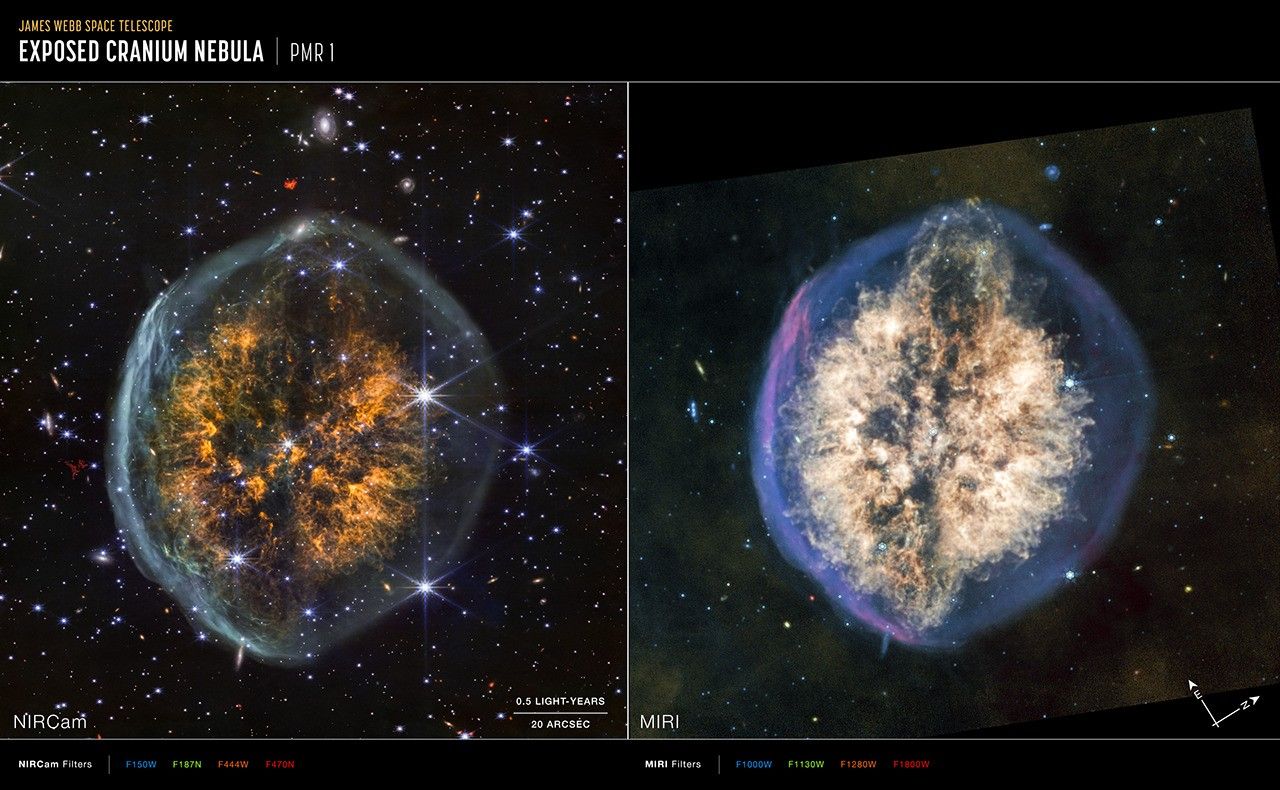
Spitzer’s indistinct view is brought into sharp focus by Webb. More stars and background galaxies shine through the view of Webb’s NIRCam, while cosmic dust glows more prominently in the light captured by MIRI.
The dark center lane that contributes to this nebula’s distinctive brain-like appearance is more noticeable in NIRCam, but its apparent role in the ejection of material at the top and bottom of the nebula is seen more clearly in MIRI’s view. Observing the cosmos in various wavelengths of light provides a more complete picture of how the universe works.
- Release DateFebruary 25, 2026
- Science ReleaseNASA’s Webb Examines Cranium Nebula
- CreditVisualization: NASA, ESA, CSA, STScI, Joseph DePasquale (STScI)
Related Images & Videos

Exposed Cranium Nebula (NIRCam and MIRI Images)
The differences in what Webb’s infrared instruments reveal and conceal within the PMR 1 “Exposed Cranium” nebula is apparent in this side-by-side view. More stars and background galaxies shine through NIRCam’s view, while cosmic dust glows more prominently in MIRI’s mid-infrared
Share
Details
Laura Betz
NASA’s Goddard Space Flight Center
Greenbelt, Maryland
laura.e.betz@nasa.gov