


























1 min read
Super-Earth Exoplanet TOI-561 b (Artist’s Concept)
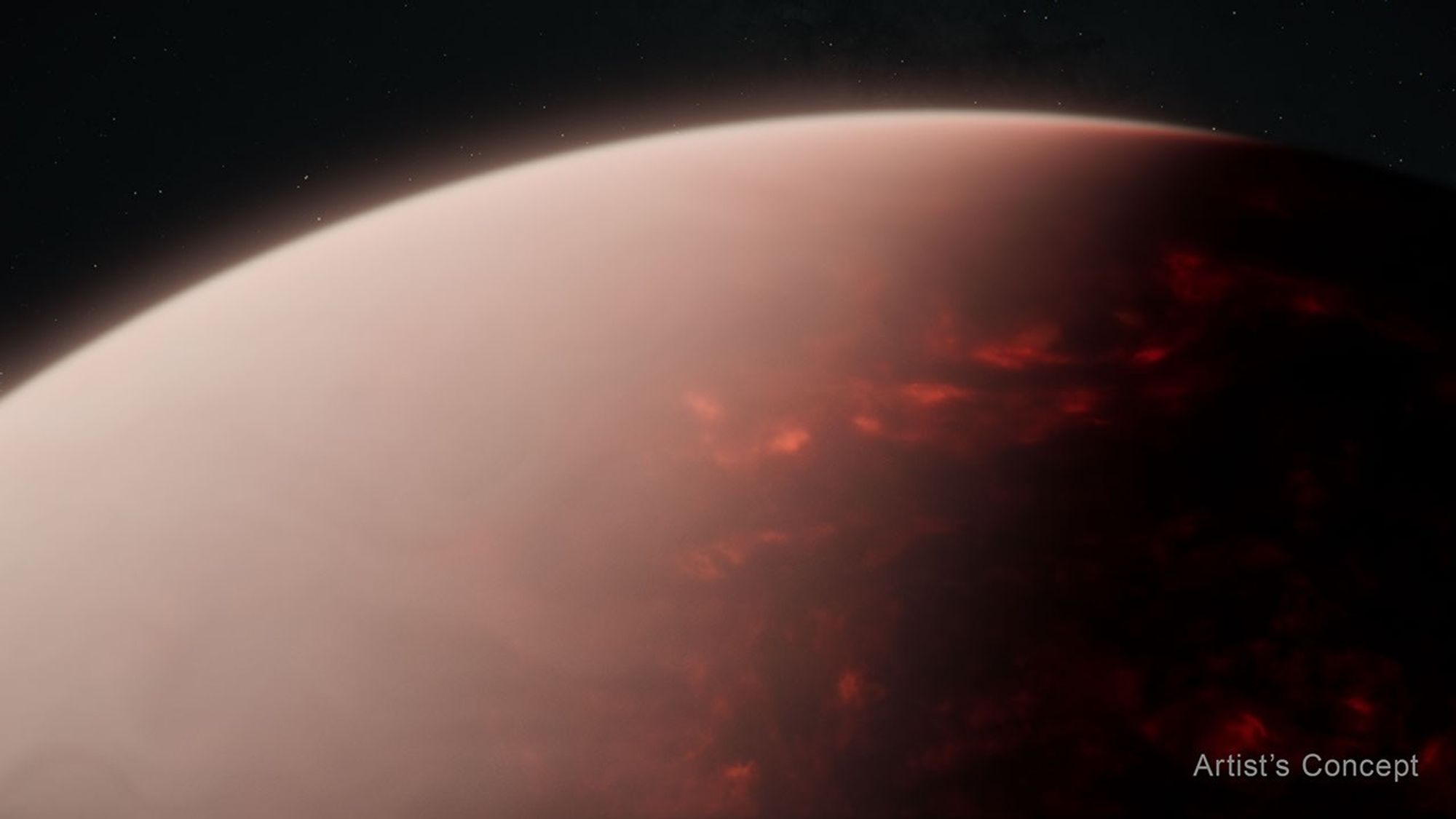
This artist’s concept shows what a thick atmosphere above a vast magma ocean on exoplanet TOI-561 b could look like. Measurements of light captured from the planet’s dayside by NASA's James Webb Space Telescope suggest that in spite of the intense radiation it receives from its star, TOI-561 b is not a bare rock.
TOI-561 b is the innermost of four planets orbiting TOI-561, a 10-billion-year-old G-type star located roughly 280 light-years from Earth, in the constellation Sextans. Classified as an ultra-short period (USP) planet, TOI-561 b orbits just 0.01 AU from its star (1% the distance between Earth and the Sun, or about one million miles), completing one circuit in less than 11 hours.
Although the star is somewhat smaller and cooler than the Sun, the planet orbits so close that its dayside surface temperature must far exceed the melting temperature of typical rock. (Planets that orbit this close to their stars are thought to be tidally locked, with a permanent dayside that faces the star at all times, and a permanent nightside in eternal darkness.) A thick atmosphere rich in volatiles like water, oxygen, and carbon dioxide would distribute heat around the planet, causing the nightside as well as the dayside to be molten.
This illustration is based on spectroscopic data and other indirect observations. Webb has not captured any images of TOI-561 b.
About the Object
- R.A. PositionR.A. PositionRight ascension – analogous to longitude – is one component of an object's position.09h52m44.44s
- Dec. PositionDec. PositionDeclination – analogous to latitude – is one component of an object's position.+06d12m57.97s
- ConstellationConstellationOne of 88 recognized regions of the celestial sphere in which the object appears.Sextans
- DistanceDistanceThe physical distance from Earth to the astronomical object. Distances within our solar system are usually measured in Astronomical Units (AU). Distances between stars are usually measured in light-years. Interstellar distances can also be measured in parsecs.280 light-years
- Object NameObject NameA name or catalog number that astronomers use to identify an astronomical object.TOI-561 b
- Object DescriptionObject DescriptionThe type of astronomical object.Super-Earth exoplanet
- Release DateDecember 11, 2025
- Science ReleaseNASA’s Webb Detects Thick Atmosphere Around Broiling Lava World
- CreditIllustration: NASA, ESA, CSA, Ralf Crawford (STScI)
Related Images & Videos

Super-Earth Exoplanet TOI-561 b and Its Star (Artist's Concept)
This artist’s concept shows what the hot super-Earth exoplanet TOI-561 b and its star could look like based on observations from NASA’s James Webb Space Telescope and other observatories. Webb data suggests that the planet is surrounded by a thick atmosphere above a magma ocean.
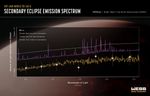
Super-Earth Exoplanet TOI-561 b (NIRSpec Emission Spectrum)
An emission spectrum captured by NASA's James Webb Space Telescope in May 2024 shows the brightness of different wavelengths of near-infrared light emitted by exoplanet TOI-561 b. Comparing the data to models suggests that the planet is surrounded by a volatile-rich atmosphere.
Share
Details
Laura Betz
NASA’s Goddard Space Flight Center
Greenbelt, Maryland
laura.e.betz@nasa.gov