







![Request for Information – Potential [Placeholder for Prize]](https://assets.science.nasa.gov/dynamicimage/assets/science/missions/a-step/FFR_Earth_Background_20251120%20.png?w=1024)












July 5-August 22, 2017
Elephant Hill Fire Chars Forest in British Columbia
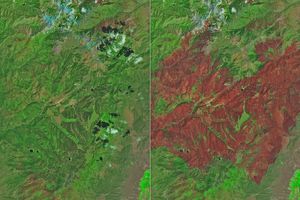
NASA satellites first detected evidence of a wildfire burning in Canada along the Thompson River near Ashcroft, British Columbia, on July 7, 2017. Since then, the Elephant Hill fire has chewed through 167,000 hectares (644 square miles) of forest, according to the British Columbia Wildfire Service.
The
(OLI) on
captured a
image (second) of the burn scar on August 22, 2017. The first image shows the area on July 5, 2017, before the fire began.
On the day that OLI acquired the image, smoke rose from hot spots along the north flank of the burn scar as fires flared up in hot, windy weather. With 400 firefighters on the scene, the blaze was 35 percent contained as of August 24, 2017.
References & Resources
- British Columbia Wildfire Service (2017, August 23) Elephant Hill (K20637). Accessed August 24, 2017.
- British Columbia Wildfire Service (2017, August 23) Maps and Photos (K20637). Accessed August 24, 2017.
- KelownaNow (2017, August 23) Elephant Hill wildfire crews work to prevent significant growth.
- Ashcroft-Cache Creek Journal (2017, August 22) Elephant Hill wildfire holds steady at 168,000 hectares. Accessed August 24, 2017.
NASA Earth Observatory images by Joshua Stevens, using Landsat data from the U.S. Geological Survey . Caption by Adam Voiland.