

















browse image for orbit 15679
Lake Eyre is a large salt lake situated between two deserts in one ofAustralia’s driest regions. However, this low-lying lake attractsrun-off from one of the largest inland drainage systems in the world.The drainage basin is very responsive to rainfall variations, andchanges dramaticallywith Australia’s inter-annual weather fluctuations.When Lake Eyre fills, as it did in 1989, it is temporarily Australia’slargest lake, and becomes dense with birds, frogs and colorful plantlife. The Lake responds to extended dry periods (often associated withEl Niño events) by drying completely.
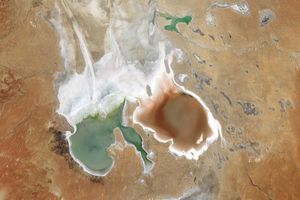
These four images from the Multi-angle Imaging SpectroRadiometercontrast the lake area at the start of the austral summers of 2000 and2002. The top two panels portray the region as it appeared on December9, 2000. Heavy rains in the first part of 2000 caused both the north andsouth sections of the lake to fill partially and the northern part ofthe lake still contained significant standing water by the time thesedata were acquired. The bottom panels were captured on November 29,2002. Rainfall during 2002 was significantly below average (http://www.bom.gov.au/ ),although showers occurring in the week beforethe image was acquired helped alleviate this condition slightly.
The left-hand panels portray the area as it appeared to MISR’svertical-viewing (nadir) camera, and are false-color views comprised ofdata from the near-infrared, green and blue channels. Here, wet and/ormoist surfaces appear blue-green, since water selectively absorbs longerwavelengths such as near-infrared. The right-hand panels are multi-anglecomposites created with red band data from MISR’s 60-degree forward,nadir and 60-degree backward-viewing cameras, displayed as red, greenand blue, respectively. In these multi-angle composites, colorvariations serve as a proxy for changes in angular reflectance, andindicate textural properties of the surface related to roughness and/ormoisture content. Data from the two dates were processed identically topreserve relative variations in brightness between them. Wet surfaces orareas with standing water appear green due to the effect of sunglint atthe nadir camera view angle. Dry, salt encrusted parts of the lakeappear bright white or gray. Purple areas have enhanced forwardscattering, possibly as a result of surface moistness. Some variationsexhibited by the multi-angle composites are not discernible in the nadirmulti-spectral images and vice versa, suggesting that the combination ofangular and spectral information is a more powerful diagnostic ofsurface conditions than either technique by itself.
The Multi-angle Imaging SpectroRadiometer observes the daylit Earthcontinuously and every 9 days views the entire globe between 82 degreesnorth and 82 degrees south latitude. The MISR Browse Image Viewer provides access tolow-resolution true-color versions of these images. These data products were generatedfrom a portion of the imagery acquired during Terra orbits 5194 and15679. The panels cover an area of 146 kilometers x 122 kilometers, andutilize data from blocks 113 to 114 within World Reference System-2 path100.
References & Resources
Image courtesy NASA/GSFC/LaRC/JPL, MISR Team. Text by Clare Averill (Acro Service Corporation/JPL).